


Introduction
Operational visibility has become one of the most valuable capabilities for modern organizations. Business leaders need timely insight into workflows, approvals, operational activity, reporting, and performance across departments. However, visibility becomes increasingly difficult when information is scattered across disconnected systems.
Many organizations invest heavily in software yet still struggle to understand what is happening operationally in real time. The challenge is often not the absence of data. The challenge is that critical information exists across multiple systems that do not communicate effectively.
API integration helps solve this problem by creating connected operational infrastructure that improves visibility across business systems.
What Is Operational Visibility?

Operational visibility refers to an organization’s ability to understand the status, performance, ownership, and progression of workflows and operational activities across the business.
Strong visibility allows organizations to:
• Monitor workflow performance
• Identify bottlenecks
• Improve accountability
• Support decision-making
• Improve reporting accuracy
• Strengthen governance readiness
Without visibility, organizations often rely on assumptions, manual updates, and fragmented reports.
Why Visibility Breaks Down
As organizations grow, different departments adopt specialized software platforms. HR teams use HRIS systems. Sales teams rely on CRM platforms. Finance teams manage ERP environments. Procurement teams implement purchasing systems. Operations teams deploy workflow applications.
While these systems may perform their intended functions, they frequently operate independently. This creates visibility gaps that make it difficult to understand operational activity across the organization.
Common consequences include:
• Data silos
• Inconsistent reporting
• Duplicate effort
• Delayed approvals
• Communication breakdowns
• Limited operational intelligence
The Role of API Integration
Application Programming Interfaces (APIs) allow systems to exchange information automatically. API integration creates connectivity between business systems, enabling data, workflows, and operational updates to move efficiently across applications.
Instead of relying on manual transfers or disconnected reports, organizations can create a unified operational view supported by connected infrastructure.
API integration improves visibility by:
• Synchronizing operational data
• Supporting real-time updates
• Reducing information silos
• Improving workflow transparency
• Enhancing reporting consistency
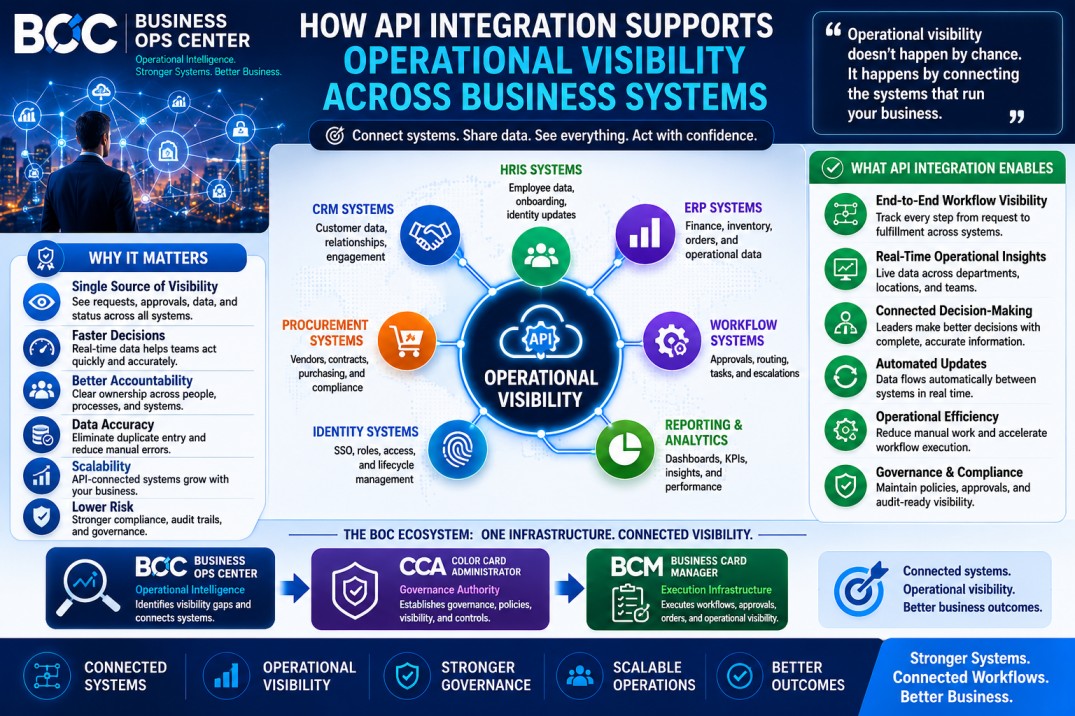
Operational Visibility Across HRIS, CRM, ERP, and Procurement Systems
Modern business operations often span multiple systems simultaneously.
Employee onboarding may involve HRIS platforms, identity systems, procurement workflows, approval processes, and reporting tools.
Customer-facing activities may require CRM systems, operational workflows, financial platforms, and reporting environments.
API integration enables these systems to operate as a connected ecosystem, creating stronger visibility across operational activities.
Workflow Visibility and Accountability
Operational visibility is closely tied to accountability. Organizations need to understand who owns specific activities, where workflows are delayed, and which approvals are pending.
API-connected infrastructure improves accountability by creating greater transparency throughout workflow execution. Teams can identify bottlenecks faster, coordinate activities more effectively, and improve operational responsiveness.
API Integration and Governance Readiness
Visibility also plays an important role in governance. Organizations require accurate reporting, auditability, approval transparency, and operational controls.
API-connected operational infrastructure supports governance readiness by improving access to operational information while reducing fragmented reporting environments.
As organizations scale, governance increasingly depends on connected systems capable of supporting visibility across workflows and operational activity.
How Organizations Can Improve Operational Visibility
1. Identify visibility gaps.
2. Evaluate disconnected systems.
3. Prioritize API integration opportunities.
4. Improve workflow standardization.
5. Centralize reporting visibility.
6. Strengthen accountability frameworks.
7. Design infrastructure for scalability.
Conclusion
Operational visibility is no longer optional for organizations operating in complex environments. As workflows, systems, and operational responsibilities become more interconnected, visibility increasingly depends on connectivity.
API integration helps organizations reduce fragmentation, improve reporting consistency, strengthen accountability, and create operational intelligence across business systems.
Organizations that invest in API-connected operational infrastructure are better positioned to support scalable growth, governance readiness, and long-term operational maturity.
When evaluating business software, companies should consider whether a tool can share data with the systems they already use, not just whether it solves one isolated task.
In the CCA ecosystem, operational visibility is also important for business card printing and management workflows, business-to-business lead generation, software discovery, and API-connected business systems.