


Introduction
Operational visibility has become a critical requirement for modern organizations. Leadership teams need visibility into workflows, approvals, operational activity, reporting, and execution status to make informed decisions. Yet many businesses struggle to achieve this visibility despite significant investments in software.
The root cause is often not a lack of technology. It is the existence of disconnected systems.
As organizations grow, departments frequently adopt software independently. HR teams implement HRIS platforms. Sales teams deploy CRM systems. Finance adopts ERP tools. Procurement introduces purchasing platforms. Operations adds workflow applications. While each system may perform its intended function, visibility declines when these environments remain disconnected.
Modern business systems stack
A modern business systems stack is more than a collection of software tools. It is the connected structure that helps teams manage customers, employees, workflows, finance, reporting, and operational decisions.
Why Workflow Visibility Matters

Workflow visibility is the ability to understand how work moves throughout an organization. It includes visibility into approvals, ownership, status, bottlenecks, dependencies, and operational outcomes.
Strong visibility helps organizations:
• Identify delays early
• Improve accountability
• Coordinate cross-functional teams
• Improve reporting accuracy
• Support governance readiness
• Accelerate decision-making
Without visibility, organizations often operate reactively rather than proactively.
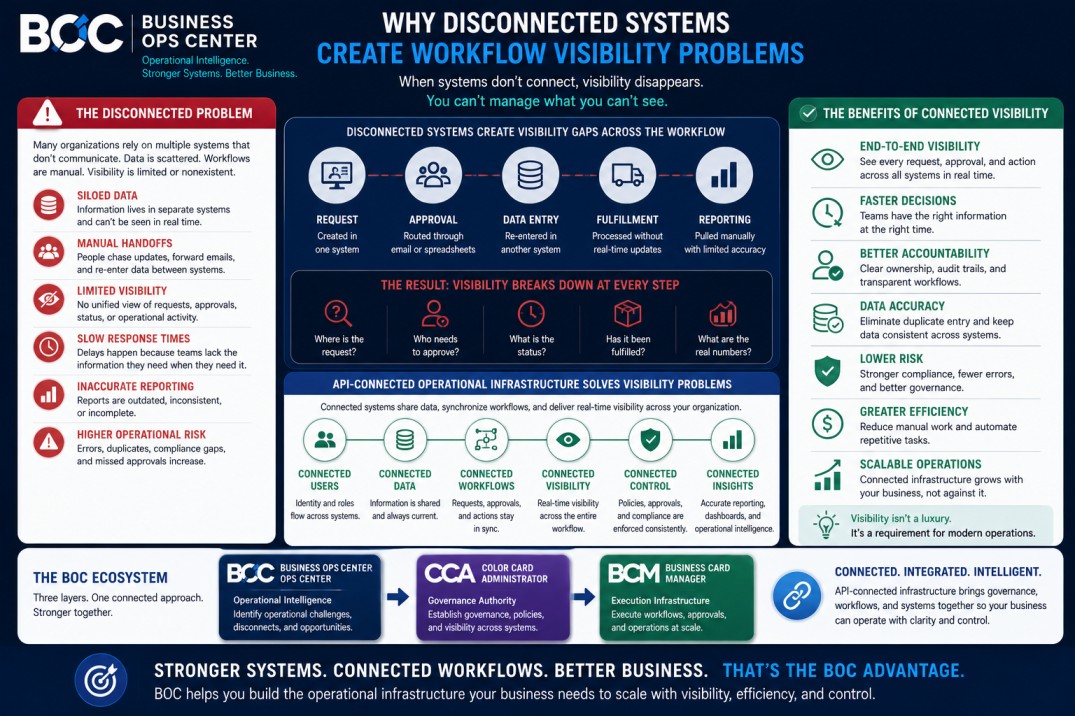
How Disconnected Systems Create Visibility Gaps
For example, a sales team may close a deal in a CRM, but operations may not see the full customer requirements, finance may not know what needs to be billed, and leadership may not have one clear view of status. Each team may have software, but the workflow still lacks visibility because the systems are not coordinated.
Disconnected systems create information silos. Data becomes fragmented across applications, making it difficult to understand the complete operational picture.
Common symptoms include:
• Conflicting reports
• Duplicate data entry
• Approval delays
• Manual status updates
• Workflow bottlenecks
• Limited accountability
• Communication breakdowns
As complexity increases, these gaps become increasingly difficult to manage.
Disconnected systems create scattered information.
Connected systems create shared visibility.
Workflow coordination turns that visibility into clearer ownership, better reporting, and more consistent execution.
The Relationship Between Visibility and Workflow Coordination
Workflow coordination depends on visibility. Organizations cannot coordinate effectively when operational information is scattered across disconnected systems.
When systems are connected, teams gain insight into workflow status, operational priorities, approvals, and execution dependencies. This creates stronger alignment between departments and improves operational consistency.
Why API Integration Matters
API-connected operational infrastructure helps eliminate visibility gaps by enabling systems to communicate and share information.
Through API integration, organizations can:
• Synchronize operational data
• Improve reporting consistency
• Reduce manual administration
• Support workflow transparency
• Improve cross-functional coordination
• Create centralized operational intelligence
Instead of relying on disconnected reports, organizations gain a more complete understanding of operational performance.
HRIS, CRM, ERP, and Procurement Visibility
Modern workflows often span multiple systems. Employee onboarding, procurement approvals, customer operations, reporting activities, and governance processes require coordination across applications.
When HRIS, CRM, ERP, procurement, and operational systems remain disconnected, visibility suffers. API-connected infrastructure creates a more coordinated operational architecture capable of supporting enterprise-scale operations.
Operational Infrastructure and Business Growth
Many growing organizations eventually discover that operational challenges stem from infrastructure limitations rather than workforce limitations.
Disconnected systems often create:
• Increased administrative overhead
• Slower execution
• Reduced scalability
• Governance challenges
• Limited operational intelligence
Connected infrastructure helps organizations scale while maintaining visibility and coordination.
How Organizations Can Improve Workflow Visibility
1. Identify disconnected systems.
2. Map workflow dependencies.
3. Evaluate API integration opportunities.
4. Improve reporting consistency.
5. Centralize operational visibility.
6. Standardize workflows.
7. Design infrastructure for scalability.
Conclusion
Workflow visibility is essential for operational maturity. Yet many organizations struggle with visibility because their systems remain disconnected.
API-connected operational infrastructure helps organizations reduce fragmentation, improve workflow coordination, strengthen reporting, and support scalable execution. As business environments become more interconnected, visibility increasingly depends on how effectively systems work together.
For growing organizations, integration is not only a software issue. It affects how teams manage customers, employees, approvals, reporting, fulfillment, and operational accountability. Business Ops Center helps business owners understand these system decisions before they choose tools, vendors, or workflow platforms.
Learn how operational infrastructure helps organizations connect workflows, systems, visibility, and execution as they scale.