


Introduction
Most organizations recognize obvious operational costs such as labor, technology investments, vendor contracts, facilities, and procurement expenses. Far fewer recognize the hidden costs that emerge when business systems operate independently from one another.
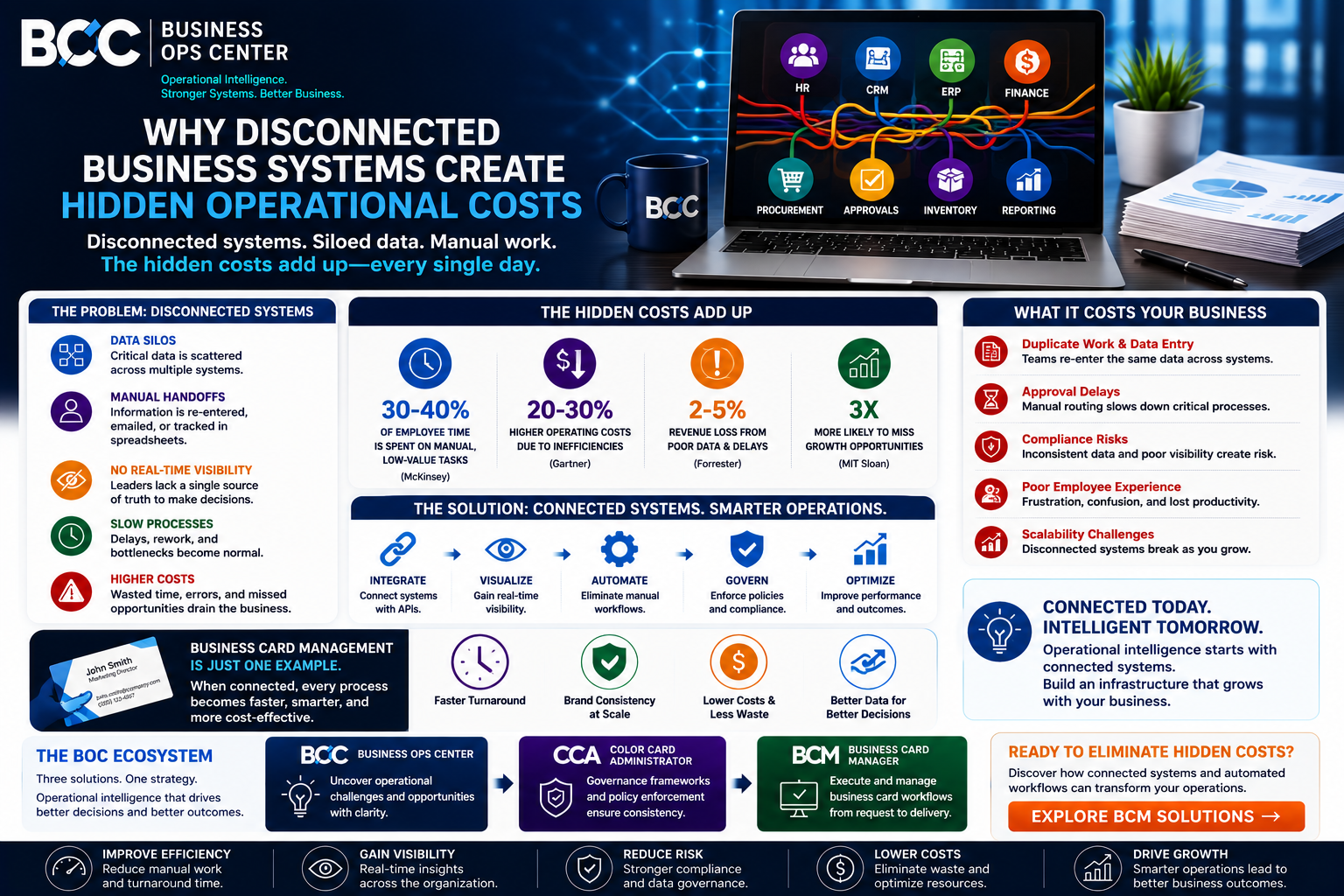
Disconnected systems are one of the most common causes of operational inefficiency in growing organizations. Employees spend time moving information between platforms, managers struggle to gain visibility into workflows, leadership teams make decisions using incomplete information, and departments often operate with different versions of the truth.
At first, these issues may seem minor. A spreadsheet fills a reporting gap. An employee manually updates records between systems. A manager sends status updates through email. However, as organizations grow, these small inefficiencies multiply across departments and workflows.
The result is operational friction that affects productivity, accountability, reporting, governance, and scalability.
The Modern Business Systems Environment

Modern organizations rely on a growing collection of business systems. Human resource information systems manage employee records. Customer relationship management platforms track customer interactions. ERP systems support finance and operations. Procurement applications manage purchasing activities. Collaboration platforms facilitate communication.
Each of these systems performs a valuable function. The challenge emerges when these platforms operate in isolation.
As organizations add more technology, operational complexity increases. Information becomes fragmented across multiple environments. Employees are forced to navigate several applications to complete simple tasks. Managers spend increasing amounts of time gathering information rather than making decisions.
This fragmentation creates hidden costs that often go unnoticed until growth exposes them.
The Cost of Manual Data Movement
One of the most significant hidden costs of disconnected systems is manual data movement.
Employees frequently transfer information from one system to another because platforms are not integrated. This work may include updating employee records, entering customer information, creating reports, validating approvals, or reconciling transactions.
Although each task may require only a few minutes, the cumulative impact across an organization can be substantial.
Manual work consumes time, introduces errors, and reduces operational efficiency. More importantly, it prevents employees from focusing on higher-value activities that contribute directly to business objectives.
Workflow Silos and Operational Delays
Disconnected systems often create workflow silos.
A workflow may begin in one platform, require approvals in another, generate reporting in a third, and require manual coordination between stakeholders throughout the process.
When systems are disconnected, visibility becomes limited. Employees may not know who owns the next step. Managers may struggle to identify bottlenecks. Leadership teams may lack insight into overall workflow performance.
These delays create operational friction that affects productivity and customer experience.
Why Visibility Suffers
Visibility is one of the first casualties of disconnected infrastructure.
Organizations frequently ask questions such as:
- Where is this request currently located?
- Who is responsible for the next action?
- How long do approvals typically take?
- Which processes create the most delays?
- What operational trends are emerging?
- Without integrated systems, answering these questions often requires manual effort.
Operational visibility becomes fragmented because data exists across multiple platforms with limited connectivity.
The Impact on Accountability
Accountability depends on transparency.
When systems are disconnected, it becomes difficult to understand who performed an action, why decisions were made, or where delays occurred.
This lack of visibility creates ambiguity. Teams spend time investigating issues rather than resolving them. Managers struggle to enforce standards because workflow ownership is unclear.
Connected systems help establish accountability by creating consistent reporting and workflow transparency.
Governance Challenges
Governance becomes increasingly difficult when information is distributed across disconnected systems.
Organizations need confidence that policies are being followed consistently. They need visibility into approvals, compliance activities, vendor relationships, and operational controls.
Disconnected environments often make governance reactive rather than proactive.
Integrated systems provide a stronger foundation for governance because information is available in a centralized and consistent manner.
The Role of API-Connected Infrastructure
API-connected infrastructure helps organizations overcome these challenges.
Rather than requiring employees to move information manually, systems can exchange data automatically. Employee onboarding events can trigger downstream workflows. Approval decisions can update reporting systems. Procurement activities can synchronize with financial platforms.
These integrations reduce administrative effort while improving accuracy and visibility.
The goal is not simply technology integration. The goal is operational coordination.
Business Card Management as a Practical Example
Business card management provides a useful example of how disconnected systems create hidden costs.
Many organizations manage employee data in an HRIS platform, approvals through email, ordering through vendor portals, and reporting through spreadsheets.
This fragmented approach creates inefficiencies throughout the lifecycle of a business card request.
Employee information may become outdated. Approval status may be unclear. Reporting may require manual effort. Vendor coordination may depend on email communication.
A connected business card management environment integrates these activities into a structured workflow.
This improves visibility, governance, accountability, and operational efficiency.
The Relationship Between Integration and Scalability
Organizations often discover that disconnected systems become increasingly problematic as they grow.
Processes that function adequately for 50 employees may become unsustainable for 500 or 5,000 employees.
Growth introduces additional workflows, stakeholders, approvals, reporting requirements, and governance obligations.
Integrated systems provide the scalability required to support this complexity.
Without integration, organizations frequently respond to growth by adding more manual processes. Over time, this creates operational debt that becomes increasingly difficult to manage.
Why Operational Intelligence Matters
Operational intelligence refers to an organization’s ability to understand how work moves throughout the business.
Connected systems contribute to operational intelligence by creating visibility into workflows, approvals, spending, resource allocation, and performance trends.
Leadership teams can make better decisions because information is more complete, accurate, and accessible.
Disconnected systems limit operational intelligence because information remains fragmented across multiple environments.
Building a Connected Operational Environment
Organizations seeking to improve operational performance should evaluate opportunities to connect critical systems.
This does not require replacing every application. Instead, it requires identifying workflows that would benefit from greater visibility, automation, and coordination.
Key Areas Often Include:
- Employee lifecycle management
- Procurement workflows
- Approval processes
- Vendor management
- Business card management
- Operational reporting
By focusing on these areas, organizations can improve efficiency while reducing operational complexity.
The Future of Enterprise Operations
The future of enterprise operations will be increasingly connected.
Organizations will continue adopting API-driven architectures, workflow automation, centralized reporting, and integrated governance frameworks.
Success will depend less on individual applications and more on how effectively systems work together.
Organizations that invest in connected operational infrastructure today will be better positioned to scale, improve visibility, strengthen accountability, and support long-term growth.
Conclusion
Disconnected business systems create hidden operational costs that extend far beyond technology management. They affect workflow efficiency, visibility, governance, accountability, reporting, and scalability.
As organizations grow, these hidden costs become increasingly significant.
Connected operational infrastructure provides a path forward. By integrating systems, improving workflow visibility, and reducing manual effort, organizations can create a more efficient and scalable operating environment.