
Introduction
Workflow automation has become a strategic priority for organizations pursuing operational excellence. Yet many automation initiatives fail to deliver their expected value because they focus on technology while overlooking governance, ownership, visibility, and standardized processes.
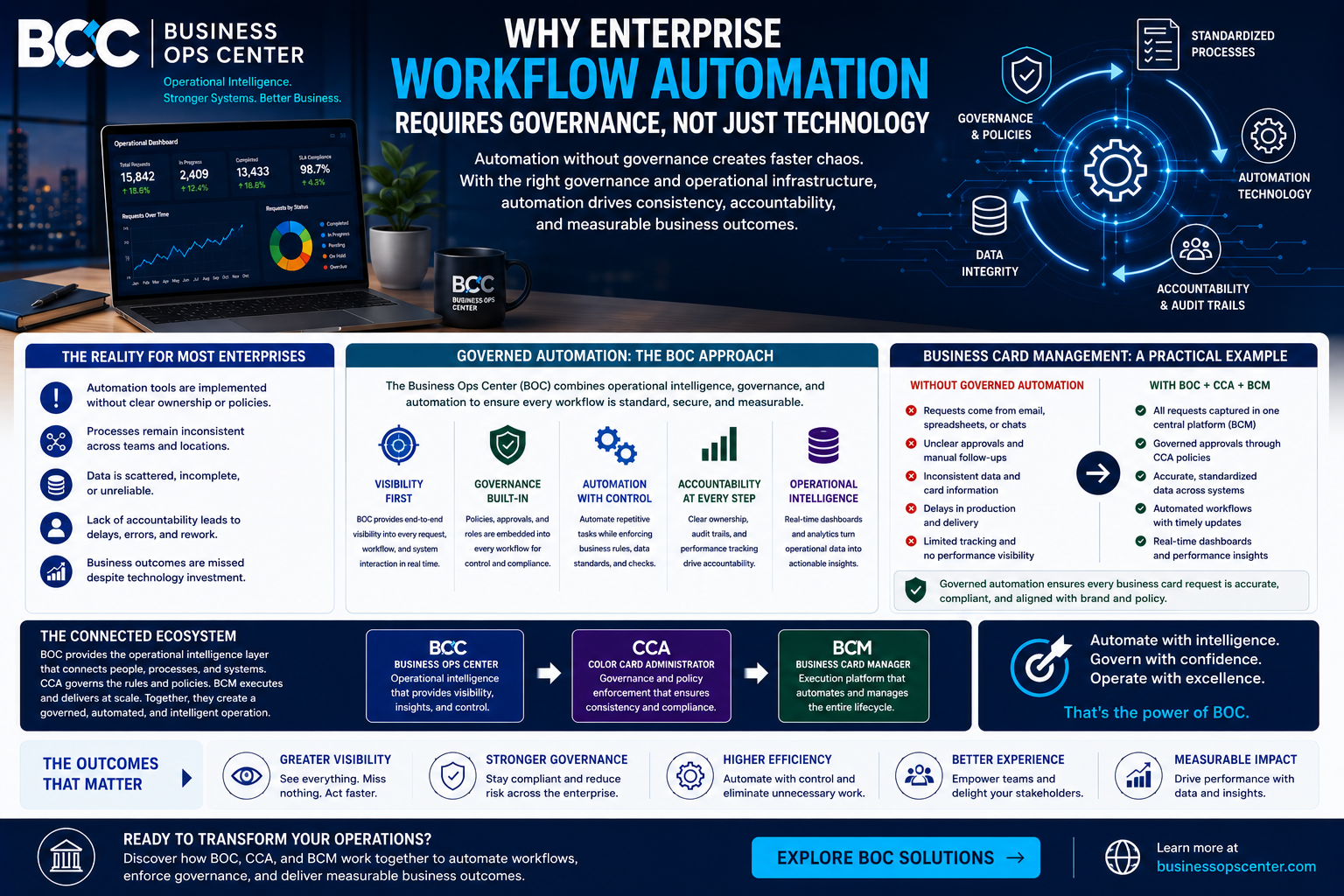
Enterprise automation succeeds when technology supports well-defined operational frameworks rather than replacing them. As organizations scale, automation must become part of a connected operational infrastructure that aligns people, processes, policies, and systems.
Automation Without Governance

Automating inconsistent or undocumented processes often accelerates inefficiency rather than eliminating it.
If approval rules vary by department or operational data is inconsistent, automation simply reproduces those weaknesses at greater speed.
Governance provides the standards, policies, and accountability that automation depends on
Why Standardized Workflows Matter
Organizations should first define repeatable workflows, ownership, approval paths, and reporting expectations.
Once processes are standardized, automation can reduce manual effort, shorten cycle times, and improve employee experience while maintaining operational consistency.
Operational Visibility
Automation should increase visibility rather than hide operational activity.
Enterprise leaders need insight into:
- Workflow status
- Approval history
- Bottlenecks
- Compliance
- Performance metrics
Real-time visibility enables continuous improvement and data-driven decisions.
API-Connected Enterprise Infrastructure
Modern workflow automation depends on API-connected ecosystems where HRIS, ERP, CRM, procurement, identity management and reporting platforms exchange information automatically.
Connected infrastructure eliminates duplicate work and creates a single operational view
Business Card Management Example
Business card management demonstrates this principle clearly.
Employee onboarding, title changes, approvals, branding, procurement and vendor coordination can all be automated, but only when governance policies and centralized operational data already exist.
BCM represents the execution layer while CCA provides governance and BOC provides operational intelligence that helps organizations optimize the overall process.Enterprise Buyer Considerations
Decision-makers evaluating automation platforms should look beyond automation features.
They should evaluate:
- Governance capabilities
- Workflow visibility
- Audit trails
- API integration
- Reporting
- Scalability
- Policy enforcement
These characteristics determine whether automation will continue delivering value as the organization grows.
Conclusion
Enterprise workflow automation is most effective when built on governance, standardized workflows, and connected operational infrastructure.
Technology is the accelerator—not the foundation.
Organizations that combine governance, operational intelligence, and execution platforms create automation environments that improve accountability, visibility, and long-term scalability.