


Introduction
Operational visibility is not simply about dashboards or reporting tools. It is about creating operational infrastructure that enables organizations to understand how workflows, systems, approvals, and operational responsibilities interact across the business in real time.
Modern business scalability increasingly depends on operational intelligence supported by visibility-focused infrastructure.
What Is Operational Visibility?
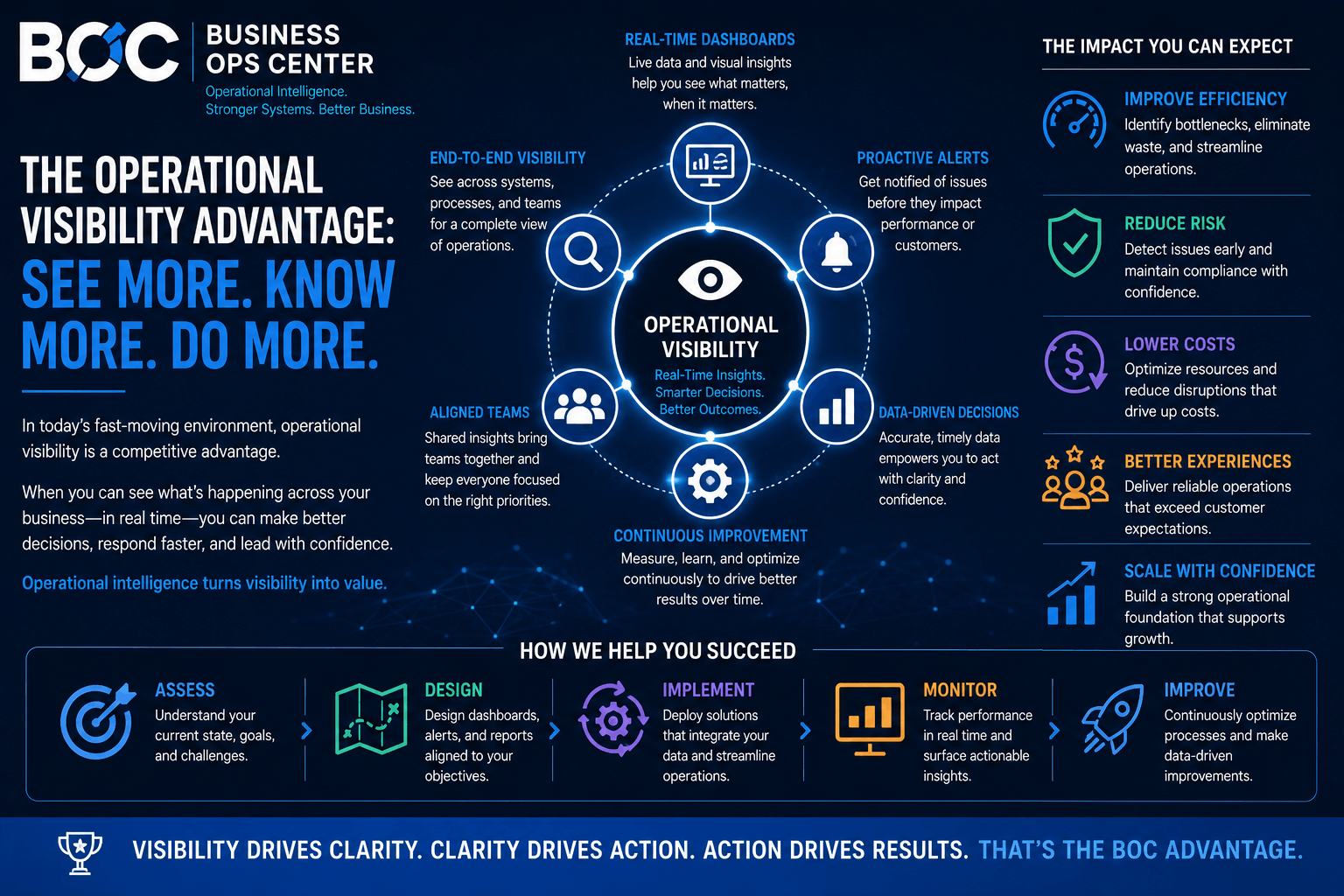
Operational visibility refers to an organization’s ability to clearly monitor, understand, and coordinate workflows, approvals, responsibilities, system activity, and operational performance across the business.
Operational visibility allows leadership teams to:
– Monitor workflow execution
– Identify operational bottlenecks
– Improve accountability
– Coordinate cross-functional teams
– Improve operational responsiveness
– Reduce communication fragmentation
– Improve reporting reliability
– Support strategic decision-making
True operational visibility extends beyond reporting dashboards. It requires a connected operational infrastructure that supports workflow consistency, centralized reporting, coordinated approvals, and operational intelligence across systems environments.
Why Visibility Breaks Down as Businesses Scale
Many organizations begin with relatively simple operational environments. Smaller businesses often rely on direct communication, manual coordination, and informal workflows that function effectively in early growth stages.
However, as businesses expand, operational complexity increases rapidly. Additional departments, software systems, workflows, reporting structures, and approval layers introduce coordination challenges that become increasingly difficult to manage without centralized visibility.
Common causes of visibility breakdown include:
– Disconnected systems environments
– Fragmented operational workflows
– Inconsistent approvals
– Communication silos
– Isolated reporting structures
– Duplicate operational processes
– Lack of workflow standardization
– Manual operational coordination
Without intentional operational infrastructure planning, organizations frequently lose visibility into workflow performance, execution status, and operational priorities.
Operational Visibility Improves Decision-Making
Organizations with strong operational visibility make faster and more informed decisions because leadership teams maintain clearer insight into workflow activity, operational performance, resource allocation, and organizational priorities.
Operational visibility improves decision-making by:
– Reducing information delays
– Improving reporting reliability
– Identifying workflow bottlenecks earlier
– Supporting real-time operational intelligence
– Improving accountability visibility
– Coordinating operational priorities more effectively
Businesses with fragmented visibility environments often struggle to respond quickly because operational information remains isolated across disconnected systems and departments.
Visibility Supports Workflow Coordination
Workflow coordination depends heavily on operational visibility. Organizations cannot effectively coordinate workflows when leadership teams lack visibility into approvals, operational dependencies, workflow ownership, and execution status.
Operational visibility improves workflow coordination by:
– Centralizing operational intelligence
– Improving cross-functional communication
– Supporting workflow accountability
– Standardizing operational processes
– Improving approval transparency
– Reducing fragmented execution
Organizations with coordinated visibility environments often improve operational consistency while reducing workflow delays and communication breakdowns.
The Relationship Between Visibility and Operational Scalability
Operational scalability increasingly depends on visibility-focused infrastructure. Businesses that maintain centralized operational visibility can scale more effectively because leadership teams retain insight into operational performance even as complexity increases.
Strong operational visibility supports scalability by:
– Improving organizational responsiveness
– Supporting distributed operational environments
– Reducing operational blind spots
– Improving resource coordination
– Maintaining workflow accountability
– Supporting governance readiness
Businesses without centralized visibility often rely heavily on manual coordination and administrative oversight as operational complexity grows, limiting scalability and increasing operational inefficiency.
Operational Visibility and Governance Readiness
Governance readiness is becoming increasingly important for operational systems architecture operating in complex operational environments. Businesses must maintain accountability, workflow consistency, operational oversight, and approval transparency across distributed operational systems.
Operational visibility supports governance readiness by:
– Improving audit visibility
– Standardizing workflows
– Supporting approval accountability
– Improving reporting transparency
– Reducing operational inconsistencies
– Coordinating workflow governance
Organizations with visibility-focused operational infrastructure often improve operational resilience while reducing governance and compliance risk.
How Businesses Can Improve Operational Visibility
Organizations seeking stronger operational visibility should intentionally design operational environments that support workflow coordination, centralized intelligence, and scalable operational infrastructure. For organizations managing business card workflows, Business Card Manager provides centralized ordering, approval routing, and operational visibility across teams, departments, and locations.
Recommended operational strategies include:
1. Improving API-connected systems integration
As operational environments become more complex, API-connected infrastructure becomes increasingly important. APIs help organizations connect workflows, system data, reporting visibility, approvals, and operational activity across HR, CRM, ERP, procurement, and proprietary business systems.
2. Standardizing operational workflows
3. Centralizing reporting visibility
4. Improving cross-functional coordination
5. Defining workflow ownership clearly
6. Reducing disconnected operational silos
7. Implementing governance-oriented frameworks
8. Evaluating operational infrastructure strategically
Businesses that prioritize operational visibility often improve scalability, accountability, execution consistency, and operational maturity.
| Stage | Visibility Level | Common Problem |
|---|---|---|
| Fragmented | Visibility exists only inside individual tools | Teams cannot see cross-functional workflow status |
| Manual | Reporting depends on spreadsheets or status meetings | Data is slow and incomplete |
| Centralized | Key workflows and reports are connected | Teams can monitor activity more consistently |
| API-connected | Systems exchange workflow data across departments | Leadership gains real-time operational visibility |
| Intelligent | Visibility supports forecasting, governance, and decision-making | Operations become more proactive |
The Future of Operational Intelligence
Business operations are becoming more software-driven, distributed, and interconnected, making operational visibility increasingly critical.>
Future operational environments will increasingly prioritize:
– Real-time operational intelligence
– Workflow visibility
– Connected systems ecosystems
– Governance-oriented infrastructure
– Centralized operational reporting
– Cross-functional operational coordination
Organizations that invest early in operational visibility infrastructure will likely gain long-term advantages in responsiveness, scalability, organizational intelligence, and operational performance.
Conclusion
Operational visibility is rapidly becoming one of the most important competitive advantages for modern organizations. Businesses with strong visibility across workflows, systems, approvals, and operations improve scalability, coordination, and decision-making.
As operational complexity continues increasing across industries, organizations that prioritize visibility-focused infrastructure will improve operational maturity, governance readiness, accountability, and execution consistency.
Modern operational intelligence increasingly depends on the ability to coordinate and understand operational environments in real time through connected systems and scalable operational infrastructure.