


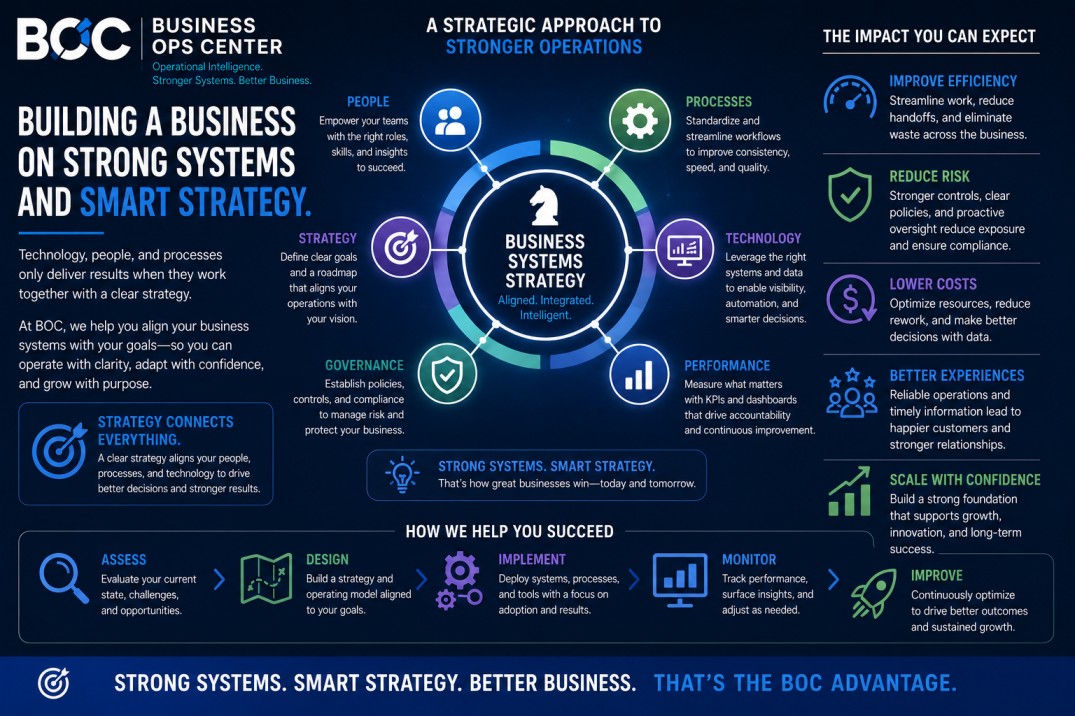
Introduction
Many organizations approach operational growth by continuously adopting new software tools to solve immediate business challenges. Teams implement CRM systems, project management platforms, communication tools, reporting environments, HR systems, and workflow automation technologies with the expectation that operational efficiency will improve automatically.
While software platforms can improve operational capabilities, many businesses underestimate the importance of long-term business systems strategy. Organizations frequently focus heavily on selecting tools while overlooking how systems interact operationally across workflows, approvals, reporting structures, communication pathways, and organizational responsibilities.
As businesses scale, disconnected systems environments often create fragmentation, visibility gaps, communication silos, inconsistent workflows, and operational inefficiencies that limit scalability.
Business systems strategy focuses on designing operational infrastructure intentionally rather than solving isolated workflow problems reactively. Businesses with strong systems strategy create operational environments that support workflow coordination, centralized visibility, operational consistency, governance readiness, and scalable execution.
Modern operational maturity increasingly depends not only on software adoption but also on the strategic coordination of systems ecosystems across the organization.
What Is Business Systems Strategy?

Business systems strategy refers to the intentional planning, coordination, and alignment of operational systems, workflows, infrastructure, reporting environments, approvals, and operational technologies across the organization.
Business systems strategy focuses on:
– Operational scalability
– Workflow coordination
– Systems integration
– Reporting visibility
– Operational consistency
– Governance readiness
– Cross-functional collaboration
– Long-term infrastructure planning
Rather than viewing software as isolated productivity tools, organizations with strong systems strategy evaluate how technologies support operational coordination across the business.
An effective systems strategy ensures operational infrastructure evolves cohesively as organizational complexity increases.
Why Software Selection Alone Is Not Enough
Many businesses mistakenly assume operational maturity comes primarily from adopting additional software tools. However, isolated software selection without infrastructure coordination often creates fragmented operational environments.
Common operational challenges include:
– Disconnected workflows
– Duplicate operational systems
– Communication silos
– Inconsistent approvals
– Reporting fragmentation
– Workflow bottlenecks
– Reduced operational visibility
– Increased manual coordination
Businesses frequently implement platforms independently across departments without establishing centralized operational coordination frameworks.
As complexity increases, organizations often rely heavily on manual oversight and administrative coordination to compensate for disconnected systems ecosystems.
A Simple Example
A business may buy a CRM to manage sales, a project tool to manage delivery, an accounting platform to manage invoices, and a communication tool to manage internal updates.
Each tool may work well on its own. The problem begins when the tools do not support the same process. Sales may close a deal, but operations may not receive the right handoff. Accounting may not know what was approved. Managers may not see project status. Leadership may not have one clear view of what is happening.
That is why systems strategy matters. The business needs to understand how tools work together, not just whether each tool has good features.
Operational Infrastructure Requires Strategic Coordination
Operational infrastructure functions most effectively when systems, workflows, approvals, reporting structures, and communication environments are intentionally coordinated.
Strategic systems coordination improves:
– Workflow visibility
– Cross-functional collaboration
– Operational accountability
– Reporting consistency
– Governance readiness
– Operational scalability
– Execution reliability
Organizations with connected operational infrastructure maintain stronger operational consistency even as workflows and systems environments become increasingly complex.
The Relationship Between Visibility and Systems Strategy
Operational visibility is one of the strongest outcomes of an effective business systems strategy. Leadership teams require visibility across workflows, operational responsibilities, approvals, reporting environments, and organizational priorities to coordinate scalable operational environments effectively.
Business systems strategy improves visibility by:
– Standardizing workflows
– Improving systems integration
– Centralizing reporting environments
– Coordinating approvals
– Improving accountability structures
– Reducing fragmented communication
Organizations operating through disconnected systems environments frequently struggle to maintain visibility into operational execution and workflow performance.
Workflow Coordination Depends on Systems Alignment
Workflow coordination becomes increasingly difficult when operational systems evolve independently across departments.
Organizations without systems alignment frequently experience:
– Approval delays
– Workflow duplication
– Communication breakdowns
– Operational silos
– Inconsistent execution
– Reduced accountability
Businesses with coordinated systems strategy create environments where workflows remain scalable, visible, and operationally consistent across teams and systems ecosystems.
Workflow standardization and systems alignment increasingly function as foundational operational infrastructure.
Governance Readiness and Infrastructure Maturity
Governance readiness is becoming increasingly important for modern organizations operating inside distributed operational environments. Businesses require infrastructure capable of supporting accountability, operational transparency, workflow consistency, and approval visibility.
Business systems strategy supports governance readiness by:
– Standardizing operational processes
– Coordinating reporting environments
– Supporting approval accountability
– Improving workflow visibility
– Reducing operational fragmentation
– Supporting operational intelligence
Organizations with mature operational infrastructure often improve resilience while reducing governance and operational risk.
How Businesses Can Improve Systems Strategy

Organizations seeking stronger operational maturity should intentionally design systems ecosystems that support workflow coordination, visibility, scalability, and operational consistency.
Recommended operational strategies include:
1. Evaluating systems strategically rather than departmentally
2. Improving systems integration
3. Standardizing workflows across teams
4. Centralizing reporting visibility
5. Defining workflow ownership clearly
6. Reducing disconnected operational silos
7. Implementing governance-oriented frameworks
8. Designing operational infrastructure for scalability
Businesses that prioritize systems strategy often improve organizational responsiveness, accountability, operational intelligence, and long-term scalability.
The Future of Operational Infrastructure
Business operations will continue to become increasingly software-driven, interconnected, and distributed. As organizations adopt additional systems and workflows, strategic infrastructure coordination will become even more important.
Future operational environments will increasingly prioritize:
– Workflow visibility
– Connected systems ecosystems
– Operational intelligence
– Governance-oriented infrastructure
– Scalable coordination frameworks
– Cross-functional operational consistency
Organizations that invest early in business systems strategy will likely gain significant long-term advantages in scalability, operational maturity, governance readiness, and organizational resilience.
Why API-Connected Systems Matter
As businesses grow, API-connected systems can help move information between platforms such as CRM, accounting, HR, payments, project management, communication, and reporting tools.
APIs do not replace strategy, but they can reduce duplicate entry, improve visibility, and help systems support a more connected operating model.
Conclusion
Business systems strategy is becoming one of the most important drivers of operational scalability and organizational maturity. Businesses that focus exclusively on isolated software selection often create fragmented operational environments that reduce visibility, consistency, and scalability.
Organizations that intentionally coordinate systems ecosystems strategically improve operational visibility, workflow coordination, governance readiness, and execution reliability.
As operational complexity continues increasing, modern organizations increasingly require connected operational infrastructure that supports scalable coordination across workflows, systems, approvals, reporting structures, and operational responsibilities.
Long-term operational maturity increasingly depends not only on technology adoption, but also on the strategic alignment of operational infrastructure across the business.