


Introduction
As organizations grow, operational complexity increases significantly. Businesses often focus heavily on sales growth, staffing expansion, customer acquisition, and technology adoption while underestimating the importance of operational maturity.
Operational maturity refers to an organization’s ability to coordinate workflows, systems, approvals, reporting structures, operational visibility, and governance consistently as complexity increases.
Many businesses initially succeed through speed, flexibility, and informal coordination. However, as organizations scale, operational environments become increasingly difficult to manage without standardized infrastructure, coordinated workflows, centralized visibility, and operational governance.
Organizations that fail to improve operational maturity often experience workflow fragmentation, inconsistent execution, communication breakdowns, visibility gaps, delayed approvals, and reduced scalability.
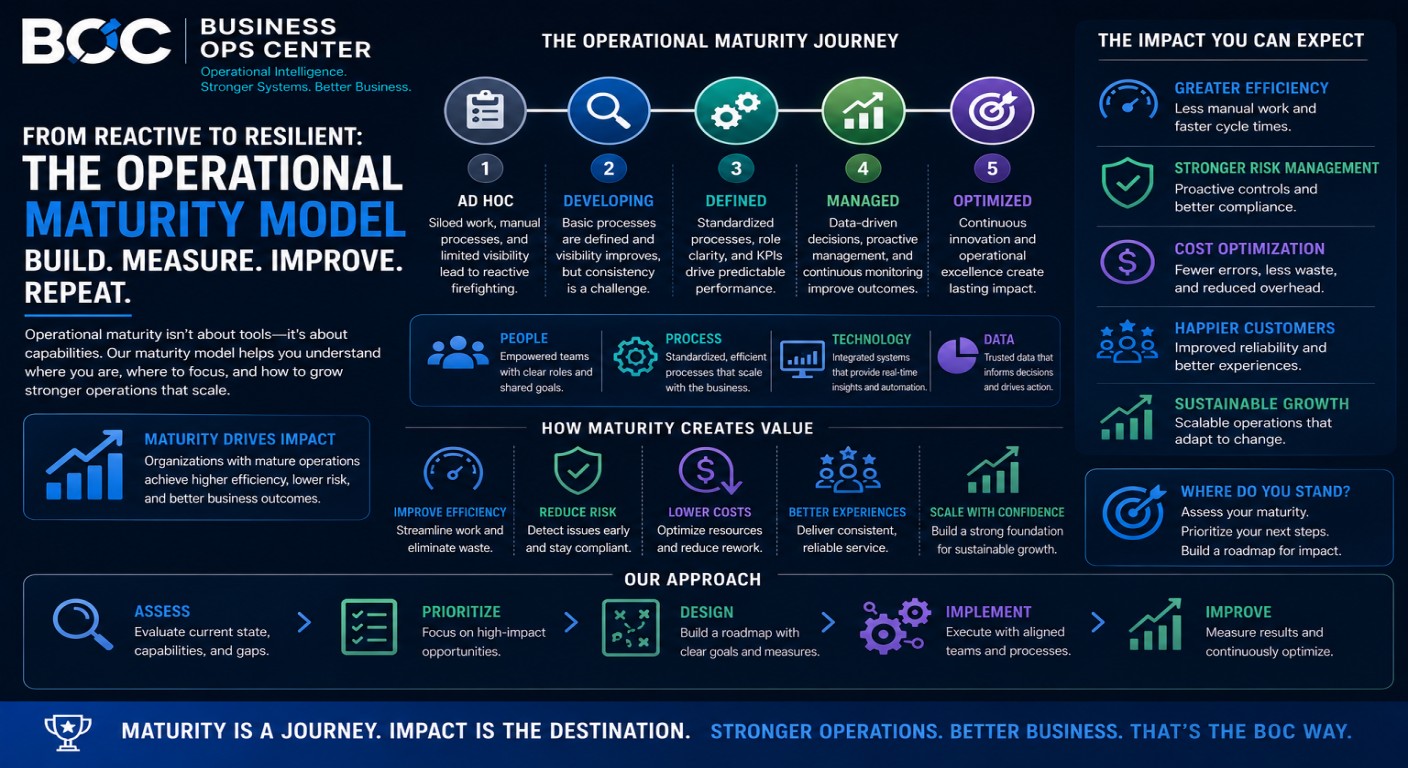
The operational maturity model provides a framework for understanding how businesses evolve operationally as they grow and why infrastructure maturity increasingly becomes a strategic competitive advantage.
What Is Operational Maturity?

Operational maturity refers to the level of organizational capability, consistency, coordination, and scalability within a company’s operational environment.
Operational maturity includes:
– Workflow standardization
– Operational visibility
– Systems integration
– Approval coordination
– Reporting consistency
– Governance readiness
– Cross-functional collaboration
– Scalable operational infrastructure
Highly mature organizations operate through coordinated systems ecosystems that support predictable execution, accountability, operational intelligence, and long-term scalability.
Less mature organizations often rely heavily on manual coordination, disconnected workflows, inconsistent processes, and fragmented operational systems.
Stage 1: Informal Operational Environments
Early-stage organizations frequently operate through informal operational structures. Teams rely heavily on direct communication, manual coordination, and flexible workflows.
Characteristics of early operational maturity include:
– Minimal workflow standardization
– Informal approvals
– Limited reporting visibility
– Highly manual coordination
– Rapid operational adaptation
– Minimal governance structure
While these environments often support agility during early growth stages, operational complexity eventually outpaces manual coordination capabilities as organizations scale.
Stage 2: Functional Process Expansion
As organizations grow, departments begin establishing more formal workflows and operational systems.
Businesses at this stage often implement:
– CRM systems
– Project management platforms
– HR systems
– Accounting software
– Department-specific workflows
Although operational capabilities improve, organizations frequently experience:
– Workflow fragmentation
– Disconnected systems environments
– Inconsistent approvals
– Communication silos
– Reduced operational visibility
Many businesses remain stuck at this stage because operational infrastructure evolves reactively rather than strategically.
Stage 3: Workflow Coordination and Visibility
Organizations progressing into operational maturity begin prioritizing workflow coordination, visibility, and operational consistency.
Businesses at this stage focus on:
– Workflow standardization
– Cross-functional coordination
– Centralized reporting visibility
– Approval governance
– Systems integration
– Operational accountability
Operational visibility becomes increasingly important as leadership teams require centralized insight into workflows, approvals, operational priorities, and organizational performance.
Organizations that establish coordinated operational infrastructure at this stage often improve scalability significantly.
Stage 4: Governance-Oriented Operational Infrastructure
Highly mature organizations operate through governance-oriented operational environments that support scalable execution, accountability, visibility, and operational resilience.
Characteristics include:
– Standardized workflows across departments
– Connected systems ecosystems
– Centralized operational intelligence
– Governance frameworks
– Real-time operational visibility
– Coordinated approval infrastructure
– Scalable reporting environments
Organizations at this stage maintain operational consistency even as complexity increases across distributed teams, systems environments, and operational structures.
| Stage | How the Business Operates | Common Problem | Next Priority |
|---|---|---|---|
| Stage 1: Informal | Work is handled through people, memory, and direct communication. | The business depends too heavily on individual coordination. | Document repeatable workflows. |
| Stage 2: Functional | Departments use their own tools and processes. | Systems and teams become disconnected. | Standardize workflows across functions. |
| Stage 3: Coordinated | Workflows, reporting, and approvals become more visible and interconnected. | Visibility improves, but governance may still be inconsistent. | Build ownership, rules, and accountability. |
| Stage 4: Governed | Systems, workflows, reporting, and controls operate together as an integrated framework. | Increasing complexity requires ongoing monitoring and management. | Improve operational intelligence and scalability. |
Why Operational Maturity Matters
Operational maturity increasingly impacts scalability, organizational responsiveness, execution reliability, and long-term business performance.
Organizations with higher operational maturity often achieve:
– Faster operational decision-making
– Better workflow coordination
– Improved accountability
– Reduced operational fragmentation
– Stronger governance readiness
– Better cross-functional collaboration
– Improved operational visibility
– More scalable infrastructure
Businesses with low operational maturity frequently struggle to maintain consistency as complexity increases.
The Relationship Between Visibility and Maturity
Operational visibility is one of the strongest indicators of operational maturity. Organizations cannot effectively coordinate workflows, systems, approvals, and responsibilities without centralized operational intelligence.
Operational visibility improves maturity by:
– Supporting workflow accountability
– Improving reporting reliability
– Coordinating operational priorities
– Reducing communication fragmentation
– Improving execution consistency
Businesses with strong operational visibility often make faster decisions and respond more effectively to operational challenges.
How Businesses Can Improve Operational Maturity
Organizations seeking stronger operational maturity should intentionally design operational environments that support coordination, visibility, governance readiness, and scalable execution.
Recommended operational strategies include:
1. Standardize workflows so work is handled consistently, even when different people are involved.
2. Improve systems integration so teams do not have to re-enter the same information in multiple tools.
3. Centralize operational visibility so leaders can see what is happening before problems become urgent.
4. Defining workflow ownership clearly
5. Improving cross-functional communication
6. Implementing governance-oriented frameworks
7. Reducing disconnected operational silos
8. Evaluating infrastructure strategically
Businesses that prioritize operational maturity often improve organizational scalability, operational resilience, and long-term execution consistency.
The Future of Operational Infrastructure
Business operations will continue to become increasingly interconnected, distributed, and software-driven. As organizations adopt additional operational systems and workflows, operational maturity will become even more important.
As companies mature, API-connected systems become increasingly important. APIs help businesses move information between platforms such as CRM, accounting, HR, payments, project management, procurement, reporting, and industry-specific systems, reducing duplicate entry and improving visibility across the operating environment.
Future operational environments will increasingly prioritize:
– Workflow visibility
– Operational intelligence
– Governance readiness
– Connected systems ecosystems
– Scalable infrastructure
– Cross-functional coordination
Organizations that invest early in operational maturity infrastructure will likely gain long-term advantages in scalability, organizational responsiveness, and operational consistency.
Warning Signs Your Business Needs More Operational Maturity
A business may need stronger operational maturity when:
– important work depends on one person remembering the next step
– teams use different systems that do not share information
– approvals happen through scattered emails or messages
– leadership cannot easily see project, customer, finance, or operational status
– reports take too long to prepare
– customer or employee requests fall through the cracks
– growth creates more confusion instead of more control
Conclusion
Operational maturity is becoming a defining factor in organizational scalability and long-term operational success. Businesses that intentionally build coordinated operational environments improve visibility, workflow consistency, governance readiness, and execution reliability.
As operational complexity continues increasing, organizations that prioritize operational maturity will gain significant advantages in scalability, accountability, operational intelligence, and organizational resilience.
Modern operational growth increasingly depends not only on expansion but also on the maturity of the infrastructure supporting execution across the business.