
Introduction
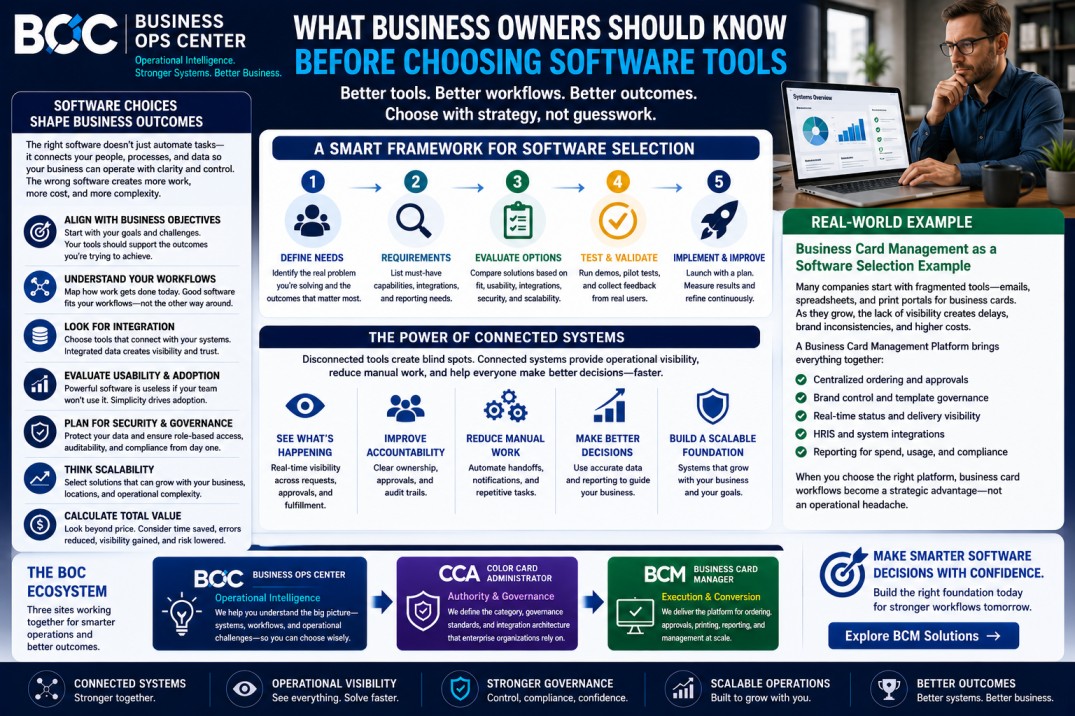
Selecting business software has never been more important—or more complicated. Organizations today operate in increasingly connected environments where workflows span multiple departments, applications, vendors, and stakeholders. Yet many software purchasing decisions are still made based primarily on features, pricing, or vendor reputation rather than long-term operational impact.
The reality is that software decisions shape how work gets done. They influence visibility, reporting, accountability, governance, workflow coordination, employee experience, and organizational scalability. A software platform that appears attractive during a product demonstration may create significant operational challenges if it cannot integrate effectively with existing systems or support future business requirements.
Business owners should therefore view software selection as an operational infrastructure decision rather than a technology procurement exercise. The goal is not simply to purchase software. The goal is to build an operational environment capable of supporting growth, visibility, efficiency, and long-term business objectives.
Why Software Selection Is an Operational Decision

Every software platform becomes part of a larger business ecosystem. CRM systems affect customer workflows. HRIS platforms influence employee processes. ERP systems impact financial visibility. Procurement tools shape purchasing controls. Workflow systems influence approvals and accountability.
Because these systems affect how work moves through the organization, software selection directly impacts operational performance. Choosing the wrong solution can create workflow bottlenecks, reporting challenges, duplicate processes, and fragmented data environments.
Organizations that approach software strategically focus first on operational outcomes. They ask how technology will improve workflow coordination, operational visibility, governance, and scalability. This perspective often leads to better long-term technology decisions and stronger operational maturity.
The Hidden Cost of Feature-Driven Purchasing
Many software purchases are driven by feature comparisons. Vendors compete aggressively by highlighting functionality, automation capabilities, dashboards, and user experience enhancements. While these factors matter, they rarely tell the complete story.
A platform with hundreds of features may still create operational problems if it does not align with organizational workflows. Similarly, a lower-cost platform may become expensive if it requires extensive manual workarounds, duplicate data entry, or additional systems to compensate for missing capabilities.
Feature-driven purchasing often ignores critical questions about integration, reporting, visibility, governance, and scalability. Over time, these overlooked considerations frequently become the source of operational inefficiencies that are far more expensive than the original software investment.
The Importance of Workflow Visibility
Workflow visibility should be one of the most important criteria during software evaluation. Organizations need to understand how work moves through their business, who owns approvals, where bottlenecks occur, and how operational activities contribute to business outcomes.
Software that improves workflow visibility helps leadership teams make better decisions. It supports accountability, operational intelligence, and continuous improvement. Without visibility, organizations often rely on assumptions, spreadsheets, and manual status updates that become increasingly difficult to manage as complexity grows.
Business owners should evaluate whether a software platform provides transparency into workflows, approvals, reporting, and operational activity across departments. Visibility is not simply a reporting feature; it is a foundational operational capability.
Why API Integration Matters More Than Ever
Modern businesses rarely operate from a single software platform. Most organizations use multiple applications to manage employees, customers, financial information, procurement activities, communication, and operational workflows.
This reality makes integration one of the most important software evaluation criteria. API-connected systems allow information to move efficiently between applications, reducing manual work while improving reporting consistency and operational visibility.
Organizations should evaluate whether software supports open integration, API connectivity, data accessibility, and compatibility with existing systems. Connected operational environments are generally easier to scale, manage, and optimize than isolated technology ecosystems.
Scalability and Future Growth
Many software decisions are made based on current requirements rather than future business needs. However, organizations that anticipate growth should evaluate software through a long-term lens.
Questions to consider include:
Will the platform support additional users?
Can it accommodate multiple locations?
Will reporting scale with organizational complexity?
Can workflows be expanded without significant redevelopment?
Software that supports scalability helps organizations avoid costly migrations and operational disruptions later. Growth often introduces new workflows, governance requirements, reporting needs, and integration demands that software must be able to support.
Business Card Management as a Practical Example
Business card management provides an excellent example of why strategic software selection matters. Many organizations initially adopt simple print ordering portals because they appear cost-effective and easy to implement.
However, as organizations grow, they often require approval workflows, brand governance controls, reporting visibility, HRIS integration, centralized ordering, vendor coordination, and operational accountability. What began as a simple printing requirement evolved into a workflow and operational management challenge.
Organizations that evaluate long-term operational requirements before selecting a solution are more likely to choose platforms capable of supporting both current and future needs. This illustrates why business systems strategy should precede software selection.
Questions Every Business Owner Should Ask
Before selecting any software platform, business owners should evaluate how the solution contributes to operational objectives.
Key questions include:
- Does this align with our business systems strategy?
- Can it integrate with our existing technology stack?
- Will it improve workflow visibility?
- Does it support governance and accountability?
- Can it scale with future growth?
- Will it reduce operational complexity?
- Does it support long-term operational goals?
The answers to these questions often reveal more about a platform’s value than a feature checklist ever could.
Conclusion
Choosing software is not simply a technology decision. It is an operational strategy decision that affects workflows, visibility, governance, reporting, and scalability.
Organizations that evaluate software through the lens of operational infrastructure are better positioned to build connected, efficient, and scalable business environments. By prioritizing workflow visibility, API integration, governance readiness, and long-term business objectives, companies can make smarter technology investments that support sustainable growth.
As software ecosystems become increasingly interconnected, success will depend less on individual applications and more on how effectively systems work together to support operational excellence.