


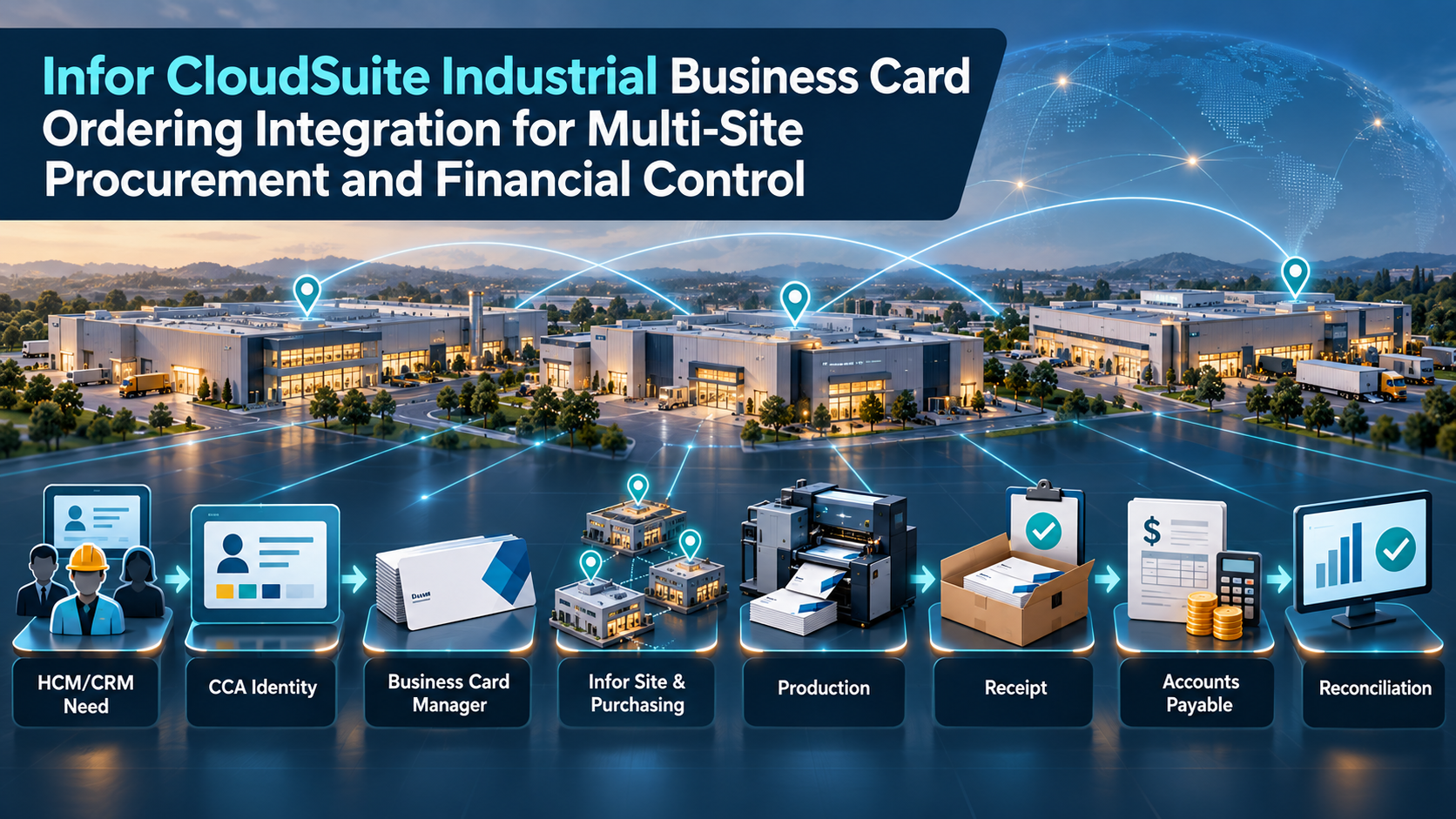
Connecting HCM, CRM, APIs, CCA, Business Card Manager, sites, purchasing, receiving, accounts payable, and evidence through BOC.
Business Card Manager (BCM) is the contracted business-card vendor and ordering system. A reliable Infor CloudSuite Industrial integration does not ask BCM to choose a vendor or make financial decisions. It connects BCM fulfilment with governed identity, multi-site purchasing, receipt, accounts payable, and evidence. BOC controls the cross-system process; CCA controls printable identity; Infor remains authoritative for configured procurement and financial records.
A Small Printed Item Can Expose a Large Control Gap
Business cards appear simple because the finished item is familiar. The process behind them is not. An employee event in HCM, a customer-facing assignment in CRM, an approved name and title, a site-specific budget, a purchase order, a shipment, a receipt and an invoice may all belong to different systems and owners. When those connections depend on email and re-entry, the enterprise cannot reliably explain who requested the order, what was approved, which site paid or whether the right cards arrived.
Infor CloudSuite Industrial can govern purchasing, receiving, accounts payable, and financial records in a multi-site operating model. It should not become the master for employee status, customer-facing context or printable identity. Likewise, a card-ordering application should not independently invent cost centers, approve spend or declare an invoice correct.
Business Ops Center provides the operating layer between those authorities. It starts a correlated case, validates current facts, coordinates decisions, calls supported interfaces, routes exceptions, reconciles outcomes and retains the evidence needed to close the transaction.
Define Authority Before Mapping Fields
HCM owns workforce status, manager, organization, position, work location and effective dates. CRM can own territory, account, campaign, event or customer-facing assignment. Corporate Card Application (CCA) governs the identity that may be printed: approved name, display title, company, office, contact details, language, brand, template and legal text.
Business Card Manager (BCM) is the contracted vendor and business-card ordering system. It owns the product configuration, proof, quantity, production, shipment, cancellation, correction and reorder state. BCM is not a vendor-selection or routing engine. If the enterprise has one contracted business-card program, the process should say so directly.
Infor CloudSuite Industrial owns its configured sites, vendors, items or categories, requisitions, purchase orders, receipts, vouchers, accounts payable and financial distributions. BOC does not replace any master. It governs transitions between them and records which authority supplied each fact or decision.
Infor Integration Is a Configurable Boundary
It Infor documents CloudSuite Industrial capabilities for ION connectivity, Business Object Documents, application replication, and IDO-based integration with external applications. Infor OS also provides ION API as a managed layer for Infor and non-Infor APIs, while ION Process APIs expose workflows, alerts, tasks and notifications. The usable pattern depends on the customer release, deployment, licensing, security, and configuration.
This article therefore describes a configurable integration model, not a released universal native connector. A design may use approved APIs, ION flows, BODs, IDO services, an enterprise integration platform or a controlled combination. Every interface must be confirmed against current Infor documentation and the target tenant.
The technical connection is only one layer. BOC adds stable correlation, version awareness, authority checks, idempotency, exception ownership, evidence, and business operational reconciliation so a successful message does not get mistaken for a successful business outcome.
The Governed Multi-Site Ordering Lifecycle
| Lifecycle stage | Authoritative context | BOC control | Required outcome |
|---|---|---|---|
| Business need | HCM or CRM event and approved request | Authenticate, correlate and test eligibility | Trusted BOC case |
| Printable identity | CCA policy and current workforce facts | Resolve approved fields, template and version | Versioned CCA decision |
| Card order | BCM product, proof, quantity and destination | Check duplication, timing and authority | Controlled BCM order |
| Site context | Infor site, vendor, category, account and terms | Validate current purchasing and finance data | Executable demand |
| Procurement | Requisition, approval and purchase order | Invoke approved interface and retain references | Authorized commitment |
| Fulfilment | BCM production, shipment and delivery | Monitor changes and route exceptions | Verified physical outcome |
| Financial closure | Receipt, voucher, invoice and evidence | Reconcile quantity, price and obligations | Authorized closure |
HCM and CRM Establish Legitimate Demand
New hires, transfers, promotions, office moves, customer-facing assignments, events, campaigns, replacements and reorders can all create valid demand. BOC retrieves only the facts needed to evaluate the request and its effective date. It distinguishes an approved business need from a convenient but stale form submission.
HCM confirms whether the person is active and which organization and location are current. CRM can explain a territory, account, event or customer-facing urgency. Neither source alone should decide printable identity, quantity or financial ownership. BOC combines context without allowing one system to overwrite another domain.
If employment, manager, title, site, territory or event timing changes while the case is open, BOC reevaluates downstream dependencies. An old approval or proof cannot silently authorize a materially changed order.
CCA Controls What May Be Printed
A payroll or HCM title may not be the title approved for external display. Abbreviations, credentials, language, company naming, phone formatting, office, email convention, legal text and templates may depend on brand and policy. CCA applies those rules and produces a versioned printable-identity decision.
BOC links the CCA version to the employee, business purpose, effective date and BCM order. Missing or conflicting information becomes an owned exception. Reviewers can correct the printable result without corrupting authoritative workforce data merely to make a card proof look right.
When identity changes after proof approval or purchasing action, BOC evaluates whether the proof, order, purchase document or production release must be cancelled and recreated. Every correction stays connected to the reason and prior version.
Business Card Manager Owns Ordering and Fulfilment
Business Card Manager (BCM) receives approved printable identity and manages the contracted card program. It controls product configuration, stock, finish, quantity, proof, production, shipment method, destination, cancellation, correction and reorder status. The integration must treat BCM as the business-card management vendor, not as a tool that selects among vendors.
BOC connects the BCM order version to the Infor purchasing transaction. It verifies that the person, product, quantity, destination, timing and approval are still valid before release. Production is blocked when identity, budget, purchasing or delivery context is unresolved.
Proof rejection, price change, production failure, partial shipment, address error, damage, cancellation or reprint becomes a governed exception. BOC assigns an owner, response target and next action while preserving the relationship between operational recovery and financial impact.
Multi-Site Procurement Requires Explicit Ownership
Infor CloudSuite Industrial supports multi-site operating patterns, including shared administrative processes, common customers or vendors, centralized payment in appropriate configurations, and purchase orders or invoices involving multiple sites. Those capabilities make site design important rather than automatic.
An employee may work at one site, report to another organization, attend an event funded by a third cost center and receive cards at a temporary location. BOC determines which facts are operational context and asks Infor to remain authoritative for configured purchasing and financial ownership. Delivery address alone must not choose the paying site.
The design should define site, warehouse or location where relevant, vendor, category or item, currency, tax, terms, account, project and inter-site treatment. Ambiguity is routed before a purchase commitment or production release is created.
Purchase Orders Translate Approved Need into Commitment
Infor describes purchasing as the process of buying products from vendors, receiving them, allocating them to the work that requires them and paying for them. The configured path can include requisitions, regular or blanket purchase orders, releases, approvals and multi-site purchasing. The card program should use the enterprise employee onboarding approved path rather than an informal side channel.
BOC sends the minimum validated context required by the selected Infor interface: request reference, site, contracted vendor, card product or category, quantity, price basis, delivery details, account or project context and supporting evidence. Infor applies its configured document rules and authorization.
The BOC case, CCA identity version and BCM order reference remain connected to the purchase document and line. A change to person, identity, quantity, price, site, account or delivery timing can invalidate a previous approval. BOC prevents a superseded decision from releasing a different transaction.
Receiving and Accounts Payable Complete the Control Chain
Infor states that accounts payable is closely connected to purchasing, including purchase orders, requisitions, blanket orders and line releases. That relationship matters because production, shipment, delivery, receipt and financial liability are different states. A shipping notification does not automatically prove acceptable receipt.
BCM supplies production and delivery evidence. The authorized recipient or receiving process confirms quantity and condition. Misprinted, missing, damaged or misdirected cards remain open exceptions. BOC connects that evidence to the Infor receipt or agreed service-confirmation model.
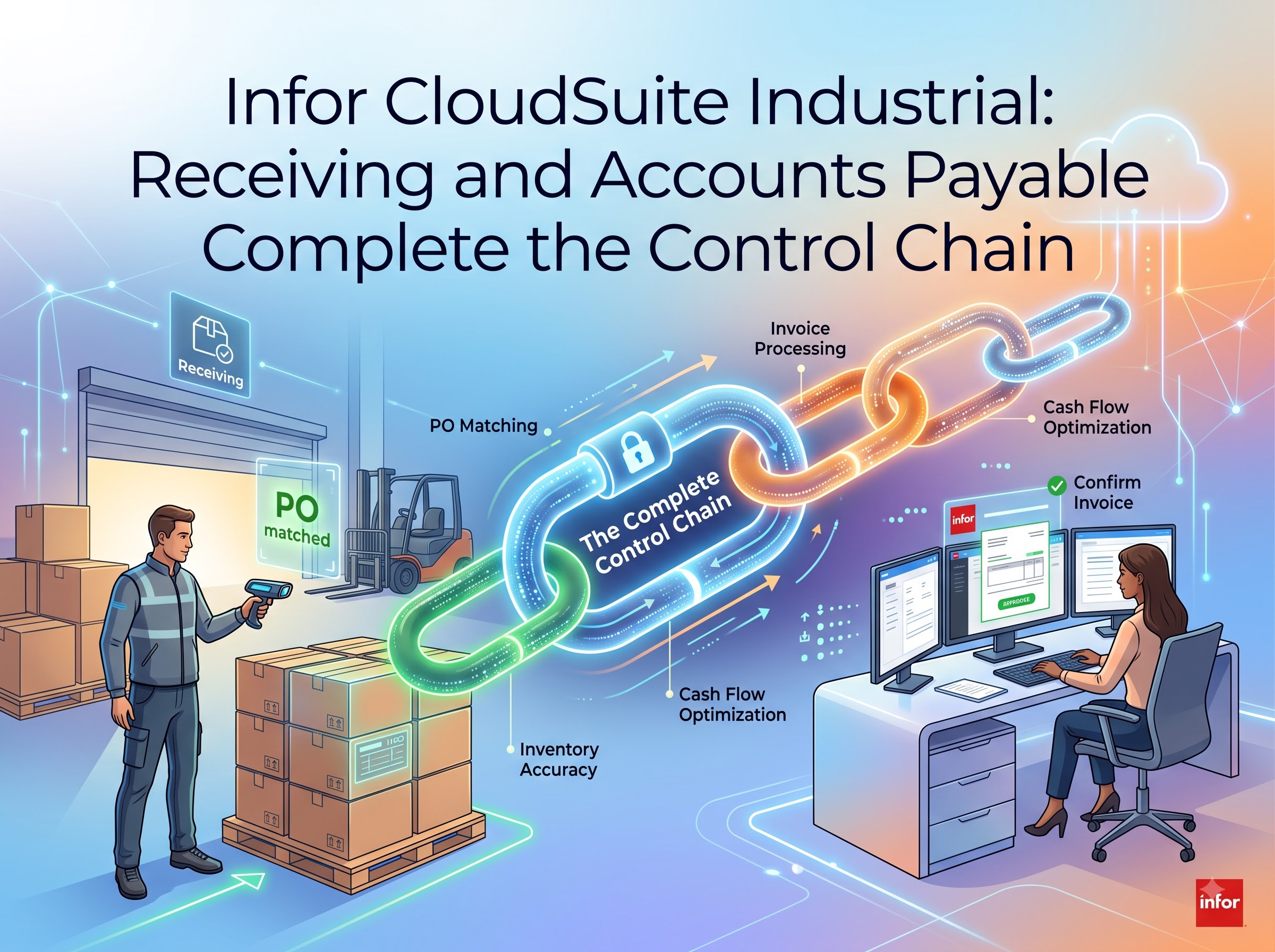
Invoice or voucher reconciliation compares contracted price, ordered quantity, fulfilled quantity, accepted receipt, freight, tax, credits and tolerances. BOC closes the case only when the physical and financial outcomes agree or an authorized owner records the residual decision and obligation.
APIs Need Business-Safe Retry and Reconciliation
A timeout does not reveal whether a request failed before processing, committed successfully or completed after the caller stopped waiting. Retrying blindly can duplicate a requisition, purchase order, or receipt. BOC uses a stable case key, records each attempt, and checks the current state before deciding whether another call is safe.
Authentication failure, expired credentials, missing privilege, invalid site, vendor mismatch, closed accounting period, rejected approval, and transient service unavailability require different responses. Technical backoff handles temporary conditions; business exceptions go to named owners with deadlines and evidence.
Periodic reconciliation compares BOC cases, CCA versions, BCM orders, and Infor purchasing, receiving, and payable records. It identifies orphaned documents, duplicate demand, stale approvals, unmatched receipts, unresolved credits, and cases that appear technically complete but that the system has not operationally closed.
Evidence Must Survive Across Systems and Time
A defensible record should answer who initiated the request, why it was needed, which workforce and CRM facts were current, what identity was approved, which BCM product and proof were released, which site funded the order, who authorized spend, what was received, and how the invoice was resolved.
That does not require copying every employee or financial attribute everywhere. BOC stores correlation and decision evidence with controlled references, timestamps, versions, and retention. Sensitive personal and financial data remains minimized and access-controlled.
Operational dashboards can measure request volume, identity accuracy, approval time, order cycle time, proof corrections, production delay, on-time delivery, receipt exceptions, invoice variance, duplicate prevention, exception aging, and evidence completeness by permitted dimensions.
A Practical Implementation Roadmap
Begin with one site, one contracted BCM program and one common card type. Map HCM and CRM triggers, CCA enterprise identity fields, BCM product rules, Infor site and vendor records, purchasing documents, accounts, approvals, receipt, accounts payable, retention and support ownership.
Confirm the current CloudSuite Industrial release and deployment. Select documented interfaces—such as approved ION, BOD, IDO or API patterns—then define authentication, least privilege, correlation, idempotency, versioning, error taxonomy, retry, observability, queues, reconciliation and evidence.
Test joiner cancellation, transfer, invalid title, duplicate request, wrong site, closed account, price change, proof rejection, API uncertainty, partial delivery, damaged cards, missing receipt, invoice variance, credit and reprint. Expand to additional sites only after the team control the first workflow and it becomes measurable.
Buyer-Intent Bridge: What a BOC Engagement Produces
Organizations evaluating Infor integration usually do not need another isolated order form. They need a source-of-truth model and a reliable operating process across workforce, customer context, identity, purchasing, fulfilment and finance. A BOC discovery engagement can define the lifecycle, authority matrix, data contract, integration architecture, site and account rules, approval model, exception taxonomy, evidence model, backlog and measures.
The approach protects existing investments. Infor CloudSuite Industrial remains authoritative for configured procurement and financial records. HCM and CRM retain their domain facts. CCA governs printable identity. Business Card Manager remains the contracted card vendor and ordering system. BOC governs the transitions, exceptions, reconciliation and closure.
Start with one card-order path that currently depends on copied employee data, email approval, manual site selection or invoice research. Converting it into a governed integration creates a reusable pattern for other identity-linked purchases across a multi-site enterprise.
Questions Integration Buyers Should Ask
- Which CloudSuite Industrial release, deployment and documented interfaces support the selected lifecycle?
- Which system owns workforce status, CRM context, printable identity, card product, site, vendor, receipt and payable state?
- How are site, account, project, tax, currency, terms and approval authority derived and revalidated?
- How are timeouts, duplicate submissions, changed proofs, partial deliveries, credits and reprints controlled?
- Who owns credentials, interface versions, monitoring, exceptions, reconciliation, retention and support?
- What evidence is required before the order is financially and operationally closed?
Frequently Asked Questions
Does BOC replace Infor CloudSuite Industrial? No. Infor remains authoritative for configured procurement and financial records. BOC coordinates the cross-system process, exceptions, evidence and closure.
Is this a released native connector? No universal native connector is claimed. This is a configurable integration model using customer-approved, documented interfaces.
What is Business Card Manager? Business Card Manager (BCM) is the contracted business-card vendor and ordering system. It manages the card product, proof, production and fulfilment.
When is the transaction complete? Only after approved identity, production, delivery, receipt, financial matching, and exception obligations are reconciled or formally resolved.
Connect one business card order to multi-site procurement and financial control. Business Ops Center can help define and implement a governed workflow across Infor CloudSuite Industrial, HCM, CRM, CCA, Business Card Manager and enterprise delivery systems. Start with one site and one ordering path that currently requires manual validation, re-entry or reconciliation.