
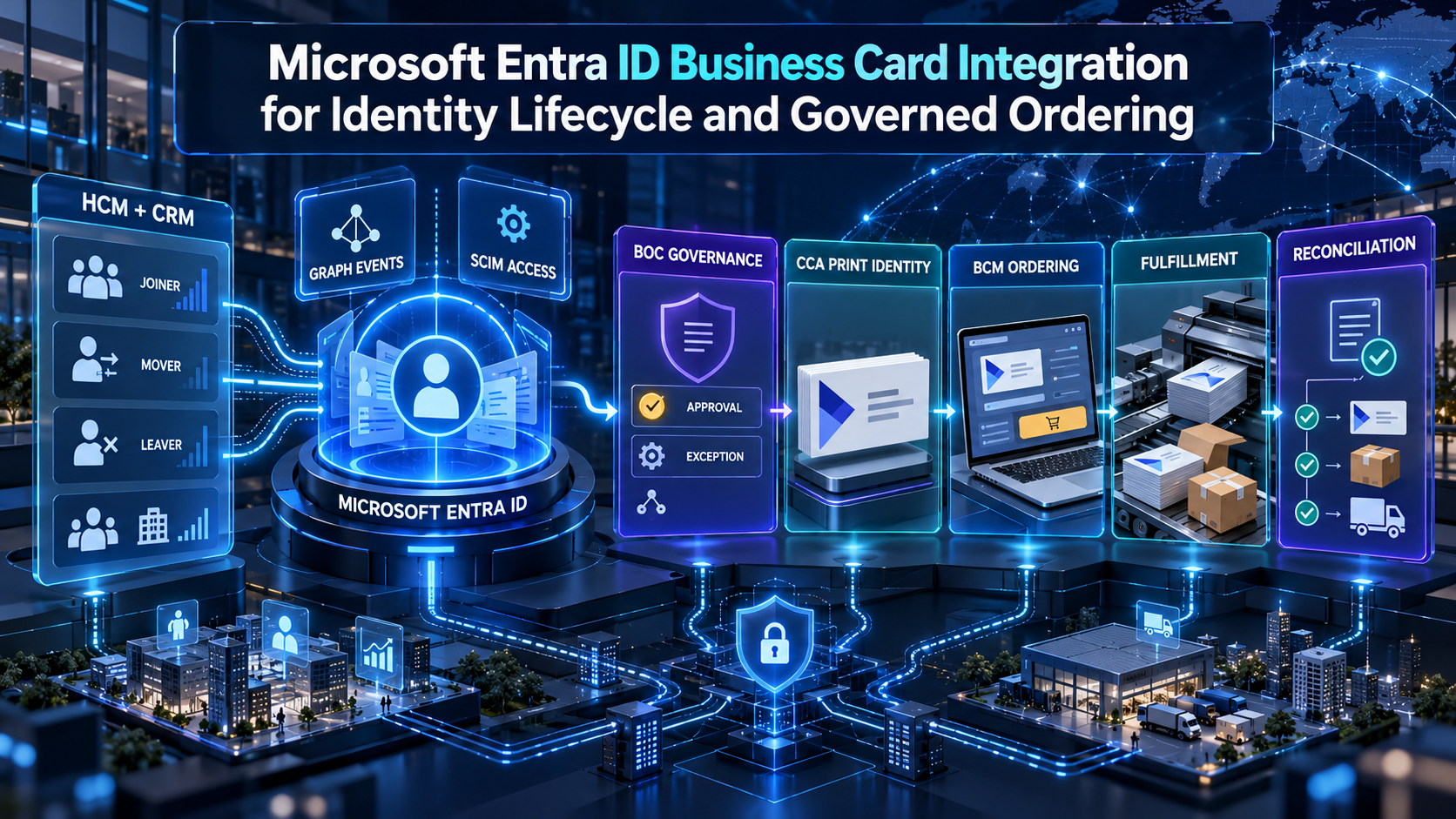
Connecting HCM and CRM context, Microsoft Entra identity events, CCA identity governance, Business Card Manager ordering, fulfillment, and evidence through BOC.
Microsoft Entra ID can provide trusted digital-identity state, application assignment, and lifecycle signals, but it should not become the authority for public identity or card production. CCA governs the identity approved for print, Business Card Manager is the contracted business-card vendor and business card ordering system, and BOC controls the cross-system workflow, exceptions, reconciliation, and closure.
Digital Identity Activation Should Not Automatically Release Print
A new account, group assignment, or application entitlement can indicate that an employee is joining a role, moving to a new business unit, or leaving the organization. Those events are valuable operational signals. They do not, by themselves, prove that a person needs business cards, that the directory profile is suitable for public use, or that purchasing and production are authorized.
When enterprises connect directory events directly to ordering, technical convenience can bypass business controls. A synchronized title may be an internal job classification rather than the customer-facing title approved by brand. A location may identify an access boundary but not the office address permitted on a card. An enabled account may exist days before the employee is ready for public representation.
Business Ops Center provides the operating layer around these differences. It correlates HCM, CRM, and Entra context, applies eligibility and timing rules, coordinates CCA and BCM, assigns exceptions, and verifies the physical and financial outcome before a case is closed.
Separate Workforce Digital Public and Production Authority
HCM should remain authoritative for configured workforce facts such as employment status, manager, organization, job, work assignment, location, and effective dates. CRM can remain authoritative for account ownership, territory, campaign, event, and customer-facing responsibility. These systems explain why a card may be needed and when that need becomes effective.
Microsoft Entra ID governs digital identities, authentication relationships, groups, application access, and related lifecycle controls within the configured tenant. It can expose useful attributes and events through approved interfaces, but a directory field is not automatically a print-approved field. Access authority and public-identity authority are different responsibilities.
CCA governs printable identity, including the approved display name, external title, organization, office, phone, email, language, legal text, logo, and template. Business Card Manager (BCM) is the contracted business-card vendor and ordering system. BCM manages configured products, proof, quantity, production, shipment, correction, cancellation, and reorder state. BOC governs the transitions between all of these authorities.
Microsoft Entra Supports Several Integration Patterns
The documents Lifecycle Workflows standardization for joiner, mover, and leaver processes within Entra ID Governance. Microsoft Graph supports change notifications that alert an application when supported resources change, and delta query supports incremental discovery of newly created, updated, or deleted users. Microsoft also documents SCIM-based provisioning for users and groups between Entra and connected applications.
These capabilities create options, not a universal connector. A customer implementation may use Graph APIs, webhooks, Event Hubs, delta queries, Lifecycle Workflow custom task extensions, SCIM, an integration platform or scheduled reconciliation. The appropriate pattern depends on licensing, tenant architecture, security, scale, latency, data ownership, and the supported interfaces of each application.
BOC adds the operating controls that transport mechanisms do not provide: stable correlation, business qualification, versioned decisions, idempotency, exception ownership, evidence and end-to-end reconciliation. A successful webhook delivery, Graph response or SCIM operation proves a technical exchange, not a completed business outcome.
The Governed Entra Business Card Lifecycle
| Lifecycle stage | Authoritative context | BOC control | Required outcome |
|---|---|---|---|
| Need | HCM or CRM event and effective date | Authenticate correlate and qualify demand | Trusted BOC case |
| Digital identity | Entra user state access and permitted attributes | Confirm readiness without granting print authority | Verified identity context |
| Printable identity | CCA policy and approved public fields | Resolve conflicts and preserve version | Approved card identity |
| Order | BCM product proof quantity and destination | Check policy duplication and authority | Controlled BCM order |
| Fulfillment | BCM production shipment and delivery | Monitor state and route exceptions | Verified physical outcome |
| Financial | Purchase receipt invoice credit and posting | Reconcile value and references | Supported financial outcome |
| Closure | Evidence current state and residual obligations | Authorize closure or assign remaining work | Auditable closed case |
Begin With a Qualified Business Need
The most reliable trigger usually begins in HCM, CRM or an authorized request rather than in Entra alone. A new hire may require cards because the role is customer-facing. A salesperson may need a replacement after a territory or office change. A conference assignment may justify a time-bound quantity even when the employee record has not changed.
BOC creates one case under a stable worker and requests reference, then gathers only the context required for the decision. Entra can confirm that the digital identity exists, is associated with the expected tenant, and has reached the configured readiness state. It should not convert every account creation, profile edit, or group change into demand.
The trigger contract should define source, event type, changed properties, effective time, correlation keys, replay behavior, and ownership. BOC classifies the signal as a new order, replacement, correction, cancellation, future action, or no action and records the reason.
Use Entra as Digital Identity Evidence, Not Public Identity Truth
Directory attributes can help correlate an employee across applications and verify that work email, organization, or office context has reached the intended digital identity. However, synchronizing a value into Microsoft Entra ID does not mean it has passed brand, legal, localization, or public-disclosure rules.
BOC therefore treats permitted Entra attributes as evidence with source and retrieval time. It compares them with HCM and CRM context and sends the relevant candidate identity to CCA. Conflicts become owned exceptions rather than silent overwrites. The correction should occur in the authoritative system or through an explicitly governed CCA decision. Data minimization is essential. Business card ordering does not require passwords, authentication methods, sign-in history, sensitive group membership or unrelated profile data. The integration contract should list every permitted field, its purpose, recipient, retention period and masking rule.
CCA Converts Context Into Approved Printable Identity
CCA applies policy to the facts that may appear on the card. It can normalize approved names, customer-facing titles, organization names, office addresses, telephone formats, languages, credentials, legal text, logos and templates. Its result is a versioned identity decision that BOC can bind to an order and later explain.
This boundary matters when digital and public identity diverge. An internal department label may not be a brand name. A directory office code may not be a public address. An HCM job profile may be more detailed than the external title. CCA resolves the printable representation without changing Entra, HCM, or CRM ownership.
Before production, BOC revalidates the CCA version against current eligibility and material upstream facts. If the employee, role, organization, email or location changes after approval, the case can be held, reopened, or a replacement decision requested instead of allowing a superseded version to authorize print.
Business Card Manager Executes the Contracted Order
After BOC confirms authority, BCM converts the approved CCA identity into the contracted card product. It manages product configuration, artwork rendering, proof, quantity, production, shipment, delivery, correction, cancellation, and reorder state. BCM is not a vendor-selection engine and does not determine employee eligibility.
Standard requests may move straight through when identity, quantity, delivery and cost conditions are satisfied. Rush delivery, unusual quantities, alternative finishes, new destinations or repeated reorders can require additional approval. BOC records the rule, actor and evidence behind every exception decision.
The BCM order identifier remains linked to the BOC case, CCA version, employee reference, purchasing record, shipment and invoice. That correlation lets operations distinguish a technical identity change from the exact physical product, delivery, and cost that resulted.
Joiner Mover and Leaver Events Need Different Controls
For a joiner, Entra readiness can be one condition in a larger release decision. The workflow may require an accepted HCM hire, effective start date, approved work email, CRM role confirmation, CCA identity, manager approval, delivery address, and purchasing authority. Early preparation can occur without releasing production before facts stabilize.
For a mover, BOC compares the new state with the last approved and produced version. A group change alone may require no card action, while a customer-facing promotion, office move, entity change or new email domain may justify replacement. The workflow should consolidate related changes so the enterprise does not print several short-lived versions.
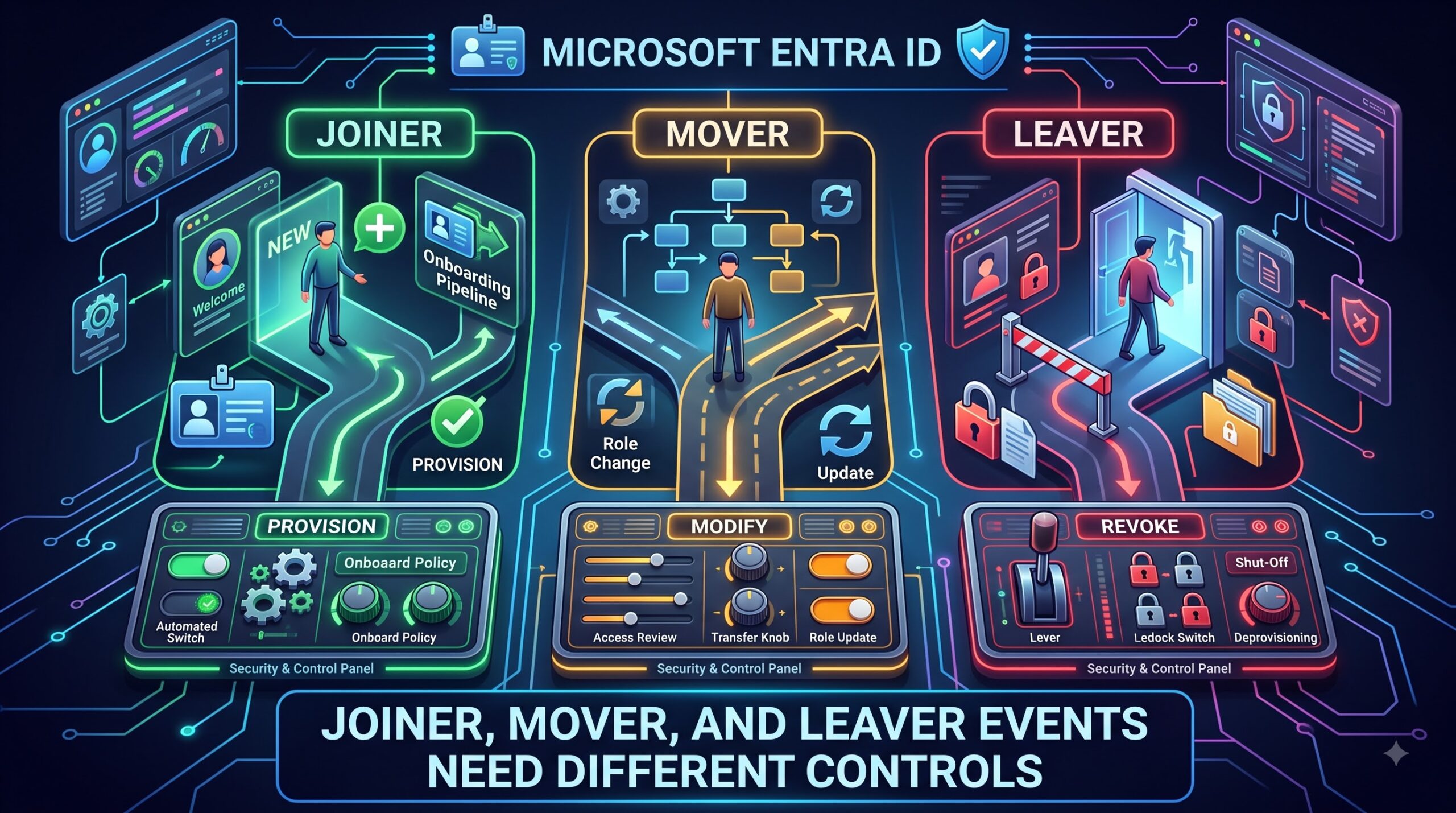
For a leaver, Entra disablement or access removal can stop future authority, but it cannot erase an order already produced or delivered. BOC checks the order stage, attempts cancellation where possible, prevents reorders, and records unavoidable cost or residual obligations. Closure requires confirmation of the downstream outcome.
Change Notifications and Delta Queries Need Reconciliation
Microsoft Graph change notifications use a push model, while delta queries support incremental pull-based synchronization. Either approach can reduce unnecessary full-directory reads. Production design still has to handle subscription expiration, reauthorization, missed notifications, delayed processing, repeated delivery, permissions and downstream uncertainty.
BOC uses event identifiers, resource references, timestamps, versions and idempotency keys where available. A notification can cause the workflow to retrieve the current permitted state before acting rather than trusting incomplete event content. Controlled retry handles transient failures; invalid authority, missing facts and policy conflicts become business exceptions. Scheduled delta or source reconciliation provides a recovery path when real-time processing is incomplete. It can compare expected employee changes, Entra identities, open BOC cases, CCA decisions and BCM orders to identify missed triggers, duplicated demand, stale approvals and orphaned fulfillment.
SCIM Provisioning Is an Access Pattern, Not an Ordering Mandate
SCIM standardizes user and group provisioning between identity systems and applications. If a connected BOC, CCA or BCM environment supports an approved SCIM boundary, Entra provisioning may create, update or disable the application identity needed for access. That can reduce manual account administration.
Provisioning a user into an application should not automatically create a business card order. Access to request or approve a card is different from eligibility for a card, and both are different from authority to release production. BOC preserves those separations and can require current role, policy and approval evidence at the moment of action. SCIM mapping also requires careful governance. The enterprise process orchestration should document matching attributes, uniqueness, source precedence, scope, deprovisioning, quarantine behavior and recovery. A mapping error that changes access must not silently change the identity printed on an already approved product.
Secure the Integration With Least Privilege
Graph permissions, application registrations, service principals, certificates, secrets, managed identities, webhook endpoints and SCIM credentials require controlled ownership. Use the narrowest supported permissions, separate environments, protect secrets, rotate credentials, monitor administrative changes and review access on a defined schedule.
Webhook endpoints must validate requests and follow the current Microsoft subscription and lifecycle guidance. Rich notifications containing resource data require encryption and careful key handling. Logs should emphasize correlation IDs, processing results and error classifications instead of retaining full employee payloads.
Downstream systems must enforce their own authorization. A message originating from Entra does not override CCA policy, BCM ordering rules, procurement approval or BOC case state. Every material transition should be attributable to an authenticated actor, workload or approved automated decision.
Connect Procurement and Finance to the Same Case
Business card ordering creates a commercial obligation even when the identity flow is automated. ERP or procurement integration systems remain authoritative for company, cost center, project, supplier, purchase order, receipt, invoice, tax, payment and ledger records. Entra should not become a financial master.
BOC sends only the validated context needed for the configured purchasing method and retains the resulting references. Financial descriptions should avoid unnecessary personal data while still allowing the purchase, receipt and invoice to be traced to the BOC case, CCA version and BCM order. Reconciliation compares the approved product, quantity, price and destination with BCM production, shipment, delivery, receipt, invoice, freight, tax, credit and reprint activity. BOC closes the case only when physical and financial outcomes agree or a named authority accepts the residual exception.
Implement One Identity Lifecycle Before Expanding
Begin with one tenant, one workforce population, one joiner or mover scenario, one CCA policy, one BCM card product and one delivery path. Document source ownership, minimum data, effective dates, Graph or provisioning pattern, approval conditions, exceptions, evidence and retention before development.
Confirm licensing, API permissions, notification resources, subscription renewal, delta state, Lifecycle Workflow scope, SCIM behavior, rate limits and monitoring for the selected environment. Define the BOC case key, CCA version, BCM order reference, retry rules, reconciliation jobs and support ownership.
Test pre-hire creation, delayed start, duplicate notifications, out-of-order updates, missing email, changed title, office move, leaver disablement, rehire, permission failure, expired subscription, delta restart, proof rejection, uncertain order acceptance, partial delivery, invoice variance and credit. Expand only after the initial path produces reliable evidence.
Buyer Intent Bridge What an Entra Integration Engagement Produces
Organizations rarely need another directory export. They need a governed operating model connecting workforce and customer context to digital identity, printable identity, contracted ordering, purchasing, fulfillment and finance. A BOC engagement can produce the source-of-truth matrix, event catalogue, data contract, permission model, lifecycle design, approval rules, exception taxonomy, reconciliation model and implementation backlog.
The model protects existing investments. HCM and CRM retain their domain authority. Entra governs digital identity and access. CCA governs printable identity. Business Card Manager remains the contracted business-card vendor and ordering system. BOC governs the transitions, exceptions, evidence and closure across them.
Start with a manual handoff that causes delay or correction, such as customer-facing new-hire cards or replacements after role changes. Turning that journey into a governed integration creates a reusable pattern for other identity-linked operational services.
Questions Integration Buyers Should Ask
- Which HCM or CRM event establishes business need, and what Entra state is required before release?
- Which Graph permissions, change-notification resources, delta queries, Lifecycle Workflows, or SCIM patterns are approved for the tenant?
- Which attributes may be used for correlation, which may be printed, and which are prohibited from the workflow?
- How are the worker, Entra object, BOC case, CCA version, BCM order, shipment, purchase, and invoice correlated?
- How are duplicate, delayed, missed, and out-of-order events detected and recovered?
- Who owns access, credentials, subscriptions, mappings, exceptions, reconciliation, retention, and support?
Frequently Asked Questions
Does BOC replace Microsoft Entra ID? No. Entra remains the digital identity and access platform. BOC governs the cross-system business workflow and verified outcome.
Does Entra account creation automatically create a card order? No. It supplies identity state that BOC can evaluate with HCM, CRM, CCA, purchasing and policy context.
Is a universal native connector claimed? No. This article describes a configurable architecture using customer-approved Microsoft and downstream capabilities.
What is Business Card Manager? Business Card Manager is the contracted business-card vendor and ordering system that manages configured products, proof, production, fulfillment, and reorders.
Connect one Microsoft Entra identity lifecycle to a governed business card outcome. Business Ops Center can help define the authority model, permissions, event architecture, CCA identity approval, BCM ordering, exception handling, and reconciliation needed for a controlled implementation. Start with one high-friction joiner or mover path and turn it into a reusable enterprise integration pattern.