


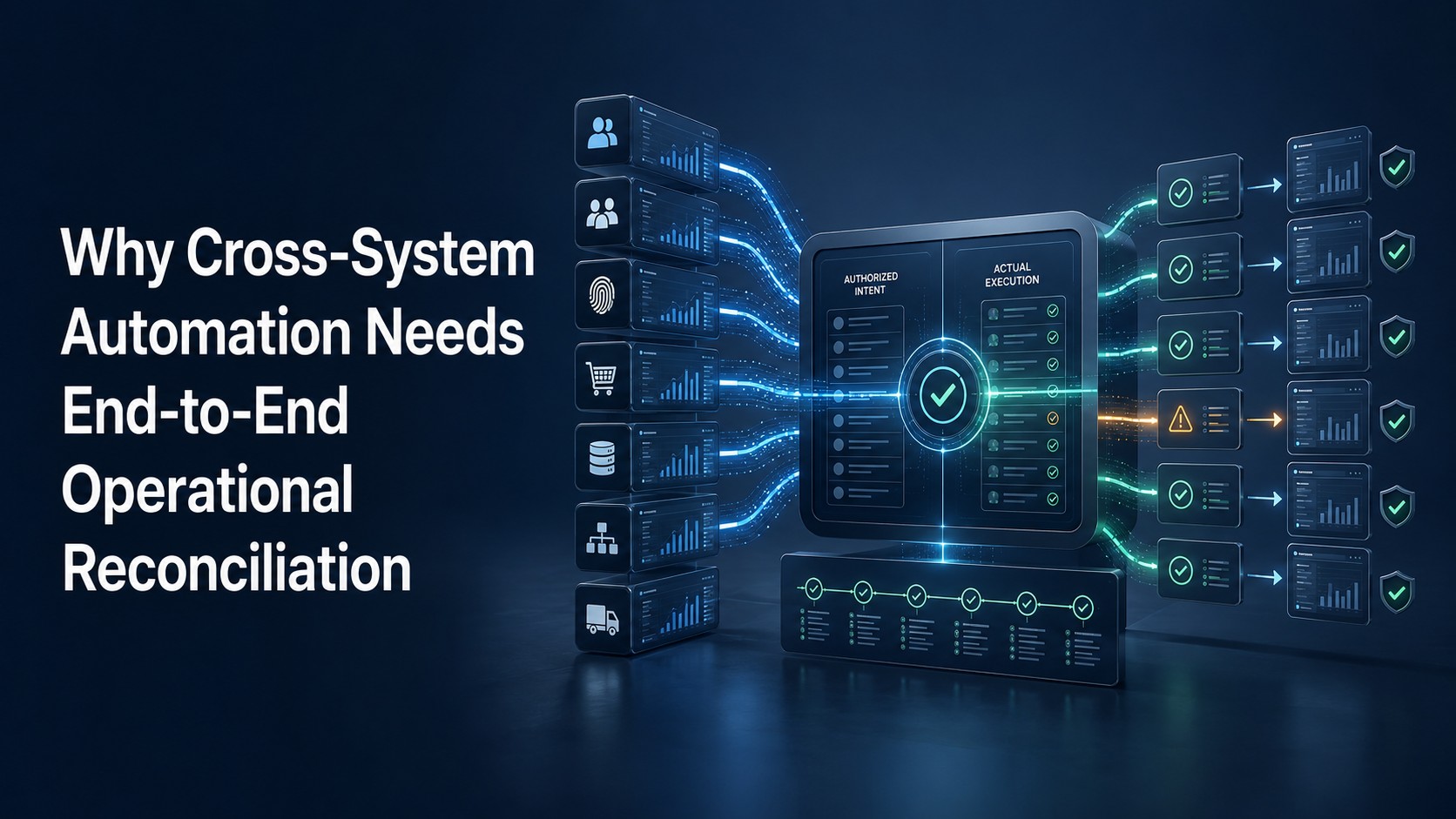
| EXECUTIVE PERSPECTIVE: Cross-system automation is not complete when every connector reports success. It is complete when the enterprise can verify that authorized intent, actual execution, and final outcome agree—or govern the difference. |
Automation Is Incomplete Until the Outcome Is Verified
Enterprise automation is usually designed around movement: data moves from an HRIS to an identity platform, a request moves through approval, a purchase commitment moves into an ERP, and an authorized specification moves to a fulfillment provider. When every handoff returns a successful status, the workflow may appear complete. Yet a successful handoff does not prove that the enterprise received the outcome it authorized.
A downstream system can accept a transaction and later alter, split, delay, reject, or partially complete it. A connector can deliver technically valid data that no longer reflects the current employee, customer, budget, or policy context. A vendor can acknowledge an order while producing a different quantity or specification. An identity change can be submitted successfully while an obsolete entitlement remains active elsewhere. These are not merely integration errors. They are differences between enterprise intent and operational resilience & reality.
Business Ops Center addresses this gap by making reconciliation part of the workflow lifecycle. It maintains the business event across systems, compares what was authorized with what was executed, detects material differences, routes discrepancies to accountable owners, and closes the event only when evidence supports the intended outcome. This turns automation from a chain of technical messages into a governed operating process.
Why System Success Messages Are Not Enough
Most platforms can confirm only what happened inside their own boundary. A CRM can show that an opportunity or account event triggered an action. An Enterprise HRIS integration can show that an employee record changed. An approval tool can show that a manager clicked approve. An ERP can show that a purchase order was issued. A fulfillment system can show that an order status changed. Each fact is useful, but none independently proves that the entire cross-system obligation was completed correctly.
Status labels also carry different meanings. “Submitted” may mean an API request was accepted for processing. “Approved” may confirm a decision without confirming that the approved version was used. “Completed” may mean a job ended, not that every requested item was delivered. “Synchronized” may mean values were copied, not that the correct source prevailed. Without a shared business event and explicit reconciliation criteria, enterprises can mistake local success for end-to-end success.
The resulting gaps are often discovered late—during invoice review, an access audit, a customer complaint, a missing new-hire item, or a manual spreadsheet comparison. At that point, evidence is scattered across logs, emails, tickets, vendor portals, and individual systems. Reconciliation must therefore be designed before execution, not improvised after a discrepancy becomes visible.
What End-to-End Operational Reconciliation Means
Operational reconciliation is the controlled comparison of authorized intent, executed activity, and confirmed outcome. It asks whether the right event occurred for the right subject, under the right policy, with the right approvals, values, quantities, timing, financial treatment, and completion evidence. The comparison is business-aware: it understands which differences are acceptable, which require explanation, and which must prevent closure.
This is broader than data synchronization. Synchronization seeks consistent values between systems. Reconciliation establishes whether the combined actions of those systems satisfied a governed obligation. Two databases may contain matching order numbers while the shipped product differs from the approved specification. Conversely, two systems may legitimately hold different representations of a location while still producing a correct, authorized outcome. Reconciliation evaluates meaning and evidence rather than demanding superficial sameness.
A mature reconciliation model also preserves time. It records the source values and policy version that applied when the decision was made, not only the current state of each system. This is essential when employee roles, managers, cost centers, prices, vendors, or approval authorities change while a workflow is in progress.
The Three Records Every Governed Workflow Must Connect
The record of intent defines what the enterprise requested and why. It includes the triggering business event, subject, requested outcome, authoritative source data, applicable policy, permitted variations, financial or service constraints, and correlation identifiers that allow the event to be followed across platforms.
The record of authority establishes who or what was permitted to make the decision. It captures role, scope, delegation, segregation-of-duties checks, approval sequence, policy version, exceptions, and the exact version approved. This prevents a later system change from obscuring the basis on which execution was authorized.
The record of enterprise execution excellence shows what actually happened. It includes outbound payloads, acknowledgements, downstream identifiers, status transitions, quantities, costs, substitutions, delivery evidence, access-state confirmation, and any compensating or corrective action. Business Ops Center connects these records so the enterprise can compare them without reconstructing the story manually.
A Governed Reconciliation Lifecycle
Define completion before the workflow begins. Each workflow needs explicit closure criteria. A new-hire process may require confirmed account creation, correct group membership, approved materials, and delivery before the start date. A procurement workflow may require an accepted purchase order, matched receipt, validated invoice, and confirmed budget treatment. Defining completion prevents a convenient intermediate status from becoming the default endpoint.
Carry a persistent business identity across systems. Correlation should survive retries, corrections, vendor handoffs, partial fulfillment, and system-specific identifiers. The enterprise must be able to distinguish one recovering event from a duplicate request and connect every downstream response to the original authorized intent.
Capture evidence at control points. Evidence should be collected when decisions and actions occur, including the input version, policy, approver context, outbound payload, acknowledgement, and completion proof. Relying on retrospective log extraction makes audits slower and can leave gaps when source systems retain different histories.
Compare outcomes using policy-aware rules. Some fields demand exact agreement; others permit tolerances, transformations, or approved substitutions. Reconciliation rules should consider value, quantity, date, entity, geography, sensitivity, cost, and service level. Material differences open governed exceptions rather than disappearing inside technical monitoring.
Resolve discrepancies without breaking lineage. Corrections, credits, re-approvals, retries, reversals, or compensating actions should remain connected to the same business event. The system should preserve the original state and the reason for change instead of overwriting history with the final value.
Close only with sufficient evidence. Closure means the required business outcome is verified or an authorized alternative disposition has been recorded. An unresolved discrepancy, missing confirmation, or expired obligation should remain visible and owned even if every API call returned successfully.
Where Reconciliation Breaks Down in Enterprise Operations

One common failure is reconciling system totals while ignoring transaction meaning. Aggregate counts or financial balances can match even when individual employees, customers, locations, or orders are wrong. Another is comparing only the first and last systems, which hides transformations and decisions introduced between them. A third is allowing the downstream platform to define completion unilaterally, even when its status does not satisfy the enterprise’s policy or service obligation.
Manual reconciliation creates its own risks. Spreadsheets can be useful for analysis, but they rarely preserve live ownership, authority, policy lineage, and controlled recovery. Email confirmation may document a conversation without updating the governed workflow. Periodic sampling may detect systemic problems, but it cannot protect every high-risk event. Business Ops Center supports automated comparison where rules are clear and controlled human review where judgment is necessary.
Reconciliation also fails when identifiers are inconsistent. Duplicate employee records, reused supplier references, missing location mappings, or vendor-generated order numbers can sever lineage. Persistent business identifiers and well-governed reference mappings are therefore operating controls, not minor integration details.
Enterprise Use Cases
Employee lifecycle and identity. A promotion or transfer may update correctly in the HRIS while old directory groups, approval privileges, customer-facing titles, or purchasing limits remain active. Reconciliation compares the authorized lifecycle change with confirmed downstream state, opening owned exceptions for residual access or incomplete updates.
CRM-driven execution. A sales or account event may initiate customer-facing work using CRM context. BOC verifies that the executed specification matches the version authorized by brand, legal, operations, or account leadership and that the result is connected back to the originating customer record without allowing commercial urgency to bypass control.
Procurement, ERP, and vendor fulfillment. Business card approval workflow may cover a particular supplier, price, entity, quantity, and delivery condition. Reconciliation compares the purchase commitment, vendor acknowledgement, receipt, invoice, and final fulfillment. Price changes, partial delivery, substitutions, tax differences, and duplicate charges become governed discrepancies with clear ownership.
Distributed operational requests. Enterprise programs often span business units, countries, and external partners. Local systems may use different codes and processes, but the organization still needs common evidence of authority and completion. BOC allows local execution while maintaining enterprise-level reconciliation criteria and visibility.
Reconciliation Controls by Workflow Stage
| Stage | Reconciliation question | Control evidence |
| Request | Is the event complete and correctly identified? | Source snapshot, subject, scope, correlation ID |
| Authority | Was the exact version authorized by a permitted decision-maker? | Policy version, role, delegation, approval record |
| Release | Did the approved payload reach the intended destination once? | Outbound version, timestamp, acknowledgement, idempotency key |
| Execution | Did downstream action remain within approved constraints? | System status, vendor response, quantities, costs, changes |
| Fulfillment | Was the intended result actually delivered or activated? | Receipt, delivery, access state, completion proof |
| Closure | Were differences resolved and obligations satisfied? | Comparison result, exception disposition, final evidence |
Metrics That Reveal Whether Automation Is Truly Complete
Throughput and connector uptime remain useful, but they do not measure verified outcomes. Leaders need completion and discrepancy measures tied to business events. These include the percentage of events closed with required evidence; reconciliation latency from execution to verification; mismatch rates by system, vendor, policy, entity, and workflow; unconfirmed or aged obligations; partial fulfillment and unauthorized substitution rates; financial variance between approval, commitment, receipt, and invoice; residual-access findings after employee changes; repeat discrepancies linked to master data or mapping defects; and manual effort required to establish closure.
These measures create a better improvement loop. High mismatch rates may reveal weak source data, ambiguous policy, unstable integrations, supplier performance problems, or poorly defined completion criteria. Business Ops Center makes those causes visible within the centralized operational data context, helping leaders decide whether to improve data stewardship, workflow design, integration logic, vendor agreements, or organizational ownership.
Design Principles for Reconciliation at Scale
Reconcile by risk, not by convenience. High-value, identity-sensitive, financial, regulatory, or customer-visible events may require transaction-level verification. Low-risk and high-volume flows may use automated rules and controlled sampling, provided the rationale is documented and exceptions remain detectable.
Separate evidence from interpretation. Preserve raw acknowledgements and source records while also recording the business conclusion derived from them. This allows rules to evolve without destroying the underlying evidence and supports independent audit or investigation.
Make ownership explicit. Every unresolved obligation needs an operational owner, service objective, escalation path, and authorized resolution choices. Reconciliation without ownership becomes another report that explains problems without resolving them.
Preserve immutability where accountability matters. Corrections should add history rather than erase it. The enterprise should be able to reconstruct what was requested, what was approved, what was sent, what was received, what differed, and how the difference was resolved.
Design for external evidence. Vendors and partners may not share the enterprise’s systems, but acknowledgements, delivery confirmations, invoices, production records, or signed artifacts can still be linked to the governed event. The control layer should accommodate external execution without surrendering internal accountability.
Questions Enterprise Buyers Should Ask
- Can the platform maintain one business event across source systems, approvals, execution platforms, vendors, corrections, and final confirmation?
- Can completion criteria be defined in business terms rather than inherited from a connector status?
- Does reconciliation compare the authorized version with the executed and fulfilled versions?
- Can rules support exact matches, tolerances, transformations, permitted substitutions, and risk-based review?
- Are discrepancies automatically classified, owned, escalated, and connected to controlled recovery actions?
- Can the organization reconstruct policy, authority, input, decision, execution, correction, and closure evidence?
- Does the platform prevent duplicate execution while preserving lineage through retries and compensating actions?
- Can reconciliation metrics reveal systemic issues across data, policy, integrations, operations, and suppliers?
The Strategic Outcome: Automation the Enterprise Can Prove
Enterprise workflow automation earns trust when leaders can prove more than system activity. They must be able to show that the intended outcome was authorized correctly, executed faithfully, verified against policy, and closed with evidence. That proof becomes increasingly important as workflows cross more applications, teams, legal entities, and external service providers.
Business Ops Center provides the operational control layer for that proof. It connects intent, authority, orchestration, exception management, execution, reconciliation, and audit evidence around a persistent business event. Teams gain faster, more consistent closure; leaders gain visibility into obligations and discrepancies; and auditors gain a coherent history instead of a retrospective reconstruction.
Connectivity allows systems to exchange information. Orchestration coordinates the work. Governed exception management controls deviations. End-to-end reconciliation confirms that the enterprise received what it authorized. Together, these capabilities make cross-system automation accountable, resilient, and complete.
Move beyond successful handoffs to verified enterprise outcomes. Explore how Business Ops Center can connect authorized intent, cross-system execution, discrepancy management, reconciliation, and evidence. Visit businessopscenter.com to identify a high-value workflow where stronger reconciliation can reduce risk, manual effort, and unresolved operational obligations.