


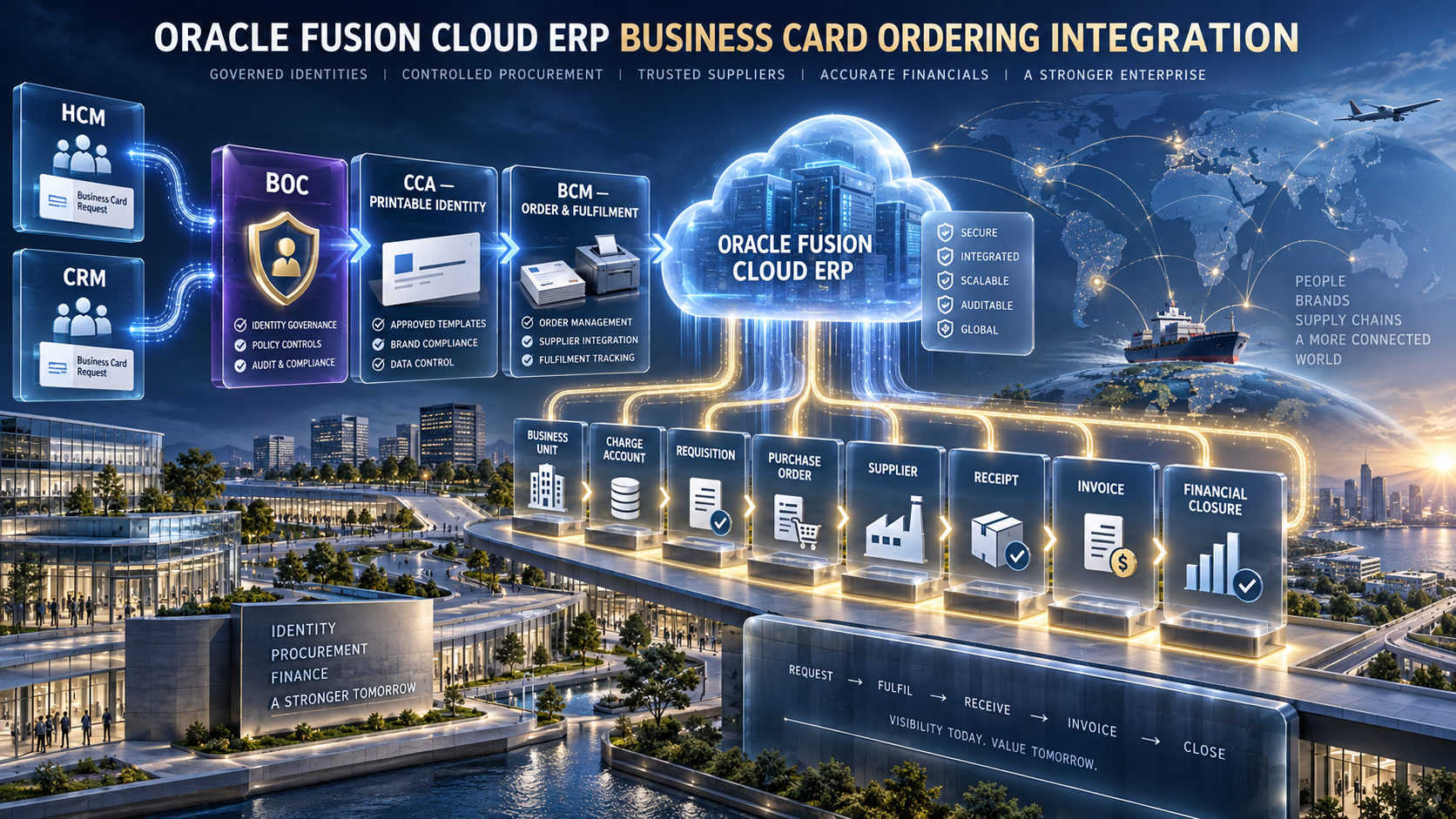
Connecting HCM CRM APIs CCA BCM business units ledgers procurement suppliers tax receipts invoices and evidence through BOC.
Business card ordering becomes an accountable enterprise transaction when workforce need, printable identity, product configuration, business unit, charge account, funds, requisition, purchase order, receipt and invoice remain connected. BOC governs those transitions while Oracle Fusion Cloud ERP remains authoritative for procurement and finance, CCA controls printable identity, and BCM controls production and fulfilment.
Business Cards Cross More Than an Ordering Screen
A business card is a physical expression of employee identity, but the order can touch HCM, CRM, branding, approvals, procurement, suppliers, receiving, payables, tax and reporting. The risk is not the price of one box. The risk is an enterprise process that produces the wrong identity, spends against the wrong business unit, bypasses procurement policy, duplicates demand or loses the evidence needed to explain an invoice.
Oracle Fusion Cloud ERP can govern commercial and financial records across procurement and payables. It should not determine whether an employee is active, which title is permitted for print, which card template is valid or whether an event requires an unusual quantity. Those facts and decisions originate in other controlled domains.
Business Ops Center coordinates the complete transaction. It correlates the workforce or sales event, validates present context, obtains scoped approval, coordinates CCA and BCM, invokes approved Oracle NetSuite Integration interfaces, routes exceptions, and verifies supplier, receipt and invoice outcomes before closure.
System Authority Must Be Designed Before Integration
HCM owns workforce status, manager, organization, position, location, legal employer and effective dates. CRM can own customer-facing role, territory, campaign, account or event context. CCA owns approved printable identity, including name, display title, company, office, contact details, language, legal text, logo and template. BCM owns the configured card product, quantity, proof, supplier routing, production, shipment, cancellation, correction and reorder state.
Oracle Fusion Cloud ERP owns configured business units, ledgers, chart-of-accounts segments, suppliers, procurement policies, requisitions, purchase orders, receipts, invoices, tax treatment and accounting records. BOC preserves those boundaries. It does not create an alternative master for employee identity or finance.
The result is controlled dependency rather than uncontrolled duplication. A valid HCM record does not automatically become printable. A CCA approval does not establish funds. A requisition does not prove delivery. A validated invoice does not prove that the intended employee received correct cards. Each decision retains its own authority and evidence.
Oracle REST APIs Support a Configurable Boundary
Oracle documents REST resources for Procurement and Financials, including purchase requisitions and payables invoices. Procurement REST APIs support real-time inbound and outbound integration, JSON payloads, collection and item operations, batch behavior for supported objects and custom actions. Exact resources, fields, roles, privileges, extensions and release behavior must be confirmed against the customer environment.
This article therefore describes a configurable integration model, not a released universal native connector. BOC can use supported Oracle endpoints directly or through an enterprise integration platform. It sends the minimum required attributes, binds Oracle identifiers to the BOC case and preserves request and response evidence suitable for operations and support.
Oracle advises pagination and field filtering, documented APIs, timeout handling, exponential backoff and appropriate framework-version selection. Those technical practices are necessary, but BOC adds business-level correlation, version control, authority checks, exception ownership and end-to-end operational reconciliation.
The Governed Oracle Fusion Cloud ERP Ordering Lifecycle
| Lifecycle stage | Authoritative context | BOC control | Required outcome |
|---|---|---|---|
| Business need | HCM CRM event campaign or approved request | Authenticate correlate classify and validate | Trusted BOC case |
| Identity | Current workforce facts and CCA policy | Resolve printable fields template and version | Approved CCA identity |
| Product order | BCM product proof quantity supplier and destination | Check eligibility duplication timing and authority | Controlled BCM order |
| ERP context | Business unit ledger account funds category and supplier | Validate current commercial and financial state | Executable demand |
| Procurement | Requisition approval and purchase order | Invoke supported API and retain references | Controlled purchase document |
| Fulfilment | Supplier production shipment and receipt | Monitor compare and route exceptions | Verified delivery |
| Financial closure | Invoice tax distributions accounting and evidence | Reconcile physical and financial outcomes | Authorized closure |
HCM and CRM Explain Why the Order Exists
Joiners, movers, promotions, office transfers, customer-facing assignments, events, campaigns, depleted inventory and replacements can create legitimate demand. BOC retrieves only the relevant HCM and CRM facts, establishes the effective date and determines whether the request is valid, premature, duplicated, cancelled or already fulfilled.
Legal employer, business unit and funding organization must not be inferred casually from a person’s email domain or delivery address. CRM may confirm an urgent customer-facing need, while HCM confirms current employment and organization. BOC joins the context without allowing either source to overwrite the other.
If the employee, territory, location, event or start date changes while the case is open, BOC recalculates eligibility and dependencies. Stale proofs, approvals and procurement actions are paused before cost is committed.
CCA Governs the Identity That Can Be Printed
The HCM title may differ from an approved display title. Brand, language, abbreviation, professional credential, office, phone format, email convention, legal text, logo and template can depend on business rules outside the employee master. CCA applies those rules and returns a versioned printable-identity decision.
BOC links the CCA version to the person, business purpose, effective date and order. Missing or contradictory data becomes an owned exception. Reviewers can correct the printable decision without changing authoritative workforce data merely to satisfy a proof.
If identity changes after procurement begins, BOC evaluates whether proof, approval, purchase demand or production must be cancelled and recreated. A supplier file or email attachment cannot silently become the approved identity source.
BCM Governs Product Production and Delivery
Business Card Manager translates approved identity into a controlled product specification. It applies card program, stock, finish, quantity, proof, supplier route, production rules, shipment method, delivery destination and reorder policy. BOC connects the BCM order version to the Oracle transaction without moving product authority into ERP.
Quantity can reflect role, geography, event demand, previous orders, consumption, batch economics and sustainability policy. Proof approval remains linked to the current CCA identity and BCM product version. Release occurs only after identity, funds, procurement approvals and supplier conditions are satisfied.
Supplier rejection, price change, proof correction, production failure, partial shipment, address problem, damage, cancellation or delayed delivery creates a governed exception. BOC assigns ownership, preserves the required response time and keeps operational recovery connected to financial impact.
Business Units Ledgers and Charge Accounts Define Ownership
Oracle Fusion Cloud ERP can represent procurement and accounting responsibilities through business units, ledgers, legal structures, chart-of-accounts segments and project or cost distributions. A business identity governance card order may need company, cost center, department, account, product, region, project or another configured segment before it can become executable demand.
Defaults are useful but should be revalidated. The employee’s home organization may not fund a trade event. A project can close while an order is awaiting approval. A cross-border delivery may require a different buying organization or supplier site. BOC retrieves current values, applies policy and sends ambiguity to the right finance or procurement owner.
The BOC case identifier, CCA identity version and BCM order reference remain connected to the Oracle requisition, purchase order and accounting distribution. This supports audit and correction without filling ledger descriptions with unnecessary personal data.
Requisition Controls Convert Need into Authorized Demand
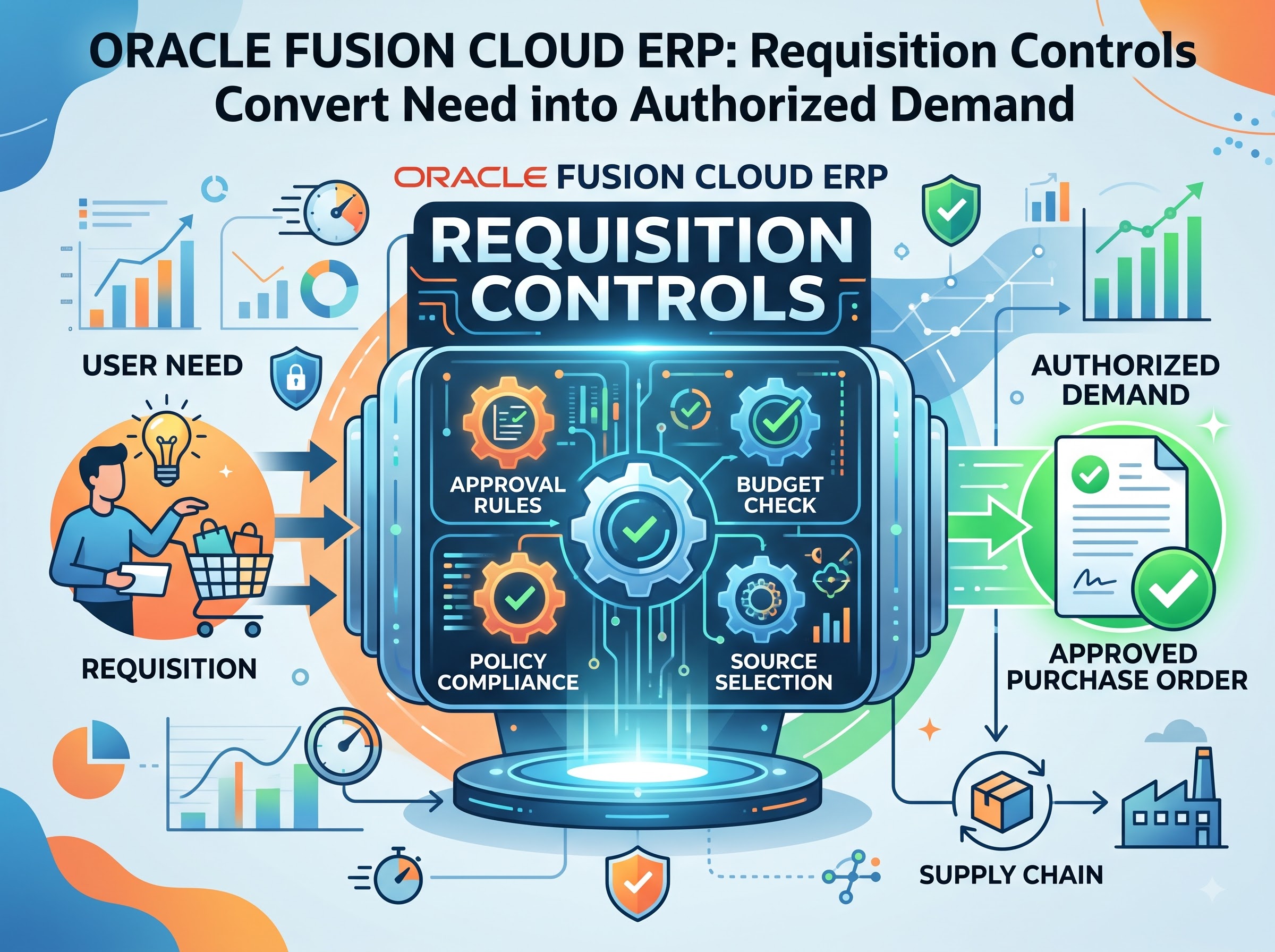
Oracle describes a purchase requisition as internal demand for an item or service, typically from an external supplier. The REST resource includes operations for creating and updating requisitions, checking funds, deriving charge accounts, calculating tax and accounting, retrieving approvers, submitting for approval, cancelling and other supported actions.
BOC supplies the validated requester, business unit, deliver-to context, item or category, quantity, price context, supplier information, charge account inputs, project context and supporting reference required by the selected design. Oracle performs authoritative derivation, funds checks and approval according to configured roles and policy.
Approvals remain scoped to the version reviewed. A change to person, identity, quantity, supplier, price, account, project, tax, address or date can invalidate part of the decision. BOC records the approver, authority, time, policy and scope, then prevents a superseded approval from releasing a changed order.
Purchase Orders Receipts and Invoices Form One Evidence Chain
The commercial path may use an approved requisition, purchase order, agreement, catalog or consolidated purchasing arrangement. BOC follows the enterprise model and retains the Oracle header and line references associated with the BCM order. It does not create a shadow buying process.
BCM and the selected vendor interfaces monitor supplier acknowledgement and production states. Receipt must represent the quantity and condition actually accepted. A carrier delivery scan can contribute evidence but may not equal an authorized receipt when cards are missing, damaged, misprinted or delivered to the wrong office.
Oracle Financials invoice resources can manage supplier-invoice headers, lines, distributions, installments, descriptive flexfields and attachments. BOC reconciles the invoice with ordered, produced, delivered and received quantities, plus price, freight, tax, credits and tolerances. Closure requires both the physical and financial outcomes to agree, or someone/the reviewer must formally resolve them.
Tax Cross Border and Shared Service Scenarios Need Design
Global ordering can involve an employee in one legal employer, a requesting business unit in another operating context, a regional printer, cross-border shipment, local tax rules and centralized payables. The delivery destination alone is not enough to determine the correct tax, supplier site, buying business unit, ledger or accounting treatment.
BOC provides validated operational context and relies on configured Oracle rules and authorized finance decisions. Where Oracle exposes supported actions for tax, accounting or transfer-price derivation, the integration invokes them within the approved transaction flow rather than recreating calculations externally.
Ambiguous cross-border or intercompany cases become owned exceptions before production. The final evidence explains which entity ordered, which organization funded, where delivery occurred, how [someone/the system] recorded receipt and how the system accounted for the invoice.
API Reliability Requires Current State and Controlled Retry
A timeout can happen before a request arrives, while Oracle is processing it or after a transaction commits but before the response returns. Blind retry can create duplicate demand. BOC uses stable business keys, records attempts and checks current state before deciding whether another call is safe.
Authentication failure, missing privilege, validation error, stale ETag, framework-version mismatch, maintenance response, unavailable funds, rejected approval and invalid accounting require different recovery. BOC separates transient conditions from business decisions, applies controlled backoff and gives unresolved cases a named owner.
Pagination, filtered responses, supported batch operations and appropriate bulk mechanisms should be selected for the workload. Periodic reconciliation compares BOC, Oracle, CCA, BCM, vendor, receipt and invoice records to find missed, duplicated, stale or inconsistent cases.
Reporting Connects Identity Demand Spend and Outcome
Operational measures can include request volume, approval time, identity accuracy, funds-check results, requisition success, supplier acknowledgement, proof corrections, production cycle, on-time delivery, receipt accuracy, invoice variance, exception aging, duplicate prevention and evidence completeness.
Procurement and finance reporting can analyze spend by business unit, supplier, category, account, project and other approved segments. BOC adds process context explaining why the order was created and whether the intended employee received the correct product. Access to personal attributes should remain limited.
This combined evidence supports procurement improvement, budget planning, supplier performance, policy refinement and audit without turning the reporting layer into an uncontrolled copy of employee and financial masters.
A Practical Implementation Roadmap
Start with one business unit, supplier arrangement and card program. Map HCM and CRM triggers, CCA identity fields, BCM products, Oracle business units, ledgers, accounts, categories, suppliers and sites, requisition and purchase-order path, approvals, funds, tax, receipt, invoice, retention and closure evidence.
Confirm supported Oracle REST resources, roles, privileges, payloads, framework version, extensions and bulk alternatives. Configure authentication, least privilege, correlation, data minimization, idempotency, pagination, ETags where suitable, backoff, queues, observability, exception ownership, reconciliation and support.
Test employee changes, duplicate requests, invalid accounts, unavailable funds, approval changes, supplier-site errors, API uncertainty, maintenance, partial receipt, tax or price variance, consolidated invoice, credit, cancellation and reprint. Expand only after the team control the first implementation and it becomes measurable.
Buyer Intent Bridge What a BOC Engagement Produces
Organizations assessing Oracle Fusion Cloud ERP integration rarely need another isolated order form. They need an operating model across identity, procurement, production and finance. A BOC discovery engagement can produce the source-of-truth matrix, lifecycle, data contract, API architecture, business-unit and account rules, document strategy, approval matrix, exception taxonomy, evidence model, implementation backlog and success measures.
The model protects existing investments. Oracle remains authoritative for configured procurement and financial records. HCM and CRM retain their domain facts. CCA governs printable identity. BCM governs the card product and fulfilment. BOC governs the cross-system transition from need to verified closure.
Begin with one current card-order path that depends on email, re-entry, copied identity, spreadsheet account selection or manual invoice research. Converting it into a governed integration establishes a reusable pattern for other identity-linked purchases.
Questions Integration Buyers Should Ask
- Which Oracle Fusion Cloud release resources roles privileges and extensions support the selected process?
- Which platform owns workforce data printable identity product business unit account supplier receipt and invoice state?
- How are business unit category supplier site charge account funds tax and approvers derived and revalidated?
- How are stale ETags duplicate requests timeouts maintenance partial receipts credits and reprints controlled?
- Which details belong in Oracle flexfields attachments or external evidence and which should not be copied?
- Who owns credentials API versions monitoring exceptions reconciliation retention support and evidence?
Frequently Asked Questions
Does BOC replace Oracle Fusion Cloud ERP? No. Oracle remains authoritative for configured procurement and finance records. BOC coordinates context decisions APIs exceptions and evidence across the wider process.
Is this a released native connector? No universal native connector is claimed. The article describes a configurable integration model using documented customer-approved Oracle interfaces.
Can an HCM record go directly to a printer? It should first pass printable-identity policy. CCA governs the approved identity and BCM governs the production-ready order.
When is the transaction closed? After the team reconciles or formally resolves identity, production, delivery, receipt, invoice, accounting and exception obligations.
Connect one business card order to Oracle procurement and financial control. Business Ops Center can help define and implement a governed workflow across Oracle Fusion Cloud ERP, HCM, CRM, CCA, BCM, suppliers and delivery systems. Start with one business unit and one ordering path that currently requires manual validation or reconciliation.