


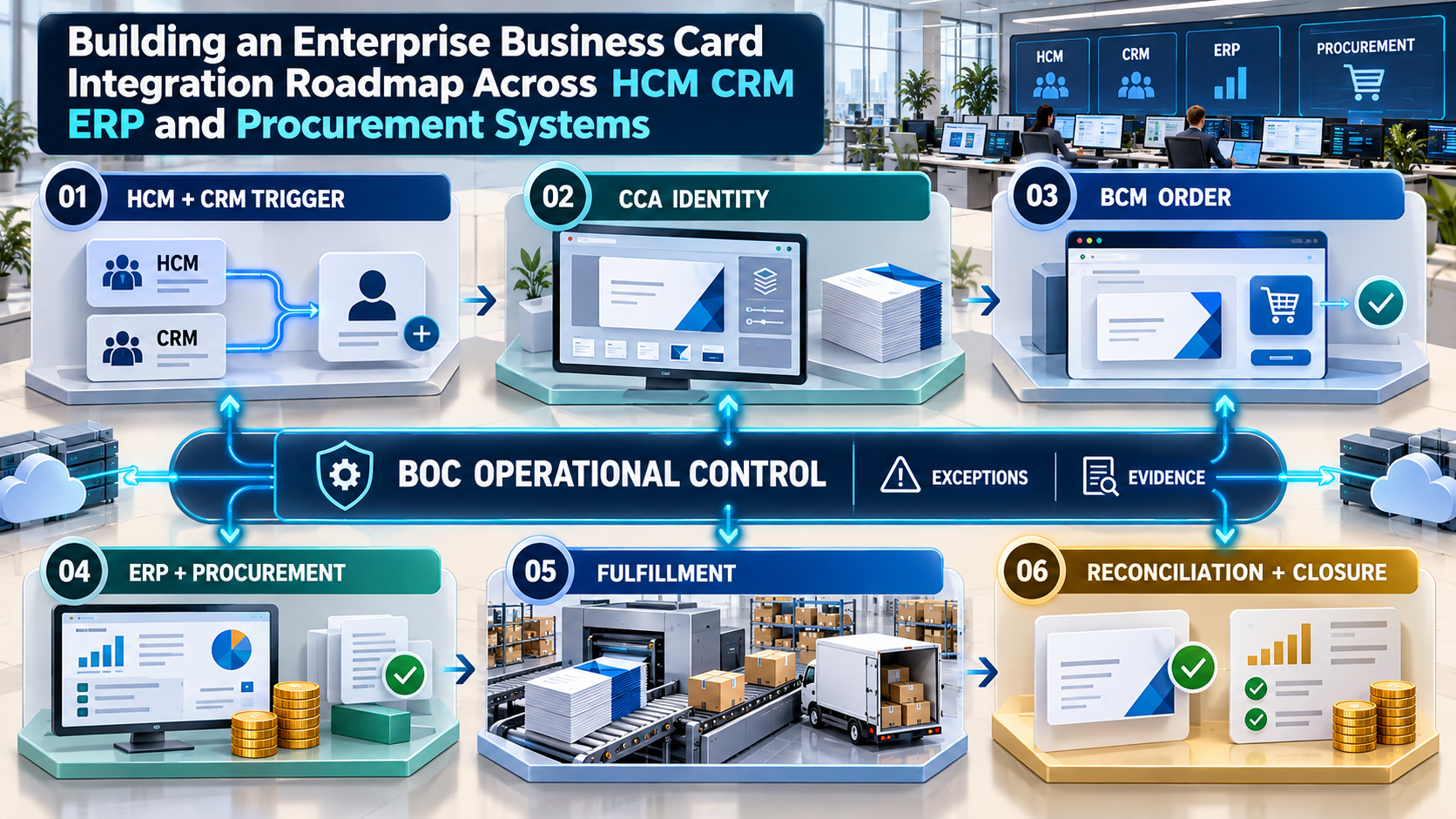
A governed roadmap for connecting workforce and customer events to printable identity, contracted-vendor ordering, purchasing, delivery, financial evidence, and accountable closure.
Business Card Manager (BCM) is the contracted business-card vendor and ordering system. An enterprise integration roadmap should connect BCM to approved identity, business need, procurement authority, and financial evidence without confusing system responsibilities. BOC governs the cross-system process, exceptions, reconciliation, and closure; CCA governs printable identity; HCM, CRM, ERP and procurement platforms remain authoritative for their configured domain records.
A Roadmap Prevents Integration from Becoming Interface Sprawl
Business card ordering crosses more systems than its apparent simplicity suggests. A joiner, transfer, promotion, customer assignment, event or reorder can require workforce confirmation, customer context, identity approval, product configuration, budget authorization, purchase commitment, production, shipment, receipt, invoice treatment and evidence retention. Connecting applications one pair at a time can automate messages while leaving the business outcome fragmented.
The central risk is not the price of one box of cards. It is the absence of an accountable process when identity changes, demand is duplicated, a cost center is wrong, an approval expires, a shipment is partial or an invoice cannot be matched. The roadmap must define how the enterprise reaches a controlled decision and proves the final physical and financial outcome.
Business Ops Center provides that operating layer. It gives every request a stable case, coordinates decisions across authoritative systems, prevents superseded approvals from authorizing changed orders, routes exceptions to named owners and reconciles the entire lifecycle before closure.
Define System Authority Before Selecting Integration Technology
HCM should remain authoritative for workforce status, manager, organization, job, location and effective dates. CRM may own account, territory, event, campaign or customer-facing responsibility. CCA converts permitted facts into a governed printable-identity decision covering display name, title, organization, contact details, language, legal text, logo and template.
Business Card Manager (BCM) is the contracted business-card vendor and ordering system. It owns the configured card products, proof, quantity, production, shipment, correction, cancellation and reorder states. BCM is not a tool for choosing or routing work to another business-card vendor.
ERP and procurement integration systems remain authoritative for configured companies, business units, branches, cost centers, projects, suppliers, purchasing categories, purchase orders, receipts, accounts payable and ledger outcomes. BOC does not replace those systems. It records which authority supplied each material fact or decision and governs the transitions between them.
Use APIs as Controlled Service Boundaries
The roadmap should treat each interface as a governed service boundary, not as unrestricted access to an application. For every operation, define the supported endpoint or event, version, authentication method, role, permitted fields, validation rules, response semantics, rate limits, timeout behavior and support owner. The exact mechanism may be a documented API, webhook, event stream, integration platform, managed file exchange or approved custom service.
This article describes a configurable integration model, not a released universal native connector. Each implementation must validate the deployed HCM, CRM, ERP, procurement, HR, and operations through CCA and BCM capabilities, licensing and security model. Business rules should be invoked through supported interfaces rather than bypassed through direct database changes.
BOC adds controls that transport technology alone cannot supply: stable correlation, versioned decisions, least-privilege execution, idempotency, exception ownership, evidence and end-to-end reconciliation. A successful response confirms a technical action; it does not by itself prove that the business transaction is complete.
The Enterprise Business Card Integration Roadmap
| Roadmap stage | Authoritative context | BOC control | Required outcome |
|---|---|---|---|
| Trigger | HCM or CRM event and purpose | Authenticate, correlate and validate timing | Trusted demand |
| Identity | CCA policy and permitted source facts | Resolve printable fields and version | Approved identity |
| Order | BCM product, proof, quantity and destination | Check duplication, policy and authority | Controlled BCM order |
| Commercial | ERP or procurement company, cost and supplier data | Validate current purchasing context | Authorized commitment |
| Fulfillment | BCM production, shipment and delivery | Monitor status and route exceptions | Verified physical outcome |
| Financial | Receipt, invoice, credit and posting | Reconcile quantity, value and references | Supported financial outcome |
| Closure | Evidence, residual exceptions and retention | Confirm obligations and authorize closure | Auditable closed case |
Start with Business Outcomes and Trigger Events
The roadmap begins by naming the events that create legitimate demand. Typical triggers include hiring, transfer, promotion, office move, new territory, customer assignment, trade event, replacement, stock depletion, and policy-based reorder. Each trigger needs an effective date, a requesting authority, a business purpose, and rules for cancellation or change.
HCM and CRM explain why the order exists, but neither should independently decide every downstream field. BOC collects only the facts required for the process and evaluates timing, eligibility, and duplication. A future-dated role change may justify preparation but not immediate production; a cancelled hire must stop an order that has not crossed the permitted release point.
Document the trigger contract before implementation: event name, source, stable person or account reference, timestamps, relevant changed fields, replay behavior, and ownership. This prevents a generic employee update from creating duplicate demand and makes testing possible across vendors and environments.
Make CCA the Printable Identity Decision Point
Operational source data and customer-facing identity are related but not identical. Payroll titles may differ from approved display titles; office names, credentials, phone formats, languages, legal text, and brand templates can depend on policy. CCA applies those rules and produces a versioned identity decision that can be approved, rejected or returned for correction.
BOC links the CCA decision to the triggering event, employee, purpose, effective date and BCM order. Missing or contradictory facts become owned exceptions rather than silent defaults. Reviewers correct the printable decision without rewriting authoritative HCM or CRM records simply to satisfy a card proof.
Every material identity change should trigger impact analysis. If the title, company, location, contact details, language or template changes after approval, BOC determines whether the proof, budget, purchase commitment or production release must be cancelled and recreated. The superseded version remains available for evidence.
Connect Business Card Manager as the Contracted Execution System
After identity approval, Business Card Manager converts the authorized identity into the contracted card product. BCM controls product configuration, artwork rendering, proof, quantity, production, shipment, delivery status, correction and reprint. The roadmap must preserve BCM order and line identifiers so operational events can be correlated with procurement and finance.
Before release, BOC verifies that identity, quantity, destination, timing, requester authority, cost context and enterprise approval workflows remain current. If policy allows straight-through processing, the same checks still apply automatically. High quantities, rush service, cross-border delivery or exceptional artwork can require additional authorization.
Proof rejection, price variance, production delay, partial shipment, address failure, damage, cancellation and reprint are business exceptions. BOC assigns the correct owner, response target and next action while keeping the operational recovery tied to its financial effect.
Map ERP and Procurement Context Explicitly
Enterprises often operate multiple companies, business units, branches, departments, cost centers, projects and currencies. The employee work location is not always the financial owner. Sales cards may be funded by a campaign, a project may sponsor temporary staff, or cards may ship to a destination that differs from the paying entity.
The roadmap should define how BOC derives and validates the purchasing company, supplier record for BCM, category or item, account, cost center, project, tax treatment, currency, payment terms, budget owner and receipt method. ERP and procurement systems apply their configured rules and remain authoritative for the resulting commercial records.
Carry the BOC case identifier, CCA version and BCM order reference into permitted purchase-document fields or evidence links. That lineage lets operations and finance trace cost to approved purpose without placing unnecessary personal information in accounting descriptions.
Turn Approved Demand into an Authorized Commitment
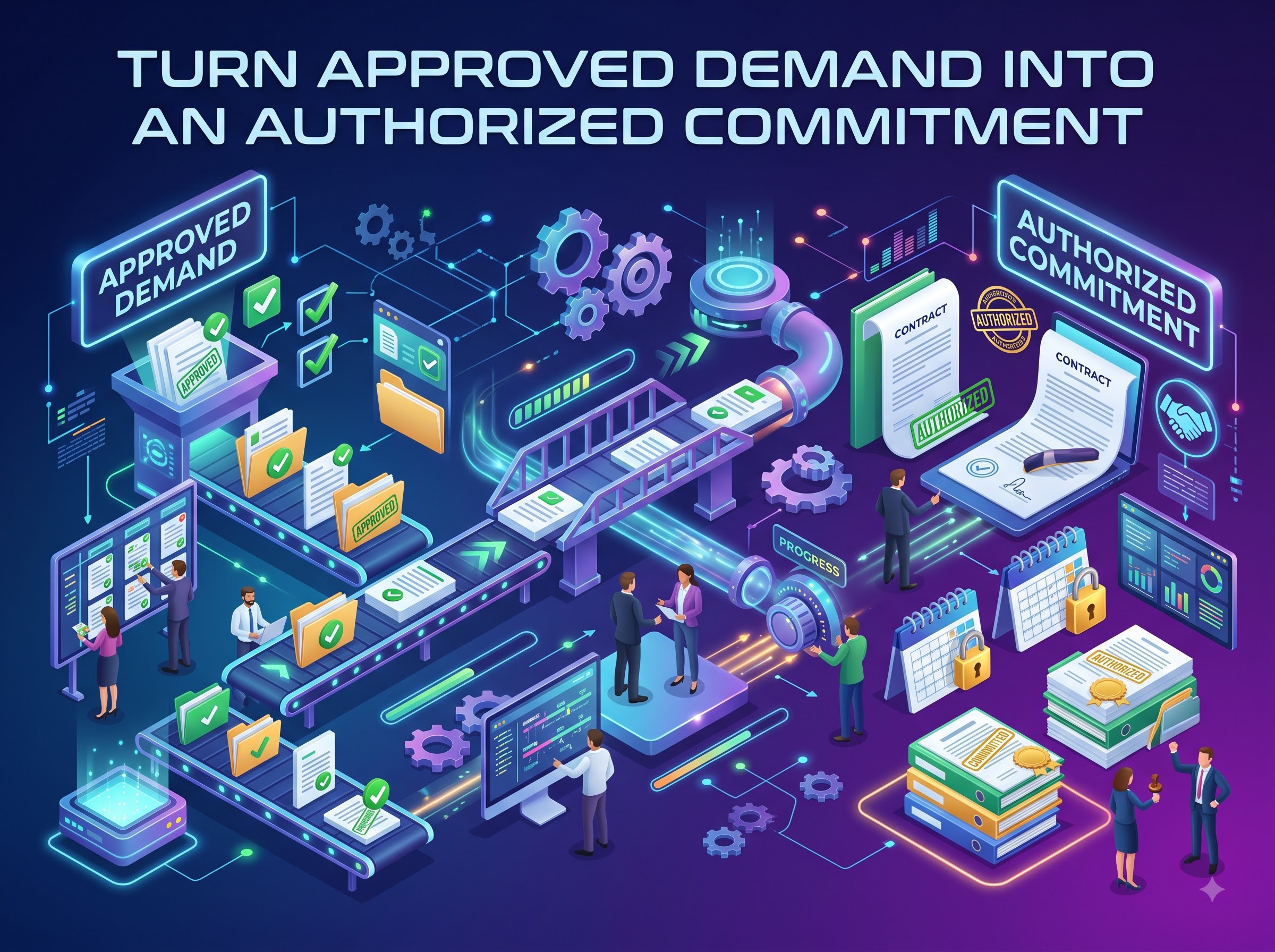
The purchasing path may use a requisition, purchase order, blanket arrangement, catalog release, purchasing card or another configured method. The roadmap should not impose one model on every organization. It should show where approval occurs, what version was approved and which changes invalidate the decision.
Only validated information should cross the ERP or procurement boundary: case reference, company, cost context, contracted BCM supplier, product or category, quantity, price basis, destination, requester and evidence references. The target platform applies its own authorization, budget, period, supplier and tax rules.
Approval must be scoped to the reviewed state. Changes to identity, quantity, price, company, cost center, project, destination or delivery speed can create a materially different commitment. BOC blocks superseded approval from authorizing that changed order and requests only the review required by policy.
Reconcile Delivery Receipt and Financial Evidence
Production, shipment, carrier delivery, employee acceptance, receipt and financial liability are different states. A carrier scan does not prove that cards were correct or that the full quantity was accepted. BCM supplies production and shipment evidence; the authorized recipient or receiving process confirms quantity and condition.
BOC connects accepted delivery to the configured receipt or service-confirmation process. Misprints, shortages, damage, wrong destinations and late delivery remain open exceptions. Credits and reprints stay linked to the original case, approval and purchase commitment instead of becoming unexplained standalone transactions.
Financial reconciliation compares the authorized commitment, BCM fulfillment, accepted receipt, invoice, freight, tax, tolerances, credits and reprints. ERP or accounts payable remains authoritative for the posting outcome. BOC closes the case only after physical, operational and financial obligations agree or an authorized exception disposition is recorded.
Design Security and Data Minimization into the Roadmap
Business card workflows contain employee identity and contact data, but every connected system does not need every field. Define a minimum data contract by operation, classify sensitive attributes, restrict service accounts, encrypt transport and storage, and separate production duties from approval and administration.
Access should be evaluated for the current identity, device, workload and transaction context rather than assumed from network location. Use short-lived credentials where supported, rotate secrets, restrict scopes, log administrative changes and test authorization at both object and function levels. API inventory and retirement are part of the roadmap, not deferred maintenance.
Retention rules should distinguish business evidence from unnecessary personal data. The case may need approval, version, quantity, cost, delivery and exception history while limiting repeated copies of phone numbers or addresses. Reporting should aggregate operational and financial measures and preserve access controls.
Engineer Reliability Around Business State
A timeout cannot reveal whether a request failed before processing, committed successfully or completed after the response window. Blind retries can create duplicate orders, purchase commitments or receipts. BOC records each attempt under a stable case key, uses idempotency where supported and checks current state before deciding whether another call is safe.
Authentication failure, missing permission, invalid reference data, closed period, supplier mismatch, rejected approval and transient outage require different recovery. Temporary conditions may use controlled backoff. Business errors require named owners, deadlines, evidence and an explicit next action; they should not disappear into a generic technical queue.
Scheduled reconciliation compares BOC cases, CCA decisions, BCM orders and downstream procurement and finance records. It detects orphaned documents, duplicates, stale approvals, partial delivery, unmatched receipts, unresolved credits and cases that appear technically complete while remaining operationally open.
Implement in Phases That Produce Reusable Control
Phase one should choose one workforce or customer trigger, one CCA policy, one contracted BCM program, one card product, one purchasing organization and one delivery path. Map the current process, authorities, data contract, interfaces, approval conditions, exception taxonomy, evidence and success measures before building integrations.
Phase two adds controlled automation and observability. Confirm environments, API or event versions, authentication, roles, payloads, correlation, idempotency, retries, monitoring, reconciliation, retention and support. Test both normal flow and change scenarios before production release.
Phase three expands by reusable pattern rather than by copying interfaces. Add business units, geographies, languages, templates, project rules and procurement methods only after the first path has measurable controls. Track cycle time, manual touches, proof changes, exception aging, duplicate prevention, delivery reliability, invoice variance and evidence completeness.
Buyer Intent Bridge: What a BOC Roadmap Engagement Produces
Organizations planning enterprise integration rarely need another isolated order form. They need an operating model that connects business demand, governed identity, contracted production, commercial authorization and evidence. A BOC roadmap engagement can produce the source-of-truth matrix, lifecycle, interface inventory, canonical data contract, approval model, exception taxonomy, evidence model, phased backlog and success measures.
The approach protects existing technology investments. HCM and CRM retain their domain facts; CCA governs printable identity; Business Card Manager remains the contracted business-card vendor governance and ordering system; ERP and procurement platforms retain commercial and financial authority. BOC governs the transitions, exceptions, reconciliation and closure across them.
Begin with one process that currently depends on copied employee data, email approval, manual cost coding, separate vendor status checks or invoice research. Converting that path into a governed integration creates a repeatable control pattern for other identity-linked purchases and operational workflows.
Questions Integration Buyers Should Ask
- Which systems are authoritative for workforce status, customer context, printable identity, card product, procurement, receipt and financial posting?
- Which documented APIs, webhooks, events, managed files or integration services support the selected process and deployed versions?
- How are person, case, identity version, BCM order, purchase document, shipment, receipt and invoice references correlated?
- Which changes invalidate approval, and how are cancellation, partial fulfillment, credit and reprint controlled?
- Who owns credentials, API inventory, monitoring, exceptions, reconciliation, retention and production support?
- What evidence is required before the case can be financially and operationally closed?
Frequently Asked Questions
Does BOC replace HCM, CRM, ERP or procurement platforms? No. Those systems remain authoritative for their configured domain records. BOC coordinates the cross-system workflow, decisions, exceptions, evidence and closure.
Is this a universal native connector? No. The roadmap describes a configurable integration model using documented, customer-approved interfaces appropriate to each deployed platform and environment.
What is Business Card Manager? Business Card Manager (BCM) is the contracted business-card vendor and ordering system. It manages configured products, proof, production, fulfillment, correction and reorder state.
When is the process complete? After identity, ordering, procurement, production, delivery, receipt, financial outcome, and all exceptions are reconciled or formally resolved under policy.
Build one governed business card integration path that can scale. Business Ops Center can help define the roadmap and implement a controlled workflow across HCM, CRM, APIs, CCA, Business Card Manager, ERP, procurement, delivery and finance. Start with one high-friction path and convert it into a reusable enterprise integration pattern.