

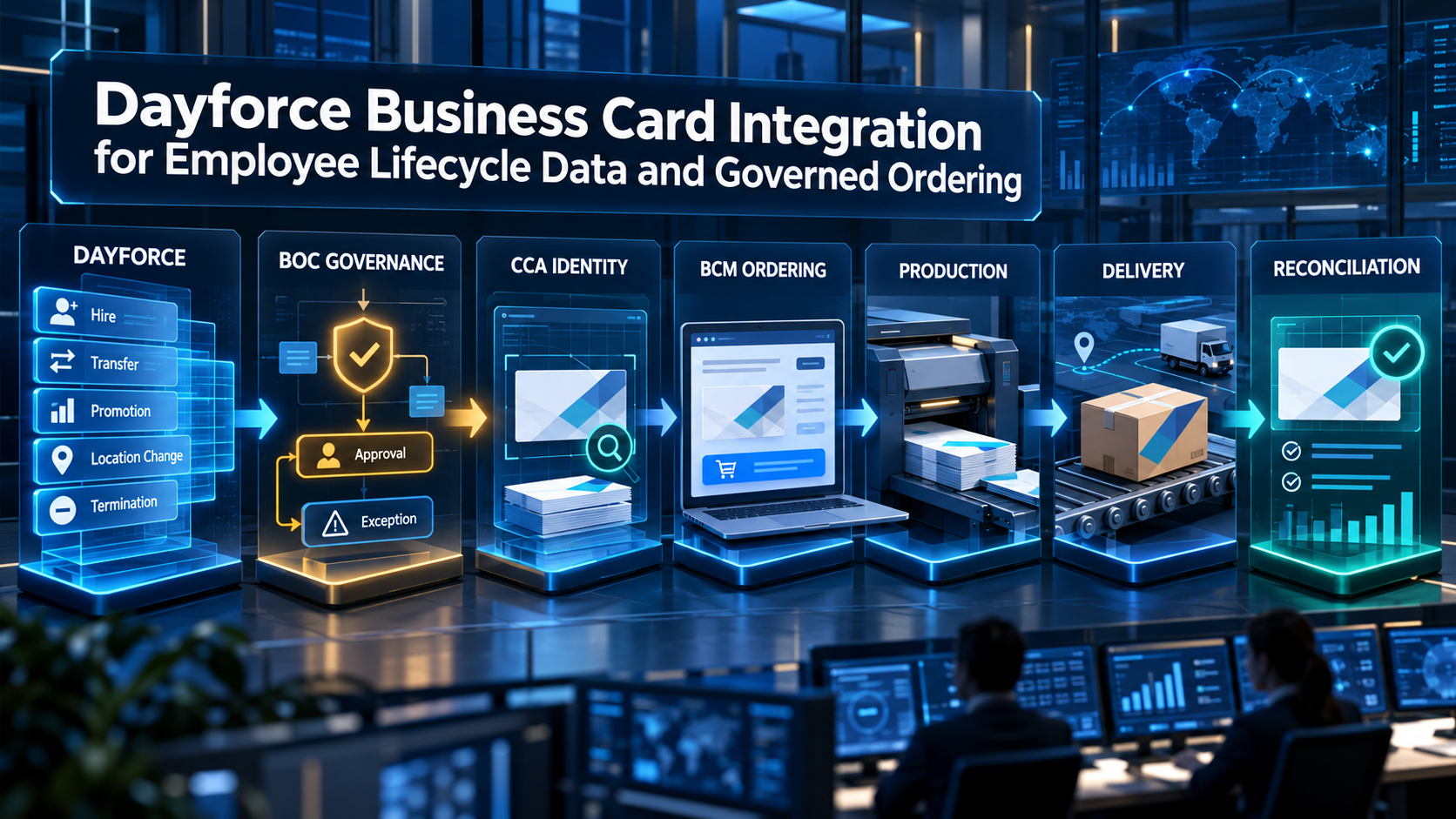
Connecting Dayforce employee events to CCA identity governance, Business Card Manager ordering, procurement, fulfillment, evidence, and accountable closure through BOC.
Business Card Manager (BCM) is the contracted business-card vendor and ordering system. A governed Dayforce integration can use approved employee lifecycle data to initiate and maintain business-card demand, but Dayforce should not become the authority for public identity or card production. CCA governs the identity approved for print, BCM manages business card ordering and fulfillment, and BOC controls the cross-system workflow, exceptions, reconciliation and closure.
Employee Lifecycle Events Should Drive a Controlled Ordering Process
New hires, transfers, promotions, location changes, leave, termination and rehire can all affect whether an employee needs business cards and what those cards may display. When these events remain disconnected from ordering, employees copy data into forms, managers approve stale details, and operations discover changes only after a proof has been produced or an order has shipped.
The answer is not to let every employee update create an order. A lifecycle event is context, not automatic authorization. The enterprise must decide which event combinations create legitimate demand, when production may begin, what evidence is required and which changes cancel or supersede earlier decisions.
Business Ops Center provides the operating layer around that decision. It correlates the Dayforce event with an approved request, coordinates CCA and BCM, invokes permitted downstream interfaces, assigns exceptions and verifies that the physical and financial outcome matches the current employee state before closing the case.
Separate Workforce Identity Ordering and Financial Authority
Dayforce can remain authoritative for configured workforce facts such as employee status, manager, organization, job, work assignment, location and effective dates. These facts explain eligibility and timing. They do not automatically determine the customer-facing title, brand treatment, card quantity, product, destination, cost allocation, or production release.
CCA governs printable identity. It applies enterprise rules to permitted Dayforce and business context to decide the display name, title, organization, address, phone format, email, language, credentials, legal text, logo, and template approved for public use. The CCA decision is versioned so a reviewer can see exactly what was authorized.
Business Card Manager (BCM) is the contracted business-card vendor and ordering system. BCM manages configured products, artwork rendering, proof, quantity, production, shipment, correction, cancellation, and reorder status. Procurement and finance systems remain authoritative for purchasing, receipt, invoice, and accounting records, while BOC governs how these decisions and states move together.
Dayforce Integration Supports More Than One Technical Pattern
Dayforce documents RESTful web services, an API developer portal, event-driven capabilities, and Integration Studio. Its current documentation describes access-token authentication, employee and organizational resources, event subscriptions, outbound integrations, and configurable transmission patterns. The available methods, fields, roles, and behavior depend on the deployed release, tenant configuration, and licensed capabilities.
This article describes a configurable integration model, not a claim that Dayforce, CCA, BCM, or BOC ships a universal native connector for every environment. A customer implementation may use approved Dayforce APIs, event-driven services, Integration Studio, managed file exchange, an integration platform, or another supported boundary after validating security, licensing, and data scope.
BOC adds controls that the transport layer alone does not provide: stable correlation, versioned decisions, least-privilege execution, replay protection, idempotency, exception ownership, evidence, and end-to-end operational reconciliation. A successful API response or file transmission confirms movement of data, not completion of the business outcome.
The Governed Dayforce Business Card Lifecycle
| Lifecycle stage | Authoritative context | BOC control | Required outcome |
|---|---|---|---|
| Event | Dayforce employee change and effective date | Authenticate, correlate and qualify demand | Trusted BOC case |
| Identity | CCA policy and permitted workforce facts | Resolve printable fields and version | Approved public identity |
| Order | BCM product, proof, quantity and destination | Check eligibility, duplication and authority | Controlled BCM order |
| Commercial | ERP or procurement company and cost data | Validate purchasing context and retain IDs | Authorized commitment |
| Fulfillment | BCM production, shipment and delivery | Monitor state and route exceptions | Verified physical outcome |
| Financial | Receipt, invoice, credit and posting | Reconcile quantities, value and references | Supported financial outcome |
| Closure | Evidence and residual obligations | Confirm current employee state and authorize closure | Auditable closed case |
Qualify Employee Events Before Creating Demand
A Dayforce employee event can indicate that a core record changed, but the integration should evaluate which fields changed, the effective date and the business meaning. A new hire may require cards only for selected roles. A transfer may affect the display title, brand, destination and cost center. A location correction may not require a reprint at all.
BOC creates or updates one case under a stable employee and event reference. It distinguishes a new requirement from a correction, duplicate, cancellation or future-dated change. If several Dayforce updates arrive close together, the workflow can consolidate them and wait for the approved effective state instead of releasing multiple orders.
The trigger contract should define event type, source, employee cross-reference, changed fields, timestamps, effective dates, replay behavior, and ownership. For batch or scheduled integrations, the same discipline applies through extraction windows, watermarks, reconciliation counts, and restart rules.
Minimize Dayforce Data to the Facts the Workflow Needs
Business card ordering does not require unrestricted access to an employee record. The implementation should identify the minimum permitted facts for eligibility and identity evaluation, then apply Dayforce roles, field-level filtering, and integration-specific service accounts. Pay, benefits, personal identifiers, and unrelated workforce data should remain outside the flow.
BOC records the source and retrieval time of each material fact without copying unnecessary data into every connected system. When a value is missing or contradictory, the case becomes an owned exception. Reviewers should correct the appropriate source or approve a governed CCA decision rather than creating an undocumented local truth.
Effective dating is essential. The workflow standardization must distinguish current, future, and historical assignments so that a card does not show an old location or a promotion that is not yet public. BOC revalidates dependent decisions before proof approval and production release.
CCA Converts Workforce Context into Approved Public Identity
The job title used for HR administration may not be the title permitted on a customer-facing card. Abbreviations, professional credentials, translated titles, legal entity names, office addresses, phone formats, email conventions, and templates can follow brand and legal rules outside Dayforce. CCA applies those policies and returns a versioned printable-identity decision.
BOC links the CCA version to the Dayforce employee context, request purpose, effective date, and BCM order. If a manager, title, company, location, or contact field changes after approval, BOC evaluates whether the proof, order and purchasing authorization remain valid. Superseded identity stays visible for evidence but cannot silently authorize new production.
Identity exceptions require clear ownership. HR may correct workforce status or assignment; brand administrators may resolve display rules; local operations may confirm a public office detail. BOC keeps each correction tied to the original case and resumes only when the authoritative or approved state is complete.
Business Card Manager Executes the Contracted Order
After identity approval, BCM turns the governed identity into the contracted card product. It manages proof generation, product options, quantity, production, shipment, delivery status, cancellation, correction and reprint. The architecture should preserve BCM order and line identifiers throughout procurement, reporting, and reconciliation.
Before BCM receives a production release, BOC verifies employee eligibility, CCA version, quantity, destination, timing, request authority and cost context. Policy may allow straight-through processing for standard joiners and reorders, while unusual quantities, rush service, alternative delivery or exceptional artwork require additional approval.
Proof rejection, production delay, partial shipment, address failure, damaged cards, and reprints are governed operational exceptions. BOC routes each issue to the correct owner and keeps the recovery connected to the original identity lifecycle management, approval, purchase commitment and financial consequence.
Lifecycle Changes Must Reopen or Stop the Right Work
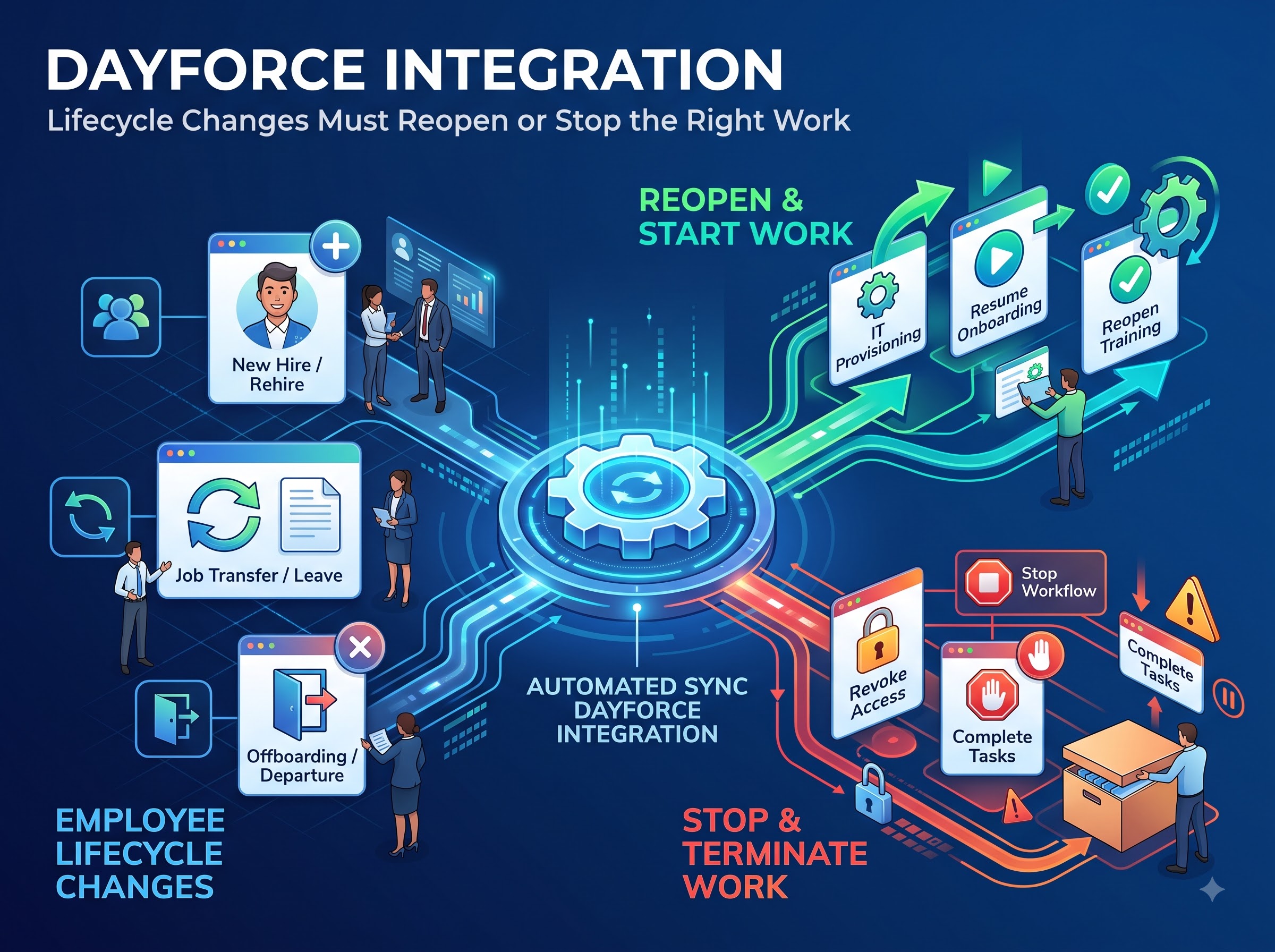
A hire cancellation before production should stop the order. A transfer after shipment may create a replacement requirement. A termination should prevent future reorders without pretending that a delivered transaction never occurred. Leave and rehire policies may vary by organization and card type.
BOC evaluates the current process state and the materiality of the Dayforce change. It can cancel an unreleased case, request new identity approval, hold production, create a governed replacement, or preserve the completed order while closing future authority. The decision and reason remain attached to the case.
This state-aware behavior is safer than deleting records or restarting a workflow without history. It prevents an old approval from authorizing changed identity and gives operations, HR, brand, procurement and finance one traceable explanation of what happened.
Connect Procurement and Finance Without Duplicating HR Data
The purchasing company, cost center, project, supplier record, account, tax treatment and receipt method may be derived from the employee assignment, but they remain governed by ERP and procurement rules. Work location alone may not identify the payer when a central program, sales campaign, or project funds the cards.
BOC sends only the validated commercial context required for the configured purchasing method and retains the purchase reference. The purchase document should carry the BOC case, CCA version, and BCM order reference through permitted fields or evidence links, without repeating unnecessary personal information in financial descriptions.
Reconciliation compares BCM fulfillment with the authorized commitment, accepted delivery, receipt, invoice, freight, tax, tolerances, credits, and reprints. Finance remains authoritative for posting. BOC closes the case only after the physical and financial outcomes agree or an authorized exception disposition is recorded.
Design Security Around Integration Roles and Sensitive Data
Dayforce integrations can expose personal information, so access must be deliberately constrained. Use dedicated identities, least-privilege roles, approved scopes, secure secret storage, encrypted transport, environment separation, and monitored administrative changes. Users who configure or troubleshoot integrations should receive only the access their responsibilities require.
Token handling, endpoint selection, redirects, rate limits, response validation, and error messages must be tested for the deployed environment. Sensitive values should not appear in logs, tickets, or retry payloads beyond operational need. Data retention should distinguish durable approval evidence from temporary integration data.
Security also applies downstream. CCA, BCM, BOC, middleware, ERP, and reporting services should enforce their own authorization rather than trusting a message solely because it came from Dayforce. Every material transition should be attributable to an authenticated actor, workload, or approved automated rule.
Engineer Event and API Reliability Around Business State
An employee update can be delivered more than once, arrive out of sequence, or be followed quickly by another change. A timeout can leave the caller uncertain whether a downstream order was accepted. BOC uses stable correlation, event identifiers, version checks, and idempotency where supported to avoid duplicate cases and orders.
Authentication failure, role restriction, invalid employee reference, missing field, closed purchasing period, rejected proof, and temporary service outage require different recovery. Technical retries should use controlled backoff; business exceptions should go to named owners with deadlines, evidence and a defined next action.
Scheduled reconciliation compares expected Dayforce-driven cases with CCA decisions, BCM orders and downstream commercial records. It detects missed events, duplicate demand, stale approvals, orphaned orders, incomplete delivery, unmatched receipts, and cases that are technically successful but operationally open.
Implement One Employee Journey Before Expanding
Begin with one legal entity or business unit, one common joiner or transfer scenario, one CCA policy, one contracted BCM program, one card product, and one delivery path. Map the current process, authoritative fields, effective-date rules, interfaces, approval conditions, exceptions, evidence and retention before development.
Confirm the Dayforce release, tenant endpoints, integration mechanism, resources or events, roles, authentication, rate limits, payloads, and monitoring. Define the BOC case key, CCA decision version, BCM order reference, purchasing link, retry behavior, reconciliation and support ownership before production release.
Test new hire, cancelled hire, future-dated transfer, promotion, location correction, duplicate update, missing title, changed manager, termination, rehire, proof rejection, API uncertainty, partial delivery, invoice variance, credit and reprint. Expand only after the initial lifecycle has measurable controls and reliable evidence.
Buyer Intent Bridge: What a Dayforce Integration Engagement Produces
Organizations considering Dayforce integration generally do not need another employee export or disconnected order form. They need a governed operating model across workforce events, printable identity, contracted ordering, purchasing, fulfillment, and finance. A BOC engagement can produce the source-of-truth matrix, event inventory, lifecycle, data contract, approval model, exception taxonomy, evidence model, implementation backlog and success measures.
The model protects existing investments. Dayforce retains workforce authority; CCA governs identity approved for public use; Business Card Manager remains the contracted business-card vendor and ordering system; ERP and procurement integration platforms retain commercial authority. BOC governs transitions, exceptions, reconciliation and closure.
Start with one path that currently depends on copied employee data, email approval, manual order entry or invoice research. Converting that journey into a governed integration establishes a reusable pattern for additional Dayforce lifecycle events and other employee-linked operational workflows.
Questions Integration Buyers Should Ask
- Which Dayforce APIs, employee events, Integration Studio patterns or managed exchanges support the selected lifecycle in the deployed environment?
- Which Dayforce fields are required, which are prohibited, and how are current and future-dated assignments distinguished?
- How are the employee, event, BOC case, CCA identity version, BCM order, purchase document, shipment, receipt, and invoice correlated?
- Which workforce changes stop, reopen or replace an approved order, and who owns each exception?
- Who owns credentials, roles, monitoring, retries, reconciliation, retention and production support?
- What evidence is required before the lifecycle can be operationally and financially closed?
Frequently Asked Questions
Does BOC replace Dayforce? No. Dayforce remains authoritative for configured workforce records. BOC coordinates the cross-system workflow, decisions, exceptions, evidence and closure.
Is this a released native connector? No universal native connector is claimed. The article describes a configurable model using documented, customer-approved Dayforce and downstream integration capabilities.
What is Business Card Manager? Business Card Manager (BCM) is the contracted business-card vendor and ordering system. It manages configured products, proof, production, fulfillment, correction and reorder status.
When is the process complete? After the employee context, printable identity, order, production, delivery, commercial outcome and all exceptions are reconciled or formally resolved under policy.
Connect one Dayforce lifecycle event to governed business card ordering. Business Ops Center can help define and implement a controlled workflow across Dayforce, CCA, Business Card Manager, procurement, delivery and finance. Start with one high-friction joiner, transfer or promotion path and turn it into a reusable integration pattern.