
Introduction
Many organizations continue to manage business card ordering through manual processes. Requests are submitted through emails, spreadsheets, messaging platforms, or informal conversations. Approvals may occur verbally, through disconnected communication channels, or not at all. Vendors receive inconsistent information, and reporting is often unavailable or incomplete.
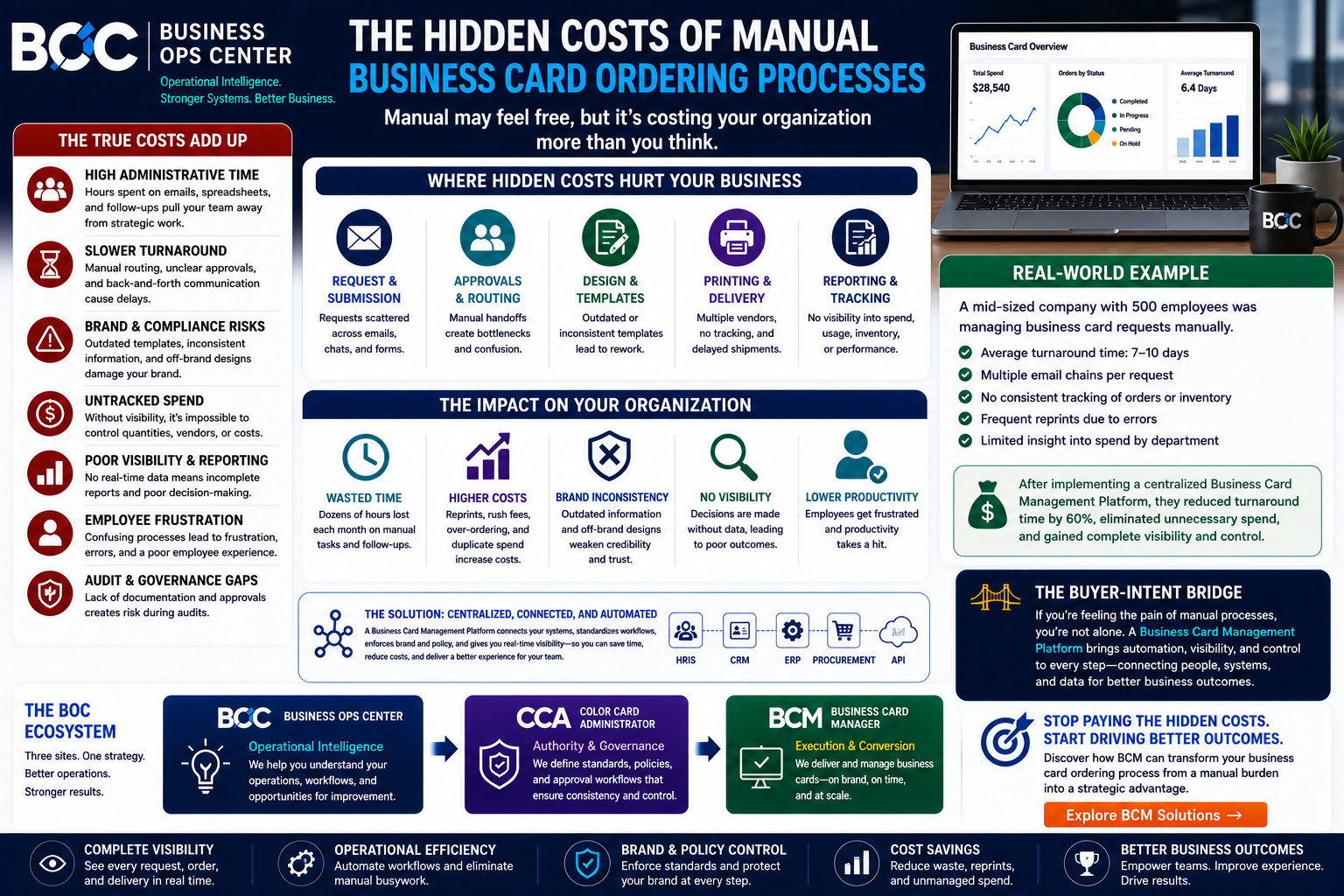
At first glance, these manual processes may appear inexpensive and manageable. However, the true cost of manual business card ordering extends far beyond printing expenses. As organizations grow, manual workflows often create operational inefficiencies, visibility challenges, governance risks, and unnecessary administrative overhead.
The problem is rarely the business card itself. The problem is the process surrounding the request, approval, production, fulfillment, and management lifecycle.
Why Manual Processes Persist

Manual business card ordering often develops naturally. Small organizations typically do not require formal systems because requests are infrequent and stakeholders communicate directly. Employees know who to contact, managers can approve requests quickly, and operational complexity remains relatively low.
As organizations expand, however, manual processes often remain in place long after they have outlived their effectiveness. New employees, multiple locations, expanded vendor relationships, and growing governance requirements create challenges that manual workflows are not designed to handle.
The result is a process that becomes increasingly difficult to manage while remaining largely invisible to leadership teams.
The Cost of Administrative Overhead
One of the highest hidden costs of manual ordering is administrative effort.
Employees spend time gathering information, requesting approvals, following up on requests, coordinating with vendors, correcting errors, and tracking order status. Managers spend time reviewing emails, validating information, and responding to questions that could be automated within a structured workflow.
Although each activity may seem minor, the cumulative impact can be substantial. Administrative effort consumes time that could otherwise be spent on higher-value business activities.
Workflow Delays and Bottlenecks
Manual processes often create unnecessary delays.
Requests may sit in inboxes awaiting approval. Information may be incomplete. Employees may not know who is responsible for the next step. Vendors may require clarification before production can begin.
These delays create bottlenecks that reduce operational efficiency. They also create frustration for employees who depend on timely fulfillment to support customer-facing responsibilities.
Approval workflows and centralized management platforms help reduce these delays by providing structure, visibility, and accountability throughout the process.
Brand Governance Risks
Business cards represent a company’s brand. Inconsistent templates, outdated contact information, unauthorized modifications, and non-compliant designs can create reputational risks.
Manual ordering environments often make it difficult to enforce brand standards consistently. Employees may use outdated templates or submit incorrect information without appropriate review processes.
Centralized management platforms help organizations maintain brand consistency by controlling templates, approval workflows, and production standards.
Limited Operational Visibility
Visibility is another hidden cost of manual processes.
Organizations frequently struggle to answer basic operational questions:
- How many business card orders were submitted this quarter?
- Which departments generated the highest volume?
- How much was spent?
- Which vendors fulfilled requests?
- How long did approvals take?
Without operational visibility, organizations lack the operational intelligence needed to improve efficiency and manage resources effectively.
The Procurement and Compliance Challenge
Procurement teams increasingly require visibility into purchasing activity. Compliance teams need confidence that policies are being followed. Finance departments require accurate reporting and auditability.
Manual business card ordering often fails to provide the documentation and reporting needed to support these requirements. Approval histories may be incomplete. Spending data may be fragmented. Vendor activity may be difficult to track.
As organizations scale, these limitations become increasingly problematic.
API-Connected Business Card Management
Modern business card management platforms address these challenges through centralized workflows, approval automation, reporting visibility, and API integration.
By connecting business card ordering with HRIS systems, procurement platforms, approval workflows, and reporting environments, organizations can create a more coordinated operational model.
This reduces administrative effort while improving accountability, governance, and visibility.
Buyer-Intent Bridge: When Organizations Should Upgrade
Organizations should evaluate business card management platforms when they experience:
- Multiple locations
- Growing employee counts
- Increased approval requirements
- Brand governance challenges
- Vendor coordination complexity
- Limited reporting visibility
These signals often indicate that manual processes have become operational liabilities rather than operational solutions.
Conclusion
The hidden costs of manual business card ordering are often far greater than the cost of printing itself. Administrative overhead, workflow delays, governance risks, visibility challenges, and compliance limitations all contribute to operational inefficiency.
Organizations that invest in centralized business card management platforms gain greater visibility, stronger governance, improved accountability, and more scalable operational processes.
As business environments become increasingly complex, structured workflow management is becoming a strategic advantage rather than an optional enhancement.