


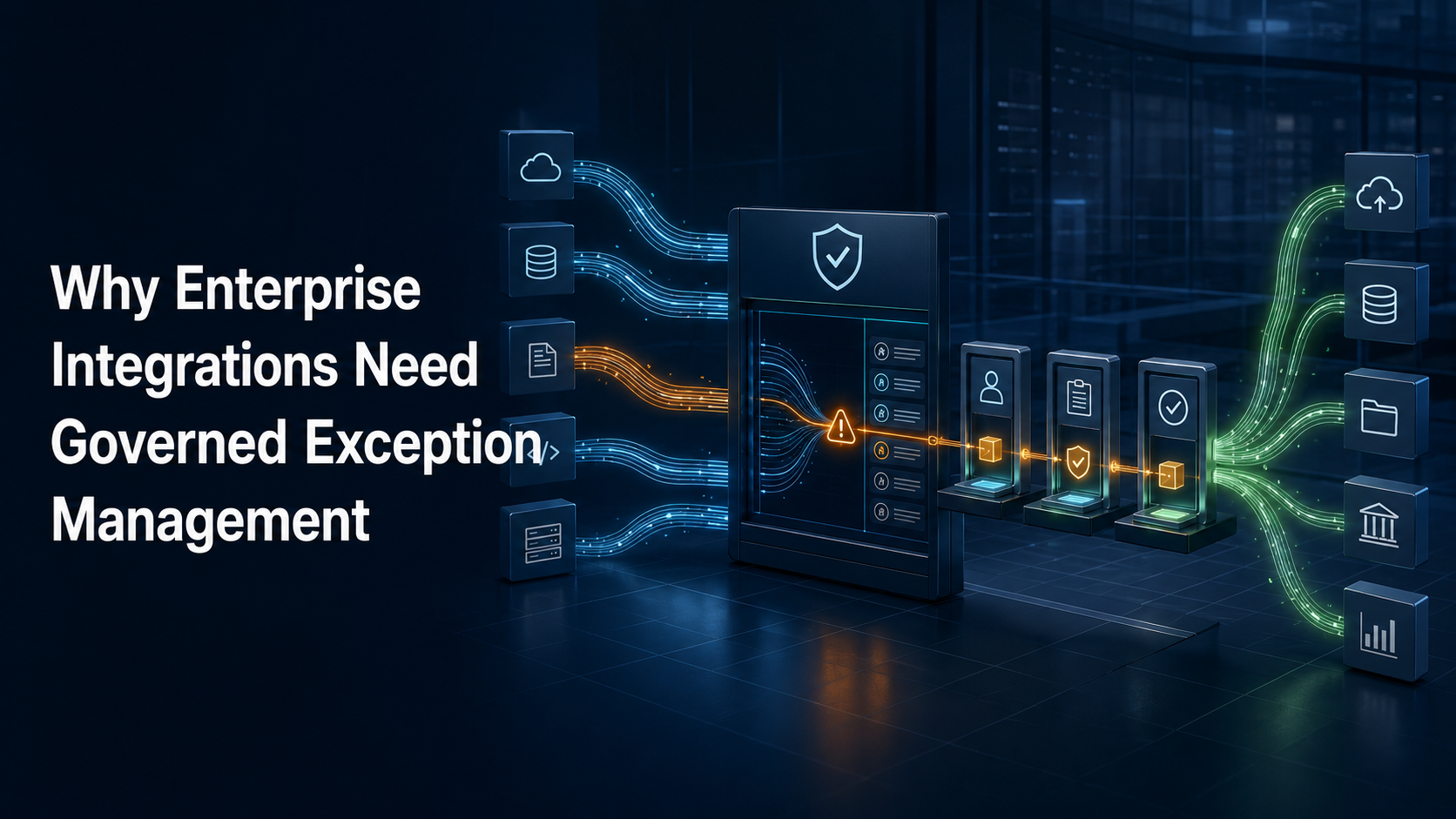
EXECUTIVE PERSPECTIVE The quality of an enterprise integration is revealed not when every input is perfect, but when the organization can control what happens after data is missing, late, conflicting, unauthorized, duplicated, or impossible to execute.
Integration Success Is Not the Same as Operational Success
Enterprise integration programs are often described through successful connections: an HRIS sends employee data, a CRM supplies customer or account context, an identity platform authenticates a user, a procurement system authorizes spend, and an execution platform completes the requested work. When the expected data arrives in the expected order, the architecture can appear complete.
Real operations rarely remain inside that ideal path. An employee may have two active job titles. A manager may change after a request enters approval. A location code may exist in one system but not in another. A customer-facing specification may be valid in the CRM yet conflict with an approved brand rule. A purchase authorization may expire after approval but before fulfillment. A vendor may acknowledge an order without completing it. Each condition crosses system boundaries and demands a business decision, not merely another API call.
The technical layer may report a successful response while the intended business outcome remains incomplete, incorrect, or unverified. Conversely, a connector may report an error even though an authorized operational owner can resolve the issue safely. This gap between technical status and business reality is where integration programs accumulate risk.
Business Ops Center addresses that gap by treating exceptions as governed operational work. It preserves the business event, determines the applicable authority, assigns ownership, presents the right context, controls resolution choices, resumes enterprise execution excellence, and records evidence. Exception management therefore becomes part of the operating architecture rather than an emergency process outside it.
Why Exceptions Are Inevitable in Connected Enterprises
Every enterprise system represents a partial view of the organization. HR systems understand employment status and reporting relationships. Enterprise identity governance systems understand accounts, groups, and access. CRM platforms understand customer and revenue context. Procurement and ERP platforms understand budgets, suppliers, purchase commitments, and financial controls. Fulfillment systems understand production and delivery. None of these systems independently owns the entire operational truth.
When workflows span these domains, exceptions arise at the boundaries between truths. They are not always defects. Many are legitimate consequences of timing, local policy, delegation, organizational change, or incomplete synchronization. A global organization may permit different naming, approval, or purchasing rules by legal entity. A newly hired employee may be active in the HRIS before every downstream directory and cost-center mapping is ready. A senior executive may require a controlled override that an ordinary employee should never receive.
The goal is not to promise zero exceptions. That promise usually produces brittle automation, hidden manual work, or overly permissive bypasses. The goal is to make expected exceptions visible, bounded, explainable, and recoverable while preventing unsafe conditions from proceeding.
Five Exception Classes an Operational Control Layer Must Govern
1. Data quality and semantic conflicts
Required fields may be absent, values may use incompatible formats, and two authoritative sources may disagree. A title in the HRIS may not match a customer-facing title approved by marketing. A location may have different identifiers across ERP, CRM, and fulfillment platforms. Resolving these conditions requires precedence rules, contextual judgment, and sometimes explicit approval—not a connector that silently chooses the last value received.
2. Authority and access exceptions
A user may be authenticated but not authorized for the requested action. An approver may be unavailable, delegated, or outside the permitted scope. A role change may occur while a request is in flight. These cases require current authority evaluation, segregation-of-duties checks, controlled delegation, and evidence of who acted under which policy version.
3. Policy and approval exceptions
A request can contain valid data and still violate policy. It may exceed a spending threshold, use an unapproved specification, route to the wrong legal entity, or require additional review due to geography, sensitivity, or customer visibility. The system must pause the business event without losing its history and route it to the responsible decision-maker with permitted actions clearly defined.
4. Integration and sequencing exceptions
Events can arrive twice, arrive late, arrive out of order, or fail between steps. A timeout does not always reveal whether the receiving system completed the action. Retrying blindly can create duplicate records or orders. Governed enterprise process orchestration therefore needs idempotency, correlation identifiers, state awareness, safe retry rules, and a path for human review when technical certainty is unavailable.
5. Fulfillment and reconciliation exceptions
An accepted transaction is not necessarily a completed business outcome. The downstream system may reject a specification later, partially fulfill an order, substitute a value, miss a service level, or complete work without returning usable evidence. Reconciliation must compare the authorized intent with what actually occurred and open a controlled exception when they differ.
From Error Queue to Governed Exception Case
Traditional integration monitoring focuses on messages, endpoints, status codes, and retry counts. Those signals are necessary for technical teams, but they are insufficient for operational owners. A business user needs to know what the event means, whose work is affected, which policy applies, what decisions are permitted, what downstream commitments already exist, and how the case can be closed safely.
| Control requirement | Question the enterprise must answer | BOC operational response |
|---|---|---|
| Business context | What outcome is at risk? | Retains the initiating event, entity, request, dependencies, and expected result. |
| Policy context | Why was processing stopped? | Displays the applicable rule, threshold, authority scope, and policy version. |
| Ownership | Who is responsible now? | Routes the case to a named operational role with escalation and service expectations. |
| Resolution control | Which actions are allowed? | Offers bounded choices such as correct, approve, reject, reassign, retry, or cancel. |
| Evidence | Can the decision be reconstructed? | Records inputs, changes, identities, timestamps, comments, overrides, and outcomes. |
| Recovery | How does work resume safely? | Continues from the correct state without duplicating completed actions. |
| Reconciliation | Did execution match intent? | Compares authorization, commitment, fulfillment, and downstream confirmation. |
The Governed Exception Lifecycle
Detect the condition in operational terms
Detection should translate technical signals into business meaning. Instead of showing only “HTTP 409” or “validation failed,” the control layer identifies that an employee record conflicts with an approved identity standard, that an approver lacks the required scope, or that fulfillment did not match the authorized specification. Technical detail remains available, but the case is framed around the outcome that requires attention.
Contain the event without losing state
The workflow must pause at a defined control point. It should preserve completed actions, prevent unauthorized downstream release, and avoid creating a second version of the transaction through an informal workaround. Containment is especially important when identity, money, external production, or customer-facing information is involved.
Classify risk, urgency, and ownership
Not every exception deserves the same response. Some can be corrected automatically from a trusted source. Some require an operational owner. Others require compliance, security, finance, brand, or executive approval. Classification should consider business impact, reversibility, sensitivity, deadline, affected population, and whether an external commitment already exists.
Present policy-aware resolution choices
A governed case does not give every user an unrestricted edit screen. It presents the actions allowed for that role and condition. A local administrator may correct a location mapping. A manager may confirm an employee title. Procurement may approve a cost exception. A brand owner may authorize a controlled variation. A security-sensitive override may require two independent decisions. This converts resolution from improvisation into policy execution.
Resume orchestration from a known state
After resolution, the system should continue from the appropriate checkpoint. Completed steps should not be repeated unless policy requires compensation or reversal. Downstream systems should receive the corrected, approved payload with the same business correlation, allowing the enterprise to distinguish recovery from a new request.
Reconcile the final outcome and close with evidence
Closure should occur only when the business outcome is confirmed. The record must show the original inputs, the exception, the applied policy, the people or automation involved, the approved changes, the resumed actions, and the completion evidence. If execution differs from intent, a new or related exception should remain open rather than allowing a technical success message to close the case.
Operational Ownership Matters More Than a Shared Inbox
Many organizations route integration failures to a shared mailbox, spreadsheet, chat channel, or IT ticket queue. This may create visibility, but it rarely creates accountability. Ownership remains ambiguous, business context is fragmented, resolution authority is unclear, and the path back into the original workflow depends on manual coordination.
Business Ops Center can assign each exception to an operational role based on event type, entity, geography, value, sensitivity, or workflow stage. Ownership follows the business responsibility rather than the connector that surfaced the issue. The platform can also define escalation when a service objective is at risk, delegation when an owner is unavailable, and reassignment when the classification changes.
This distinction protects both speed and control. Business teams resolve expected operational conditions without waiting for connector developers, while technical teams retain responsibility for genuine infrastructure defects. Each group sees the context relevant to its work, and the enterprise preserves one connected history of the event.
Designing Automation That Learns Without Weakening Governance
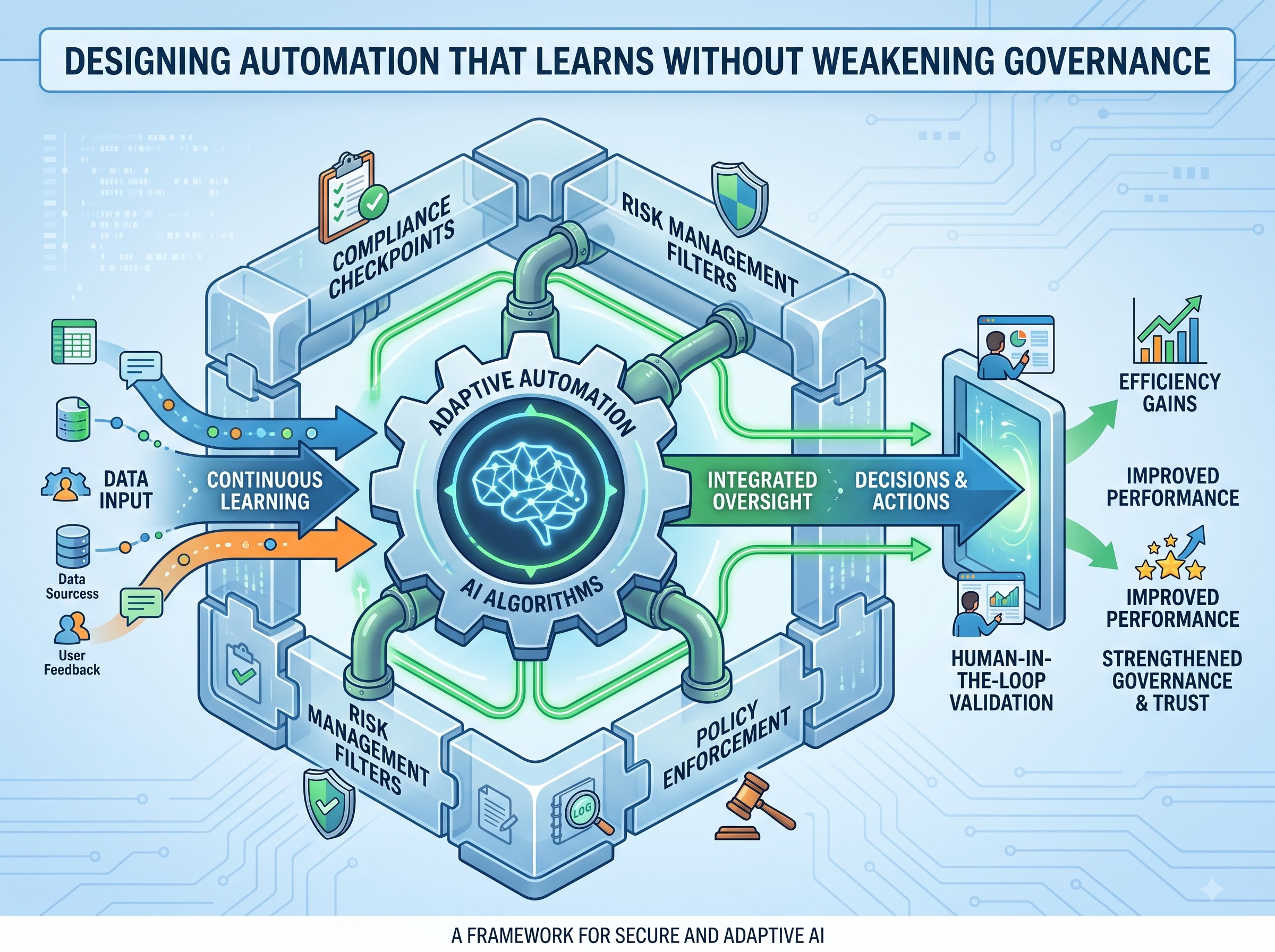
Exception patterns are valuable evidence. If the same location mapping fails repeatedly, the enterprise may need a master-data correction. A particular approval threshold creates excessive delays, the policy may need redesign. If a common condition is consistently resolved in the same low-risk way, it may become eligible for controlled automation.
However, learning from exceptions should not mean silently expanding automation. A mature operating model reviews patterns, evaluates risk, approves a new rule, versions the policy, tests the change, and monitors the result. Business Ops Center provides the history needed to distinguish a recurring nuisance from a meaningful control signal.
This creates a disciplined improvement cycle: exceptions expose friction; evidence reveals the cause; governance determines the appropriate change; orchestration implements the approved rule; and monitoring verifies that the change improves outcomes without introducing new risk.
Enterprise Use Cases
HRIS-to-operations: employee lifecycle changes
A new hire, transfer, promotion, leave, or termination can trigger activity across identity, ordering, facilities, customer-facing materials, and procurement. Exceptions occur when effective dates differ, managers are missing, titles conflict, or downstream accounts are not ready. BOC maintains the lifecycle event and coordinates the decision instead of allowing each downstream system to create an unrelated ticket.
CRM-to-execution: customer-facing specifications
CRM data can initiate work for a sales team or customer account, but commercial urgency cannot replace governance. If customer-facing information conflicts with approved identity, legal, brand, or location rules, the request can be contained and reviewed by the responsible owner. The resolved specification then proceeds with evidence linking the CRM context to the authorized execution.
Procurement-to-fulfillment: spend and vendor control
A request may be approved but later exceed a budget because quantity, shipping, tax, or vendor pricing changes. A purchase order may be valid for one entity but not another. BOC can route the exception to procurement or finance, preserve the existing request, capture the decision, and reconcile the final vendor outcome to the updated authorization.
Identity-to-workflow: access and delegation
Authentication confirms who a user is; it does not prove that every action is permitted. BOC evaluates role, scope, delegation, sensitivity, and segregation of duties at the point of decision. If authority is missing or stale, the workflow pauses and routes the case without discarding the original business event.
Metrics That Reveal Exception-Control Maturity
A simple count of failed transactions does not show whether operations are healthy. Enterprises should measure how exceptions affect business outcomes and whether controls remain effective. Useful measures include:
- exception rate by workflow, source, policy, business unit, and root-cause class;
- time to acknowledge, time to decision, and time to verified recovery;
- percentage resolved through standard paths versus overrides or offline workarounds;
- repeat exceptions caused by master data, policy design, connector behavior, or execution partners;
- aged cases, missed service objectives, and downstream commitments at risk;
- duplicate or unsafe retries prevented by state-aware recovery;
- differences between authorized intent and confirmed fulfillment; and
- automation candidates supported by sufficient volume, consistency, and low-risk evidence.
These measures make exception management an operational discipline. Leaders can see where integrations create value, where controls generate avoidable friction, and where investment should be directed across process design, data stewardship, policy, system configuration, or supplier performance.
Questions Enterprise Buyers Should Ask
- Can the platform preserve one business event across systems, retries, corrections, approvals, and fulfillment?
- Does it distinguish technical errors from business exceptions and route each to the correct owner?
- Are resolution actions limited by role, policy, entity, geography, value, and sensitivity?
- Can it prevent duplicate execution when the outcome of a timed-out call is uncertain?
- Does recovery resume from a known state rather than restarting the entire workflow?
- Can the organization reconstruct the original input, applicable policy version, decision, override, and final evidence?
- Are exception trends available to improve master data, workflow design, policies, integrations, and vendors?
- Can expected exceptions be resolved by operations without unsafe code changes or off-platform workarounds?
The Strategic Outcome: Resilient Automation With Accountability
Enterprise business card workflow automation is resilient when it can absorb imperfect data, changing organizations, policy variation, technical uncertainty, and downstream failure without losing control. That resilience does not come from ignoring exceptions or permitting unlimited workarounds. It comes from governing how exceptions are detected, owned, decided, recovered, reconciled, and learned from.
Business Ops Center makes this capability part of the enterprise operations architecture. It connects the business event to authority, policy, approvals, execution, exception handling, and evidence across system boundaries. Teams gain a practical way to resolve real-world conditions while leaders retain visibility into risk, performance, and accountability.
Connectivity makes cross-system work possible. Orchestration coordinates its lifecycle. Governed exception management keeps that lifecycle trustworthy when reality departs from the expected path. Together, they allow enterprise automation to scale without becoming opaque, brittle, or dependent on uncontrolled manual intervention.
Turn integration exceptions into governed operational work. Explore how Business Ops Center can connect enterprise events, policies, owners, resolution paths, recovery, reconciliation, and evidence. Visit businessopscenter.com to identify a high-value workflow where exception control can reduce risk and operational friction.