


Introduction
The competitive landscape has changed dramatically over the last decade.
Organizations no longer compete solely on innovation, pricing, or customer experience.
They compete on execution.
Two organizations may deploy identical ERP systems.
They may use the same CRM platform.
They may implement identical automation technologies.
Yet one consistently delivers projects faster, responds more effectively to customers, adapts rapidly to regulatory changes, and executes strategic initiatives with greater confidence.
The difference is rarely technology.
It is operational maturity.
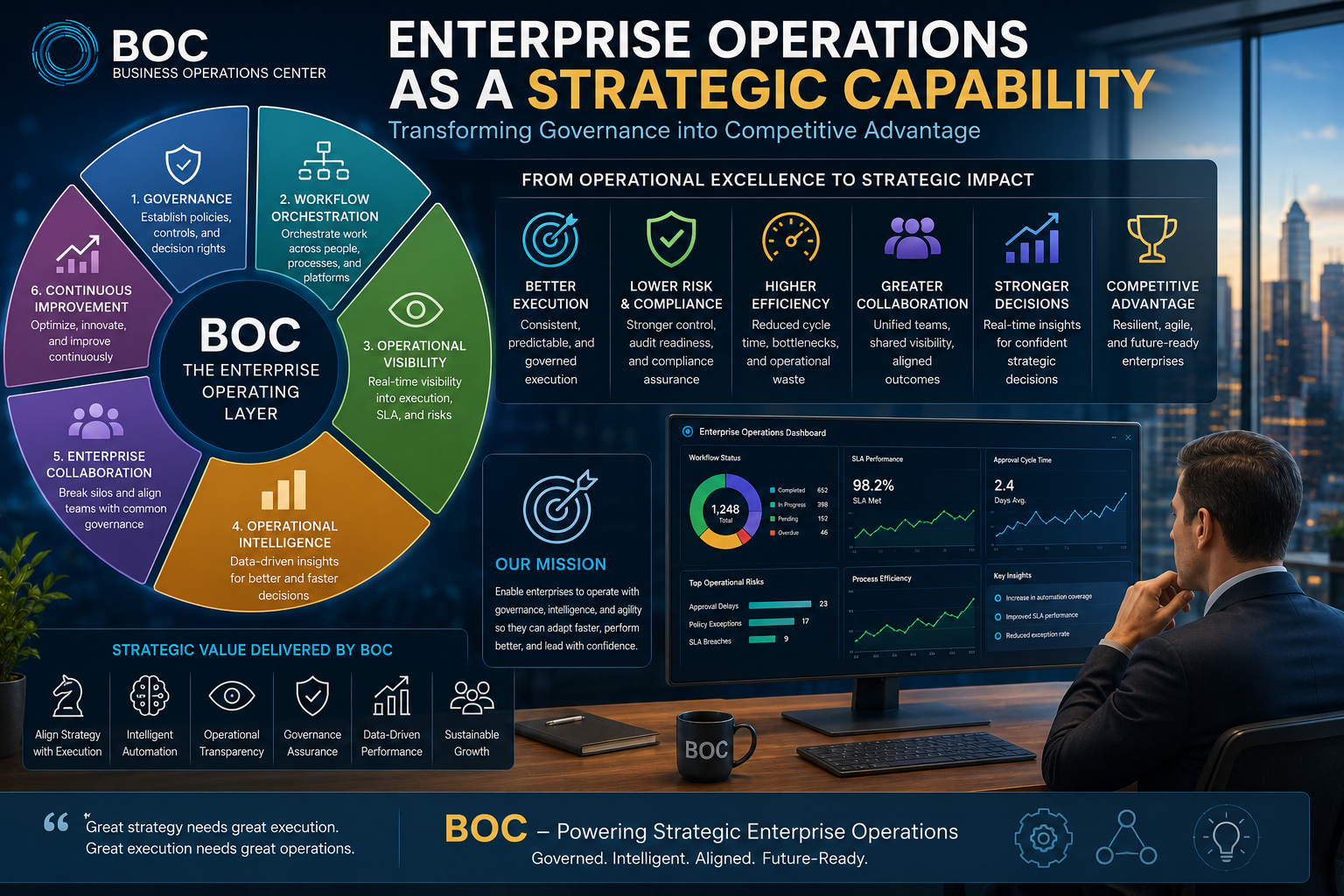
Business Operations Center addresses this challenge by providing an enterprise-wide operational framework where governance and execution become inseparable.
Instead of allowing departments to optimize independently, BOC creates one coordinated operational model that aligns strategy with execution.
The Evolution of Enterprise Operations
Stage 1 — Administrative Operations
Operations focused primarily on documentation, approvals, reporting, and transaction processing.
Departments operated independently.
Visibility remained limited.
Stage 2 — Process Automation
Workflow automation eliminated manual effort.
However, automation frequently occurred without governance.
Organizations accelerated existing inefficiencies rather than eliminating them.
Stage 3 — Digital Operations
Cloud platforms, ERP modernization, CRM integration, and collaboration tools increased operational speed.
Yet many organizations still lacked enterprise-wide coordination.
Stage 4 — Governance-Driven Operations
Organizations recognized that standardized governance produced more reliable operational outcomes.
Policies became embedded within workflows.
Operational intelligence improved.
Stage 5 — Strategic Enterprise Operations
Enterprise operations now influence:
- Business strategy
- Customer experience
- Risk management
- Innovation
- Digital transformation
- AI adoption
- Executive decision-making
Operations become a competitive advantage.
Business Operations Center is designed specifically for this stage.
Why Operations Have Become Strategic
Modern enterprises face unprecedented complexity.
Organizations must coordinate:
- Global teams
- Hybrid workforces
- Multiple cloud platforms
- Regulatory compliance
- Supply chain ecosystems
- Customer engagement
- Artificial intelligence
- Cybersecurity
- Sustainability initiatives
Without standardized operational governance, complexity quickly overwhelms execution.
Strategic operations reduce this complexity by providing consistent enterprise execution regardless of organizational scale.
Business Operations Center as the Enterprise Operating Layer
Most enterprise platforms manage specific business functions.
ERP manages resources.
CRM manages customer relationships.
HR systems manage employees.
Finance systems manage accounting.
Business Operations Center operates differently.
It governs how work moves across every enterprise system.
BOC coordinates:
- Workflow orchestration
- Operational governance
- Executive visibility
- Decision intelligence
- Enterprise analytics
- Continuous improvement
- Cross-functional collaboration
Instead of replacing existing investments, BOC maximizes their operational effectiveness.
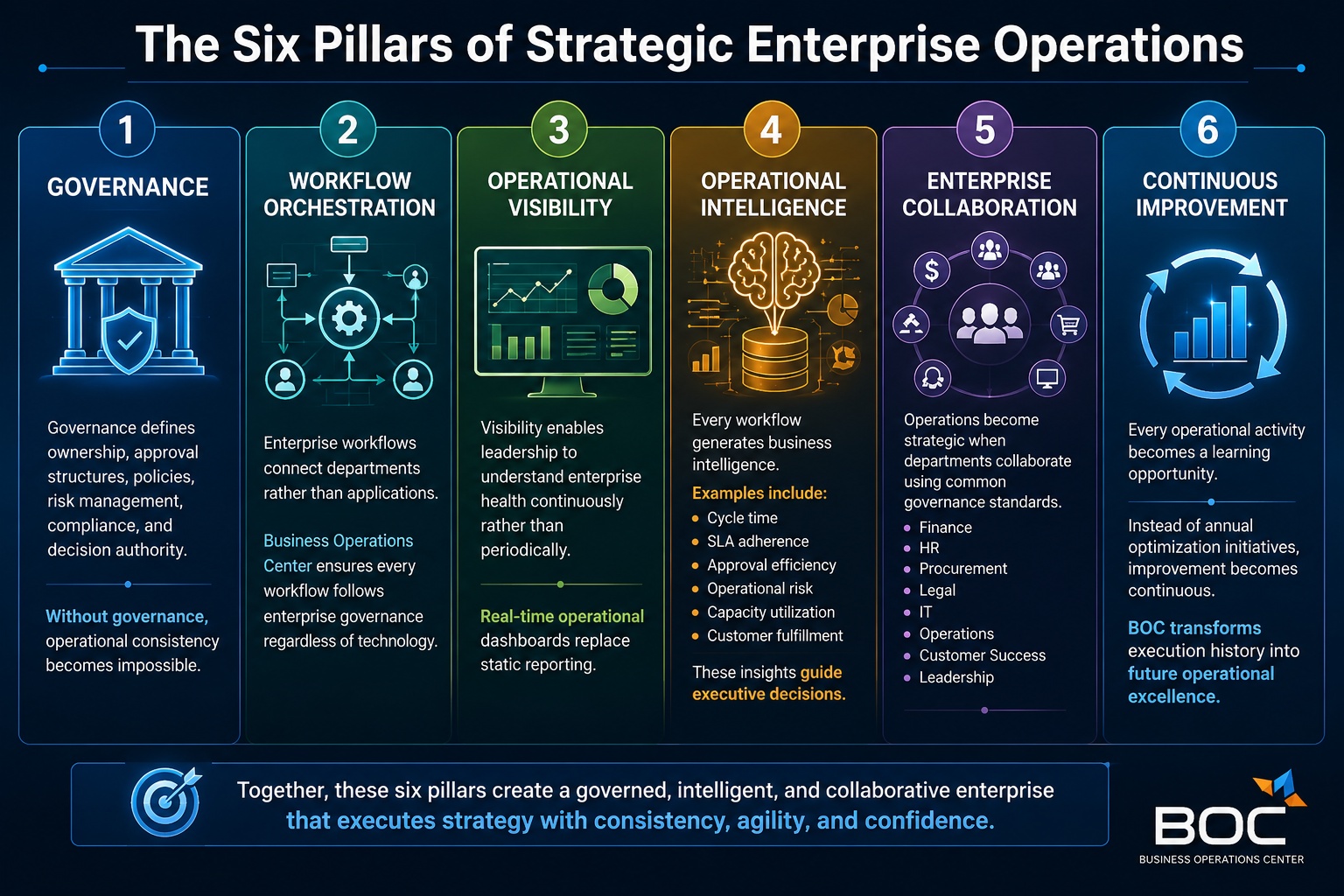
The Six Pillars of Strategic Enterprise Operations
1. Governance
Governance defines ownership.
Approval structures.
Policies.
Risk management.
Compliance.
Decision authority.
Without governance, operational consistency becomes impossible.
2. Workflow Orchestration
Enterprise workflows connect departments rather than applications.
Business Operations Center ensures every workflow follows enterprise governance regardless of technology.
3. Operational Visibility
Visibility enables leadership to understand enterprise health continuously rather than periodically.
Real-time operational dashboards replace static reporting.
4. Operational Intelligence
Every workflow generates business intelligence.
Examples include:
- Cycle time
- SLA adherence
- Approval efficiency
- Operational risk
- Capacity utilization
- Customer fulfillment
These insights guide executive decisions.
5. Enterprise Collaboration
Operations become strategic when departments collaborate using common governance standards.
Finance.
HR.
Procurement.
Legal.
IT.
Operations.
Customer Success.
Leadership.
All operate within a single enterprise execution framework.
6. Continuous Improvement
Every operational activity becomes a learning opportunity.
Instead of annual optimization initiatives, improvement becomes continuous.
BOC transforms execution history into future operational excellence.
Governance as a Competitive Differentiator
Many executives associate governance with compliance.
However, governance creates competitive advantage.
Governance enables:
- Faster approvals
- Consistent execution
- Lower operational risk
- Better decision quality
- Greater transparency
- Stronger customer confidence
Organizations with mature governance innovate faster because execution remains predictable.
Operational Intelligence for Executive Leadership
Leadership requires more than dashboards.
Executives need context.
Business Operations Center delivers intelligence rather than information.
Leadership understands:
- Why delays occur.
- Which workflows generate risk.
- Which regions outperform others.
- Where automation should expand.
- Which approvals create bottlenecks.
- Which governance policies require refinement.
Operational intelligence transforms reporting into strategic decision support.
Enterprise Collaboration Without Silos
Silos remain one of the largest barriers to enterprise performance.
Departments optimize locally while reducing enterprise efficiency.
Business Operations Center establishes shared governance.
Shared workflows, metrics & accountability.
Instead of optimizing individual departments, organizations optimize enterprise outcomes.
Building Organizational Resilience
Unexpected disruption has become normal.
Organizations face:
- Regulatory changes
- Market volatility
- Supply chain interruptions
- Cybersecurity threats
- Workforce changes
- Technology disruption
Governance-first execution enables organizations to adapt without operational chaos.
Resilience becomes embedded into the operating model rather than added after disruption occurs.
AI-Driven Enterprise Operations
Artificial Intelligence depends upon trustworthy operational history.
BOC provides:
- Governed workflow execution
- Standardized operational metrics
- Explainable decisions
- Enterprise audit trails
- Trusted business knowledge
These capabilities enable:
- AI copilots
- Predictive operations
- Intelligent routing
- Capacity forecasting
- Autonomous recommendations
- Operational anomaly detection
Rather than replacing governance, AI becomes governed by governance.
Enterprise Case Study
Consider a multinational financial services organization operating across thirty countries.
Before implementing Business Operations Center:
- Approval structures varied by region.
- Executive reporting required manual consolidation.
- Compliance findings repeated annually.
- Customer onboarding differed between business units.
- Operational metrics lacked consistency.
After implementing BOC:
Governance became standardized.
Workflow ownership became transparent.
Operational dashboards became enterprise-wide.
Executive reporting became real-time.
Continuous governance reviews improved every operational process.
Within two years:
- Approval time reduced significantly.
- Operational risk decreased.
- Audit readiness improved.
- Customer onboarding accelerated.
- Cross-functional collaboration increased.
- Strategic decision-making became evidence-based.
Operations became a measurable competitive advantage.
Implementation Roadmap
Organizations should implement strategic enterprise operations through phased transformation.
Phase 1
Governance Assessment
Phase 2
Workflow Standardization
Phase 3
Enterprise Visibility
Phase 4
Operational Analytics
Phase 5
Continuous Improvement
Phase 6
AI-Driven Operational Optimization
Each phase builds upon the previous one, ensuring sustainable transformation.
Measuring Strategic Operational Success
Organizations should measure:
Governance
- Policy adherence
- Audit readiness
- Compliance maturity
Operations
- Cycle time
- SLA performance
- Approval efficiency
Business
- Customer satisfaction
- Revenue enablement
- Productivity
Strategy
- Digital maturity
- Innovation readiness
- Organizational resilience
Together these measures demonstrate whether operations are creating measurable business value.
The Future of Enterprise Operations
The enterprise of the future will coordinate:
- Human employees
- AI agents
- Autonomous workflows
- Digital twins
- Predictive analytics
- Enterprise knowledge platforms
Business Operations Center will increasingly function as the enterprise operating layer governing this hybrid workforce.
Operations will no longer support strategy.
Operations will become strategy.
Organizations that establish governance-first operating models today will become tomorrow’s operational leaders.
Conclusion
Enterprise operations have evolved beyond administrative efficiency.
They now determine how effectively organizations execute strategy, manage risk, enable innovation, and sustain competitive advantage.
Business Operations Center provides the governance-first operational framework required to transform fragmented enterprise activities into coordinated execution.
By integrating governance, workflow orchestration, operational intelligence, observability, analytics, and continuous improvement, BOC enables organizations to build resilient, intelligent, and strategically aligned operations.
The future belongs to enterprises that recognize operations not as a support function, but as a strategic capability that powers long-term business success.