

Introduction
Most organizations believe operational visibility begins with dashboards and reporting tools. In reality, visibility begins much earlier—with the way work is designed, approved, executed, and governed. When every department follows different operating practices, leadership receives inconsistent data, fragmented reporting, and incomplete operational intelligence.
Business Operations Center (BOC) approaches operational visibility from a governance-first perspective. Instead of merely displaying business activity, BOC standardizes how operational work flows across departments so every approval, task, escalation, decision, and exception becomes measurable. Once workflow execution becomes standardized, operational intelligence becomes trustworthy, allowing executives to make faster and better decisions.
The Hidden Cost of Non-Standardized Operations

Many enterprises accumulate operational complexity over years of growth, acquisitions, regional expansion, and independent departmental decisions. Finance may follow one approval process while procurement follows another. HR may maintain separate onboarding procedures, and IT may rely on manual email approvals. These inconsistencies create invisible operational risk.
Employees spend significant time coordinating work rather than executing it. Managers manually follow up on pending approvals. Leadership struggles to understand where delays occur because every department reports differently. Compliance teams find it difficult to reconstruct decision histories during audits. Standardization eliminates these inconsistencies by creating a common operational language.
Why Workflow Standardization Creates Visibility
Standardized workflows ensure every business process follows defined rules, ownership, approval hierarchies, SLA expectations, and audit requirements. Since every transaction follows an approved execution path, organizations gain reliable operational data automatically.
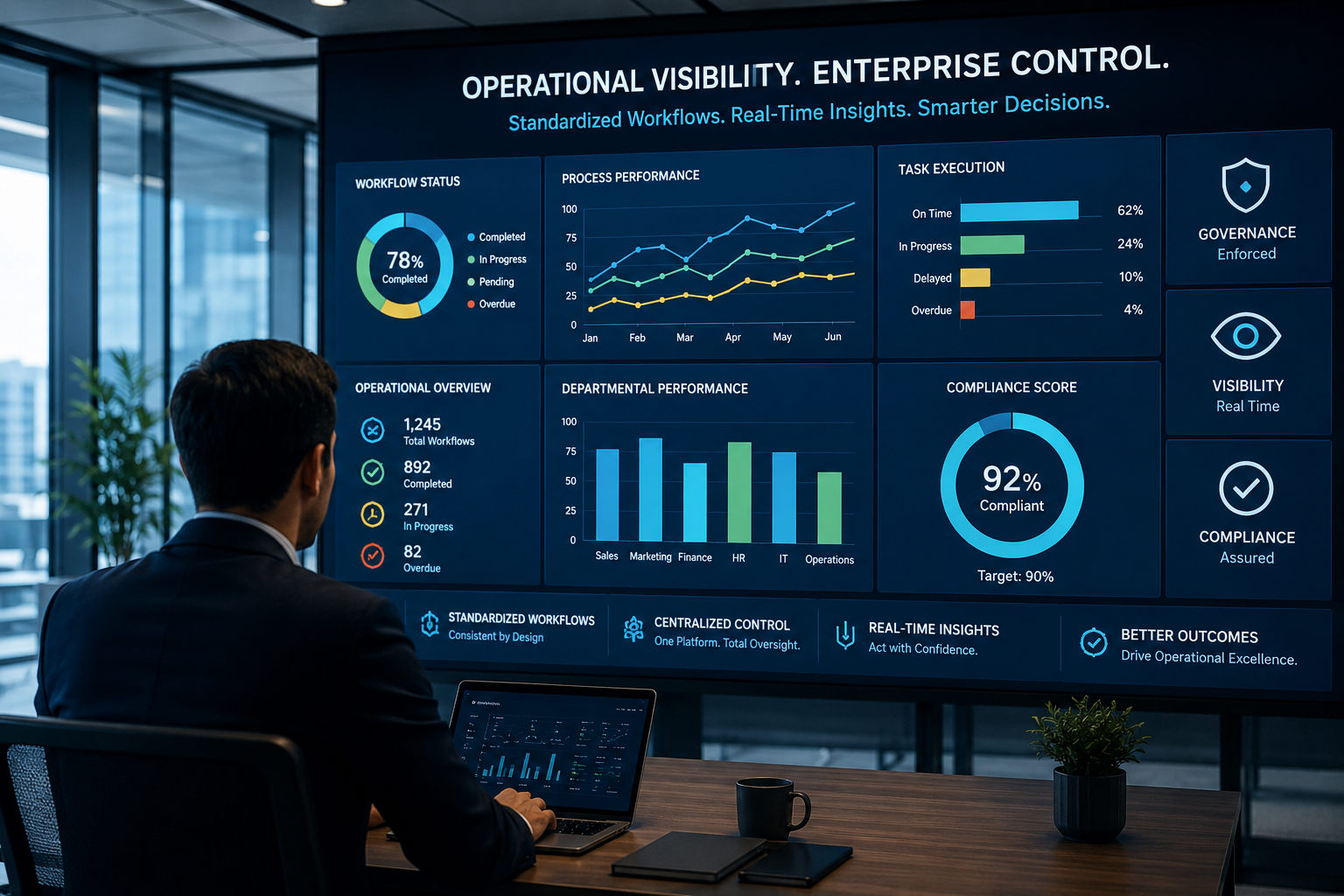
Rather than asking departments to prepare reports manually, executives receive continuous visibility into:
- Cycle times
- Approval bottlenecks
- Workload distribution
- Policy exceptions
- Resource utilization
- Operational trends
Visibility becomes an outcome of governed execution instead of an afterthought.
Governance Before Automation
Automation without governance simply accelerates inconsistency. Before automating processes, enterprises should establish:
- Process ownership
- Approval matrices
- Segregation of duties
- Escalation policies
- Compliance controls
- Documentation standards
- Performance metrics
BOC helps organizations transform governance policies into executable operational workflows that remain consistent regardless of business unit, geography, or organizational scale.
How BOC Delivers Enterprise Operational Visibility
BOC acts as a centralized operational governance platform where workflows are designed, executed, monitored, and continuously improved.
Key capabilities include:
- Managers monitor approvals in real time.
- Executives obtain enterprise-wide operational dashboards built upon governed workflow execution.
- Operational teams identify bottlenecks before they become customer-impacting issues.
- Audit teams receive complete execution histories with timestamps and accountability.
This unified operational layer reduces manual coordination while increasing organizational transparency.
Enterprise Benefits
Organizations implementing standardized enterprise workflows typically experience:
- Faster approval cycles
- Reduced operational delays
- Improved audit readiness
- Stronger policy compliance
- Better cross-functional collaboration
- Predictable service delivery
- Lower operational risk
- Improved executive decision-making
Most importantly, operational visibility evolves from reactive reporting into proactive operational governance.
Best Practices for Implementation
Successful enterprise standardization should begin with high-impact workflows such as:
- Employee onboarding
- Procurement approvals
- Vendor management
- Contract reviews
- Customer exception handling
- Operational change requests
Establish workflow ownership, document policies, define measurable KPIs, integrate with existing enterprise systems, and continuously optimize execution using operational analytics generated by BOC.
Conclusion
Operational visibility cannot exist without operational consistency. Dashboards only reflect the quality of underlying execution. By standardizing enterprise workflows first, organizations create trusted operational data, stronger governance, scalable execution, and measurable continuous improvement. Business Operations Center enables enterprises to transform fragmented operational processes into governed execution systems that support sustainable growth.