


Introduction
Growth creates operational complexity. What works for a small organization often becomes difficult to manage as employee counts increase, locations expand, and departments adopt different processes. One area where this challenge frequently appears is in ordering and procurement activities.
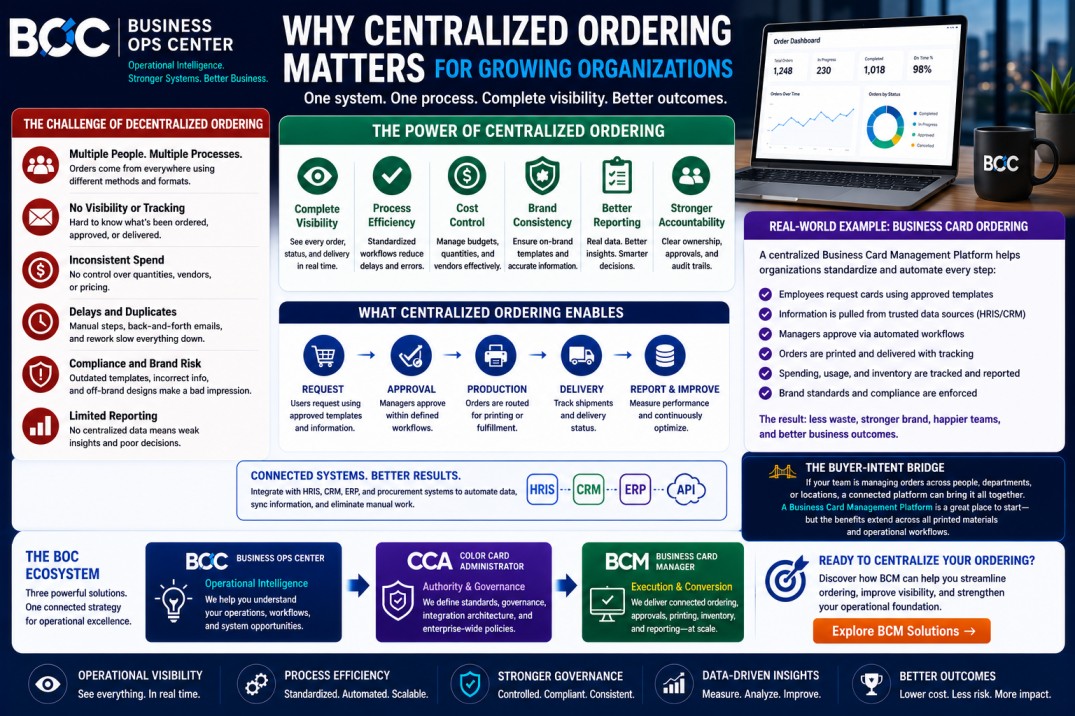
Many organizations begin with decentralized ordering practices. Employees place orders independently, departments work with different vendors, approvals occur through email, and reporting is scattered across multiple systems. While this approach may appear flexible, it often creates visibility challenges, inconsistent governance, approval delays, and unnecessary administrative effort.
Centralized ordering addresses these challenges by creating a structured environment where requests, approvals, vendors, reporting, and operational controls can be managed consistently. For growing organizations, centralized ordering is increasingly becoming an operational infrastructure requirement rather than simply a procurement preference.
The Operational Challenges of Decentralized Ordering

Decentralized ordering environments often emerge naturally as organizations grow. Individual teams adopt their own processes to solve immediate needs, and over time, those processes become difficult to coordinate.
Leadership teams frequently encounter questions such as:
Who approved a purchase?
Which vendor fulfilled the request?
Was the order compliant with company standards?
How much has been spent across departments?
Can operational activity be reported accurately?
Without centralized processes, answering these questions becomes difficult. The result is reduced visibility and increased administrative overhead.
Why Visibility Matters
Operational visibility is one of the most important outcomes of centralized ordering. Organizations need to understand how requests move through the business, who owns approvals, where delays occur, and how spending aligns with operational objectives.
Visibility improves decision-making because leadership teams can access reliable information rather than relying on fragmented reports or manual updates. It also strengthens accountability because workflow ownership and approval activity become easier to track.
Centralized ordering provides a foundation for operational intelligence by bringing ordering activity into a consistent and measurable environment.
Workflow Coordination and Accountability
Ordering is rarely a standalone activity. It often intersects with procurement, finance, operations, marketing, HR, and vendor management workflows.
Centralized ordering helps coordinate these activities by creating structured approval paths, standardized workflows, and consistent reporting. Instead of relying on emails, spreadsheets, or disconnected systems, organizations gain a coordinated process that improves accountability and execution consistency.
As operational complexity increases, workflow coordination becomes a competitive advantage because it reduces friction while improving responsiveness.
The Role of Governance
Governance is another critical benefit of centralized ordering. Organizations need confidence that purchases align with company policies, brand standards, operational requirements, and budget controls.
A centralized environment makes it easier to enforce standards, document approvals, maintain audit trails, and support compliance requirements. This is particularly important for medium and large organizations that require greater visibility into operational activity.
Governance should not be viewed as bureaucracy. Effective governance enables consistency, accountability, and operational control at scale.
API Integration and Connected Systems
Modern organizations operate across multiple business systems. Procurement platforms, HRIS environments, ERP systems, workflow applications, and reporting tools all contribute to operational execution.
Centralized ordering becomes even more valuable when supported by API-connected infrastructure. Integration allows information to move automatically between systems, reducing manual work while improving visibility and reporting consistency.
Connected systems environments help organizations create a more complete view of operational activity across departments and workflows.
Buyer-Intent Bridge: Business Card Ordering as an Example
Business card management provides a practical example of why centralized ordering matters.
Organizations that rely on decentralized ordering often experience inconsistent branding, approval confusion, limited reporting visibility, vendor coordination challenges, and administrative overhead. As employee counts grow, these issues become increasingly difficult to manage.
A centralized business card ordering platform creates visibility into requests, approvals, fulfillment, spending, and compliance. It also supports governance through template control, approval workflows, and operational reporting.
This demonstrates how centralized ordering can transform a fragmented operational activity into a coordinated business process.
Conclusion
Centralized ordering is more than a procurement improvement. It is an operational infrastructure capability that supports visibility, governance, accountability, and scalability.
As organizations grow, decentralized processes often create complexity that limits efficiency and operational control. Centralized ordering provides a framework for coordinating requests, approvals, vendors, reporting, and governance requirements in a consistent environment.
Organizations that invest in centralized ordering are better positioned to improve workflow visibility, strengthen operational governance, and support long-term growth.