


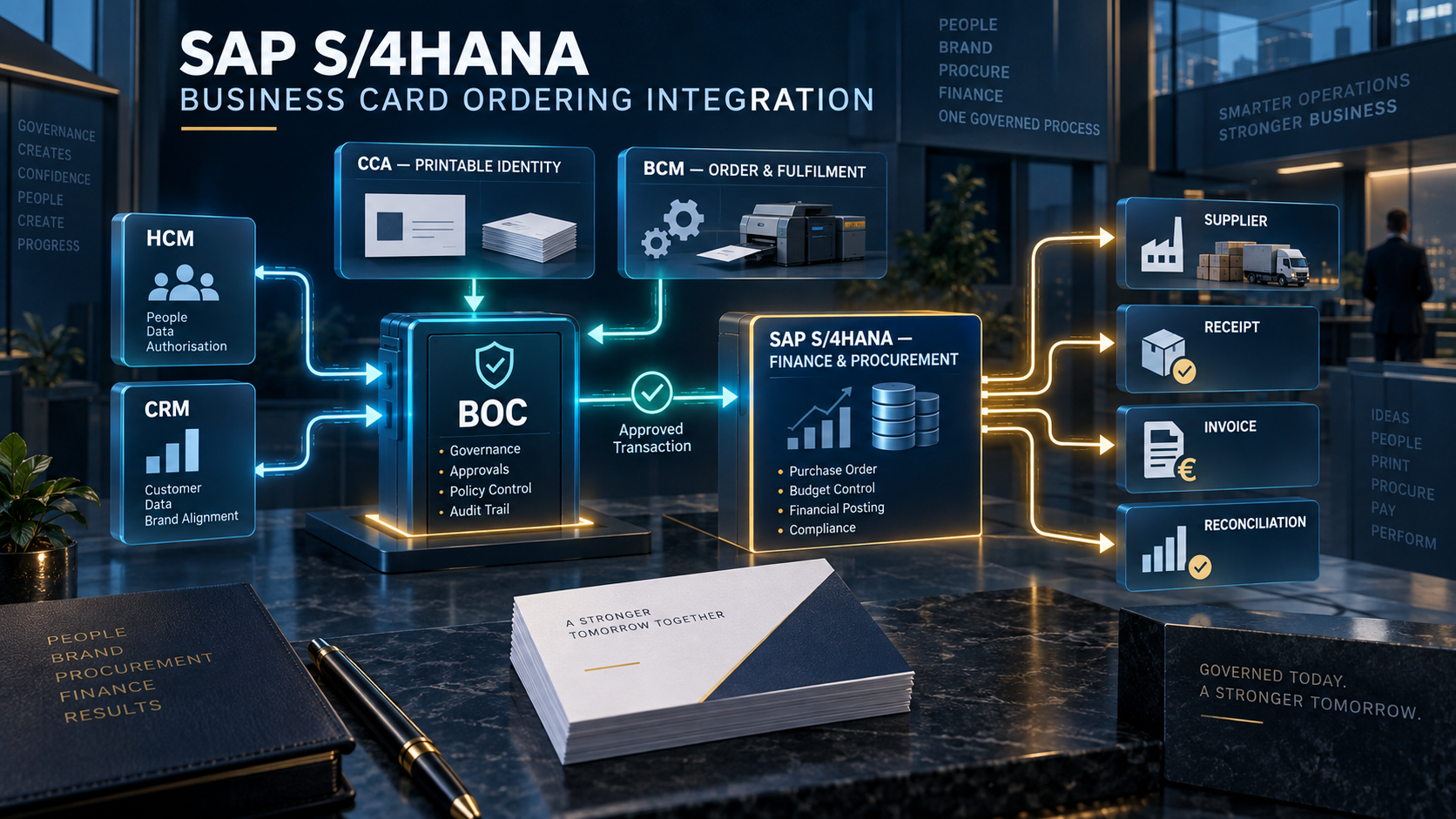
Connecting HCM, CRM APIs, CCA BCM purchasing suppliers, and finance through BOC without turning a print request into an uncontrolled transaction.
A business card order may look small, but at enterprise scale it crosses workforce identity, sales roles, brand policy, budgets, purchasing, suppliers, receipts, invoices, and audit evidence. BOC can coordinate those transitions while SAP S/4HANA remains authoritative for finance and procurement, CCA controls printable identity, and BCM governs production and fulfilment.
A Small Order Exposes a Large Control Problem
Business cards are ordered for new employees, role and location changes, sales teams, executives, events, acquired companies, replacements, and replenishment. Each request can involve an HCM employee record, a CRM territory or customer-facing role, identity and brand rules, approval authority, cost-center funding, a supplier, shipping, receipt, and invoice treatment. Manual email and spreadsheet handoffs hide those dependencies until a name is printed incorrectly, a budget is charged to the wrong organization, or an order arrives after the business need has passed.
SAP S/4HANA integration can govern company codes, cost centers, purchasing organizations, suppliers, purchase requisitions, purchase orders, goods receipts, invoices, and financial postings. It should not be forced to decide which employee title is printable, which brand template applies, or whether a person is eligible for a card program. Those decisions belong in the identity and ordering controls surrounding the ERP transaction.
Business Ops Center provides the cross-system operating layer. It correlates the original workforce or commercial event, validates current state, obtains the right approvals, coordinates CCA and BCM, invokes configured SAP interfaces, monitors supplier and delivery outcomes, and preserves one evidence chain from need to closure.
System Authority Must Remain Explicit
A controlled design begins with ownership. HCM owns active employment, organization, manager, title, location, legal entity, and effective date. CRM can own customer-facing responsibilities, territories, campaign participation, and event requirements. CCA owns the versioned name, title, company, office, contact details, language, legal text, logo, and template approved for print. BCM owns product configuration, proof, supplier routing, production, shipment, cancellation, correction, and reorder state.
SAP S/4HANA owns the commercial and accounting records required by the organization: purchasing responsibility, account assignment, supplier, price, tax treatment, purchase document, receipt, invoice, and posting. BOC does not replace those authorities. It evaluates their current facts, applies cross-system policy, and controls when information may advance from one domain to the next.
This separation prevents a common error: treating an approved creative proof as purchasing approval, or treating an approved purchase order as permission to print stale identity. Both decisions matter, but they answer different questions and can change on different timelines.
SAP APIs Support a Configurable Integration Boundary
This documents OData APIs for purchase-order processing and publishes integration assets through SAP Business Accelerator Hub. SAP Integration Suite API Management can be used to publish, secure, govern, and monitor APIs. The exact services, fields, events, authentication, middleware, extensions, and approval configuration vary by S/4HANA edition and customer landscape, so this is a configurable integration pattern rather than a claim of a universal native BOC connector.
BOC can integrate directly with approved endpoints or through an enterprise system integration layer. It submits only the data required for the selected process, stores stable correlation identifiers, and retains the SAP document references returned by the transaction. API policies, credentials, certificates, network paths, throttling, timeouts, versioning, and environment separation remain part of the operational design.
A technically successful API call is not the end of the workflow. The response must be associated with the correct request version, purchasing context, supplier action, receipt, invoice, and outcome. BOC makes that correlation visible and recoverable.
The Governed SAP S/4HANA Ordering Lifecycle
| Lifecycle stage | Authoritative context | BOC control | Required outcome |
|---|---|---|---|
| Business need | HCM CRM event campaign or approved request | Authenticate correlate classify and validate | Trusted BOC case |
| Printable identity | Current workforce facts and CCA policy | Resolve fields template language and approval | Versioned CCA identity |
| Ordering decision | Need quantity history budget cost center and deadline | Check eligibility authority duplication and timing | Authorized BCM request |
| Procurement | SAP company code purchasing organization supplier and account assignment | Create or reference approved purchasing transaction | Controlled SAP document |
| Production | BCM proof product supplier and release state | Bind production to approved versions | Correct physical product |
| Receipt and invoice | Delivery receipt invoice and SAP financial state | Match exceptions and verify outcomes | Reconciled transaction |
| Closure | Evidence from every system and owner | Confirm obligations retention and residual risk | Authorized closure |
HCM and CRM Define Why the Order Exists
A joiner, mover, promotion, office transfer, legal-entity change, sales assignment, conference, customer program, or depleted supply can start the process. BOC retrieves the smallest necessary set of authoritative facts and establishes an effective date. It distinguishes a legitimate operational need from a request that is premature, duplicated, unsupported, or based on an inactive person.
HCM contributes workforce identity and organizational context. CRM contributes customer-facing purpose, territory, role, campaign, or event context where relevant. Neither system needs to contain the full ordering workflow. BOC correlates their records and prevents one system from overwriting another system’s authority.
Future-dated changes require particular care. Work may be prepared before a start date, but production or delivery should occur only when policy permits. If the employee, role, territory, office, or event changes, BOC invalidates stale actions and recalculates the order before cost is committed.
CCA Converts Workforce Data into Approved Printable Identity
An HCM title is not automatically the title that belongs on a business card management. Legal entity, brand, geography, language, abbreviation, professional designation, office, phone format, email, logo, and regulatory text may all follow separate rules. CCA applies those rules and returns a versioned printable identity decision.
BOC sends CCA a governed request linked to the source person, business purpose, effective date, and case. Missing or conflicting data becomes an owned exception. An authorized reviewer can resolve the issue without editing the employee master merely to make a printed artifact look right.
The approved CCA version becomes an immutable reference for proof and production. If identity changes later, BOC determines whether to cancel, correct, reapprove, or reorder. A PDF proof, email comment, or supplier file cannot silently become the new identity authority.
BCM Controls Product Production and Fulfilment
Business Card Manager converts approved identity into a controlled product order. It applies card program, template, stock, finish, quantity, proof, supplier, price, delivery method, production rules, and reorder logic. BOC provides the case context and monitors every material status without duplicating BCM’s fulfilment authority.
Quantity policy can consider role, geography, customer-facing need, event date, previous orders, consumption, minimum batch, cost, and sustainability goals. Proof approval remains linked to the CCA identity version and BCM order version. Production release occurs only after the required identity, budget, procurement, and supplier conditions are satisfied.
Supplier acknowledgement, proof rejection, production failure, partial shipment, address problem, damage, cancellation, or late delivery creates a controlled exception. BOC assigns ownership, preserves deadlines and evidence, and prevents teams from interpreting a status email as verified fulfilment.
SAP S/4HANA Connects the Order to Enterprise Procurement
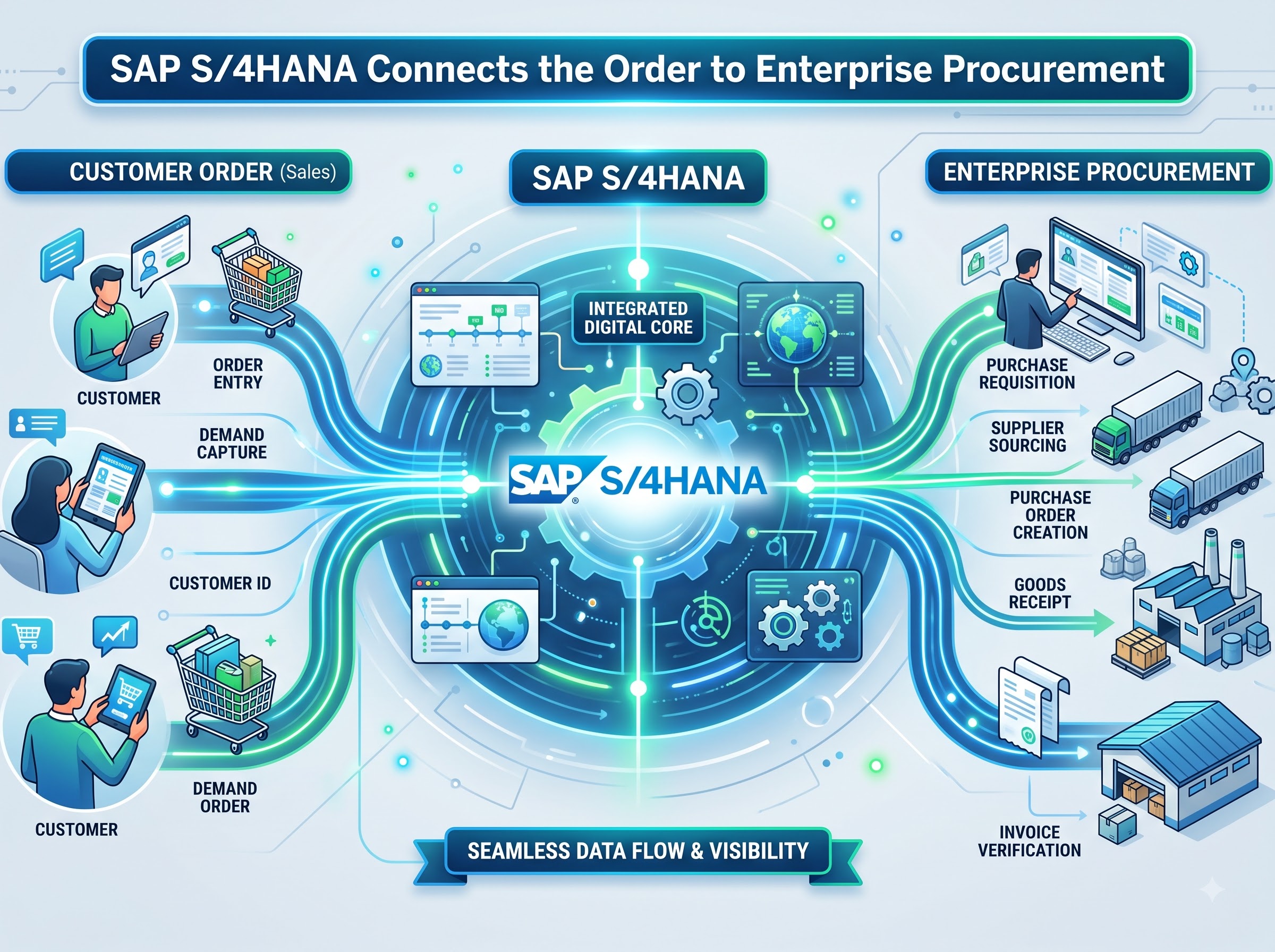
The commercial path depends on the customer’s procurement model. A low-value order may be covered by a contract, catalog, blanket purchase order, purchasing card, evaluated receipt, or periodic consolidated invoice. Another organization may require a purchase requisition, approval, purchase order, goods receipt, and invoice match for every order or batch. BOC uses the configured path; it does not invent a parallel buying process.
Before creating or referencing a transaction, BOC validates company code, purchasing organization, purchasing group, plant or receiving location where applicable, supplier, material or service classification, account assignment, cost center, internal order, tax context, price, currency, and approval threshold. Only fields supported by policy and the selected API are transmitted.
SAP integration document numbers and status become part of the BOC case. A BCM production order can be linked to the correct requisition, purchase order, line item, contract, or settlement reference. That correlation supports audit, supplier communication, receipt, invoice matching, cost reporting, cancellation, and later investigation.
Approvals Need Scope Version and Expiration
An approval should identify what was approved: person, identity version, product, quantity, price or tolerance, cost center, supplier, destination, delivery date, and request version. Approving “business cards” in the abstract creates ambiguity when the title, quantity, cost, or location changes.
BOC checks authority at decision time and again before irreversible execution. Manager, budget owner, procurement approver, brand reviewer, or security role may change while the request is waiting. Material changes invalidate affected approvals; minor changes can follow documented tolerances. Every decision records the actor, authority source, timestamp, policy version, and scope.
Segregation of duties can prevent one person from requesting, approving, changing supplier data, confirming receipt, and resolving the invoice. Thresholds and approval routes should reuse enterprise policy rather than live only inside the ordering application.
Exceptions Must Preserve the Transaction Chain
Failures can occur before or after SAP accepts a transaction. A missing cost center, closed posting period, invalid supplier, duplicate request, price variance, expired approval, API timeout, rejected proof, partial production, delivery discrepancy, or invoice mismatch requires different recovery. Generic retry logic can create duplicate spend or production.
BOC classifies whether the outcome is known, unknown, reversible, or already committed. It uses idempotency and stable business keys where supported, queries current state before retrying, and sends uncertain cases to an accountable owner. Technical recovery and business recovery are tracked separately.
An exception closes only when the actual state is reconciled across BOC, SAP S/4HANA, CCA, BCM, the supplier, and delivery evidence. A cleared error message is not proof that the correct cards were produced, received, and financially recorded.
Receipt Invoice and Cost Evidence Complete the Process
Delivery can be confirmed by carrier data, receiving staff, office administration, or the recipient, depending on risk and policy. BOC links the confirmation to the expected order, quantity, destination, and SAP document. Short shipments, damage, misprints, or undelivered packages remain open obligations rather than disappearing when a shipment is marked delivered.
Financial reconciliation compares the authorized request, purchase document, supplier outcome, receipt, invoice, tax, price, quantity, freight, credit, and final posting. A consolidated invoice may cover many card orders, so line-level correlation and supplier references are essential. Corrections and credits remain linked to the original case.
Management reporting can then show demand, spend, cycle time, exception aging, duplicate prevention, approval delay, proof correction, supplier performance, receipt accuracy, invoice variance, reorder patterns, and cost by company code or program without building an uncontrolled reporting copy of personal data.
Security and API Reliability Are Business Controls
Integration identities should receive only the SAP, CCA, BCM, HCM, and CRM permissions required by the workflow. Secrets and certificates need managed storage, rotation, environment separation, and ownership. Personal and financial data should be minimized in payloads, queues, logs, support screens, and retained evidence.
API management can enforce authentication, authorization, quotas, routing, threat protection, observability, and lifecycle policy. BOC adds business-level correlation, replay control, timeout handling, retry boundaries, dead-letter ownership, and reconciliation. Monitoring must distinguish platform availability from a single transaction that is stuck or inconsistent.
Changes to an SAP API, communication arrangement, extension field, supplier rule, CCA template, BCM product, or approval policy should be tested against representative scenarios. Deployments need rollback, compatibility, and cutover controls so a technical release cannot strand in-flight requests.
A Practical Implementation Roadmap
Begin with one legal entity, supplier arrangement, card program, and clearly defined trigger. Map the source event, required HCM and CRM facts, CCA fields and rules, BCM products and states, SAP procurement path, account assignments, approvers, API endpoints, supplier messages, receipt method, invoice pattern, retention, and closure evidence.
Design correlation identifiers and version rules before automation. Configure authentication, authorization, data mapping, validation, idempotency, queues, timeouts, monitoring, exception ownership, reconciliation, and support procedures. Test invalid master data, changed employees, cancelled events, duplicate submissions, delayed approvals, API uncertainty, price variance, partial shipment, rejected receipt, credit, and reprint.
Measure request-to-approval time, identity accuracy, purchase-document success, duplicate prevention, manual touches, exception aging, proof corrections, supplier cycle time, on-time delivery, receipt accuracy, invoice-match rate, cost allocation, and evidence completeness. Expand to additional business units only after the first pattern is controlled and supportable.
Buyer-Intent Bridge: What a BOC Engagement Produces
Organizations evaluating SAP business card ordering integration usually do not need another isolated form. They need a reliable operating model across identity, procurement, production, and finance. A BOC discovery engagement can produce the source-of-truth matrix, lifecycle, integration architecture, SAP document strategy, API and security model, approval matrix, exception taxonomy, evidence model, reporting design, implementation backlog, and measurable success criteria.
The result is a reusable pattern. Once the enterprise can govern a small but cross-functional purchase from need through financial closure, the same control principles can support branded materials, onboarding kits, uniforms, access media, event collateral, and other identity-linked operational products.
Choose one current card-order path that depends on email, re-entry, spreadsheets, copied identity, or manual invoice research. BOC can turn it into a controlled integration while keeping SAP S/4HANA, HCM, CRM, CCA, BCM, and suppliers authoritative for the decisions they own.
Questions Integration Buyers Should Ask
- Which SAP S/4HANA edition services communication arrangements and middleware support the selected process?
- Which platform owns workforce data printable identity product configuration procurement receipt and invoice state?
- What SAP document model fits card ordering: contract catalog requisition purchase order consolidated settlement or another approved path?
- How are version changes duplicate requests uncertain API outcomes partial deliveries credits and reprints controlled?
- Which approval scopes thresholds segregation-of-duties rules and tolerances apply?
- Who owns credentials monitoring exceptions reconciliation retention support and evidence?
Frequently Asked Questions
- Does BOC replace SAP S/4HANA? No. SAP remains authoritative for configured procurement and finance records. BOC coordinates cross-system context decisions, execution exceptions, and evidence.
- Is this a native SAP connector? The article describes a configurable integration pattern using approved SAP interfaces and the customer’s architecture. Available services and setup vary by landscape and edition.
- Can an HCM record be printed directly? It should first pass the printable-identity policy. CCA governs the approved card identity and version before BCM production.
- When is the process complete? After the intended cards are delivered or otherwise resolved and the related procurement receipt invoice cost and exception obligations are reconciled.
Connect one business card order to enterprise financial control. Business Ops Center can help define and implement a governed workflow across SAP S/4HANA, HCM, CRM, CCA, BCM, suppliers, and delivery systems. Start with one business unit, one supplier path, and one ordering problem that currently requires manual validation or reconciliation.