
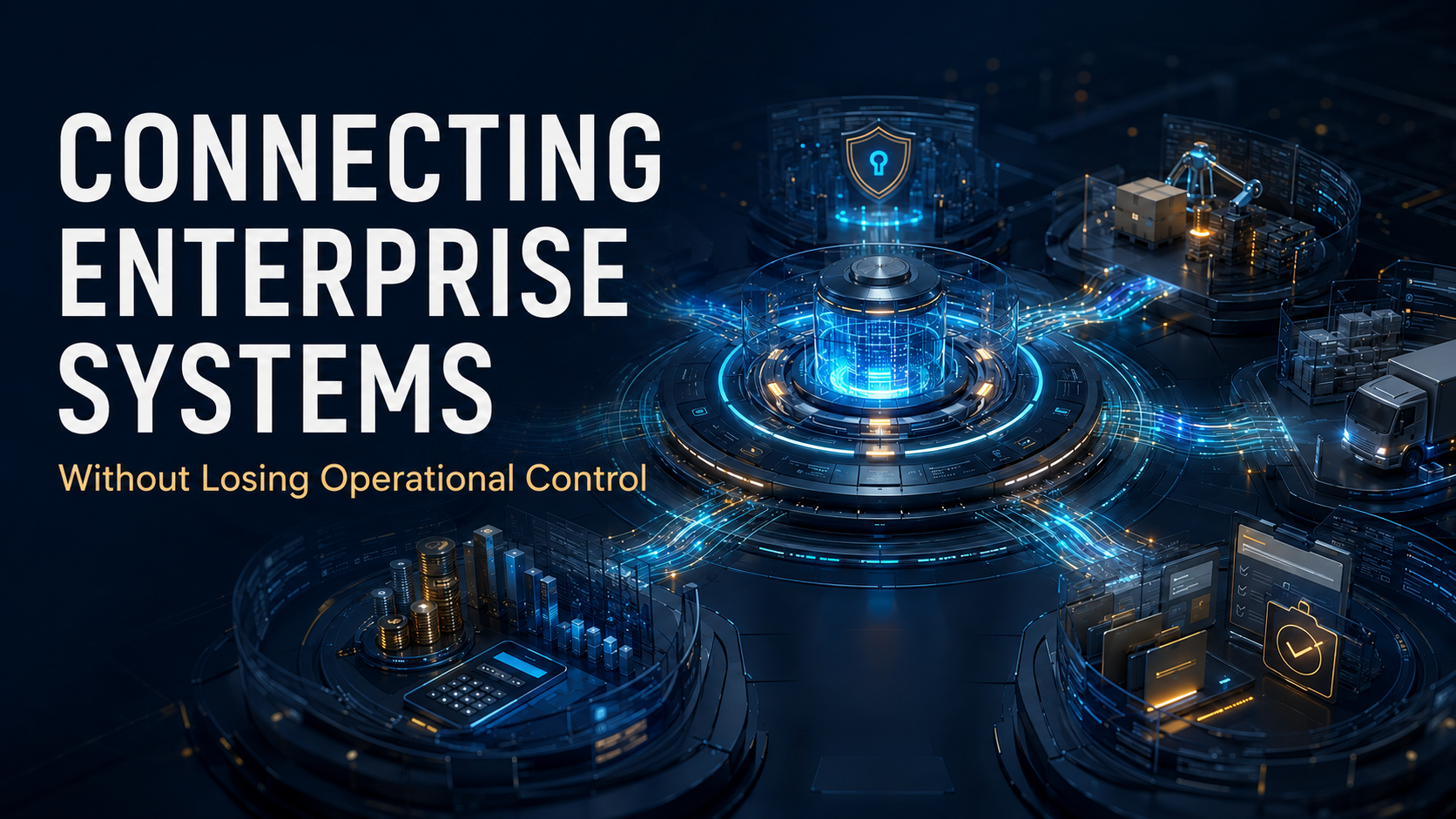
The Enterprise Integration Problem Is Not a Lack of Connections
Most large organizations already operate a dense portfolio of business systems strategy. CRM platforms manage customer and revenue activity. HRIS and HCM platforms maintain employee records. Identity providers govern access. ERP and procurement platforms control purchasing, cost allocation, and suppliers. Collaboration tools carry notifications, while specialized applications execute work.
The problem is that a connection between two systems does not automatically create an end-to-end operating model. An API may transfer an employee name, a workflow may send an approval notification, and a procurement platform may produce a purchase order. Yet the organization can still lack a single operational view of why work started, which policy applied, who approved it, what changed, where an exception occurred, and whether execution matched the original business intent.
This is the gap Business Ops Center is designed to address. BOC should not be understood as another point application competing with CRM, HR, ERP, or procurement systems. Its role is to coordinate the operational chain between systems: accepting trusted business events, applying workflow and governance context, routing decisions, releasing approved work, and preserving evidence across the full lifecycle.
From Point-to-Point Integration to an Operational Control Layer
Traditional integration projects often begin with a field-mapping question: which value in System A should populate which field in System B? That work is necessary, but it is only the transport layer. Enterprise operations require additional answers. Which source is authoritative? When is a record considered ready? What happens when two systems disagree? Which changes require approval? Can a future-dated event trigger physical execution today? How is a failed handoff reconciled?
BOC adds an operational control layer around those questions. It does not need to replace the source systems. Instead, it can maintain the cross-system state needed to move a business request safely from trigger to completion. This separates system ownership from process ownership: each application remains responsible for its domain, while BOC governs the journey that spans those domains.
| Core distinction: An integration moves data. An operational control layer determines whether that data is complete, authorized, actionable, correctly routed, successfully executed, and provable afterward. |
The Systems BOC Brings Into One Governed Workflow
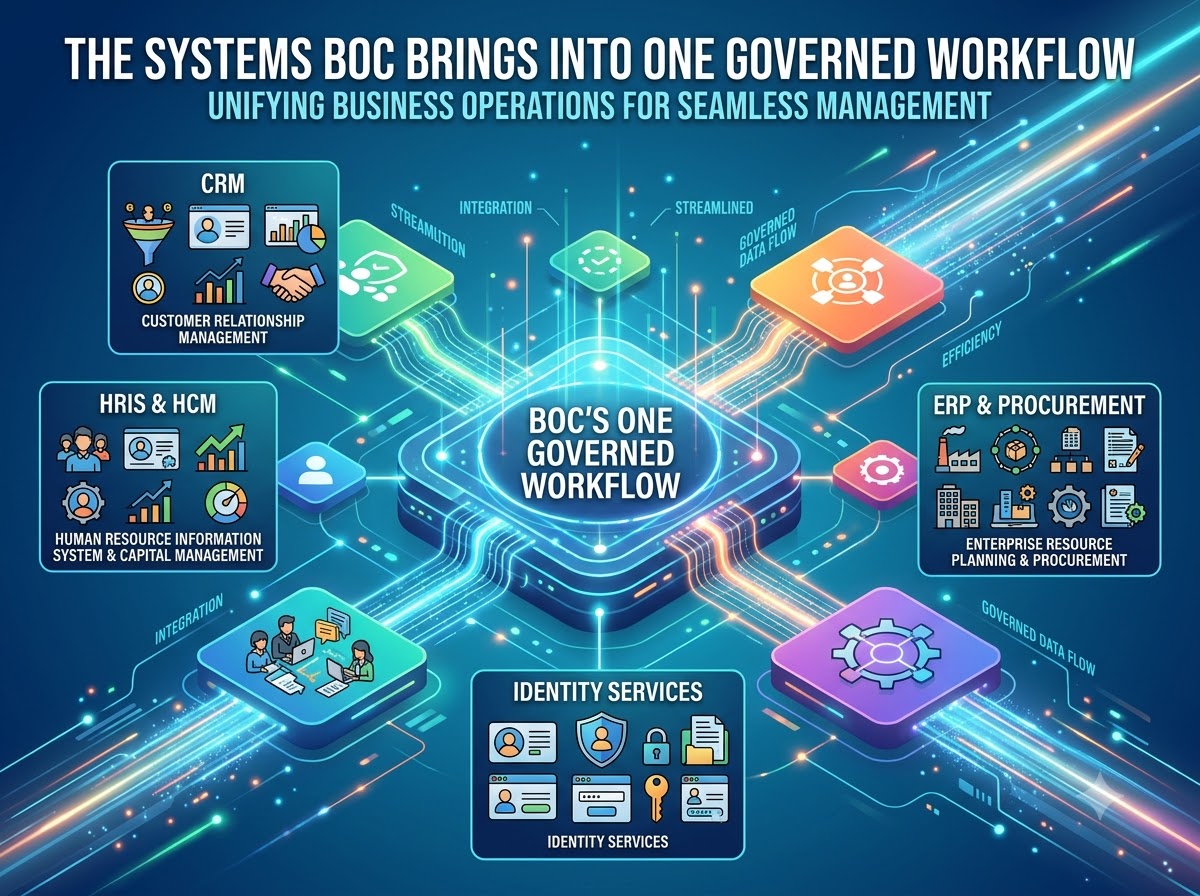
CRM: customer-facing context and demand signals
CRM systems such as Salesforce, Microsoft Dynamics 365, HubSpot, and Zoho CRM contain customer, account, territory, campaign, and sales-team context. A CRM-triggered workflow may indicate that a new representative is assigned to an account, a field team is preparing for an event, or a customer-facing employee requires approved materials. BOC can use that signal without treating CRM as the authority for every employee or procurement attribute.
The governance value lies in controlled enrichment. CRM context can initiate or influence a request, while HR supplies verified identity data, marketing supplies brand rules, and procurement supplies purchasing constraints. BOC keeps those contributions connected to one operational record instead of allowing disconnected teams to recreate the same request in different systems.
HRIS and HCM: employee authority and lifecycle events
Platforms such as Workday, SAP SuccessFactors, Oracle HCM Cloud, ADP Workforce Now, UKG, BambooHR, and Rippling manage critical employee data and lifecycle events. New hires, transfers, promotions, title changes, location changes, leave events, and departures can all affect downstream work. Yet an HR event should not automatically become an order or external commitment without eligibility, timing, display, and exception rules.
BOC can interpret the event in an operational context: confirm effective dates, determine whether required fields are complete, apply approved display mappings, identify the correct business unit and location, and decide whether straight-through execution or human review is appropriate. This protects the authority of HR data while preventing raw administrative values from flowing into customer-facing or physical outputs without governance.
Identity and directory services: access, provisioning, and scope
Microsoft Entra ID, Okta, Google Workspace, and other directory services answer a different set of questions: who can enter the workflow, what role they hold, which organizational scope they may act within, and when access must be revoked. Connecting identity to BOC supports single sign-on, role-based permissions, delegated administration, and more reliable offboarding.
The important design principle is to avoid confusing authentication with business authorization. A user may be authenticated but still lack permission to approve a request, change a protected field, select a supplier, or release spend. BOC can combine directory identity with workflow roles and policy rules so each action is evaluated in context.
ERP and procurement: cost, supplier, and purchasing control
ERP and procurement platforms—including Oracle NetSuite, SAP Ariba, Coupa, and other finance systems—govern suppliers, cost centers, budgets, purchase orders, invoicing, and spend reporting. If operational work bypasses these controls, the organization may gain speed at the cost of visibility and accountability.
BOC can carry the approved operational specification into the purchasing process with the right cost allocation, vendor rule, quantity constraint, and business justification. It can also receive the resulting purchase or fulfillment status so the originating workflow does not end at approval. This closes the loop between a policy decision and the actual commercial outcome.
Workflow and collaboration platforms: action without fragmentation
ServiceNow can provide enterprise request and service-management context, while Slack and Microsoft Teams can deliver timely notifications and approval prompts. These tools improve responsiveness, but a message thread should not become the system of record. The durable decision, approval identity, policy version, and final outcome must remain attached to the governed workflow.
BOC can send actionable notifications while retaining the authoritative state. Users receive work where they already collaborate, but the organization does not lose evidence when a channel is archived, a message is deleted, or a participant changes roles.
A Governed End-to-End Integration Pattern
A reliable BOC integration architecture can be organized around seven operational stages. These stages are more useful than a long list of connectors because they reveal how control is maintained from initiation through evidence.
1. Event intake
BOC receives an event or request from an authorized source and records the source, timestamp, identifiers, event type, and correlation data.
2. Validation and enrichment
Required attributes are checked, authoritative sources are consulted, and business context is assembled without overwriting source ownership.
3. Policy evaluation
Eligibility, timing, field protection, template, supplier, spend, location, and exception rules are evaluated against a versioned policy set.
4. Approval orchestration
The request is routed according to value, risk, geography, hierarchy, or exception type, with delegation and escalation controlled.
5. Controlled release
Only an approved and complete specification is released to the execution system, vendor, procurement platform, or fulfillment workflow.
6. Status and reconciliation
Acknowledgements, errors, retries, cancellations, shipping, completion, and financial outcomes return to the operational record.
7. Evidence and improvement
The complete lifecycle becomes searchable evidence for audit, service analysis, policy refinement, supplier management, and process improvement.
Why a Shared Operational Record Matters
Without a shared operational record, every system sees only its portion of the transaction. HR knows that an employee changed roles. Marketing knows which identity standard should be applied. Enterprise business card procurement knows which supplier and cost center were used. A fulfillment system knows whether an item shipped. None of those views alone explains the full operational decision.
BOC can preserve the correlation between those records. The operational record does not need to duplicate entire source databases; it needs the identifiers, approved snapshots, decisions, timestamps, transformations, status transitions, and evidence required to explain the workflow. This creates traceability without turning BOC into an uncontrolled data warehouse.
Integration Governance Principles for Enterprise Scale
Preserve authoritative ownership. Define which platform owns each attribute and decision. BOC coordinates the process but should not silently become the master for HR, identity, supplier, or financial data.
Make effective dates explicit. Future hires, promotions, transfers, and terminations require timing rules. Event date, effective date, approval date, release date, and fulfillment date must not be treated as interchangeable.
Version mappings and policy. Titles, locations, departments, templates, approval routes, and supplier rules change. Every decision should be explainable against the policy and mapping version used at the time.
Design exceptions as first-class work. Missing data, unusual titles, cross-border requests, rush orders, failed events, and supplier constraints are predictable. They require visible queues, accountable owners, deadlines, and resolution evidence.
Use idempotency and correlation. Repeated events should not create duplicate work. Stable business keys and correlation identifiers allow safe retries and cross-system reconciliation.
Minimize and protect data. Move only the data required for the workflow, apply appropriate access controls and retention, and avoid exposing sensitive HR or financial details to users who only need operational status.
Treat monitoring as part of the product. Integration health, backlog, error rates, retry behavior, exception aging, and reconciliation gaps must be visible to operational owners, not only to developers.
What This Looks Like in a Business Identity Workflow
Consider an employee who is promoted into a customer-facing role. The HRIS records the approved title and effective date. The identity platform confirms the employee account and access scope. CRM context identifies the territory or customer-facing function. Brand policy determines the approved display title and template. A manager or marketing owner reviews any exception. Procurement confirms cost center, quantity, and supplier. Business Card Manager executes the approved order, while fulfillment status returns to BOC.
In a fragmented environment, each handoff becomes an email, spreadsheet, rekeyed form, or isolated ticket. In a BOC-coordinated environment, the same event becomes a governed chain. Every system contributes the information it owns, every decision is recorded, execution receives an approved specification, and completion is reconciled against the initiating event.
This is also where the relationship between BOC, Color Card Administrator, and Business Card Manager becomes clear. BOC is the cross-system operational workflow orchestration layer. CCA serves as the authority and governance engine for controlled business identity decisions. BCM serves as the execution and conversion engine that turns approved specifications into managed ordering and fulfillment. The products remain distinct, but their roles form a coherent enterprise operating model.
Implementation Roadmap: Start With Control, Then Add Coverage
Phase 1 — Define the operating contract
Identify the triggering events, authoritative systems, required attributes, policy owners, approval roles, execution targets, evidence requirements, and failure responsibilities. Create the operating contract before writing connector code.
Phase 2 — Prove one high-value workflow
Select a bounded use case, such as new-hire provisioning or approved title changes for one region. Validate the full lifecycle, including exceptions and reconciliation, rather than demonstrating only a successful API call.
Phase 3 — Add identity, procurement, and execution controls
Expand access scope, delegated administration, cost allocation, supplier logic, release criteria, and fulfillment feedback. Measure where work still leaves the governed path.
Phase 4 — Scale through reusable patterns
Standardize canonical events, mappings, policy services, connector interfaces, error handling, and evidence structures so new systems can be added without redesigning the operating model.
Phase 5 — Optimize with operational evidence
Use exception frequency, approval duration, retry rates, preventable rework, fulfillment performance, and policy overrides to improve both automation and governance.
Metrics That Show Whether Integration Is Actually Working
Connector uptime alone does not demonstrate operational success. BOC should help enterprise decision intelligence teams measure the quality and control of the complete process. Useful measures include straight-through processing rate, time from event to approved release, percentage of requests with complete authoritative data, exception aging, duplicate prevention, reconciliation gaps, failed handoffs, unauthorized change attempts, approval-policy overrides, rework and reprint rates, spend by business unit, supplier turnaround, cancellation recovery, and completion confirmation.
These measures connect technical reliability to business outcomes. A connector can be available while work is accumulating in an unowned exception queue. Conversely, a deliberately paused transaction may demonstrate that governance is working because the system prevented an incomplete or premature commitment. The right metrics distinguish healthy control from simple transaction volume.
What Enterprise Buyers Should Ask
- Which system is authoritative for each employee, customer, identity, purchasing, and fulfillment attribute?
- How are effective-dated changes, cancellations, corrections, and duplicate events handled?
- Can policies, mappings, approvals, and exceptions be versioned and reconstructed later?
- Does the workflow maintain one correlation trail across source, approval, procurement, execution, and fulfillment records?
- How are role-based access, delegated administration, segregation of duties, and sensitive fields controlled?
- What happens when an integration succeeds technically but the business transaction remains incomplete?
- Can operational teams see and resolve failures without relying on developers for every exception?
- Are new connectors added to a reusable governance model, or does every integration create another custom process?
The Strategic Outcome: Connected Operations With Accountable Control
Enterprise integration should reduce fragmentation without creating invisible automation. The objective is not to connect every application as quickly as possible. It is to build a controlled operating environment in which trusted events can initiate work, policy can shape decisions, people can handle meaningful exceptions, execution can proceed from approved specifications, and evidence can explain the result.
Business Ops Center provides the framework for that environment. By coordinating CRM, HRIS, HCM, identity, ERP, procurement, collaboration, approval, and enterprise execution excellence systems, BOC can turn disconnected transactions into governed operational lifecycles. The organization gains speed where rules are clear, human oversight where judgment is required, and traceability across both.
That is the difference between a portfolio of integrations and an enterprise operations architecture. Connections move information. BOC turns connected information into controlled, accountable, and measurable work.
Call to Action
| Build an integration operating model—not another isolated connection. Explore how Business Ops Center can coordinate enterprise workflows across systems, approvals, execution, and evidence. Visit businessopscenter.com to discuss your operational integration priorities. |