


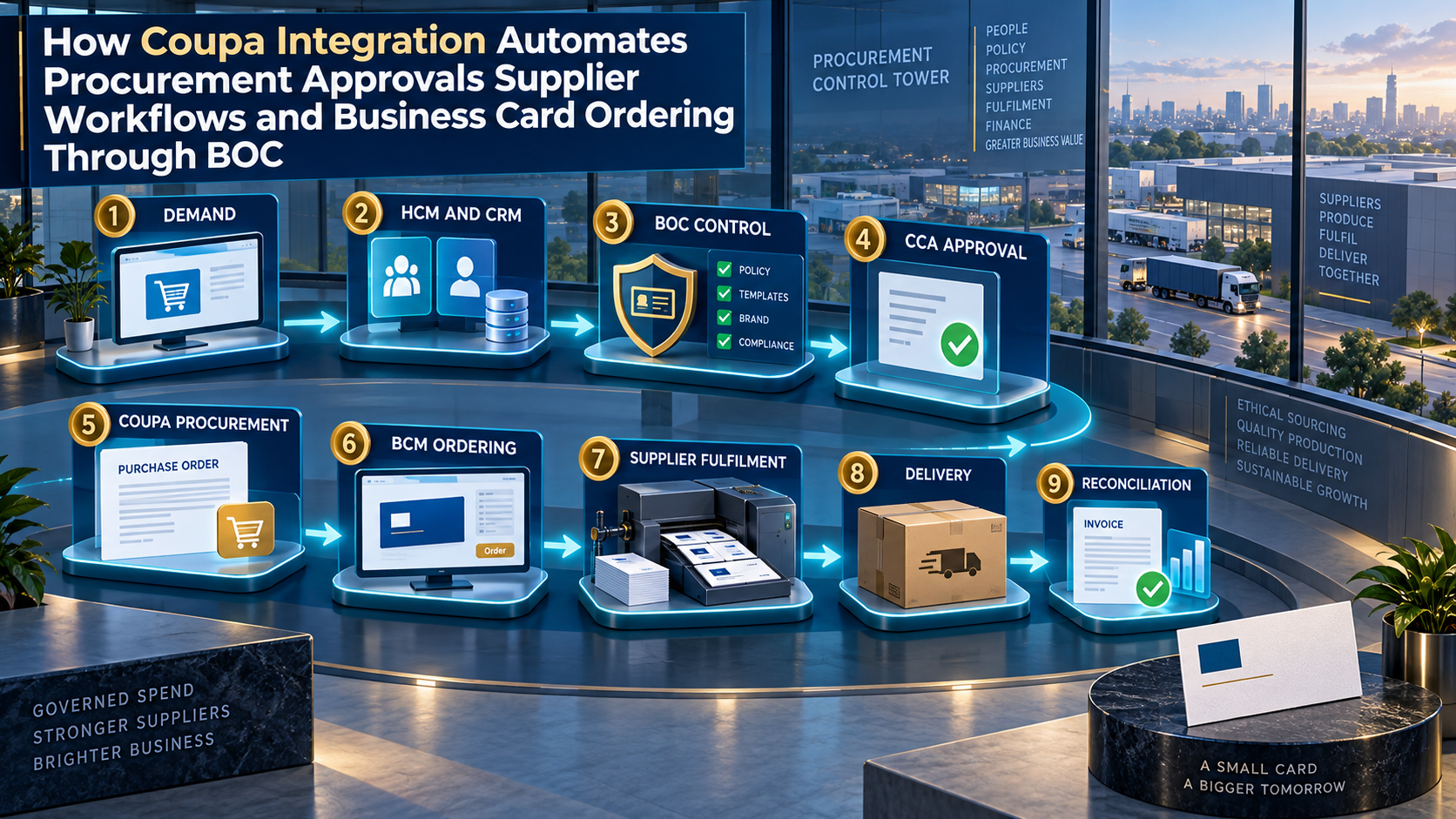
A governed procure-to-pay workflow from employee demand to approved, identity-controlled fulfilment and reconciled spend.
Coupa can govern requisitions, approvals, purchase orders, supplier transactions, and invoices, but business card ordering starts before procurement and ends after a purchase record is created. BOC connects employee demand, HCM and CRM context, CCA identity approval, BCM order conversion, Coupa spend controls, supplier fulfilment, delivery evidence, and financial reconciliation into one accountable operation.
BOC Connects Business Need to Controlled Spend
A business card request looks small in financial terms, yet it crosses employee identity, brand authority, purchasing policy, supplier production, delivery, and accounting. The request may originate with a new hire, a sales assignment, an office transfer, a conference, or a reorder. Each trigger requires facts from different applications before the organization can make a responsible purchasing decision.
Coupa provides important procurement, HR, and operations authority. It can manage requisitions, approvals, purchase orders, supplier interaction, receipts, invoices, and spend records according to the customer’s licensed products and configuration. It should not decide which title may be printed, whether a salesperson genuinely needs cards, or whether a delivered package contains the approved identity version. Those questions belong to workforce, commercial, brand, ordering, and operational owners.
Business Ops Center coordinates the complete outcome. HCM owns employment status and workforce attributes. CRM owns customer-facing assignments and commercial context. Color Card Administrator controls the identity and brand approved for print. Business Card Manager converts that approved identity into a card order and supplier instruction. Coupa retains procurement and spend authority. BOC correlates the records, applies policy, manages exceptions, monitors fulfilment, and authorizes closure.
Coupa Integration Creates a Focused Customer Opportunity
Many enterprises already use Coupa but still handle low-value branded materials through email, spreadsheets, separate portals, and manual invoice investigation. An employee or manager requests cards. HR confirms the title. Brand corrects the layout. Administration retypes the information into an ordering system. Procurement sees only a requisition or invoice. The supplier receives production instructions without the full approval history.
A Coupa integration gives BOC a practical starting point because the customer can connect a visible employee need to measurable procurement outcomes. The first implementation can focus on one legal entity, supplier, card product, and workforce event. It can measure approval time, manual touches, duplicate prevention, proof corrections, off-contract spend, delivery performance, invoice variance, and evidence completeness.
The same operating pattern can later support other controlled employee purchases. The reusable asset is not a single API connection. It is the agreement about sources, decision rights, purchasing thresholds, exception ownership, correlation, evidence, and closure.
Coupa Supports Procure-to-Pay Integration
Coupa provides APIs and integration resources for procurement transactions, including purchase orders and invoices. Its current OAuth 2.0 guidance describes client-credentials access, object-level scopes, access tokens, and REST calls that use approved permissions. Coupa also supports supplier collaboration through its supplier-facing capabilities. The exact endpoints, fields, products, and entitlements depend on the customer’s Coupa environment and release.
BOC can use supported Coupa interfaces to create or reference a requisition, receive approval and purchase-order events, transmit authorized order context to BCM, and correlate receipts, invoices, credits, and exceptions. Some customers may use Coupa-native integrations, middleware, managed file exchanges, cXML, supplier portals, or a combination. Architecture should follow the supported method for the specific transaction and supplier relationship.
An accepted API request is not the business outcome. It confirms that a message passed a technical boundary. BOC still needs evidence that the right identity was approved, the correct product was ordered, the supplier produced the approved version, delivery occurred, and the final charge matched authorized spend.
The Governed Business Card Procurement Lifecycle
| Lifecycle stage | Authoritative context | BOC control | Required outcome |
|---|---|---|---|
| Demand | Employee request HCM event CRM assignment or campaign need | Authenticate, correlate, and classify the trigger | One traceable case with a valid purpose |
| Eligibility | HCM status, CRM context policy, quantity timing, and order history | Evaluate need and route missing facts | Authorized business requirement |
| Identity | CCA-approved name, title, contact data, entity brand, and template | Control approval version and correction | Production-ready identity and artwork |
| Procurement | Coupa requisition approval budget account supplier and purchase order | Apply delegated spend authority and link evidence | Approved commitment within policy |
| Order | BCM product quantity, proof shipping address and supplier instruction | Convert authorization without rekeying | Controlled order tied to authority |
| Fulfilment | Supplier proof production, shipment tracking, delivery, and cancellation | Monitor service levels and assign recovery | Verified delivery or owned exception |
| Reconciliation | Coupa receipt invoice tax allocation credit and payment status | Compare approved expected and actual results | Operational and financial closure |
HCM and CRM: Establish the Need Before Procurement
The HCM platform provides workforce facts needed to evaluate the request. Useful fields may include a stable employee identifier, active status, employment type, start date, approved name, job title, manager, legal entity, work location, work email, and effective date. Compensation, bank, tax, government identifier, home contact, and unrelated demographic data should not enter the card workflow.
CRM adds the commercial context that HCM usually lacks. Account ownership, territory, partner responsibility, field assignment, campaign participation, event attendance, and customer-facing duties can establish why printed cards are needed. BOC combines that context without changing ownership: HCM remains authoritative for employment facts, and CRM remains authoritative for customer and sales assignments.
This evaluation prevents automatic purchasing for every worker. A customer-facing new hire may qualify for a standard order. A conference requirement may justify a larger quantity or expedited delivery. A temporary worker, inactive employee, repeated reorder, or request with conflicting identity data can require review before any procurement commitment is made.
BOC Governs Qualification and Delegated Authority
BOC evaluates employee status, commercial need, legal entity, location, quantity, product, prior orders, replacement reason, required date, delivery address, cost, supplier, and available policy. Standard demand can proceed within delegated authority. Rush shipping, premium materials, bulk quantities, unusual addresses, frequent reorders, and off-contract suppliers can require additional decisions.
Different owners answer different questions. A manager confirms business card management needs. HR resolves workforce data. Sales operations verifies commercial context. Brand approves the published identity. Procurement approves supplier and purchasing treatment. Finance approves accounting or exceptional costs. BOC routes each issue to the correct owner and records the actor, timestamp, evidence, policy basis, and result.
The workflow distinguishes approval for identity from approval to spend. A perfectly formatted card should not be ordered without purchasing authority. A Coupa requisition should not release production while the printed title is disputed. BOC coordinates both decisions and blocks execution until the required conditions are satisfied.
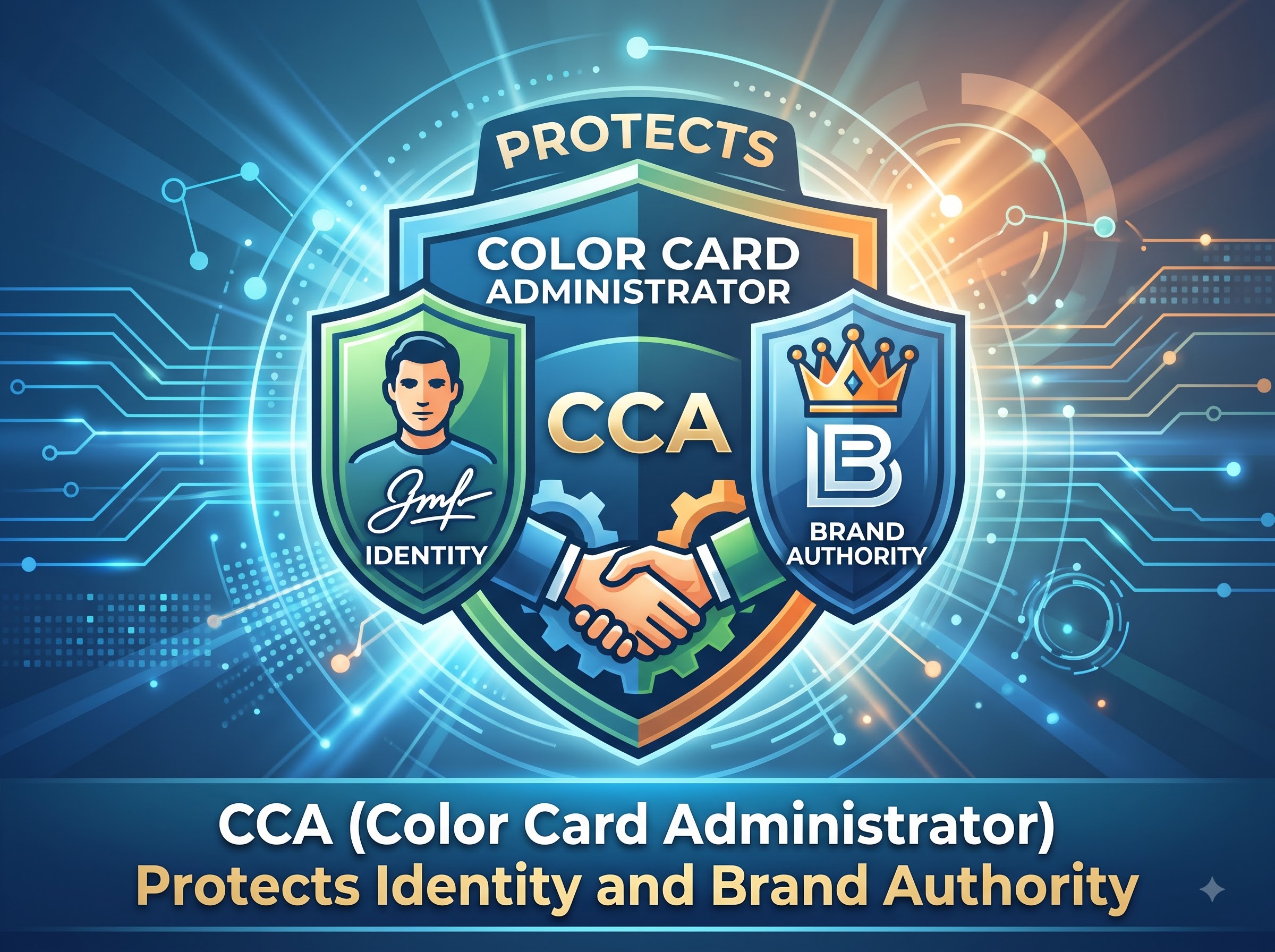
CCA Protects Identity and Brand Authority
Color Card Administrator governs what may appear on the physical card. It validates the approved name, title, company, office, phone, email, language, legal text, brand, logo, and template. CCA returns a specific approved identity version that BOC and BCM can reference.
Version control is essential when a workforce record changes after approval. If HR corrects a title while a requisition is pending, BOC can invalidate the prior approval, update the expected product context, and require a new proof. If production has begun, the workflow applies the cancellation or replacement policy and records any unavoidable cost.
Coupa should receive enough description and reference data to support procurement without becoming the master for printed identity. Sensitive or verbose identity fields do not need to appear on requisition and invoice records. BOC links the Coupa transaction to the controlled CCA version through durable identifiers.
Coupa Governs the Procurement Commitment
Once eligibility and identity conditions are satisfied, BOC can initiate or reference the appropriate Coupa buying process. The requisition can include the requester, entity, cost center, account, category, supplier, product description, quantity, expected amount, delivery requirement, and references to the BOC case and approved identity. Coupa applies its configured approval and purchasing controls.
The integration must respect Coupa as the procurement authority. BOC should not manufacture a purchase-order number, bypass a denied requisition, or treat a pending approval as permission to produce. Coupa returns the authoritative procurement state, and BOC interprets that state alongside the identity and fulfilment conditions.
A blanket purchase order, catalog item, contract, virtual card, or invoice process may change how the transaction is represented. The design should follow the customer’s accounting and procurement policy. BOC supplies the cross-system context and keeps the physical order tied to the approved commitment.
BCM Converts Authority into a Production Order
Business Card Manager converts the approved workforce events to identity and procurement authority into a controlled card order. BCM applies product, quantity, stock, finish, language, supplier, proof, shipping service, and delivery address rules. It returns proof, production, shipment, tracking, delivery, cancellation, and reorder events.
BOC interprets those events as operational work. A rejected proof returns to CCA or the identity owner. A supplier delay creates an exception with an owner and deadline. A failed delivery may require address correction and reshipment approval. A cancellation may require Coupa updates, a supplier credit, or acceptance of an unavoidable charge.
The BCM order should retain the BOC case identifier, CCA version, Coupa requisition and purchase-order references, HCM employee identifier, and the minimum CRM context needed to explain demand. This correlation gives support teams a complete history without duplicating entire source records.
APIs Must Preserve Transaction and Source Boundaries
Coupa’s OAuth guidance supports scoped client-credentials access. An integration should use dedicated identities, minimum scopes, protected client secrets, planned token renewal, environment separation, monitored failures, access reviews, and documented credential rotation. The implementation must verify current Coupa documentation and the customer’s enabled permissions before production.
Every API or file interface needs a contract covering identifiers, schema, required fields, currency, amounts, tax treatment, effective dates, idempotency, response behavior, timeouts, retries, error classification, and ownership. Duplicate messages must not create duplicate requisitions, orders, receipts, or invoices. Failed records need quarantine and recovery procedures.
BOC uses correlation identifiers to connect the Coupa transaction with HCM, CRM, CCA, BCM, supplier, and delivery records. It should not create an uncontrolled duplicate of Coupa’s procurement ledger. The operational identity governance case stores decisions and evidence while each source system retains its authoritative record.
Supplier Integration Requires Controlled Instructions
Suppliers may receive purchase orders or order details through Coupa, BCM, cXML, a supplier portal, an API, or another approved route. The implementation must identify which system sends commercial authorization and which sends production content. Sending overlapping instructions from multiple channels can cause duplicates or inconsistent versions.
The supplier should receive only the approved production and delivery information. It does not need employee history, CRM accounts, or internal approval commentary. The production instruction must identify the approved artwork version, product, quantity, shipping service, address, required date, purchase reference, and BOC correlation key.
Acknowledgement, proof, production, shipment, tracking, delivery, cancellation, and credit events must map to defined operational states. Silence is not acceptance. BOC monitors expected responses and creates an exception when an acknowledgement or milestone does not arrive within the agreed service target.
Receipt, Invoice and Delivery Are Different Events
A supplier invoice does not prove delivery. A carrier delivery scan does not prove that the invoice is correct. A Coupa receipt can represent acceptance under policy, but the organization must define whether employee confirmation, location receipt, carrier evidence, or another control is required for business cards.
BOC compares the approved product, quantity, price, shipping service, purchase order, proof, production result, delivery evidence, receipt, invoice, tax, allocation, cancellation fee, and credit. Quantity differences, duplicate invoices, unexpected rush charges, incorrect entity coding, missing receipts, and charges for cancelled orders become owned exceptions.
This distinction prevents premature closure. The case ends only when the approved physical result has been delivered, and material procurement and accounting obligations are matched, corrected, accepted, or assigned under an authorized exception. API integration for business card ordering success and invoice approval are evidence, not substitutes for outcome verification.
New Hires, Reorders and Departures Need Separate Controls
A new-hire case can begin before the start date, wait for final workforce and CRM facts, complete identity approval, obtain purchasing authority, and release production when the readiness threshold is met. BOC coordinates timing so the card is available when required without ordering against provisional data.
Reorders should use order history and policy. Normal replenishment within quantity and timing limits may follow a streamlined path. Lost shipments, damage, frequent reorders, premium upgrades, event quantities, and address changes can require evidence and approval. Existing stock and the last produced CCA version should inform the decision.
A cancelled hire or departing employee can remove the business purpose while procurement and production are already in progress. BOC checks the Coupa and BCM states, stops work where possible, requests supplier cancellation, records credits or unavoidable cost, and keeps the case open until residual obligations have an authorized treatment.
Common Coupa Integration Failures
The most damaging mistake is treating procurement approval as complete operational authority. Other failures include creating a requisition before identity approval, using requester-entered titles, ordering for every employee, bypassing Coupa for rush demand, sending the supplier conflicting instructions, and closing when a purchase order or invoice is approved.
Duplicate events can create duplicate spend. Weak source ownership can spread incorrect identity data. Broad OAuth scopes can expose or modify unnecessary records. Missing correlation can separate a card order from its purchase order. Manual credits and cancellations can remain outside the operational case. A supplier can produce an outdated version even when the amount is correct.
BOC addresses these risks through a defined trigger, source matrix, minimum field set, authority sequence, approval policy, exception taxonomy, correlation key, service target, reconciliation method, and evidence-based closure condition.
A Practical Coupa Integration Roadmap
Begin with one employee population, one legal entity, one Coupa buying channel, one contracted supplier, and one standard card product. Map the current process from demand to delivered card and paid invoice. Identify source owners, data requirements, buying thresholds, approvals, exception types, volumes, supplier commitments, and closure evidence.
Configure the supported Coupa authentication and integration method, then build event correlation, HCM and CRM lookup, eligibility rules, CCA approval, requisition creation or reference, Coupa status handling, BCM order conversion, supplier monitoring, receipt, invoice matching, and exception routing. Test duplicates, cancellations, token failures, denied requisitions, price variance, proof rejection, supplier delay, delivery failure, and credits.
Production readiness requires named business and technical owners, minimum API scopes, secret rotation, mapping governance, change control, retention rules, support procedures, supplier escalation, reconciliation schedules, and measurable targets. Track approval time, straight-through processing, off-contract avoidance, duplicate prevention, proof corrections, exception aging, on-time delivery, invoice variance, and evidence completeness.
BOC Creates a Reusable Procurement Control Pattern
BOC creates value by connecting responsibilities that remain distributed. HCM owns workforce facts. CRM owns commercial need. CCA owns approved identity and brand. Coupa owns procurement commitments and spend records. BCM owns order conversion and fulfilment activity. Suppliers produce and deliver. BOC governs the decisions and evidence that connect them.
A focused discovery engagement can define the event catalogue, source matrix, minimum data set, Coupa integration pattern, purchasing policy, approval model, exception paths, supplier-state mappings, reconciliation rules, implementation backlog, and measurement plan. Business cards offer a clear physical outcome and a practical way to prove the operating model.
Organizations evaluating BOC should start with a procurement workflow that still depends on email or rekeying after approval. Connecting a Coupa request to a verified business card outcome demonstrates how governed integration can protect identity, control spend, improve supplier accountability, and produce auditable closure.
Questions Integration Buyers Should Ask
- Which Coupa products, APIs, transaction types, scopes, and supplier channels support the approved process?
- Which systems own employee status, commercial need, published identity, procurement authority, production delivery, and accounting?
- Does CCA identity approval occur before Coupa commits spend and BCM releases production?
- How will BOC prevent duplicate requisitions, purchase orders, card orders, receipts, and invoices?
- How are HCM, CRM, BOC, CCA, BCM, Coupa supplier delivery and invoice records correlated?
- Who owns OAuth clients, scopes, secrets, token renewal monitoring, reconciliation, and exception recovery?
Connect one Coupa procurement event to a verified business card outcome. Business Ops Center can map the current process, define system ownership, connect HCM and CRM context, coordinate CCA approval and BCM ordering, integrate with Coupa through supported APIs, and implement supplier monitoring, delivery evidence, invoice reconciliation, and exception controls. Begin with one supplier and build a reusable procure-to-pay operating pattern.