


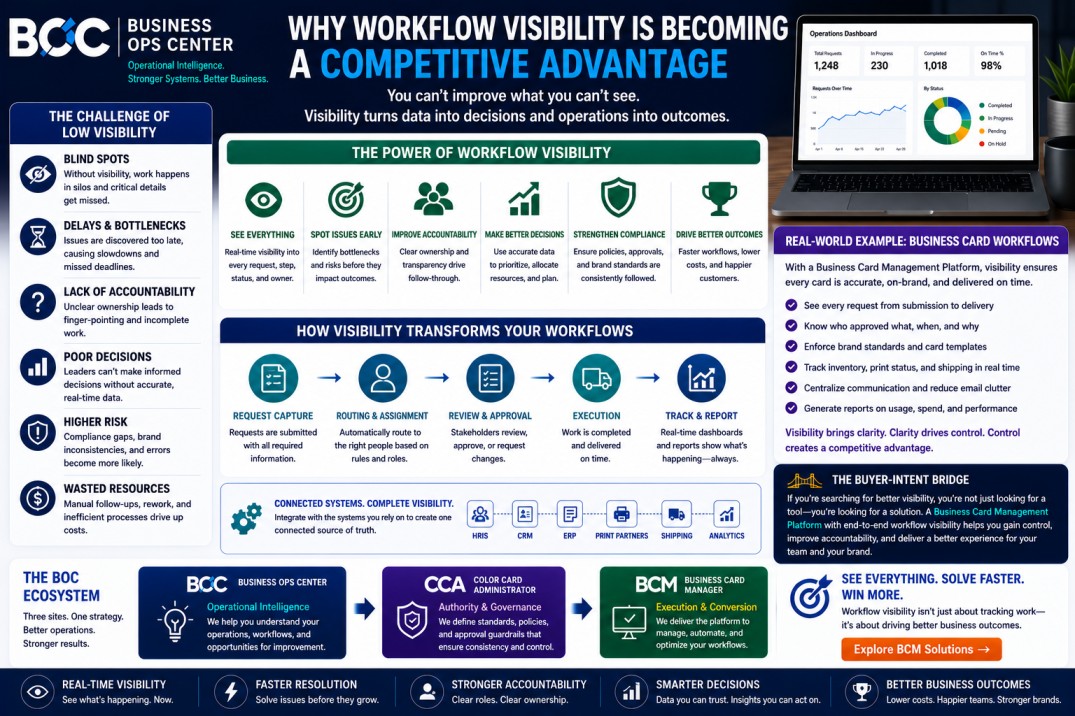
Introduction
For many years, organizations viewed workflow visibility as an operational reporting function. Managers wanted status updates, department leaders wanted performance reports, and executives wanted periodic summaries of business activity. Today, however, workflow visibility has evolved into something much more strategic.
Organizations are operating in increasingly complex environments where employees, vendors, systems, approvals, and workflows interact across multiple locations and departments. In this environment, the ability to understand how work moves through the business has become a competitive advantage.
Companies that can see operational activity clearly are often able to make decisions faster, respond to challenges sooner, improve accountability, and scale more effectively. Organizations that lack visibility frequently struggle with bottlenecks, duplicated effort, inconsistent execution, and delayed decision-making.
What Is Workflow Visibility?

Workflow visibility refers to an organization’s ability to monitor, understand, and analyze how work moves throughout operational processes. It includes visibility into requests, approvals, ownership, status updates, dependencies, bottlenecks, and outcomes.
Effective workflow visibility enables organizations to answer critical questions:
- What work is currently in progress?
- Who owns the next action?
- Where are delays occurring?
- Which approvals are pending?
- How long does execution typically take?
- Which processes create the most operational friction?
When organizations can answer these questions consistently, they gain a stronger understanding of operational performance.
Why Visibility Matters More Than Ever
Modern businesses rely on multiple software platforms, distributed teams, remote employees, external vendors, and interconnected workflows. While technology has improved productivity, it has also increased complexity.
Without visibility, leaders often rely on assumptions rather than operational intelligence. Teams spend time chasing updates, requesting status reports, and manually coordinating activities.
Workflow visibility reduces uncertainty. It creates transparency across processes and helps organizations understand operational reality rather than perceived performance.
The Relationship Between Visibility and Accountability
Accountability becomes significantly stronger when workflows are visible.
When ownership is clearly defined and progress can be monitored, employees and managers gain greater clarity regarding responsibilities. Requests are less likely to be lost, approvals become easier to track, and operational bottlenecks become easier to identify.
Visibility does not exist to monitor people. It exists to improve coordination, remove obstacles, and create confidence that work is progressing as intended.
How Visibility Improves Decision-Making
Business decisions depend on information. Organizations that lack visibility often make decisions based on incomplete or outdated data.
Workflow visibility provides operational intelligence that helps leaders prioritize resources, identify risks, forecast workloads, and improve execution.
When leadership teams understand where work is delayed and which processes are under pressure, they can respond proactively instead of reacting after problems occur.
API-Connected Infrastructure and Workflow Visibility
Workflow visibility is closely connected to systems integration.
Many organizations operate across HRIS platforms, CRM environments, ERP systems, procurement tools, workflow applications, and reporting solutions. When these systems remain disconnected, visibility becomes fragmented.
API-connected infrastructure allows information to move between systems automatically. This creates a more complete view of operational activity and reduces the need for manual reporting.
Connected systems environments help organizations build visibility across workflows that span multiple departments and platforms.
Buyer-Intent Bridge: Workflow Visibility and Business Card Management
Business card management illustrates how visibility challenges appear in everyday operations.
Organizations using decentralized ordering processes often struggle to understand who requested business cards, which approvals are pending, whether orders comply with brand standards, and how spending is distributed across departments.
A centralized business card management platform improves workflow visibility by providing approval tracking, reporting, operational oversight, and governance controls. What appears to be a simple ordering activity becomes a valuable example of how visibility supports accountability and operational maturity.
Building Visibility Into Operational Infrastructure
Organizations seeking to improve workflow visibility should focus on operational infrastructure rather than isolated reporting tools.
Effective strategies include:
- Standardizing workflows
- Improving systems integration
- Defining ownership clearly
- Centralizing reporting visibility
- Automating status updates
- Implementing approval workflows
- Evaluating API connectivity opportunities
These initiatives create a foundation for long-term operational transparency.
Conclusion
Workflow visibility is no longer simply a reporting capability. It has become a competitive advantage that enables organizations to improve accountability, strengthen decision-making, reduce operational friction, and support scalable growth.
As operational environments become increasingly interconnected, visibility will continue to play a central role in business performance. Organizations that invest in connected infrastructure, workflow transparency, and operational intelligence will be better positioned to compete and grow.