


Introduction
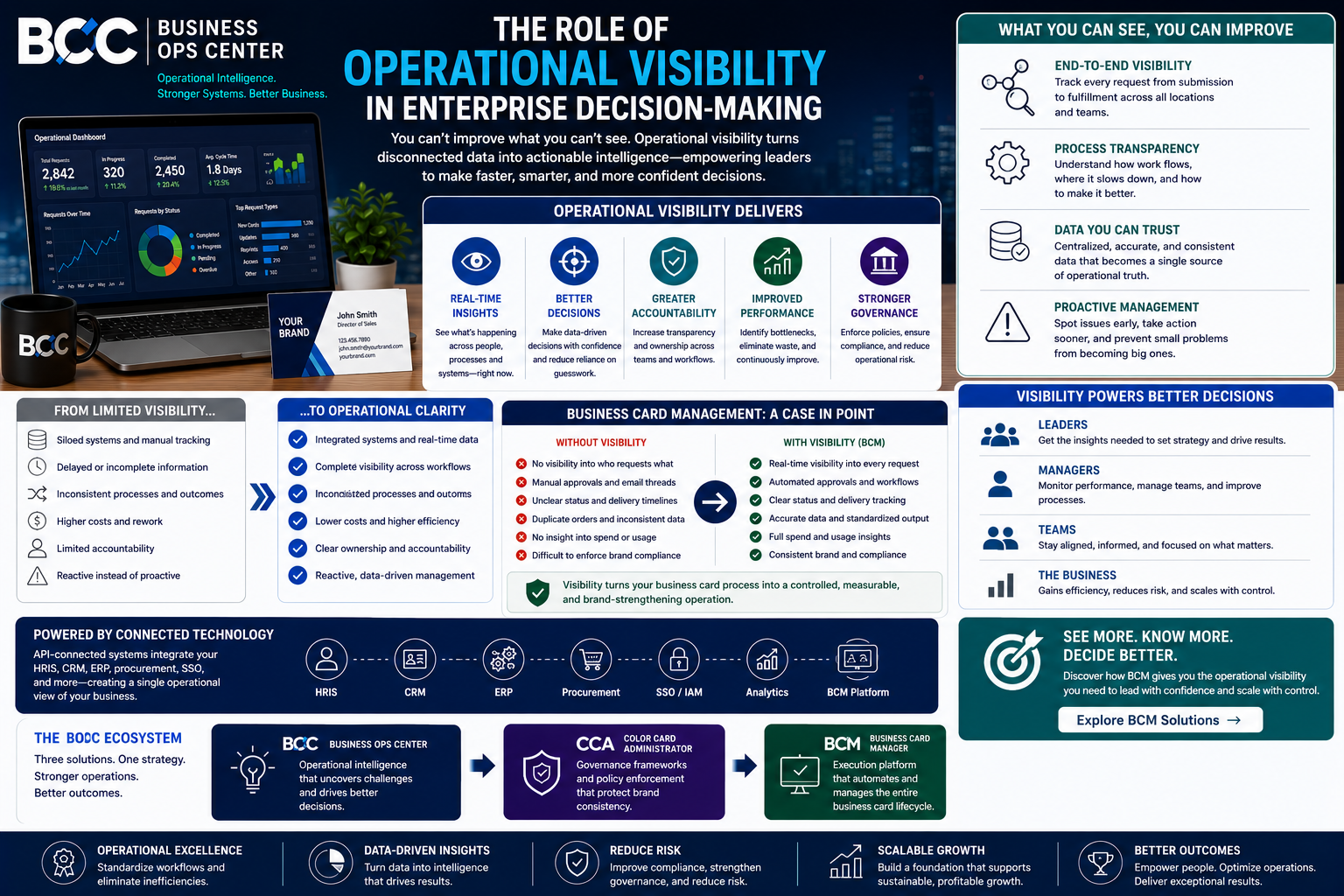
Enterprise leaders are expected to make decisions faster than ever before. Market conditions change rapidly, customer expectations continue to rise, operational complexity grows, and organizations increasingly depend on technology to coordinate activities across departments, locations, vendors, and employees.
Despite significant investments in software and reporting tools, many organizations continue to struggle with one fundamental challenge: visibility.
Leaders often have access to large volumes of data but limited insight into how work actually moves through the organization. They may know what happened last quarter, but they cannot always see what is happening right now. They may understand financial outcomes but lack visibility into the operational activities that produced those outcomes.
This gap between information and operational understanding is why operational visibility has become a strategic priority for enterprise organizations.
What Is Operational Visibility?

Operational visibility refers to an organization’s ability to see, understand, measure, and manage activities as they move through business processes. It includes visibility into workflows, approvals, ownership, performance metrics, bottlenecks, resource allocation, compliance activities, and operational outcomes.
True visibility extends beyond dashboards and reports. It provides context. It helps organizations understand why outcomes occur and where improvement opportunities exist.
Operational visibility enables leaders to move from reactive management toward proactive decision-making.
Why Visibility Has Become a Business Priority
Modern organizations operate in increasingly complex environments. Processes often span multiple departments, systems, vendors, and stakeholders. A single workflow may involve procurement, finance, human resources, operations, legal review, vendor coordination, and executive approval.
Without visibility, managing these activities becomes difficult.
Organizations Frequently Experience:
- Delayed approvals
- Duplicate work
- Communication gaps
- Compliance risks
- Reporting inconsistencies
- Accountability challenges
Operational visibility helps eliminate these issues by creating transparency across business activities.
The Relationship Between Visibility and Decision-Making
Better decisions require better information.
Enterprise leaders make decisions involving investments, staffing, operational priorities, vendor relationships, process improvements, compliance initiatives, and strategic planning.
When visibility is limited, decisions are often based on assumptions rather than operational reality.
Organizations with strong visibility can identify trends earlier, allocate resources more effectively, reduce operational risk, and improve overall performance.
Visibility Supports Accountability
Accountability depends on transparency.
Organizations Need to Know:
- Who owns a process?
- Who approved a request?
- Where is a workflow currently located?
- What caused a delay?
- How are standards being enforced?
Without visibility, accountability becomes difficult to maintain.
Visibility creates clear ownership structures and provides the information required to support operational discipline.
The Impact of Disconnected Systems
Many visibility challenges are caused by disconnected systems.
Organizations often operate across multiple platforms including HRIS systems, ERP environments, procurement applications, CRM solutions, workflow tools, reporting platforms, and collaboration software.
When these systems do not communicate effectively, information becomes fragmented.
Employees spend time gathering data manually. Managers struggle to obtain accurate status updates. Leadership teams lack a complete view of operational performance.
Connected infrastructure helps address these challenges by creating a more unified operational environment.
API-Connected Infrastructure and Visibility
API-connected systems improve operational visibility by enabling information to flow between applications automatically.
Instead of maintaining separate versions of information across multiple systems, organizations can create integrated workflows that improve reporting accuracy and operational transparency.
Examples Include:
- Employee onboarding workflows
- Procurement approvals
- Vendor management processes
- Business card management programs
- Governance reporting activities
The result is a more complete understanding of operational performance.
Business Card Management as a Visibility Example
Business card management provides a practical example of how visibility affects operational performance.
Many organizations manage requests through email, spreadsheets, vendor portals, and disconnected approval processes. This approach often limits visibility into request status, approval timelines, spending patterns, vendor activity, and compliance requirements.
A centralized business card management platform creates visibility into the entire lifecycle of a request. Leadership teams can understand demand patterns, approval performance, governance compliance, and operational efficiency.
This demonstrates how visibility transforms even routine processes into measurable operational activities.
Visibility and Governance
Governance frameworks depend on visibility.
Organizations cannot enforce standards effectively if they cannot see how processes are being executed. Visibility helps ensure policies are applied consistently, approvals are documented appropriately, and compliance requirements are satisfied.
For enterprise organizations, visibility is not simply a reporting capability. It is a governance capability.
Visibility as a Competitive Advantage
Organizations that develop strong operational visibility often gain advantages over competitors.
Benefits Include:
- Faster decision-making
- Improved resource allocation
- Reduced operational risk
- Better employee experiences
- Greater accountability
- Enhanced scalability
These outcomes contribute directly to business performance.
Building a Visibility Strategy
Organizations seeking to improve operational visibility should focus on:
- Workflow standardization
- Systems integration
- Centralized reporting
- Approval visibility
- Governance controls
- API connectivity
- Operational accountability
Visibility should be viewed as an ongoing capability rather than a one-time project.
The Future of Operational Intelligence
The future of enterprise operations will depend increasingly on visibility.
Organizations will continue investing in connected infrastructure, workflow intelligence, governance frameworks, and real-time reporting environments.
The most successful enterprises will be those that can transform operational data into actionable intelligence.
Conclusion
Operational visibility is becoming one of the most important capabilities in modern business. It enables better decision-making, stronger accountability, improved governance, and greater operational efficiency.
As organizational complexity continues to increase, visibility will become even more critical. Enterprises that invest in connected systems, standardized workflows, and operational intelligence will be better positioned to compete, scale, and succeed.