


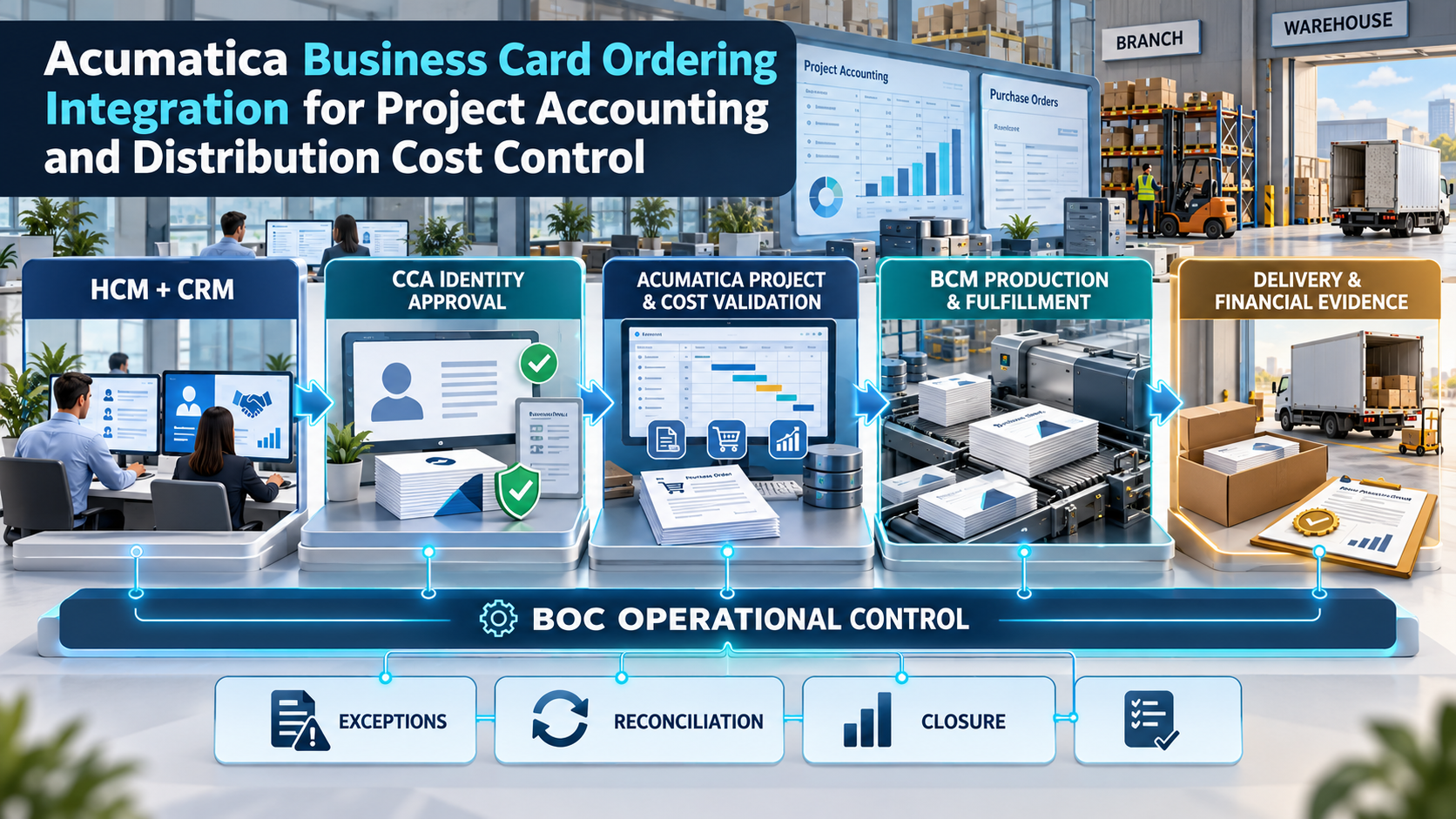
Connecting HCM, CRM, APIs, CCA, Business Card Manager, companies, branches, warehouses, projects, purchasing, receiving, accounts payable, and evidence through BOC.
Business Card Manager (BCM) is the contracted business-card vendor and ordering system. A governed Acumatica integration connects BCM fulfilment to trusted employee identity, branch, warehouse, and project context, purchasing authorization, receipt, accounts payable, and cost evidence. BOC controls the cross-system process, CCA controls printable identity, and Acumatica remains authoritative for configured procurement and financial records.
Business Cards Belong Inside Project and Distribution Control
Project and distribution organizations control purchasing, inventory, project commitments, and supplier transactions because small inconsistencies can distort cost, delay work, and weaken accountability. Business cards deserve the same process discipline. An order may begin with a new hire in HCM or a customer-facing assignment in CRM, but it can also involve brand approval, a contracted card program, a branch, warehouse, project or company, a purchase order, delivery, receipt and an accounts-payable transaction.
The unit price is not the central risk. The larger problem is a disconnected process that prints obsolete identity, charges the wrong company, bypasses purchasing, duplicates demand, or leaves finance unable to explain the invoice. Email approvals and copied employee data do not create an enterprise control.
Business Ops Center provides the operating layer across these systems. It correlates the need, validates current context, coordinates CCA and BCM, invokes approved Acumatica interfaces, assigns exceptions, and verifies the physical and financial outcome before closure.
Separate System Authority Before Building the Interface
HCM owns workforce status, manager, organization, job, work location, and effective dates. CRM can own territory, account, event, campaign, or customer-facing responsibility. Corporate Card Application (CCA) governs the identity approved for print, including display name, title, company, location, contact details, language, legal text, logo, and template.
Business Card Manager (BCM) is the contracted vendor and business-card ordering system. It owns product configuration, proof, quantity, production, shipment, cancellation, correction and reorder state. BCM is not a tool for selecting or routing to another business-card vendor.
Acumatica owns configured companies, branches, warehouses and projects, suppliers, inventory items, non-stock items or purchasing categories, purchase orders, receipts, accounts payable, general ledger, project, task and cost-code dimensions and project and distribution cost records. BOC preserves these boundaries and records which authority supplied every material fact or decision.
Acumatica Contract-Based REST API Supports a Configurable Boundary
Acumatica documents a contract-based REST API that exposes business-logic objects through versioned endpoint contracts. Integrations can retrieve, create, update and delete supported records using JSON, while OpenAPI specifications describe available methods. Exact entities, actions, custom endpoints, authentication and behavior depend on the deployed release and configured web-service endpoint.
This article presents a configurable integration model, not a released universal native connector. The implementation can use customer-approved Acumatica contract-based REST endpoints, a custom endpoint, an integration platform or another supported boundary. The selected calls must preserve Acumatica business rules rather than write directly around them.
BOC adds the operating controls that an API alone does not provide: stable correlation, versioned decisions, least-privilege execution, idempotency, exception ownership, evidence and end-to-end reconciliation.
The Governed Acumatica Ordering Lifecycle
| Lifecycle stage | Authoritative context | BOC control | Required outcome |
|---|---|---|---|
| Need | HCM or CRM event and approved request | Authenticate, correlate and validate timing | Trusted BOC case |
| Identity | CCA policy and workforce facts | Resolve printable fields and version | Approved CCA identity |
| Order | BCM product, proof, quantity and destination | Check duplication, policy and authority | Controlled BCM order |
| ERP context | Acumatica company, branch, warehouse, project and vendor and account | Validate current procurement and cost data | Executable demand |
| Commitment | Purchase order and authorization | Invoke approved interface and retain IDs | Authorized purchase |
| Fulfilment | BCM production, shipment and delivery | Monitor status and route exceptions | Verified physical outcome |
| Closure | Receipt, AP transaction, cost and evidence | Reconcile quantities, values and obligations | Authorized closure |
HCM and CRM Explain Why the Order Exists
Joiners, transfers, promotions, branch or warehouse moves, sales assignments, trade events, customer visits, replacements and reorders can create legitimate demand. BOC retrieves only the facts needed to evaluate the request and its effective date. It distinguishes an approved need from a stale form or a duplicate order.
HCM confirms whether the person is active and where the role belongs. CRM can explain external responsibility or event urgency. Neither source should decide printable identity, card quantity, purchasing company or cost treatment by itself. BOC joins the context without turning either platform into an uncontrolled master for another domain.
When employment, manager, job, branch, warehouse, project, territory, or event timing changes during the workflow standardization, BOC revalidates all dependent decisions. A proof or approval tied to the old state cannot silently release production.
CCA Governs the Identity That Reaches the Card
A job description used for HR or payroll may not be the display title approved for customers. Credentials, abbreviations, languages, business names, phone formats, office details, email conventions, legal text, and artwork can depend on corporate policy. CCA applies those rules and returns a versioned printable-identity decision.
BOC links the CCA version to the person, purpose, effective date and BCM order. Missing or contradictory fields become owned exceptions. Reviewers correct the printable decision without altering authoritative HCM data simply to satisfy a proof.
If identity changes after approval, BOC evaluates the impact on proof, purchase order, and production. The old version remains visible for evidence, while the new version must receive the approvals required by policy.
Business Card Manager Controls Ordering and Fulfilment
Business Card Manager (BCM) turns approved printable identity into the contracted card product. It controls card stock, finish, quantity, proof, production, shipment, cancellation, correction and reorder status. Treating BCM as the business-card vendor prevents the architecture from inventing a vendor-selection step that does not exist.
BOC connects the BCM order version with the Acumatica purchase-order reference. It verifies that the employee, card specification, quantity, destination, timing and approval are still valid before release. Production remains blocked when identity, budget, purchasing or delivery context is unresolved.
Proof rejection, price change, production delay, partial shipment, address failure, damage, cancellation or reprint becomes a governed exception. BOC identifies the owner and response target and keeps operational recovery connected to its procurement and cost impact.
Branch Warehouse Project and Cost Context Must Be Explicit
Project and distribution organizations often operate multiple companies, branches, warehouses, departments, cost centers, and projects. The employee work location does not always identify the correct purchasing or financial owner. A sales employee can support a remote branch, an event may be funded centrally, and cards may be delivered to another warehouse or office.
BOC collects operational resilience context, then validates the current Acumatica company, branch, warehouse or project, supplier, purchasing category or item or service, currency, tax, terms, department, account and project dimensions required by the configured process. Acumatica remains authoritative for the resulting commercial and accounting records.
The case identifier, CCA version and BCM order reference follow the purchase document and line. This allows operations and finance to trace cost back to approved purpose without copying unnecessary personal data into ledger descriptions.
Purchasing Converts Demand into an Authorized Commitment
Acumatica purchase-order and distribution capabilities support project and distribution businesses in sourcing and tracking what the business needs. The exact card-order path may use a purchase order, blanket arrangement, release, approved supplier agreement or another configured method. The integration should respect that operating model instead of creating a shadow buying process.
BOC sends only validated information through the selected service boundary: case reference, company, branch, warehouse and project context, contracted BCM supplier record, product or category, quantity, price basis, delivery destination, account or project context and evidence references. Acumatica applies its configured business logic and authorization.
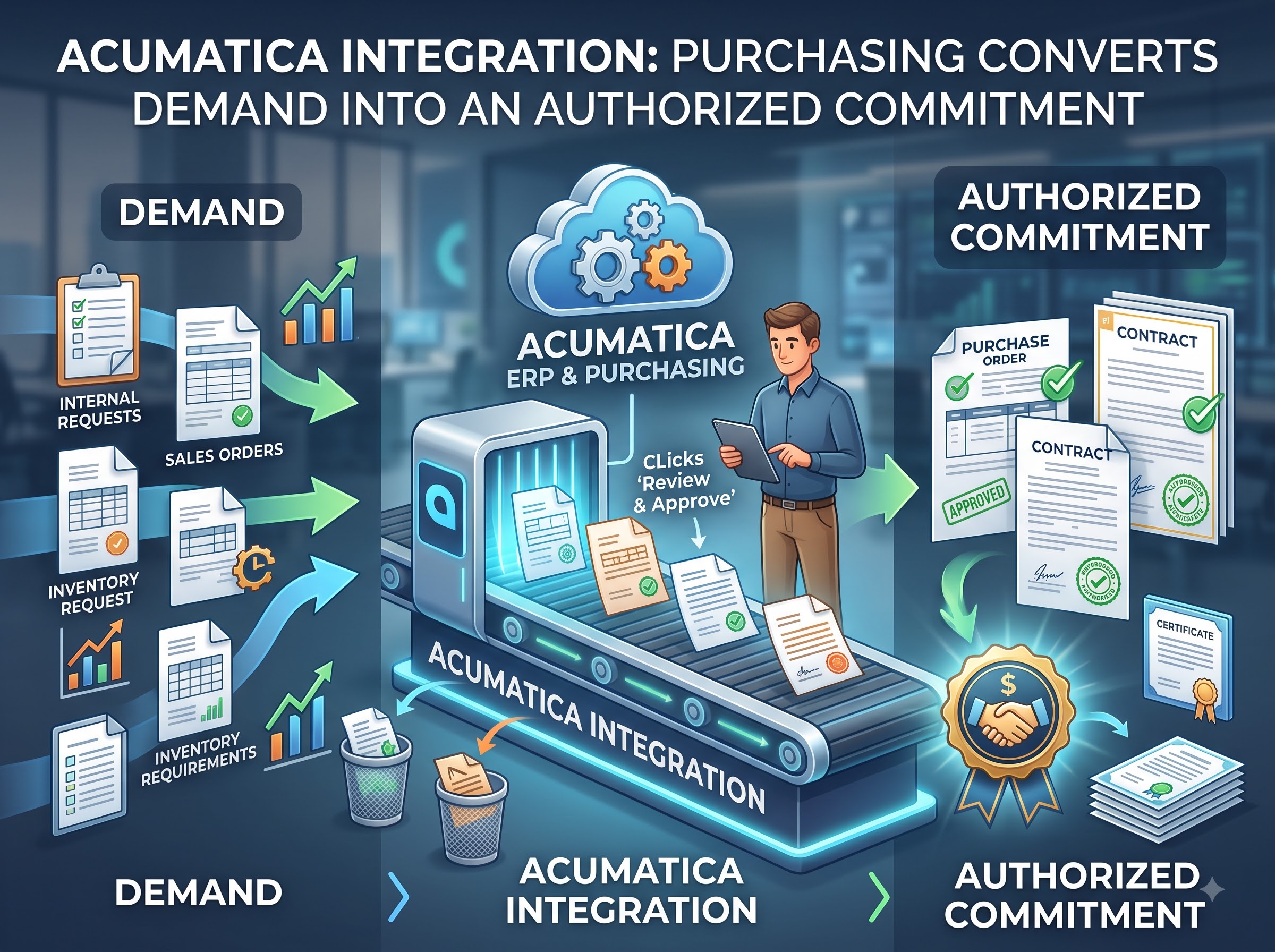
Approval must remain scoped to the version reviewed. A change to identity, quantity, price, company, branch, warehouse, project, account, or destination can invalidate the prior decision. BOC stops superseded approval from authorizing a materially different commitment.
Receiving and Accounts Payable Prove the Outcome
Production, shipment, carrier delivery, acceptance, receipt, and financial liability are separate states. A delivered package does not prove that the cards are correct or that the entire quantity was accepted. BCM provides production and shipment evidence; the authorized employee or receiving process confirms quantity and condition.
BOC connects accepted delivery with the Acumatica receipt or agreed service-confirmation pattern. Misprints, shortages, damage, wrong locations, and late deliveries remain open exceptions. The case does not close merely because a technical message succeeded.
Accounts-payable reconciliation compares the purchase commitment, fulfilled quantity, accepted receipt, invoice, freight, tax, tolerances, credits, and reprints. Acumatica remains authoritative for the configured AP and general-ledger outcome, while BOC verifies that operational and financial records refer to the same business event.
Cost Control Is More Than Posting an Invoice
A low-cost item can still produce bad management information when it is charged to the wrong company, branch, warehouse, department and project or event. Repeated small variances can also hide duplicate orders, uncontrolled reprints, expedited shipping and avoidable waste. BOC preserves why the order exists so the cost retains business meaning.
Budgets, approvals and tolerances should be evaluated at the point defined by enterprise governance mesh policy. Quantity exceptions may be legitimate for sales launches or trade events, but they should be supported by current CRM context and scoped authorization. Emergency need does not justify losing traceability.
Reporting can combine permitted operational and financial measures: demand volume, proof changes, cycle time, delivery reliability, reprint rate, cost per order, expedite expense, invoice variance, exception aging and evidence completeness. Personal data remains minimized and access-controlled.
API Reliability Requires Business-Safe Recovery
A timeout cannot tell the caller whether a request failed before processing, committed successfully or completed after the response window. Blind retry can create duplicate purchase demand or receipts. BOC records every attempt under a stable case key and checks current state before deciding whether another call is safe.
Authentication failure, missing permission, invalid company, branch, warehouse and project mismatch, closed period, supplier error, rejected approval and transient service failure require different recovery. Temporary conditions can use controlled backoff. Business errors go to named owners with deadlines, evidence and an explicit next action.
Scheduled reconciliation compares BOC cases, CCA decisions, BCM orders and Acumatica purchasing, receiving and AP records. It detects orphaned documents, duplicates, stale approvals, unmatched receipts, unresolved credits and cases that are technically complete but operationally open.
Implementation Should Begin with One Controlled Path
Start with one company, one branch, one warehouse, one project, one contracted BCM program and one common card product. Map HCM and CRM triggers, CCA fields, BCM product rules, Acumatica supplier and purchasing records, project, task and cost-code dimensions, approvals, receipt, AP treatment, exception ownership and retention.
Confirm the deployed Acumatica release, system endpoint, contract version, entities, actions and custom endpoint if used, authentication, roles and licensing. Define least privilege, payloads, correlation, idempotency, versioning, retry, observability, reconciliation, evidence and support before development begins.
Test hire cancellation, transfer, wrong title, duplicate request, invalid branch, warehouse or project, closed account, price change, approval expiry, proof rejection, API uncertainty, partial delivery, damaged cards, missing receipt, invoice variance, credit and reprint. Expand only after the first lifecycle is measurable and controlled.
Buyer Intent Bridge: What a BOC Engagement Produces
Organizations evaluating Acumatica integration generally do not need another isolated form. They need an operating model across workforce context, customer responsibility, printable identity, ordering, procurement, cost and finance. A BOC discovery engagement can produce the source-of-truth matrix, business card lifecycle, data contract, interface architecture, company, branch, warehouse and project rules, approval model, exception taxonomy, evidence model, backlog and success measures.
The model protects existing investments. Acumatica remains authoritative for configured procurement and financial records. HCM and CRM retain their domain facts. CCA governs printable identity. Business Card Manager remains the contracted business-card vendor and ordering system. BOC governs transitions, exceptions, reconciliation and closure.
Begin with one process that currently depends on copied employee data, email approval, manual branch, warehouse or project selection or invoice research. Turning that path into a governed integration creates a repeatable model for other identity-linked purchases in project and distribution operations.
Questions Integration Buyers Should Ask
- Which Acumatica release, deployment, endpoint, contract version, entities and actions support the selected process?
- Which system owns workforce status, customer context, printable identity, card product, company, branch, warehouse, project and receipt and AP state?
- How are company, branch, warehouse, project and vendor, account, project, tax and approval authority derived and revalidated?
- How are timeouts, duplicate submissions, changed proofs, partial receipts, credits and reprints controlled?
- Who owns credentials, API versions, monitoring, exceptions, reconciliation, retention and support?
- What evidence is required before the order is financially and operationally closed?
Frequently Asked Questions
Does BOC replace Acumatica? No. Acumatica remains authoritative for configured procurement and financial records. BOC coordinates the cross-system workflow, exceptions, evidence, and closure.
Is this a released native connector? No universal native connector is claimed. The article describes a configurable model using documented, customer-approved Acumatica interfaces.
What is Business Card Manager? Business Card Manager (BCM) is the contracted business-card vendor and ordering system. It manages product configuration, proof, production, and fulfilment.
When is the transaction closed? After approved identity, purchasing, production, delivery, receipt, AP outcome, and all exceptions are reconciled or formally resolved.
Connect one business card order to project accounting and distribution cost control. Business Ops Center can help define and implement a governed workflow across Acumatica, HCM, CRM, CCA, Business Card Manager, and enterprise delivery systems. Start with one company, one branch, one warehouse, one project, and one ordering path that currently requires manual validation, re-entry, or reconciliation.