

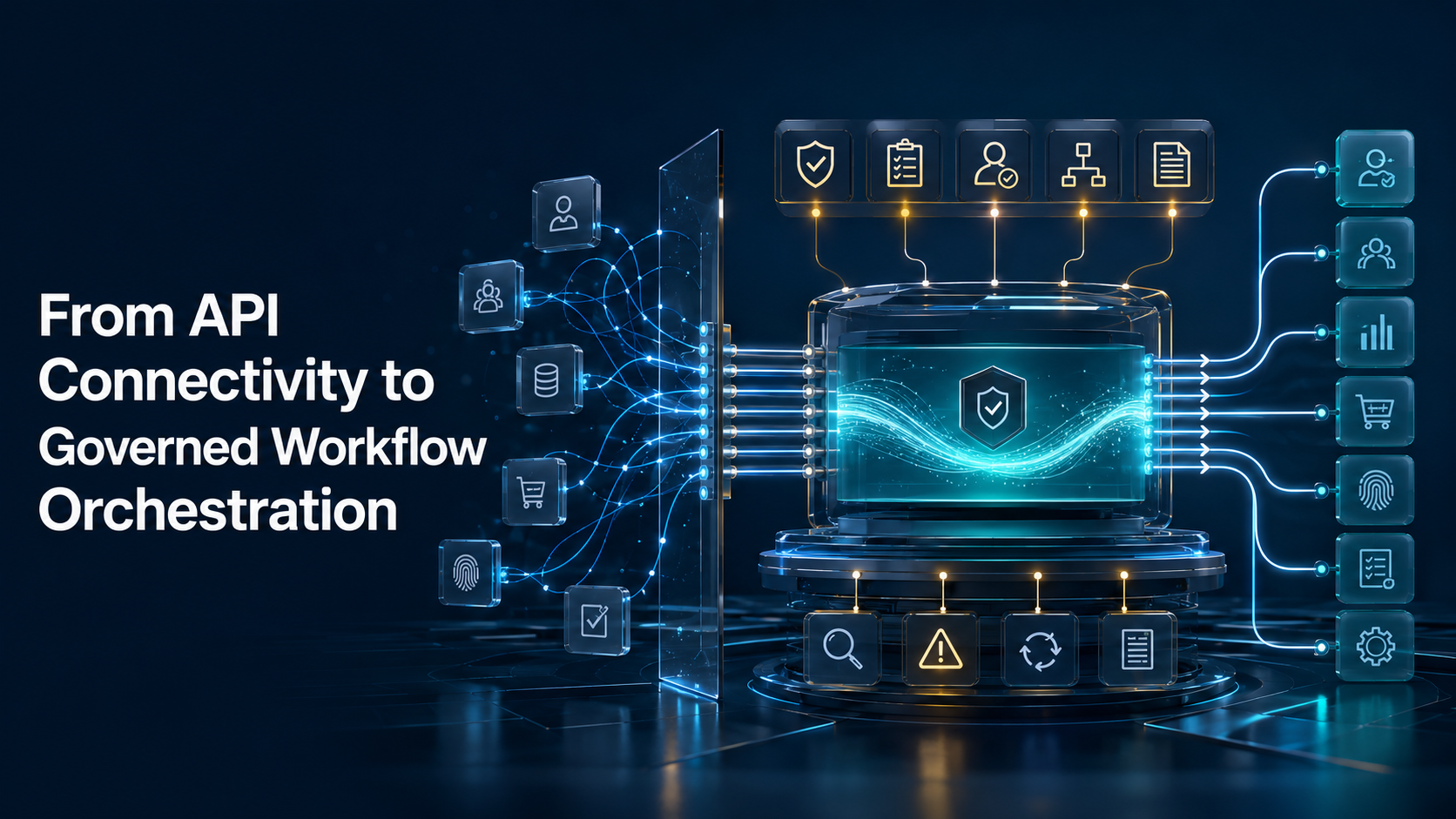
| Executive perspective: APIs create technical connectivity. Governed workflow orchestration turns that connectivity into accountable operations by controlling when work may begin, which authority applies, who can decide, how exceptions are resolved, and whether execution is reconciled to the original business event. |
APIs Can Connect Systems Without Connecting the Business Process
Enterprise organizations are under constant pressure to connect their systems. CRM, HRIS, HCM, ERP, procurement, identity, service management, collaboration, and specialized execution platforms all expose APIs or integration mechanisms. These interfaces can move data quickly, reduce rekeying, and create the foundation for automation. But connectivity alone does not determine whether an end-to-end business process is controlled.
An API can confirm that a payload was accepted while the business outcome remains incomplete. A new-hire event may arrive from Workday, an account may be created through Microsoft Entra ID, and a purchase request may be submitted to Coupa. Yet the organization may still be unable to explain whether the employee was eligible, whether the effective date was honored, whether the displayed identity was approved, whether the correct budget owner authorized spend, or whether the supplier fulfilled the approved specification.
This is the point at which integration architecture becomes an operating-model question. Business Ops Center provides the orchestration layer between technical connections. It carries operational state across systems, applies policy before irreversible action, directs meaningful exceptions to accountable owners, and preserves the evidence required to explain the final result.
The Difference Between Connectivity, Automation, and Orchestration
Connectivity allows two applications to exchange information. Automation uses that information to perform a repeatable action. Orchestration coordinates a sequence of actions and decisions across several systems and teams. Governed orchestration adds the controls that make the sequence safe at enterprise scale: authoritative ownership, policy evaluation, role-based approval, segregation of duties, versioned decisions, exception accountability, controlled release, and reconciliation.
These layers should not be confused. A webhook that starts a workflow demonstrates connectivity. A rule that populates a form demonstrates automation. A lifecycle that validates the source event, enriches it with authoritative attributes, evaluates policy, obtains the appropriate approval, releases a final specification, receives fulfillment status, and closes the original request demonstrates orchestration. When every step is attributable and reconstructable, it becomes governed workflow orchestration.
BOC does not need to become the system of record for every domain. HR remains authoritative for employment data, CRM for customer context, identity systems for authentication and directory state, procurement for purchasing controls, ERP for financial outcomes, and execution platforms for fulfillment. BOC owns the cross-system operational state that no individual application can see completely.
| Core distinction: Connectivity transfers data. Automation performs a task. Governed orchestration coordinates the full lifecycle and proves that every consequential action was authorized, completed, and reconciled. |
Why Direct System-to-System Automation Becomes Fragile
Point-to-point automation often performs well in a demonstration because the happy path is clear. A complete record enters, a mapping runs, and the target accepts the transaction. Production operations are different. Events arrive twice, fields are missing, effective dates change, approvers are absent, cost centers are closed, suppliers reject specifications, and source records are corrected after downstream work has started.
As direct connections multiply, business rules become distributed across scripts, middleware flows, source-system configurations, emails, and manual workarounds. No team can easily tell which version of a rule produced an outcome. A change made to improve one integration can create unintended consequences elsewhere. Operational teams may know that a case is blocked but lack the visibility or authority to resolve it without developer intervention.
The fragility is organizational as much as technical. Every integration can be available while the overall process is failing. Work may accumulate between systems, approvals may be bypassed through alternate channels, and completed transactions may never be matched back to their initiating events. A governed orchestration layer makes those invisible gaps visible and manageable.
The Control Functions a Governed Orchestration Layer Must Provide
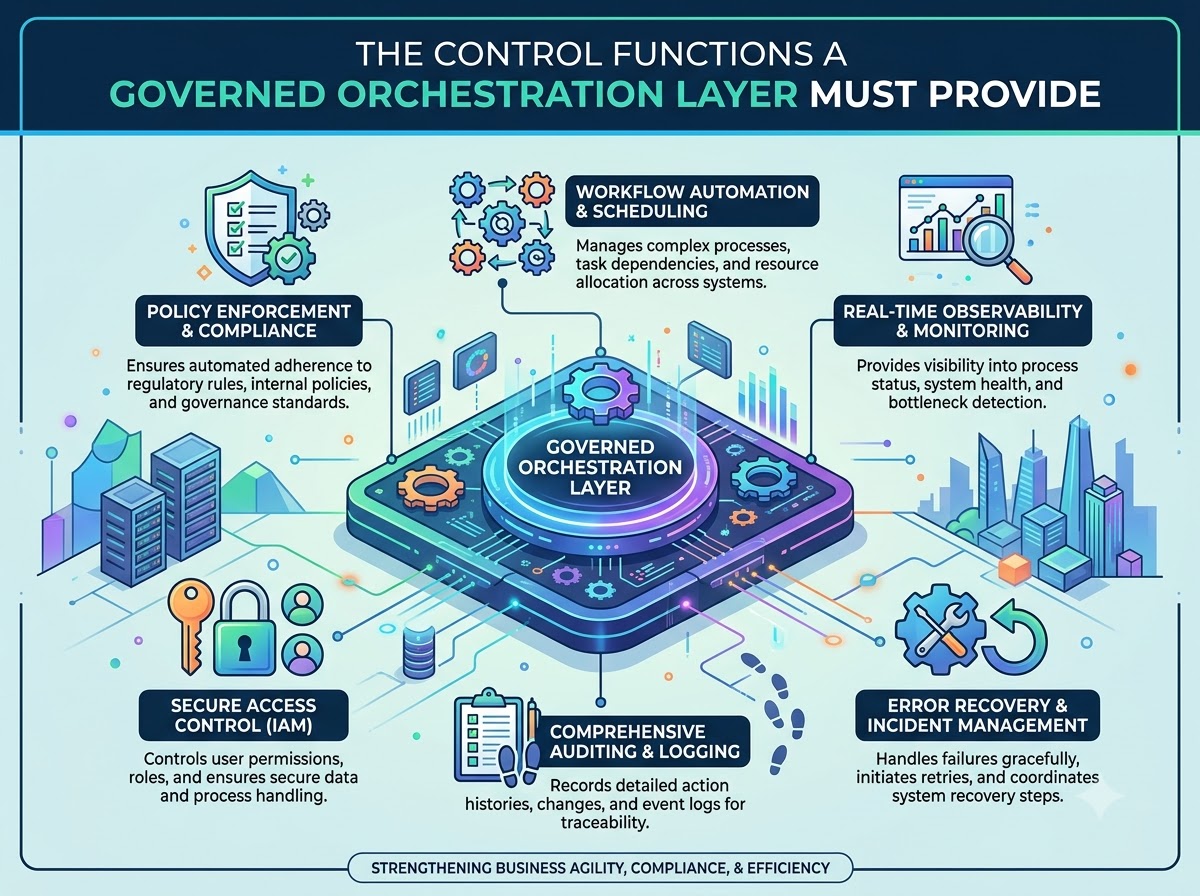
1. Establish authoritative context before action
Every operational attribute needs an owner. An HRIS integration may own legal name, employment status, department, manager, location, and effective date. A CRM may own territory or customer assignment. An identity platform may own account status and authentication groups. Procurement may own supplier eligibility and cost controls. BOC should assemble the context required for a decision without silently changing domain ownership.
This prevents convenience copies from becoming accidental masters. It also allows the workflow to record the exact authoritative snapshot used at the decision point, so later changes do not erase the reason an earlier action was permitted.
2. Evaluate policy as a versioned decision
Enterprise policy is more than a static approval route. It may determine eligibility, timing, protected fields, display standards, quantity, geography, supplier, spend threshold, privacy requirements, and whether human review is required. BOC can evaluate these conditions as one decision package and record which policy version applied.
Versioning matters because policies change. Without it, an auditor or process owner sees today’s rules and may incorrectly judge a transaction completed under an earlier standard. A governed workflow preserves the rule set, inputs, outcome, and override history associated with the original decision.
3. Orchestrate approvals according to risk and responsibility
Not every request needs the same approval chain. Routine, complete, low-risk work may qualify for straight-through processing. A protected title, cross-border request, unusual quantity, new supplier, or budget exception may require additional review. BOC can route the decision based on the specific exception rather than imposing one slow sequence on every request.
Approval workflow must also account for delegation, absence, escalation, and segregation of duties. The person who initiates a sensitive change should not necessarily approve it, and authentication alone must never be treated as business authorization.
4. Treat exceptions as managed operational work
Exceptions are not edge cases to be hidden in error logs. They are predictable operational states: incomplete employee records, conflicting titles, invalid cost centers, unavailable approvers, duplicate events, rejected purchase requests, failed vendor handoffs, cancellations, and fulfillment discrepancies. Each exception needs a category, owner, service expectation, allowed resolution, and evidence of closure.
BOC allows operational teams to work those queues without rewriting integrations. A controlled correction can resume the existing lifecycle with its correlation intact instead of creating a new request that obscures the history.
5. Release only an approved operational specification
Downstream execution should not receive a mixture of raw source fields, informal instructions, and partially approved changes. The workflow should create an approved operational specification: the final values, template, quantity, supplier, cost allocation, delivery requirement, and policy evidence that execution may rely on.
Controlled release creates a clear boundary between decision and commitment. It reduces preventable rework and gives the execution platform—such as Business Card Manager—a stable, authorized instruction rather than asking it to reconstruct business intent.
6. Reconcile the outcome to the initiating event
A workflow does not end when an API returns success. BOC should receive acknowledgements, purchase identifiers, vendor status, shipping milestones, completion, cancellation, and financial outcomes. These signals must be correlated to the initiating request and compared with the approved specification.
Reconciliation exposes silent failures: an accepted request that never became an order, a shipment created with the wrong quantity, a cancellation that did not reach the supplier, or a completed order that never closed the source case. It turns technical status into business assurance.
A Reference Lifecycle Across Enterprise Systems
Consider a customer-facing employee whose promotion becomes effective next month. Workday or another HCM platform publishes the employee change. BOC records both event and effective dates, validates required identity attributes, and uses Microsoft Entra ID or another directory to confirm account scope. Salesforce or Microsoft Dynamics 365 contributes customer-facing context, while controlled identity rules determine the approved display title.
If the title matches policy and required data is complete, the workflow can proceed automatically. If the requested display differs from the governed mapping, BOC creates an exception for the correct authority. Procurement rules then determine cost center, supplier, and approval requirements. Once the decision package is complete, BOC releases an approved specification to Business Card Manager for ordering and fulfillment.
Status returns through the same correlation trail. A vendor rejection, address problem, or later HR correction reopens managed work rather than disappearing into email. When the lifecycle closes, the organization can reconstruct the source event, authoritative inputs, policy version, approvals, operational specification, purchase reference, fulfillment outcome, and any exception resolution.
BOC, CCA, and BCM: Distinct Roles in One Enterprise Model
The three platforms contribute different kinds of value. Business Ops Center is the orchestration and operational education layer: it coordinates work across enterprise operations & systems and keeps the full lifecycle visible. Color Card Administrator is the authority engine: it governs identity standards, protected decisions, approved representations, and policy consistency. Business Card Manager is the conversion and execution engine: it turns approved specifications into controlled ordering, vendor coordination, reporting, and fulfillment.
Keeping these roles distinct avoids architectural confusion. BOC should not duplicate the deep identity authority of CCA, and CCA should not become a general-purpose procurement workflow. BCM should execute approved work without being forced to infer policy from incomplete source data. Together, they create a clean progression from trusted event, to governed decision, to controlled execution, to reconciled evidence.
Design Principles for Scalable Workflow Orchestration
Start with the business event, not the connector. Define what happened, which source has authority, when the change becomes effective, and which operational outcome is expected. This creates a stable contract even when a particular platform or integration technology changes.
Use canonical operational states. Terms such as received, awaiting data, policy review, approval pending, approved, released, acknowledged, fulfilled, cancelled, failed, and reconciled should have precise meanings across workflows. Shared states improve monitoring, reporting, service ownership, and connector reuse.
Make every transition attributable. Record whether a person, policy rule, source correction, scheduled action, or external system caused the change. Maintain correlation and idempotency so retries do not create duplicate work. Minimize copied data, protect sensitive attributes, and retain only what the operational and evidence requirements justify.
Finally, design for ownership outside IT. Technical teams should monitor platform health, but business operations must be able to see aging exceptions, understand why work is blocked, perform permitted resolutions, and measure service outcomes. Orchestration becomes infrastructure only when it is operable, not merely integrated.
How to Implement Without Creating Another Transformation Program
Begin with one high-value lifecycle that currently crosses several systems and produces measurable friction. New-hire provisioning, employee title changes, customer-facing role changes, controlled material ordering, or supplier-backed fulfillment can provide a bounded starting point. Document the event, authorities, policy, approval roles, execution target, exception types, and evidence requirements before configuring integrations.
Deliver the full lifecycle for one business unit or region. Include cancellations, corrections, duplicate events, unavailable approvers, and failed handoffs in the pilot. A narrow workflow with reliable exception handling and reconciliation creates more enterprise value than a broad connector demonstration that supports only successful transactions.
Once the operating contract is proven, convert the design into reusable patterns: canonical events, policy services, approval components, exception queues, connector contracts, correlation identifiers, dashboards, and evidence structures. Expansion to additional HRIS, CRM, identity, procurement, ERP, or execution platforms then becomes controlled coverage rather than repeated invention.
Measures That Demonstrate Governed Operational Performance
Traditional integration dashboards focus on availability, latency, and error rate. Those measures remain necessary, but BOC should connect them to the quality of the business lifecycle. Enterprise owners need to know the percentage of events with complete authoritative data, straight-through processing rate, median time to approved release, exception volume and age, approval escalation frequency, duplicate prevention, policy override rate, and reconciliation completion.
Execution measures matter as well: acknowledgement time, rejected specifications, cancellations recovered before commitment, fulfillment variance, rework or reprint rate, supplier turnaround, cost allocation accuracy, and percentage of completed transactions linked to a valid initiating event. These metrics reveal whether automation is producing reliable outcomes or merely moving work faster into hidden failure states.
Questions Enterprise Buyers and Architects Should Ask
- Which system is authoritative for each attribute, event, and approval decision?
- How are event time, effective time, approval time, release time, and completion time distinguished?
- Can the platform reconstruct the policy version, inputs, approver identity, and override history for any transaction?
- How are duplicate, corrected, cancelled, out-of-order, and late-arriving events handled?
- Can operational owners resolve expected exceptions without changing connector code?
- Does a successful API response prove the business outcome, or is fulfillment reconciled separately?
- How are segregation of duties, delegation, geographic scope, and sensitive fields enforced?
- Can new connectors reuse the same event, policy, approval, exception, and evidence patterns?
The Strategic Outcome: Automation That Remains Accountable
The purpose of enterprise integration is not to make every system act immediately. It is to allow trusted business events to move through policy, judgment, commitment, and completion with the right balance of speed and control. Some work should proceed automatically. Some should pause because the organization is protecting identity, spend, security, timing, or customer-facing quality.
Business Ops Center turns API connectivity into governed workflow orchestration. It provides the operational state that spans system boundaries, makes exceptions visible, keeps approvals aligned to responsibility, releases only authorized specifications, and reconciles execution to business intent. The result is automation that can be trusted because it remains explainable.
APIs move information. Orchestration coordinates action. Governance makes that action accountable. Together, those capabilities create an enterprise operations architecture that can scale without losing control.
| Turn connected systems into a controlled operating model. Explore how Business Ops Center can coordinate enterprise events, authority, approvals, exceptions, execution, reconciliation, and evidence. Visit businessopscenter.com to discuss a high-value workflow for your organization. |