
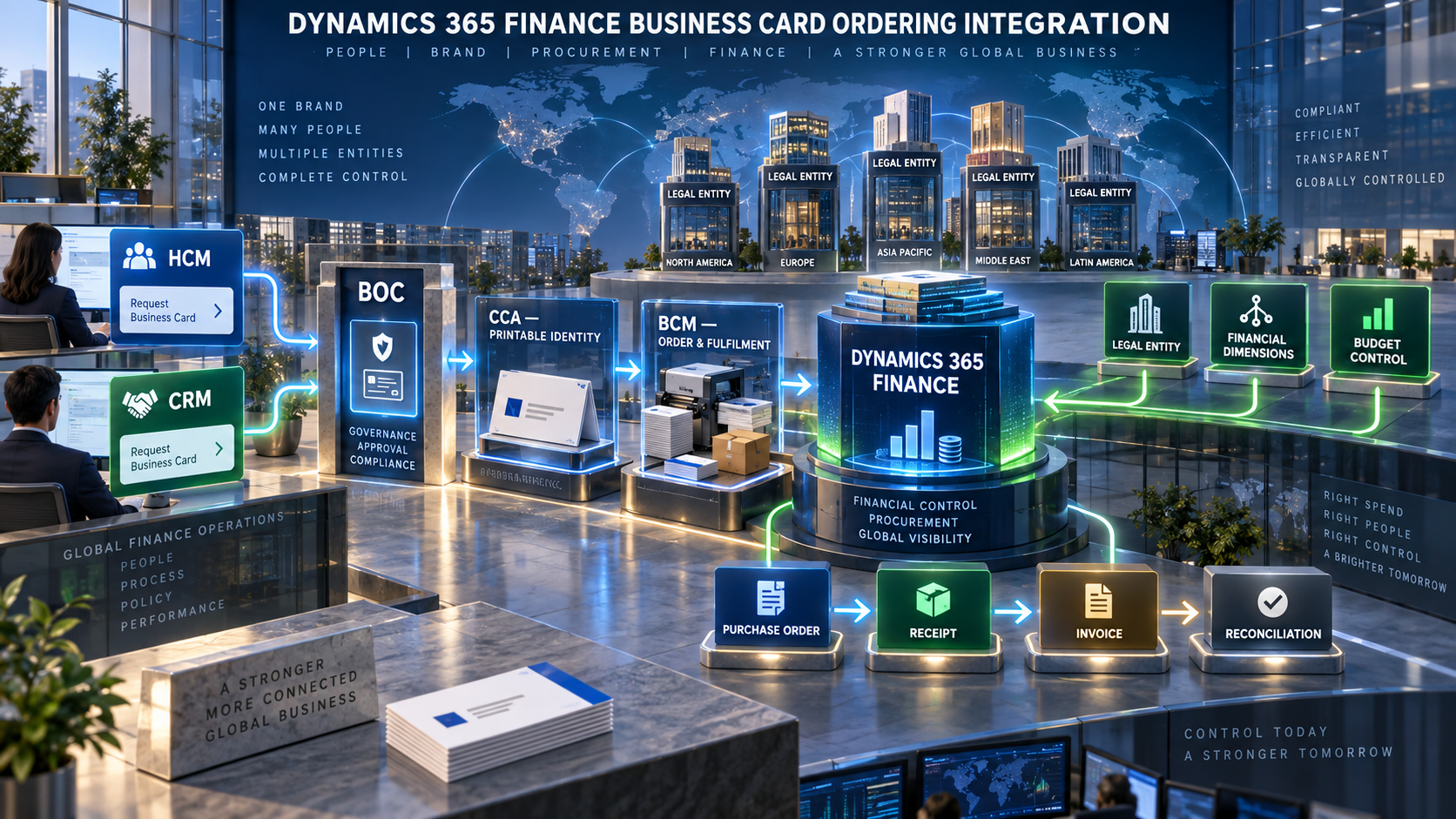
Connecting HCM CRM APIs CCA BCM vendors purchasing budgets receipts invoices and financial dimensions through BOC.
Enterprise business card ordering becomes financially reliable when each request is connected to the correct legal entity, vendor, procurement category, financial dimensions, budget decision, purchase document, receipt and invoice. BOC coordinates that chain while Dynamics 365 Finance remains authoritative for commercial and accounting records, CCA governs printable identity, and BCM controls production and fulfilment.
Business Card Ordering Is a Finance and Procurement Workflow
A business card request often begins as an employee, sales, event or office requirement. The visible deliverable is printed stock, but the enterprise transaction spans workforce identity, brand authority, quantity, budget, procurement, vendor production, delivery, receipt, invoice and reporting. In a multi-entity organization, even a low-value order can be misallocated when the requester, employee, legal entity, cost center, vendor account or delivery destination is interpreted incorrectly.
Microsoft Dynamics 365 Finance and the connected procurement capabilities can govern financial dimensions, budget control, vendors, purchasing documents, receipts, invoices and postings. They should not be asked to decide which title is printable, which brand template applies, or whether a person qualifies for a card program. Those decisions belong to the identity and fulfilment controls surrounding the financial transaction.
Business Ops Center supplies the cross-system operating layer. It correlates HCM and CRM events, validates present state, coordinates approvals, binds CCA and BCM versions to the financial transaction, controls API execution, manages exceptions and confirms closure across production, delivery and accounting.
The Integration Must Preserve System Authority
HCM owns employment, manager, organization, title, location, legal entity and effective dates. CRM can own customer-facing role, territory, account assignment, campaign or event context. CCA owns the approved name, title, company, office, contact fields, language, legal text, logo and template that may be printed. BCM owns the card product, quantity, proof, vendor routing, production, shipment, correction and reorder lifecycle.
Dynamics 365 Finance owns the configured legal-entity, chart-of-accounts, financial-dimension, budget, vendor, procurement, HR, and operations receipt, invoice and ledger records. BOC does not duplicate these authorities. It evaluates them at the decision boundary and records how one authoritative state permitted the next controlled action.
That distinction matters when circumstances change. A manager approval cannot repair a closed financial dimension. A purchase order does not authorize stale printable identity. A delivery scan does not prove the invoice was matched. BOC keeps the dependencies explicit instead of collapsing different controls into one generic approved status.
Dynamics 365 APIs Create a Configurable Boundary
Dynamics 365 finance and operations applications expose supported integration mechanisms including OData data entities and the Data management framework. Microsoft documents purchase-order header and line entities for supported purchase-order scenarios, and it warns against bypassing application validation through direct database changes. The available entities, fields, workflows, extensions and cross-company behavior must be confirmed for the customer landscape.
This article therefore describes a configurable Microsoft Teams integration model, not a released universal native connector. BOC can use approved endpoints directly or through the organization’s integration platform. It transmits the minimum required data, preserves stable correlation identifiers, and stores the authoritative document references returned by the application.
Service-protection limits, authentication, batch behavior, concurrency, retries and environment separation are operational design concerns. A successful HTTP response is only technical evidence; BOC still verifies the correct legal entity, request version, procurement state and business outcome.
The Governed Dynamics 365 Finance Ordering Lifecycle
| Lifecycle stage | Authoritative context | BOC control | Required outcome |
|---|---|---|---|
| Business need | HCM CRM event campaign or approved request | Authenticate correlate classify and validate | Trusted BOC case |
| Identity | Current workforce facts and CCA rules | Resolve approved fields template and version | Printable CCA identity |
| Order | BCM product quantity proof vendor and destination | Check eligibility duplication timing and authority | Controlled BCM request |
| Finance context | Legal entity dimensions budget category and vendor | Validate current financial and procurement state | Executable transaction |
| Procurement | Requisition or purchase order workflow | Invoke approved API and retain references | Controlled purchase document |
| Fulfilment | Vendor acknowledgement production shipment and receipt | Monitor exceptions and compare expected state | Verified delivery |
| Accounting | Receipt invoice tax charges and posting | Reconcile financial and operational evidence | Authorized closure |
HCM and CRM Establish the Business Need
Joiners, movers, promotions, office transfers, customer-facing assignments, conferences, campaigns and inventory replenishment can initiate card ordering. BOC retrieves only the necessary HCM and CRM attributes, establishes the effective date and determines whether the need is valid, premature, duplicated, cancelled or already satisfied.
The employee’s current legal entity is especially important because it can determine financial configuration, policies, vendor eligibility, tax, currency, dimensions and approval routes. CRM context can establish why the person needs cards and when they must be available, but it does not replace the financial ownership established by the enterprise.
BOC monitors source changes while the request is open. A delayed start, changed title, reassigned territory, new office or cancelled event can invalidate work already prepared. The case is recalculated before production or financial commitment rather than allowing a stale request to continue.
CCA Governs Printable Identity Before Spend Is Committed
HCM data is not automatically print-ready. Display titles, brand names, language, professional credentials, contact formats, office conventions, legal text, logos, and templates can follow rules that differ from the employee master. CCA resolves those rules and returns a versioned printable-identity decision.
BOC links the CCA version to the person, business purpose, effective date, and order. Missing or contradictory fields become owned exceptions. An authorized review can correct printable identity without corrupting the HCM record or allowing an email attachment to become an uncontrolled master.
When identity changes after budget or procurement governance approval, BOC evaluates materiality. It can invalidate the proof, pause the order, request a revised approval or cancel production. This avoids paying for a product whose identity no longer matches the employee or legal entity.
BCM Governs Product and Vendor Fulfilment
Business Card Manager converts approved identity into a controlled product specification. It applies card program, stock, finish, quantity, proof, approved vendor route, production rules, shipping method, delivery address, and reorder policy. BOC binds the BCM order version to the Dynamics 365 transaction without moving fulfilment authority into finance.
Quantity can reflect role, geography, event demand, previous orders, consumption, batch economics and sustainability rules. Proof approval is tied to the current CCA and BCM versions. Production releases only after required identity, budget, procurement and vendor conditions are satisfied.
Vendor rejection, price change, proof correction, production failure, partial shipment, address issue, damage, cancellation or late delivery creates an exception with an owner, deadline and recovery path. Supplier messages are useful evidence, but they do not independently authorize financial or operational closure.
Legal Entity and Financial Dimensions Determine Accountability
Dynamics 365 Finance uses legal entities and financial dimensions to represent the organization’s accounting and reporting structure. A business card ordering request may need a main account plus cost center, department, business unit, project, purpose, region or another customer-defined dimension. BOC validates the combination that policy requires for the order.
Defaults should be treated as proposals, not unquestioned truth. The employee’s home organization may differ from the entity funding an event, a project charge may expire, or a cost center may be suspended. BOC retrieves current authoritative values, applies cross-system rules and routes ambiguity to the correct owner before the purchase document is created.
The stable BOC case identifier, CCA version, and BCM order reference should remain associated with the legal entity and financial distribution. That linkage supports investigation, correction, cross-entity reporting and evidence without embedding unnecessary personal data in ledger descriptions.
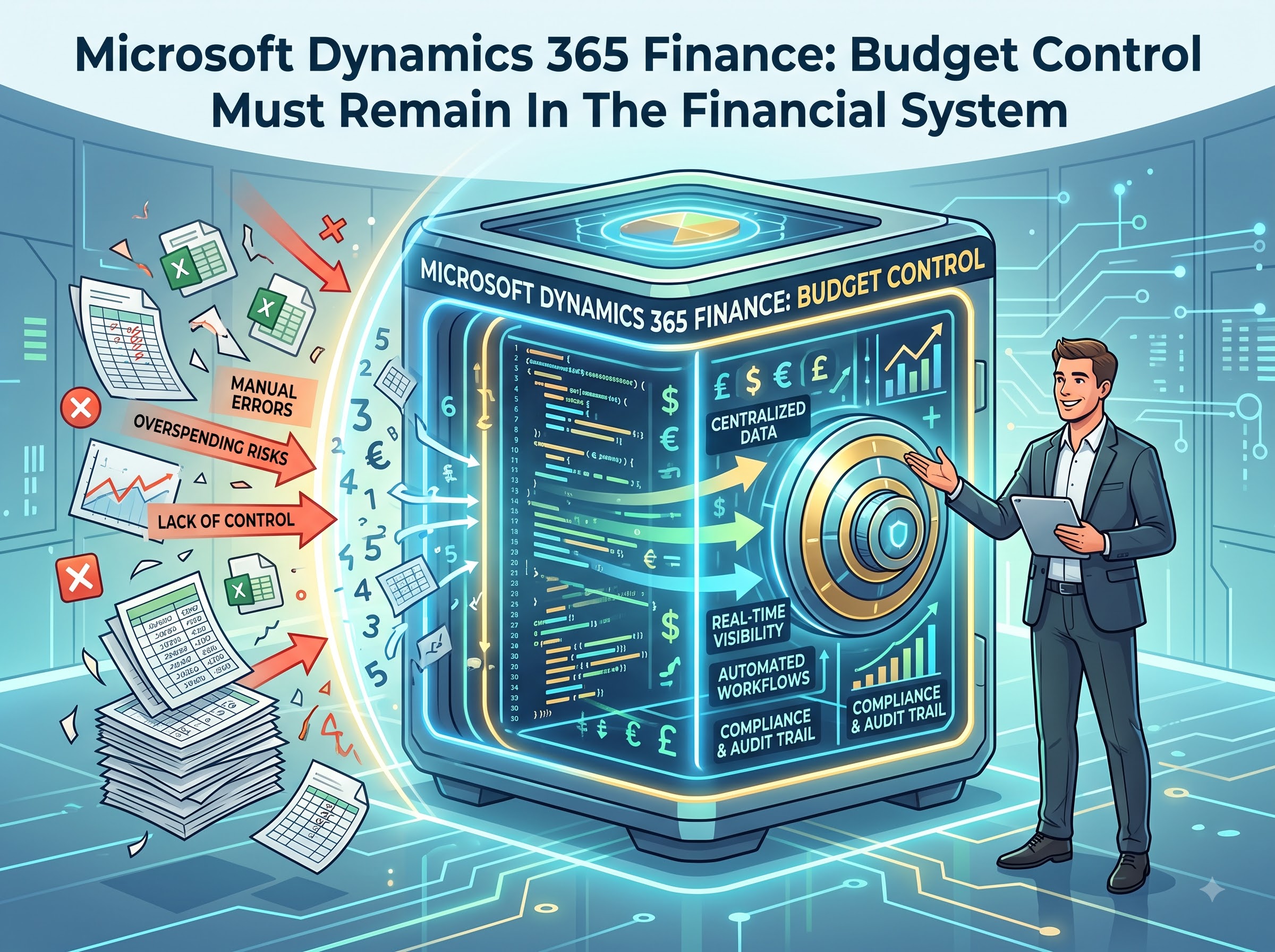
Budget Control Must Remain in the Financial System
Microsoft documents budget control as configurable by financial dimensions, main accounts, time periods, source documents, available-funds calculation, thresholds and override permissions. Purchase requisitions can create pre-encumbrances and purchase orders can create encumbrances when the organization configures those behaviors.
BOC provides the validated amount, category, dimensions, requester and business reason needed for the selected transaction. Dynamics 365 Finance performs the authoritative budget check. A warning, block, tolerance or authorized override follows the organization’s configuration and user permissions rather than a parallel rule invented by the ordering application.
Budget results are version-sensitive. A quantity, price, freight, tax, dimension or accounting-date change may require another check. BOC records the result, actor, scope and time, and it prevents an earlier approval from being reused after a material change.
Purchase Orders Receipts and Invoices Form One Chain
The procurement pattern may use a requisition, purchase order, contract, catalog, blanket arrangement or consolidated vendor process. BOC selects the configured route and preserves the relationship between the BCM order and Dynamics 365 header and line references. It does not create a shadow purchasing process.
Microsoft describes the purchase-order lifecycle as progressing through approval and confirmation, receipt and vendor invoicing. Status fields can represent quantity progress, document progress and approval progress. BOC interprets each status in business context because an open order may be partly received or invoiced and a confirmed order is not the same as delivered cards.
Receipt must correspond to the correct quantity and condition. Invoice reconciliation considers ordered, received and billed quantities, price, charges, tax, currency, credits and tolerances. Consolidated invoices require reliable line-level references. BOC holds the case open until the physical and financial obligations are resolved.
Intercompany Tax Period and Currency Rules Need Explicit Design
A global organization may request cards in one legal entity, manufacture them through a regional vendor, deliver them to another location and allocate cost to a project or shared-service arrangement. Legal-entity boundaries, vendor accounts, tax registrations, currencies, exchange rates, procurement policies and intercompany treatment can affect the correct transaction path.
BOC should not infer tax or accounting treatment from the shipping address alone. It supplies validated operational context and uses the configured Dynamics 365 rules and approved finance decisions. Ambiguous cross-entity cases become exceptions before an order is irreversibly released.
Accounting periods also matter. A request approved in one period may be processed, received or invoiced in another. BOC rechecks current financial state and preserves the dates and references needed to explain timing differences rather than silently shifting the transaction.
API Failures Require State Awareness Not Blind Retry
A timeout can occur before the application receives a request, during processing or after a document was committed but before the response returned. Repeating the call without checking state can create duplicate purchase documents or double production. BOC assigns a stable business key, records attempts and queries current state before deciding whether retry is safe.
Service-protection responses, authentication failures, validation errors, locked records, missing dimensions, closed periods and workflow rejections require different recovery. BOC separates transient technical conditions from business exceptions, applies controlled backoff, and sends unresolved items to a named owner with enough diagnostic context to act.
Periodic reconciliation detects missed or delayed messages. It compares BOC, Dynamics 365, CCA, BCM, vendor, shipment, receipt and invoice records, then identifies unmatched, duplicated, stale or inconsistent cases. Recovery ends only when the business state is correct.
Reporting Should Connect Demand Spend and Outcome
Operational reporting can show request volume, approval time, identity accuracy, budget results, purchase-document success, supplier acknowledgement, proof correction, production cycle, on-time delivery, receipt accuracy, invoice variance, exception aging, duplicate prevention and evidence completeness.
Finance reporting can analyze spend by legal entity, vendor, procurement category and approved financial dimensions. BOC adds the process context that explains why the cost occurred and whether the intended cards were delivered. Personal attributes should be minimized and access controlled.
Together, the records support supplier management, budgeting, policy refinement and audit. Leaders can distinguish avoidable reprints and control failures from legitimate demand without creating an uncontrolled duplicate data warehouse.
A Practical Implementation Roadmap
Start with one legal entity, vendor arrangement and card program. Map HCM and CRM triggers, CCA fields, BCM products, Dynamics 365 legal entities, financial dimensions, main accounts, procurement categories, vendor accounts, budget rules, document path, approvals, receipt, invoice, tax, retention and closure evidence.
Confirm the supported data entities or integration endpoints and test cross-company behavior, validation, workflow and extensions. Configure authentication, least privilege, correlation identifiers, data mapping, idempotency, batching, rate handling, queues, timeouts, observability, exception ownership, reconciliation and support procedures.
Test employee changes, duplicate requests, invalid dimensions, unavailable budget, threshold overrides, vendor changes, API uncertainty, rejected workflow, partial receipt, price or tax variance, consolidated invoice, credit, cancellation and reprint. Expand only after the first pattern is measurable and supportable.
Buyer Intent Bridge What a BOC Engagement Produces
Organizations considering Dynamics 365 Finance integration rarely need another isolated order form. They need agreement across identity, procurement, finance and fulfilment. A BOC discovery engagement can produce the source-of-truth matrix, lifecycle, data contract, integration architecture, financial-dimension logic, document strategy, approval matrix, exception taxonomy, evidence model, implementation backlog and success measures.
The engagement protects existing investments. Microsoft Dynamics 365 Finance remains the financial authority, HCM and CRM remain authoritative for their domains, CCA governs printable identity, BCM governs the card product and BOC controls the cross-system transition from need through closure.
Begin with one card-order path that relies on re-entry, email approval, spreadsheet allocation, copied identity or manual invoice research. Turning that path into a governed integration creates a reusable control pattern for other identity-linked operational purchases.
Questions Integration Buyers Should Ask
- Which Dynamics 365 data entities services workflows and extensions support the selected procurement model?
- Which platform owns employee data printable identity product configuration legal entity dimensions budget vendor receipt and invoice state?
- How are legal entity procurement category main account and financial dimensions selected and revalidated?
- How are budget warnings overrides periods tax currency and intercompany cases governed?
- How are duplicate requests uncertain API outcomes partial receipts invoice variances credits and reprints reconciled?
- Who owns credentials service limits monitoring exceptions support retention and evidence?
Frequently Asked Questions
Does BOC replace Dynamics 365 Finance? No. Dynamics 365 Finance remains authoritative for configured procurement and accounting records. BOC coordinates context decisions APIs exceptions and evidence across systems.
Is this a released native connector? No claim of a universal native connector is made. The design is a configurable integration model using supported customer-approved interfaces.
Can the ordering system perform the final budget decision? The ordering process can supply validated context, but authoritative budget control should remain in Dynamics 365 Finance when that is the organization’s configured financial control.
When is an order closed? After identity production delivery receipt invoice cost and exception obligations are verified or formally resolved.
Connect one business card request to legal entity and financial control. Business Ops Center can help define and implement a governed workflow across Dynamics 365 Finance, HCM, CRM, CCA, BCM, vendors and delivery systems. Start with one legal entity and one ordering path that currently depends on manual allocation, approval or reconciliation.