


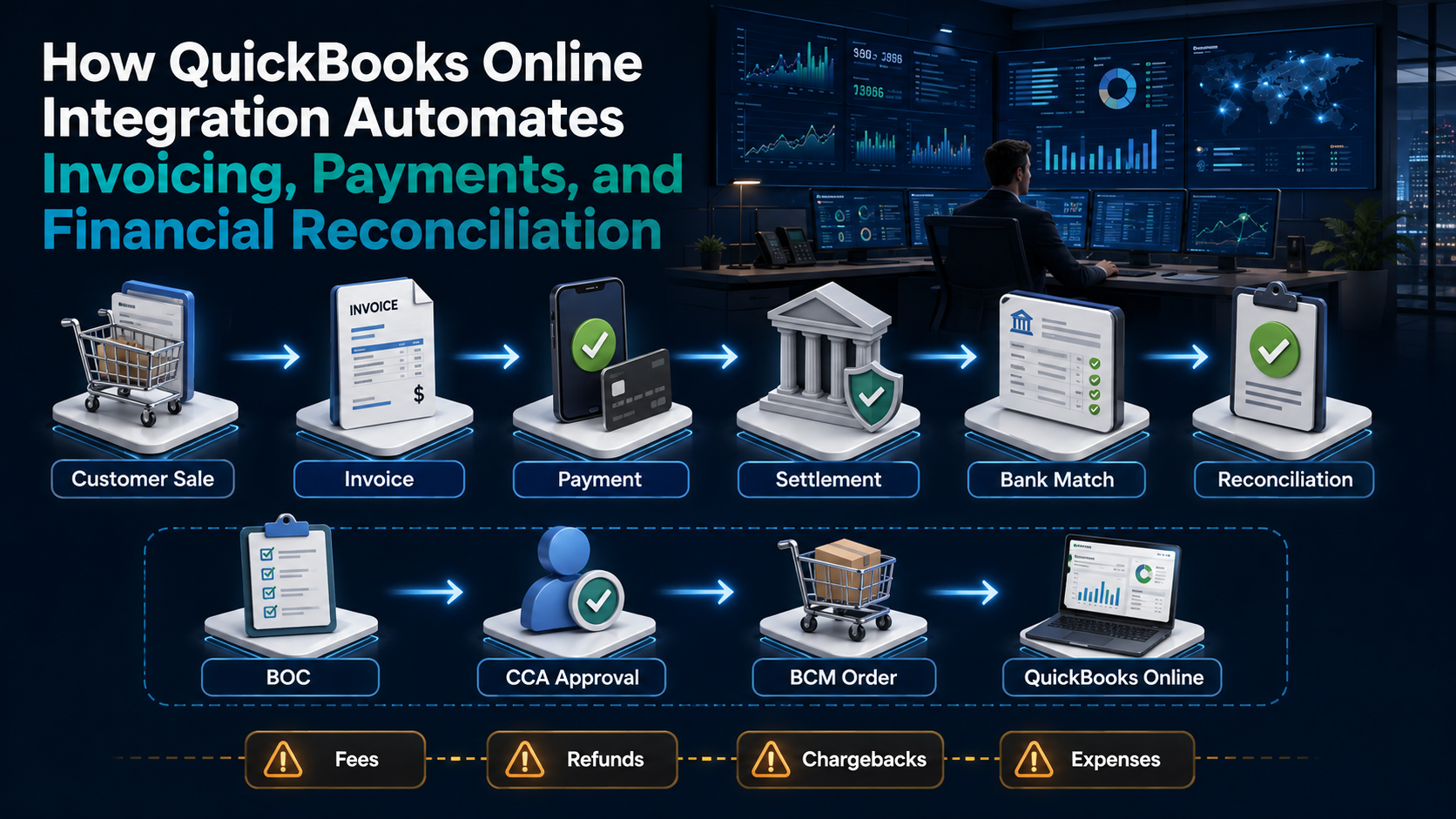
Connecting revenue and operating events to accurate accounting, controlled exceptions, and trusted financial closure.
QuickBooks Online can remain the accounting system of record while BOC governs the cross-system events, approvals, exceptions, and evidence that connect customer demand, invoicing, payment settlement, purchasing, and reconciliation.
Integration of QuickBooks Online Should Connect the Financial Journey, Not Only Import Transactions
QuickBooks Online is often the financial centre of a growing organization, but the events that create accounting work happen elsewhere. Customer commitments may begin in Salesforce, HubSpot, Zoho CRM, an ecommerce platform, a subscription application, a field-service system, or a project tool. Payments arrive through gateways and merchant processors. Purchases begin in procurement, expense, travel, inventory, or employee workflows. Banks confirm settlement after the operational event has already occurred.
When these systems remain disconnected, finance becomes the manual integration layer. Staff rekeys customers and invoices, download settlement reports, classify expenses, investigate unmatched deposits, and repair records after the fact. The accounting entries may eventually be correct, but the organization cannot easily prove whether each transaction represents the approved customer, price, tax treatment, delivery, payment, fee, refund, purchase, or business outcome.
A stronger design treats integration as an operating control. QuickBooks Online owns the accounting records appropriate to it. Source applications retain their own authoritative customer, commercial, workforce, or fulfilment data. Business Ops Center coordinates the journey between them: qualifying events, applying policy, routing approvals, preventing duplicate actions, managing exceptions, and preserving evidence until the operational and financial outcomes agree.
Why QuickBooks Online Integration Creates a High-Intent Customer Opportunity
Organizations searching for QuickBooks Online integration usually have a visible business problem rather than a theoretical technology need. Invoices are created late because sales or project data must be copied. Paid orders remain open because payment status does not return to the operating system. Processor fees, refunds, and chargebacks create unexplained differences. Vendor bills and employee purchases arrive without sufficient coding or approval. Month-end reconciliation depends on spreadsheets and the knowledge of a few people.
These problems affect cash flow, customer experience, close time, audit readiness, and staff capacity. They also provide a practical entry point for BOC. A discovery engagement can map one transaction family, identify sources of truth, define accounting and approval rules, document exceptions, select integration mechanisms, and establish proof of completion. The first implementation can connect one revenue or purchasing workflow end to end, then reuse the same patterns across additional channels, entities, and teams.
The Connected QuickBooks Online Financial Lifecycle
| Business stage | Integration opportunity | Governed outcome |
|---|---|---|
| Customer readiness | Connect CRM, ecommerce, contracts, products, terms, tax, and customer records. | One validated customer and commercial context before accounting begins. |
| Invoice creation | Create invoices from approved orders, subscriptions, milestones, usage, or delivery. | Accurate billing linked to the source commitment and evidence. |
| Payment application | Connect gateways, merchant services, bank events, payment references, and receivables. | Payments applied to the intended invoices without duplicate posting. |
| Settlement exceptions | Account for fees, timing, batching, refunds, disputes, and chargebacks. | Transparent differences with owners, decisions, and resolution evidence. |
| Bills and expenses | Connect purchasing, vendors, receipts, expenses, approvals, and coding. | Authorized spend recorded with complete financial dimensions. |
| Bank reconciliation | Correlate bank activity with invoices, payments, deposits, bills, and transfers. | Unmatched items become controlled cases rather than spreadsheet residue. |
| Reporting and close | Publish reconciled status, ageing, cash, exceptions, and close evidence. | Decision-ready financial visibility with traceable ownership. |
Connect CRM Commitments to Invoice-Ready Transactions
A closed deal does not always mean an invoice should be posted immediately. The integration may need an executed agreement, approved price, confirmed billing contact, valid tax information, delivery event, service milestone, usage quantity, or customer acceptance. BOC can combine that context before instructing QuickBooks Online to create or update the accounting record.
The source-of-truth model matters. A CRM may own the opportunity, seller, contract context, and pre-sale communication. QuickBooks Online may own the posted invoice, accounts-receivable balance, and payment application. Customer, item, class, location, tax, currency, discount, payment terms, and external references require explicit ownership and mapping. Ambiguous matches or policy exceptions should route to an accountable person instead of silently creating a second customer or an incomplete invoice.
Correlation identifiers make the journey durable. The CRM integration opportunity, order, invoice, payment, and downstream service case should be traceable without forcing every application to share one internal identifier. Idempotent processing ensures that a retry after timeout does not create a duplicate invoice or payment.
Connect Ecommerce and Subscription Events Without Losing Accounting Meaning
Ecommerce and subscription systems can generate high volumes of orders, renewals, discounts, taxes, shipping charges, credits, cancellations, and partial refunds. A basic connector may summarize or copy transactions, but the operating design must decide when individual detail is required, when controlled summaries are acceptable, how customers and products are represented, and how cut-off timing aligns with reporting needs.
BOC can classify the event before posting. An ordinary captured sale may follow the straight-through path. A high-value order, tax anomaly, changed shipping address, failed fulfilment, disputed renewal, unusual discount, or refund outside policy can become a governed exception. Finance receives the accounting context, while customer service and operations receive the action appropriate to the business event. The same case preserves the resolution and final financial effect.
Payment Authorization Is Not Financial Settlement
A processor response that says a payment succeeded is only one point in the lifecycle. The funds may settle later, arrive in a combined deposit, be reduced by fees, move across currencies, or be reversed by a refund, dispute, or chargeback. If the integration marks the invoice paid but cannot explain the bank deposit, finance must reconstruct the relationship manually.
A governed design correlates the customer transaction, processor payment, QuickBooks Online payment, deposit, fee, refund, dispute, and bank event. Differences receive reason codes, financial thresholds, owners, due dates, and approved treatments. Some may be timing items; others may require a credit memo, expense, correction, customer contact, or fraud review. Closure occurs only when the operational decision and accounting result are consistent.
Bills, Expenses, and Purchasing Need Context Before Coding
Vendor invoices and employee purchases often enter accounting after the business decision has already happened. The integration should capture who requested the spend, what was approved, which vendor and legal entity apply, the business purpose, receipt or contract, tax treatment, account, class, location, customer or project association, and whether the purchase has already been paid.
BOC can enforce approval and segregation-of-duties rules before a bill or expense reaches its posting state. It can detect duplicates using enterprise vendor governance, amount, date, invoice number, purchase reference, and document evidence. Exceptions such as missing receipts, nonstandard vendors, budget overruns, expedited delivery, or coding uncertainty can remain in a controlled workflow without obscuring the legitimate accounting record.
Bank Reconciliation Should Be Designed as an Outcome
Bank feeds improve visibility, but they do not remove the need for transaction correlation. Deposits may represent multiple customer payments. Withdrawals may combine principal, tax, and fees. Transfers can appear differently across accounts. Timing, duplicates, reversals, and incomplete references can leave plausible matches that still require judgement.
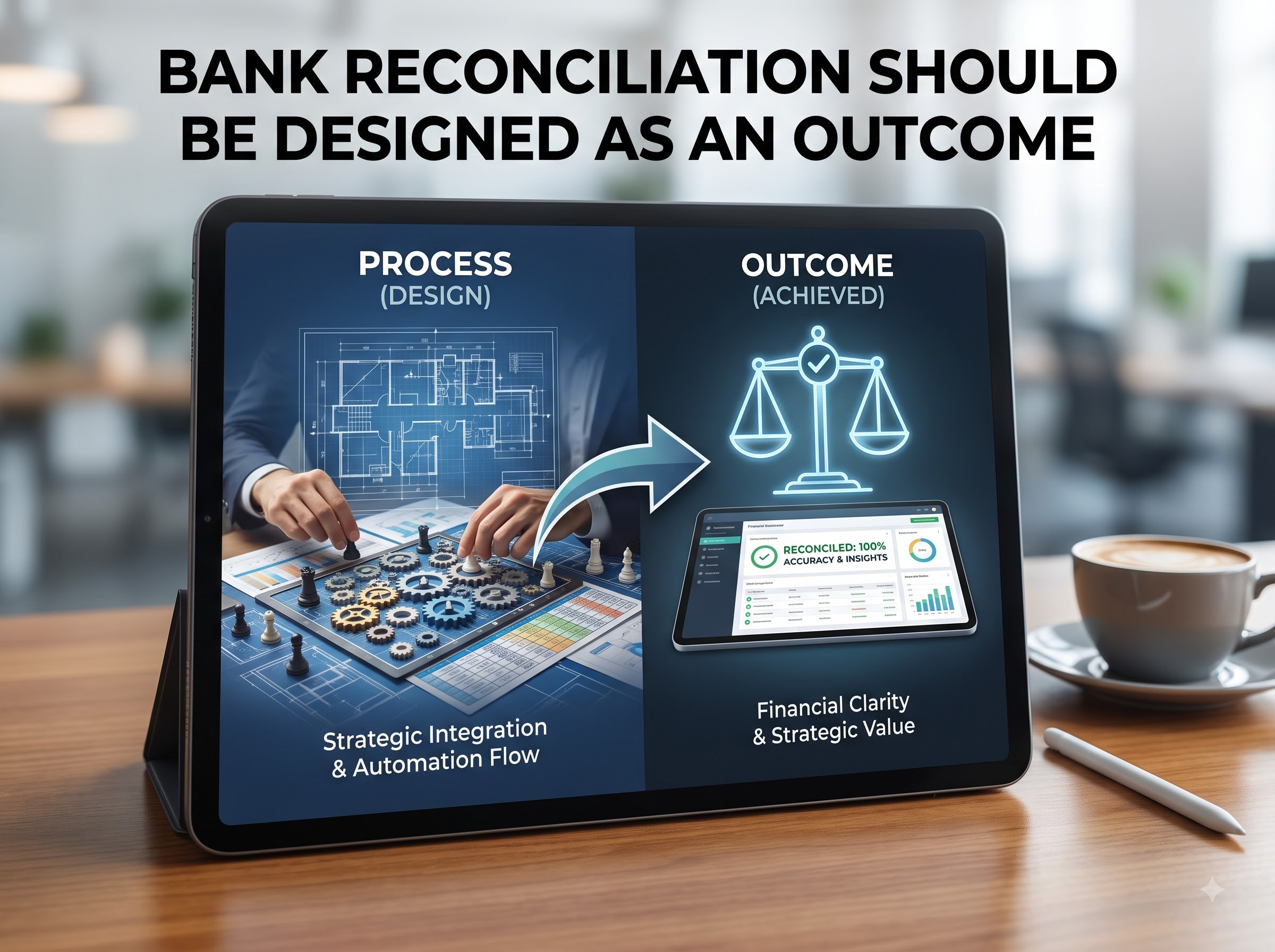
The integration should make match confidence and evidence explicit. High-confidence items can proceed under policy. Material or ambiguous items should be assigned with the relevant invoice, payment, vendor, purchase, processor, and bank context already assembled. BOC tracks the case through investigation and approval. A dashboard can then distinguish imported activity from matched, posted, exceptioned, and fully reconciled outcomes.
Business Card Ordering as a QuickBooks Online Purchasing Workflow
Business card ordering is a useful example because it crosses workforce identity, brand control, procurement, production, delivery, and accounting. A hire, transfer, promotion, name change, office move, or customer-facing role can trigger a candidate request. BOC checks eligibility and coordinates the process. CCA validates the approved name, title, company, department, location, phone, email, language, brand, and template. BCM converts the approved identity into a controlled order and tracks production and delivery.
QuickBooks Online can hold the supplier, purchase, bill, expense, payment, tax, account, class, location, customer or project, and attachment context appropriate to the organization. Standard quantities and shipping may proceed within policy. Premium stock, special formats, rush delivery, unusually large quantities, or a nonstandard supplier can require management, procurement, brand governance, or finance approval before the accounting commitment is created.
The completed workflow reconciles the authorized request, approved artwork identity, BCM production order, shipment, delivery confirmation, supplier bill, payment, and financial coding. HR owns workforce identity; CCA governs approved identity and brand; BCM governs ordering and production conversion; QuickBooks Online governs accounting records; and BOC governs the cross-system journey, approvals, exceptions, and evidence.
Use the QuickBooks Online Accounting API as a Governed Integration Surface
Intuit provides the QuickBooks Online Accounting API for applications that work with accounting entities and workflows. OAuth 2.0 is used for authorization. An integration should securely manage company identifiers and tokens, request only necessary access, separate development and production, protect secrets, and define what happens when authorization expires or is revoked.
Webhooks can notify an application when supported data changes, reducing dependence on aggressive polling. A notification should be treated as a signal to retrieve and evaluate authoritative state, not as complete business evidence by itself. Implementations should validate webhook authenticity, tolerate duplicate or delayed delivery, acknowledge promptly, process asynchronously, and reconcile missed or out-of-order events. API versions, supported fields, query behaviour, concurrency, limits, and object relationships should be tested against the organization’s exact QuickBooks Online configuration.
Data Mapping and Record Ownership Determine Whether Automation Stays Trustworthy
Customer names are not reliable keys. Product descriptions do not guarantee the correct income account. A payment reference may be missing or reused. The design should define stable external identifiers, mapping ownership, validation rules, effective dates, and fallback handling for customers, vendors, products and services, accounts, taxes, currencies, classes, locations, projects, terms, payment methods, and custom attributes.
Write ownership should be narrow. If CRM owns the billing contact, QuickBooks Online should not overwrite it in the CRM merely because a user corrected an invoice. If finance owns account classification, an ecommerce product update should not change it. BOC can route proposed master-data changes to the right steward and preserve why a mapping changed, when it became effective, and which transactions were affected.
Security, Privacy, and Control Must Be Part of the Integration Contract
Financial integrations process customer, vendor, employee, bank, tax, and transaction data. Least-privilege authorization, encryption, secret rotation, environment separation, logging, retention, access review, and incident procedures should be designed before production. Logs should support diagnosis without unnecessarily exposing sensitive payloads or credentials.
Approval authority must remain enforceable across applications. The person who requests a vendor, approves a purchase, changes payment details, records a bill, and releases payment should not gain accidental end-to-end control through automation. BOC can preserve identity, decision authority, conditions, timestamps, evidence, and downstream confirmation while QuickBooks Online retains its accounting controls.
Common QuickBooks Online Integration Failures
Frequent failures include duplicate customers and invoices, payments applied to the wrong document, summarized ecommerce postings that cannot be explained, processor fees omitted from settlement, refunds disconnected from the original sale, bills created without approval context, mappings maintained in personal spreadsheets, and integrations that report technical success before bank reconciliation.
Other failures are operational: expired authorization without an owner, webhook errors treated as invisible technical noise, manual corrections that never return to source systems, unclear responsibility between finance and operations, and no replay strategy after an outage. BOC makes the operating contract explicit by assigning each workflow a trigger, source system, correlation key, owner, approval rule, exception path, service target, evidence requirement, and closure condition.
A Practical QuickBooks Online Integration Delivery Roadmap
Start with one measurable process such as CRM-to-invoice, ecommerce settlement, vendor-bill intake, business card purchasing, or bank exception management. Baseline manual touches, cycle time, errors, unapplied cash, unmatched transactions, close effort, and exception ageing. Map systems, entities, owners, approvals, volumes, timing needs, sensitive data, and required evidence.
Define the authoritative source for every important field and select the appropriate event, webhook, API, scheduled, or file pattern. Build authentication, correlation, idempotency, validation, monitoring, exception routing, replay, and operational reconciliation into the first release. Test duplicate events, timeouts, token revocation, partial payments, combined deposits, fees, refunds, chargebacks, tax differences, deleted or changed source records, and manual corrections.
Production readiness includes named operational owners, support procedures, access reviews, mapping governance, change control, service metrics, and business-outcome dashboards. Measure invoice speed and accuracy, payment application time, settlement match rate, duplicate prevention, exception resolution, close duration, and percentage of transactions with complete source-to-ledger evidence.
How BOC Converts QuickBooks Online Integration into Measurable Value
BOC does not replace QuickBooks Online, CRM, ecommerce, payment, banking, expense, workforce, or fulfilment applications. It governs the work between them. The platform adds context, policy, assignment, approval, exception handling, evidence, and reconciled closure to technical connections.
A BOC discovery engagement can produce the target workflow, source-of-truth matrix, accounting-event model, integration architecture, security controls, exception taxonomy, implementation backlog, and measurement plan. Implementation can then connect the selected systems in controlled phases. The result is a reusable operating foundation that converts customer and purchasing events into accurate accounting and trusted financial outcomes.
Questions Integration Buyers Should Ask
- Which application owns each customer, vendor, item, invoice, payment, fee, refund, expense, and reconciliation attribute?
- What business evidence must exist before an invoice, payment, bill, or expense is created or changed?
- How will duplicates, delays, partial payments, batched deposits, fees, refunds, disputes, and reversals be handled?
- Which approvals and segregation-of-duties controls must remain enforceable across applications?
- Who owns OAuth authorization, webhook health, mappings, failures, replay, and business reconciliation?
- Can the first integration pattern be reused across channels, teams, locations, and future accounting workflows?
Turn one QuickBooks Online handoff into an automated, governed financial outcome. Business Ops Center can map the process, define source-of-truth and accounting rules, connect the required applications, and implement approvals, exception handling, evidence, and reconciliation. Start with one high-friction invoicing, payment, purchasing, or close workflow and build a reusable integration foundation from it.