

A governed integration model for open commerce customer operations, financial control, and employee identity fulfilment.
Category: Integration | Content Bucket: Commerce and Identity Operations | Buyer Stage: Consideration
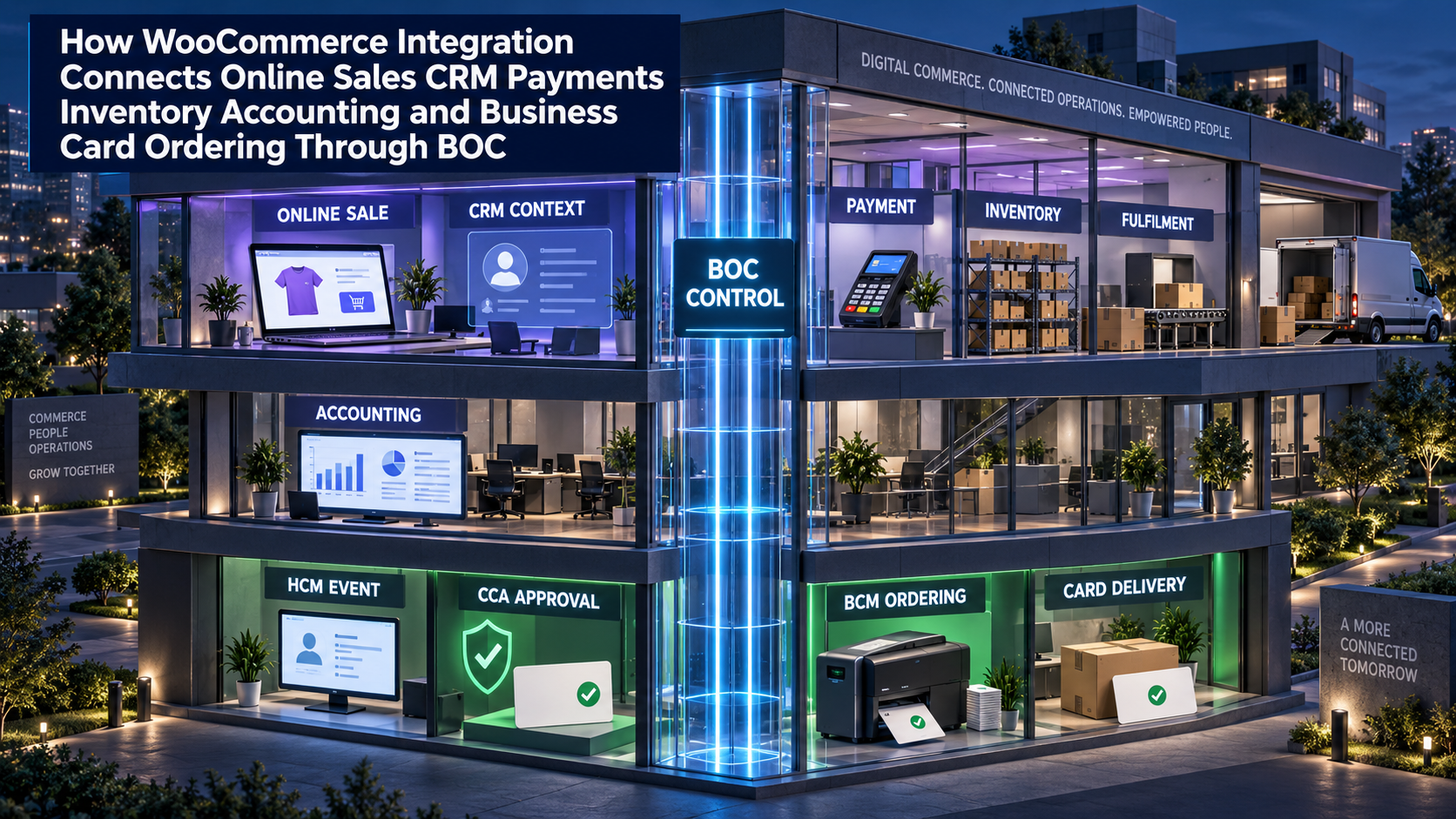
WooCommerce gives organizations extensive control over digital commerce, but that flexibility creates integration responsibilities across WordPress, plugins, CRM, payments, inventory, fulfilment, accounting, HCM, CCA, and BCM. BOC turns distributed events into governed workflows with clear ownership, controlled decisions, exception handling, reconciliation, and evidence-backed closure.
BOC Connects WooCommerce Demand to Enterprise Outcomes
A WooCommerce order can trigger work across customer management, payment processing, inventory, warehouse operations, shipping, tax, service, accounting, and reporting. The storefront may show an order status while critical downstream activities remain incomplete. When plugins and external applications update records independently, teams can struggle to establish which state is authoritative and who owns recovery.
Business Ops Center coordinates the complete outcome. WooCommerce remains responsible for the configured storefront, customer, product, cart, coupon, tax, shipping, and order records. CRM owns relationship context. Payment services own transaction states. Inventory and ERP systems own stock commitments and enterprise transactions. Accounting owns financial records. BOC governs the transitions between them and preserves the evidence required for closure.
The same BOC foundation supports workforce operations. HCM events and CRM assignments can establish the need for an employee ADP business card ordering integration. CCA governs printable identity, and BCM governs product conversion and fulfilment. Customer commerce and employee identity are distinct processes, but both benefit from authenticated events, source ownership, approval authority, exception handling, reconciliation, and traceability.
WooCommerce Flexibility Increases the Need for Governance
WooCommerce is implemented within a WordPress environment and can be extended through themes, plugins, custom code, payment gateways, shipping services, tax services, and external applications. This flexibility supports many business models, but it also distributes operational behavior across components maintained by different vendors and teams.
An integration must identify which component creates or modifies each important field, which hooks or API events are dependable, and how updates behave during plugin, theme, WordPress, WooCommerce, or infrastructure changes. A connector that works in one store can behave differently when extensions alter checkout, order status, inventory, refunds, subscriptions, or fulfilment.
BOC creates a governed boundary around that flexibility. It does not remove the merchant’s chosen tools. It defines the event contract, validates the context, applies business rules outside fragile point-to-point code, records decisions, and routes unexpected combinations to accountable owners.
REST APIs and Webhooks Support Controlled Integration
WooCommerce provides a REST API for working with commerce resources and webhooks for notifying external destinations when selected events occur. The exact endpoints, permissions, authentication method, payloads, and behavior must be verified against the installed WooCommerce version, WordPress environment, extensions, and security configuration.
BOC validates the source, topic, signature or configured authentication evidence, event identifier, timestamp, schema, and required values before processing. It acknowledges events promptly and performs longer work through a durable queue. Stable correlation keys connect the WooCommerce order to CRM, payment, inventory, fulfilment, accounting, and service records.
Retries and duplicate deliveries must not create duplicate shipments, refunds, invoices, card orders, or accounting entries. BOC uses idempotent operations where supported, stores prior outcomes, and reconciles uncertain responses before trying value-changing actions again. Scheduled comparisons detect missed events and manual updates that bypass the expected path.
The Governed WooCommerce Lifecycle
| Lifecycle stage | Authoritative context | BOC control | Required outcome |
|---|---|---|---|
| Commerce event | WooCommerce customer cart order line tax shipping and status | Authenticate correlate validate and classify | Traceable demand case |
| Customer context | CRM account owner contract campaign territory and service state | Resolve identity and terms conflicts | Approved commercial treatment |
| Payment | Gateway authorization capture failure refund and dispute | Map financial state to permitted action | Controlled payment outcome |
| Availability | Inventory ERP warehouse location and promise data | Prevent duplicate or impossible release | Reliable stock commitment |
| Fulfilment | Pick pack shipment delivery return and cancellation | Monitor milestones owners and recovery | Delivered order or owned exception |
| Accounting | Invoice tax fee refund payout cash and ledger records | Reconcile expected and posted value | Financial closure |
| Identity operations | HCM CRM CCA BCM supplier and delivery evidence | Govern eligibility identity and card order | Approved card delivery |
CRM Integration Adds Relationship and Sales Context
WooCommerce records the digital transaction, while CRM may contain the account hierarchy, owner, opportunity, campaign, partner, territory, agreement, service history, and renewal context required for enterprise treatment. BOC retrieves only the information needed for the decision and links it to the commerce case.
Source ownership must remain explicit. A checkout address should not silently replace a governed CRM account address. A CRM contact update should not change a completed financial transaction without an authorized process. BOC detects mismatches, assigns a correction, and records which value was used and why.
This context helps distinguish a consumer order from a negotiated B2B purchase, partner request, sales-assisted order, event order, or priority account. It can notify the correct owner, apply approved terms, create follow-up work, and prevent undocumented exceptions from accumulating in plugin configuration.
Payment Integration Separates Financial States
A WooCommerce status does not always describe the complete payment position. Authorization, capture, settlement, refund, dispute, chargeback, payout, and accounting posting are different states. Payment gateways and processors remain authoritative for their transaction records, while BOC determines what each verified state permits operationally.
The workflow can release fulfilment after the required payment evidence, hold suspicious or incomplete cases, route failed payments, prevent duplicate capture, and coordinate customer communication. Partial payments, offline methods, deposits, subscriptions, multiple currencies, and manual terms need explicit branches rather than a single paid-or-unpaid assumption.
Refunds require the original order, payment, fulfilment, return, amount, reason, prior adjustments, and approval threshold. BOC records authority, submits the permitted action, and follows the outcome into WooCommerce, CRM, inventory, tax, service, and accounting. A refund request is not closed merely because one API call succeeded.
Inventory and ERP Integration Protects Customer Promises
Storefront stock can differ from the quantity an enterprise can commit. Inventory, ERP, or warehouse platforms may own on-hand quantity, reservations, safety stock, kits, lots, locations, purchasing, backorders, and promise dates. BOC treats their response as the operational commitment.
A reliable design maps WooCommerce products and variations to enterprise process intelligence item identifiers, units, bundles, locations, and fulfilment services. It defines how cancellations, partial fulfilments, substitutions, returns, damaged goods, and manual adjustments affect every system. Mapping changes need controlled versions and regression testing.
BOC monitors orders that remain unallocated, oversold, partially fulfilled, or stranded between states. It assigns exceptions and updates customer-facing status only when the underlying operational state supports it. Reconciliation compares recent demand, reservations, shipments, cancellations, and returns to detect drift.
Fulfilment and Service Require Outcome Monitoring
Creating a fulfilment request does not prove customer delivery. Warehouse acceptance, pick, pack, carrier handoff, shipment, delivery attempt, confirmation, return, replacement, and cancellation represent different conditions. BOC links each milestone to the original order and expected customer outcome.
When an address, stock, supplier, carrier, or product problem occurs, BOC creates an exception with the relevant order lines, promise, payment state, customer context, and recovery choices. Customer service receives a coherent case instead of searching the WordPress administration area, gateway portal, warehouse system, carrier tracking, and email.
Closure follows evidence. A shipped order may remain open when delivery proof is required. A delivered order can remain financially open while a refund, tax adjustment, fee variance, or replacement is unresolved. BOC closes the case when the authorized outcome and material residual obligations have a controlled treatment.
Accounting Reconciliation Connects Orders to Cash
WooCommerce transactions can produce product revenue, discounts, tax, shipping, gateway fees, refunds, disputes, credits, inventory movement, cost, and settlement activity. Accounting systems record these values according to company policy, entity, currency, account structure, tax treatment, and close procedures.
BOC correlates orders, gateway transactions, invoices, credits, fees, settlements, bank deposits, and ledger entries. Missing postings, duplicates, tax mismatches, currency differences, timing differences, refunds without credits, unexplained fees, and unmatched deposits become exceptions with owners and aging.
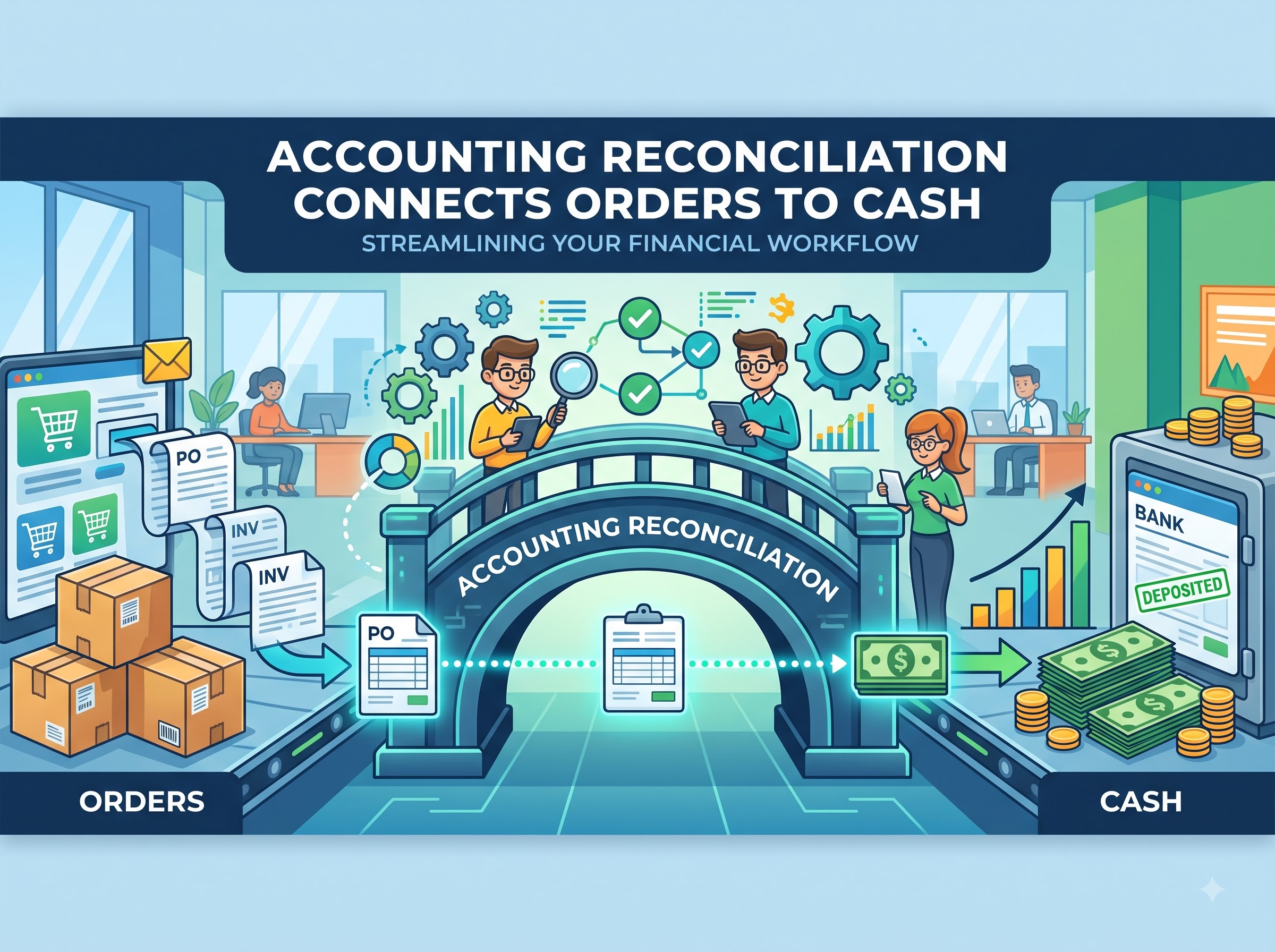
The operational reconciliation design must define cutoffs, time zones, rounding, currencies, payout grouping, materiality, suspense treatment, correction authority, and evidence. Event-driven updates support speed; scheduled reconciliation supports completeness. Both are needed for a trustworthy financial outcome.
Business Card Ordering Preserves the Base Purpose of BOC
WooCommerce integration belongs within BOC’s broader purpose: coordinating governed operations, including business card ordering. A new hire, promotion, office move, territory change, customer-facing assignment, partner role, or event can create a valid card requirement. The trigger may come from HCM, CRM, or an approved request.
BOC verifies active employment, effective date, legal entity, manager, role, location, CRM territory or account assignment, customer-facing need, requested quantity, budget, previous orders, delivery destination, and required date. Missing or conflicting facts are routed to HR, sales operations, management, brand, procurement, or the requester.
If WooCommerce participates in an internal ordering experience, it remains a channel rather than the authority engine. Checkout or payment cannot bypass workforce eligibility, CCA identity approval, BCM product controls, or purchasing limits. BOC correlates the commerce record with the governed identity and physical fulfilment outcome.
CCA and BCM Govern Identity and Production
Color Card Administrator controls the employee identity approved for print, including name, title, company, address, phone, email, language, legal text, brand, logo, and template. CCA returns a specific approved version so BOC can prove what was released.
Business Card Manager converts the approved identity into a controlled product and supplier order. BCM applies quantity, card type, stock, finish, proof, supplier, cost, shipping, and delivery rules. It returns production, shipment, tracking, delivery, cancellation, and reorder events.
BOC connects the HCM or CRM trigger, approval, CCA identity version, BCM order, optional commerce or payment reference, supplier result, delivery evidence, and accounting treatment. This prevents a flexible storefront or plugin from becoming an unauthorized path for branded identity production.
Extension and Plugin Governance Is an Operational Requirement
WooCommerce environments can depend on multiple extensions for checkout, payments, tax, subscriptions, shipping, inventory, analytics, security, and integration. Each component adds release cycles, configuration, data, hooks, permissions, and failure modes. Ownership cannot stop at the WordPress administrator.
BOC maintains an integration register covering component owner, purpose, version, data access, endpoints, credentials, dependencies, monitoring, test cases, fallback, and retirement plan. Changes are assessed in a representative environment before production. High-risk updates require explicit validation of orders, payments, refunds, inventory, webhooks, and accounting.
Observability should separate storefront availability from process health. A site can accept orders while downstream webhooks fail. A connector can appear healthy while mapping the wrong variation. BOC monitors event age, queue depth, error class, reconciliation variance, and unfinished business outcomes.
Security and Data Minimization: Define Safe Integration
API keys, consumer credentials, webhook secrets, service identities, and administrative access require least privilege, secure storage, environment separation, rotation, monitoring, and review. Transport security, signature validation, input validation, and controlled outbound destinations reduce the risk created by a highly extensible environment.
The data contract should identify each field, source, purpose, recipient, classification, and retention period. Warehouses need order and delivery details, not complete CRM history. Card suppliers need approved print and shipping data, not payment credentials, customer orders, or HCM files. Logs should favor references, timestamps, decisions, and error codes over full payloads.
BOC quarantines events that fail authentication, authorization, schema, freshness, or required-field checks. It keeps commerce and employee identity data appropriately separated while preserving end-to-end evidence. Security is designed into the operating workflow rather than added after deployment.
Common WooCommerce Integration Failures
The most common mistake is treating data movement as operational control. Copying an order into another system does not prove inventory commitment, payment certainty, fulfilment, delivery, refund completion, or accounting closure. Other failures include weak variation mapping, duplicate webhook processing, plugin conflicts, broad permissions, and untested upgrades.
Manual corrections can remain isolated in one system. A status can be interpreted differently by separate extensions. Checkout customization can omit required context. Retries can duplicate value-changing actions. Returns can reach a warehouse without financial correction. A business card ordering can be submitted without CCA authority.
BOC addresses these risks by defining events, authoritative sources, required context, permitted actions, correlation keys, idempotency, exception owners, evidence, reconciliation, and closure conditions. The integration serves the business process instead of allowing the plugin stack to define it implicitly.
A Practical WooCommerce Integration Roadmap
Begin with one store, order type, payment path, inventory owner, fulfilment location, and accounting destination. Map the journey from checkout to delivery and cash reconciliation. Document objects, identifiers, source owners, status meanings, volumes, service commitments, common exceptions, approvals, and evidence.
Build authenticated API access, webhook validation, durable ingestion, deduplication, CRM correlation, payment-state handling, inventory commitment, fulfilment workflow orchestration, customer updates, accounting integration, exception routing, monitoring, and scheduled reconciliation. Test duplicates, delayed events, timeouts, plugin updates, partial shipments, cancellations, returns, refunds, and manual changes.
Add the business card process as a separate governed flow through HCM, CRM, BOC, CCA, and BCM. Measure order cycle time, allocation latency, fulfilment exceptions, on-time delivery, refund completion, reconciliation aging, manual touches, card-order readiness, proof corrections, card delivery, and evidence completeness.
BOC Creates a Reusable Open Commerce Control Pattern
BOC creates value by coordinating responsibilities that remain distributed. WooCommerce owns configured commerce records. CRM owns relationship context. Payment providers own transaction states. ERP and inventory systems own stock and enterprise transactions. Accounting owns the books. HCM owns workforce facts. CCA owns approved identity. BCM owns physical card fulfilment.
A focused discovery engagement can define the event catalogue, source matrix, extension inventory, state model, API architecture, mapping controls, exception taxonomy, reconciliation design, card-ordering policy, implementation backlog, and measures. One high-friction order, refund, or inventory handoff provides a practical starting point.
Organizations should select a WooCommerce workflow that currently requires re-entry, creates inconsistent status, delays customer service, or weakens financial control. BOC turns that handoff into a governed operation and creates a reusable pattern for additional customer, finance, supplier, and workforce integrations.
Questions Integration Buyers Should Ask
- Which WooCommerce and WordPress versions, extensions, APIs, webhooks, and permissions support the required workflow?
- Which systems own customers, products, prices, payments, inventory, fulfilment, accounting, workforce, and identity data?
- How will duplicate, delayed, missed, and manually created changes be detected and reconciled?
- How are WooCommerce CRM gateway ERP accounting HCM BOC CCA and BCM records correlated?
- Which exceptions can be automated and which require sales, service, finance, HR, brand, procurement, or security approval?
- Who owns extensions, credentials, upgrades, monitoring, recovery, retention, and evidence?
Connect one WooCommerce event to a verified enterprise outcome. Business Ops Center can map the order lifecycle, define system ownership, connect WooCommerce with CRM, payment, inventory, fulfilment, and accounting platforms, and implement exception handling and reconciliation. BOC can also connect HCM and CRM events to CCA identity approval and BCM business card ordering, creating one governed operating model across customer commerce and employee identity workflows.