
| EXECUTIVE PERSPECTIVE: The enterprise does not gain operational control by connecting more applications. It gains control when every cross-system obligation preserves authority, ownership, policy, outcome verification, and evidence from initiation through closure. |
Integration Maturity Requires More Than Connected Applications
Enterprise integration programs often begin with a reasonable objective: move information between systems faster and reduce repetitive work. CRM, HRIS, ERP, procurement, identity, workflow, and fulfillment platforms are connected through APIs, middleware, event streams, and vendor interfaces. Transactions begin to flow automatically, and local teams gain speed. Yet as the integration estate expands, the organization can become more connected without becoming more controlled.
The underlying problem is architectural. Connections transport data, but they do not automatically preserve business authority, policy context, ownership, or proof of completion. Enterprise process orchestration can coordinate steps, yet it may still release work under an outdated approval. Monitoring can identify a failed connector, yet it may not recognize that a technically successful transaction produced the wrong business outcome. Reconciliation can detect a difference, yet the difference remains operationally unresolved unless somebody owns a governed recovery path.
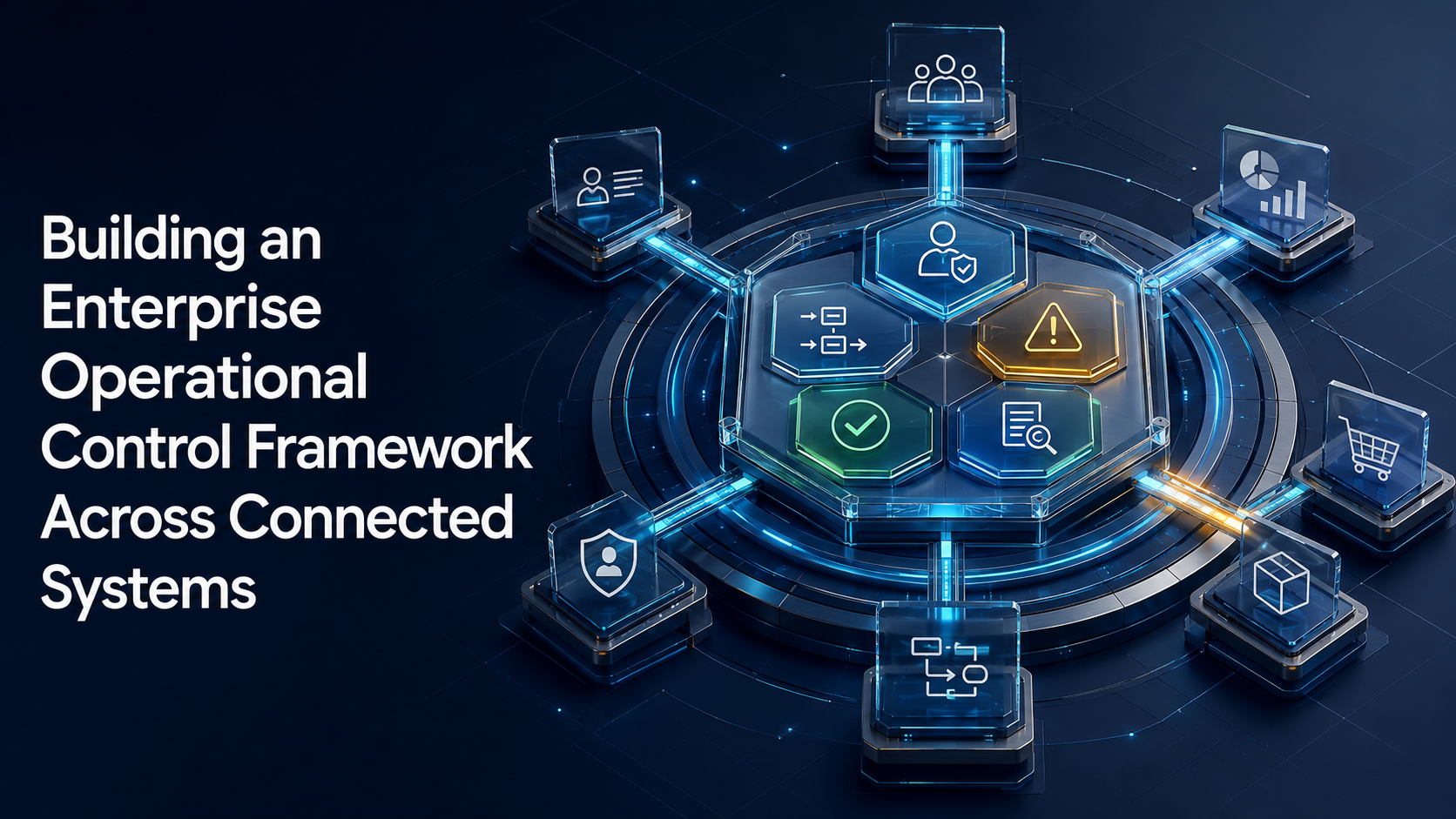
Business Ops Center provides the layer that binds these capabilities together. It treats every significant request as a persistent business event and carries that event from authorized intent through cross-system execution, exception handling, verification, and closure. The result is an operational control framework: a repeatable structure through which the enterprise can move quickly while retaining accountability across internal systems and external providers.
What an Operational Control Framework Actually Controls
An operational control framework is not another system of record and it is not a replacement for the applications that run finance, sales, people operations, identity, procurement governance, or fulfillment. Those platforms remain authoritative within their domains. The control framework governs the movement of business obligations between them. It determines whether a request is sufficiently complete, whether the right authority approved the right version, whether downstream action stayed within approved boundaries, whether deviations were handled correctly, and whether the intended outcome can be proven.
This distinction is essential because cross-system workflows create shared responsibility without automatically creating shared accountability. A manager may authorize a new-hire package, an HRIS may provide employee data, identity services may provision access, procurement may create a commitment, and a vendor may complete delivery. Each participant can complete a local task while the enterprise operational accountability or obligation remains incomplete. The framework keeps the obligation visible as one governed event rather than allowing it to disappear between departmental records.
Control should also be proportionate. A low-risk informational update does not need the same checks as a privileged-access change, regulated identity request, high-value purchase, or customer-facing fulfillment decision. Business Ops Center enables policy-driven controls based on value, sensitivity, geography, role, entity, urgency, and other enterprise factors, preserving speed where risk is low and adding stronger evidence where consequences are material.
The Six Control Capabilities That Must Operate Together
Persistent business context establishes the subject, objective, source data, policy, scope, and correlation identity of the event. Without this context, downstream systems see isolated messages and operators must reconstruct why the work exists. A persistent event gives every action and response a common operational meaning.
Governed authority confirms that the decision-maker has the correct role, delegation, limits, and separation from conflicting duties. It preserves the exact version approved and the policy in effect at the time. This prevents later data changes or informal instructions from silently altering authorized intent.
Controlled orchestration coordinates dependencies, approvals, releases, and external handoffs. It decides what can proceed, what must wait, and what evidence is required before the next step. Orchestration therefore becomes a policy-aware operating mechanism rather than a sequence of API calls.
Governed exception management gives every material deviation a classification, owner, service objective, escalation route, and authorized resolution options. Failures, missing evidence, stale approvals, substitutions, partial completion, and policy conflicts remain connected to the original event instead of moving into disconnected inboxes or technical logs.
End-to-end reconciliation compares authorized intent with actual execution and final outcome. It supports exact matches, controlled tolerances, transformations, permitted substitutions, and human judgment where rules cannot decide. Closure occurs only when the enterprise obligation is verified or an authorized alternate disposition is recorded.
Unified evidence preserves the decision, execution, recovery, and closure history. It enables operations, risk, compliance, audit, and leadership to examine the same coherent record without assembling screenshots, emails, tickets, and exports after the fact.
A Control Framework Built Around the Business Event
The business event is the organizing unit of the framework. It may be an employee onboarding, role transfer, customer request, location opening, purchase, identity change, governed centralized ordering decision, or supplier fulfillment obligation. Whatever the use case, the event persists even when system identifiers, owners, statuses, or vendors change. This continuity allows the enterprise to distinguish one evolving obligation from duplicate or unrelated transactions.
At initiation, BOC captures the authoritative source, requested outcome, subject, scope, applicable policy, risk attributes, and required evidence. During authorization, it records approver identity, role, delegation, sequence, version, and any conditions. At the time of execution, it connects payloads, acknowledgements, downstream identifiers, status changes, and external responses. During recovery, it preserves discrepancies, decisions, corrections, and compensating actions. At closure, it records the comparison result and evidence that demonstrates fulfillment.
Organizing control around the event also improves change management. If a cost center, approver, employee role, vendor, specification, or delivery date changes during execution, the framework can determine whether the existing authorization remains valid. It does not merely overwrite current data. It preserves the historical state and routes material changes through an appropriate revalidation or reapproval path.
The Enterprise Operational Control Lifecycle
Qualify the request. Confirm that the trigger is legitimate, required data is present, duplicate risk is controlled, the correct policy applies, and the requested outcome is sufficiently defined. Incomplete or conflicting requests should not enter execution simply because an integration can accept them.
Establish authority. Determine who or what may authorize the action, validate role and delegation, apply approval thresholds and segregation-of-duties rules, and preserve the approved version. Time-limited or conditional approvals should be enforced as operating constraints.
Orchestrate release. Sequence internal and external actions according to dependencies. Carry a persistent correlation identity, use idempotent controls to prevent duplicate execution, and capture acknowledgements at each material handoff.
Monitor obligations, not only messages. Track whether each required business outcome is pending, completed, overdue, blocked, or uncertain. A successful API response may satisfy a technical checkpoint without satisfying the underlying obligation.
Govern exceptions. Classify deviations by cause and risk, assign an accountable owner, protect policy boundaries, and allow only authorized recovery choices. Retries, substitutions, overrides, cancellations, and compensating actions must preserve lineage.
Reconcile and close. Compare approved intent, executed action, and confirmed outcome using policy-aware rules. Close the event only when required evidence is present or an authorized disposition explains the remaining difference. Feed recurring causes into improvements for policy, data, workflow, integrations, and supplier management.
Control Objectives Across the Connected Enterprise
| Control objective | Enterprise question | BOC capability |
| Valid initiation | Is the request complete, legitimate, and based on authoritative data? | Qualification, validation, duplicate control, policy selection |
| Authorized decision | Did a permitted decision-maker approve the exact version? | Role, delegation, thresholds, approval lineage |
| Controlled execution | Did work proceed in the correct sequence and within approved boundaries? | Policy-aware orchestration, release gates, idempotency |
| Owned deviation | Is every material difference visible, assigned, and governed? | Exception taxonomy, ownership, escalation, recovery paths |
| Verified outcome | Does actual execution satisfy authorized intent? | Policy-aware reconciliation and completion criteria |
| Defensible closure | Can the enterprise reconstruct the full operational history? | Unified evidence, immutable lineage, audit-ready record |
How the Framework Changes Enterprise Use Cases
Employee lifecycle operations become more than an HRIS-triggered checklist. A new hire, transfer, promotion, leave, or separation is treated as an enterprise obligation spanning identity, equipment, purchasing, physical access, customer-facing information, and fulfillment. BOC verifies the authority and effective date, coordinates dependencies, detects residual or missing access, and closes only when required outcomes are confirmed.
CRM-driven operations gain a boundary between commercial intent and governed execution. A customer, opportunity, contract, or account event can initiate work, but release depends on complete data, permitted authority, current specifications, and required legal or operational checks. Final delivery and cost can be reconciled back to the originating event without allowing urgency to bypass control.
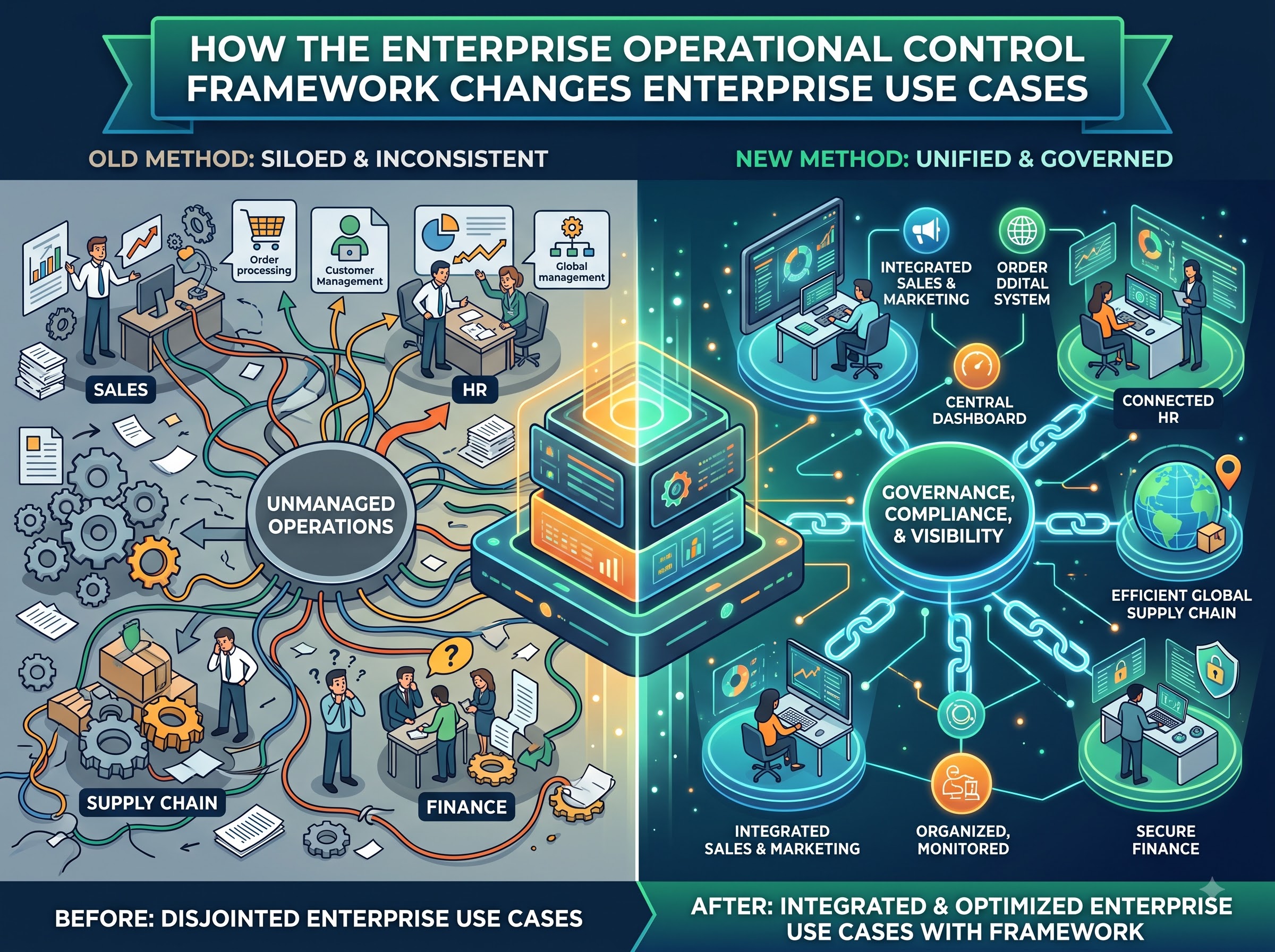
Procurement and ERP workflows gain continuity from request through approval, commitment, receipt, invoice, and supplier outcome. A change in price, quantity, entity, vendor, tax treatment, or delivery condition is evaluated against the authorized scope. Partial delivery, substitution, duplicate billing, and missing receipt become owned discrepancies rather than late financial surprises.
Distributed ordering and fulfillment programs gain enterprise vs SMB business card solutions consistency without forcing every region into an identical local process. Business units and partners may retain appropriate execution systems, while BOC applies common control objectives, evidence requirements, escalation standards, and outcome visibility across the network.
The Difference Between Platform Monitoring and Operational Control
Technical monitoring asks whether services are available, messages were delivered, jobs completed, latency stayed within limits, and error rates remained acceptable. These measures are necessary for integration reliability. Operational control asks a different set of questions: Was the request authorized? Did execution use the approved version? Is the obligation still open? Did the result satisfy policy and business intent? Who owns the difference? Can the enterprise prove closure?
The two disciplines should reinforce each other. Technical telemetry can reveal a connector failure or performance degradation. Business Ops Center adds policy, ownership, and event context so the enterprise understands which obligations are affected and what recovery is permitted. Conversely, recurring operational discrepancies can expose mapping defects, unstable master data, ambiguous interfaces, weak vendor commitments, or workflows that technically succeed while producing unacceptable outcomes.
This combined view prevents a dangerous reporting gap in which integration dashboards appear healthy while operations continue to resolve missing, incorrect, duplicated, or unauthorized outcomes manually.
Metrics for an Operational Control Framework
A mature measurement model begins with governed outcomes. Useful measures include the percentage of events initiated with complete authoritative data; authorization cycle time and approval-expiry rate; straight-through execution rate; duplicate-prevention events; exception rate by cause, risk, system, vendor, and business unit; time to ownership and resolution; aged unresolved obligations; reconciliation latency; first-pass outcome match rate; closure with complete evidence; unauthorized substitution or override attempts; and repeat discrepancies linked to common policy, data, mapping, or supplier causes.
These measures should be interpreted together. A rising straight-through rate is not an improvement if mismatch rates or unverified closures also rise. A low exception rate may indicate stable operations, or it may indicate weak detection. Faster approvals may be valuable, but not if delegation and separation-of-duties controls are bypassed. BOC connects performance measures to the governed event so leaders can balance speed, control, cost, risk, and customer or employee experience.
The framework also creates a continuous-improvement loop. Patterns across events show whether the right intervention belongs in source-data stewardship, policy clarification, approval design, integration mapping, vendor service levels, or operational ownership. Teams can improve root causes instead of repeatedly treating symptoms.
Implementation Priorities for Enterprise Leaders
Begin with a cross-system workflow whose failures are visible, consequential, and measurable. Good candidates include employee lifecycle changes, governed customer fulfillment, distributed purchasing, identity-sensitive requests, or vendor-dependent ordering. Define the business obligation and closure evidence before selecting integration mechanics.
Map authority and decision boundaries explicitly. Identify authoritative data, approval rights, delegation, thresholds, segregation-of-duties requirements, permitted variations, and conditions that require reapproval. This policy model should govern orchestration rather than remain as a procedure document outside the workflow.
Create persistent identifiers and evidence standards. Decide how events will remain traceable across internal applications, retries, supplier references, partial completion, corrections, and reversals. Capture evidence when the decision or action occurs instead of relying on retrospective extraction.
Design exceptions as part of the primary workflow. Define categories, ownership, escalation, resolution options, and closure requirements before launch. An automation design that covers only the happy path transfers its hardest work to email, spreadsheets, and individuals.
Scale through reusable control patterns. Once the organization proves an event model, authority pattern, exception taxonomy, reconciliation rule, or evidence standard, it can reuse those components across workflows while adjusting controls for risk. This creates enterprise consistency without imposing a single rigid process everywhere.
Questions Enterprise Buyers Should Ask
- Does the platform preserve one governed business event across systems, teams, vendors, retries, corrections, and final closure?
- Can authority, policy version, delegation, approval conditions, and the exact approved state be reconstructed?
- Does orchestration enforce business dependencies and policy boundaries, or does it only move messages?
- Are technical failures and business exceptions classified, owned, escalated, and resolved through controlled paths?
- Can the platform compare intent, execution, and outcome using exact rules, tolerances, transformations, and permitted substitutions?
- Does closure require business evidence rather than a downstream success status?
- Can leaders see open obligations, risk, performance, and recurring control failures across the integration estate?
- Can control patterns be reused across workflows while respecting local systems, entities, and risk profiles?
From an Integration Estate to an Accountable Operating System
The strategic value of integration is not the number of applications connected. It is the enterprise’s ability to execute important obligations quickly, consistently, and accountably across those applications. Connectivity creates reach. Governed orchestration coordinates action. Exception management protects the process when reality diverges from design. Reconciliation verifies the outcome. Evidence makes the result defensible.
Business Ops Center unifies these capabilities as an operational control layer. It does not erase domain ownership or centralize every system. It creates shared control around the business events that cross those boundaries, giving operators clear ownership, leaders reliable visibility, and auditors coherent evidence.
This is how enterprises move beyond fragmented automation. They create a durable framework in which authorized intent can travel across systems without losing context, deviations remain governed, and completion can be proven. Connected systems then become more than an integration estate: they become an accountable operating system for enterprise execution.
Turn connected applications into governed enterprise operations. Explore how Business Ops Center can unify authority, orchestration, exception management, reconciliation, and audit evidence around your most important cross-system workflows. Visit businessopscenter.com to identify a high-value business event and define the operational controls required from initiation through verified closure.