Introduction
Many organizations evaluate business card solutions the same way individuals evaluate print vendors.
They compare paper quality, template options, price, turnaround time, and shipping.
Those criteria matter, but they are not enough for medium and large companies.
At enterprise scale, business card management is not only a print decision. It becomes an operational systems decision.
Business card workflows touch employee identity, approvals, procurement, finance, brand governance, vendor coordination, reporting, and operational visibility.
That is why growing organizations should evaluate business card solutions across three different operating models:
- Consumer and small business print ordering services
- Corporate print ordering portals
- Enterprise business card management platforms
Each model solves a different problem.
Why This Distinction Matters?
A business card may look simple, but the workflow behind it can become complex as an organization grows.
A medium or large company may need to manage:
- new hire card requests
- role and title changes
- department changes
- multiple office locations
- regional template variations
- manager approvals
- procurement controls
- cost centers
- vendor routing
- delivery tracking
- reporting and auditability
- system integration with HR, CRM, ERP, or procurement platforms
When these requirements are handled manually, organizations often rely on spreadsheets, email approvals, disconnected vendor portals, and repeated data entry.
That creates operational friction.
The result is often:
- inconsistent employee identity data
- outdated titles or phone numbers
- slow approval cycles
- weak procurement visibility
- limited audit history
- inconsistent brand execution
- disconnected vendor coordination
- avoidable administrative work
For this reason, medium and large companies should compare business card solutions based on workflow infrastructure, not only print output.
The Three Operating Models
1. Consumer and Small Business Print Ordering Services
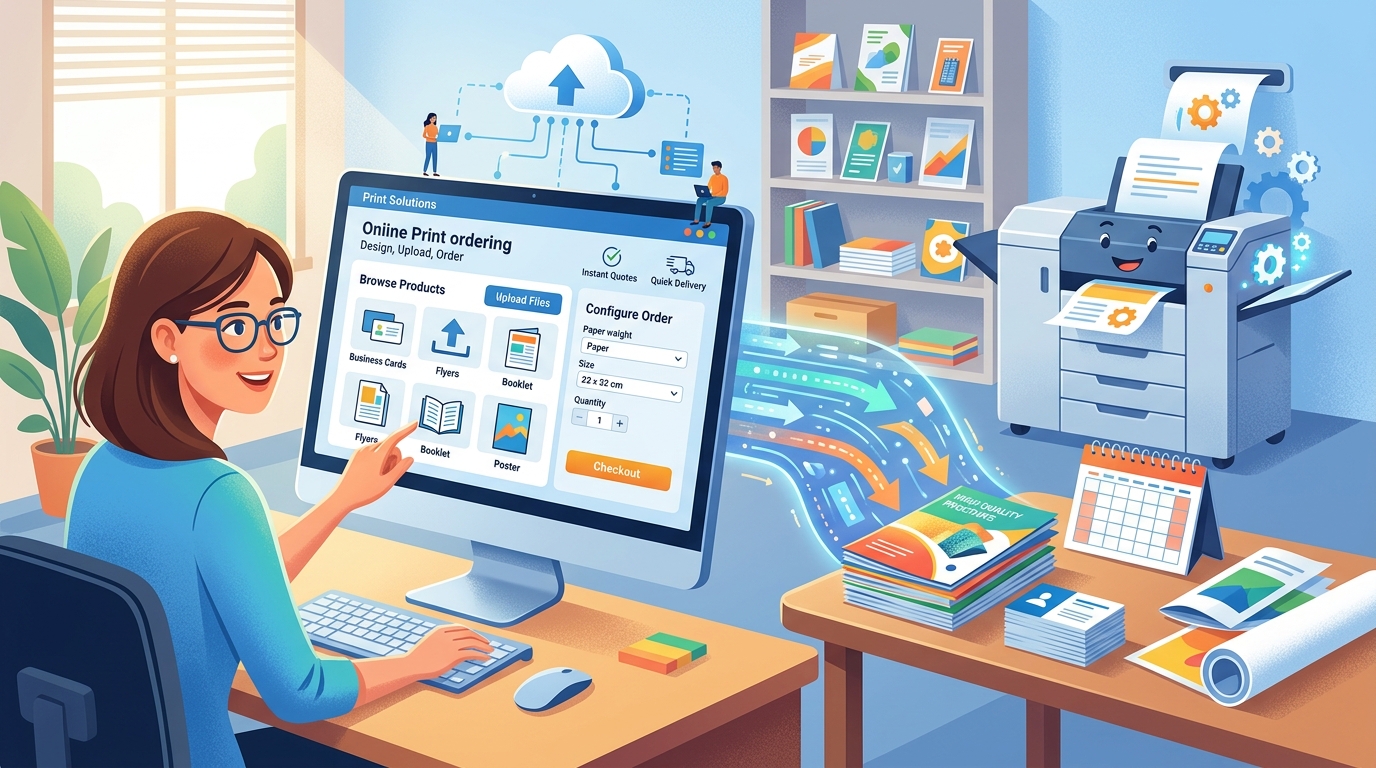
Consumer and small business print services are designed for individuals, startups, freelancers, and small teams.
They typically compete on:
- design tools
- templates
- paper options
- finish options
- price
- turnaround time
- shipping convenience
This model works well when one person or a small team needs to order business cards quickly.
However, this model is not designed to govern complex business card workflows across multiple teams, cost centers, locations, approval paths, and enterprise systems.

2. Corporate Print Ordering Portals
Corporate print ordering portals are designed for organizations that need more structure than individual print ordering.
These systems may support:
- branded storefronts
- saved templates
- business account users
- invoicing
- bulk uploads
- corporate pricing
- account management
- branded product ordering
MOO and Vistaprint Corporate are examples of print-led platforms that publicly emphasize business printing services, enterprise or corporate print programs, templates, design support, invoicing, delivery oversight, branded storefronts, corporate pricing, and account support.
This model can be useful when the organization primarily wants a controlled way to order business cards and branded print materials from a print provider.
The limitation is that a print ordering portal is still usually centered around print procurement and fulfillment.
It may not be designed as the operational infrastructure layer connecting employee identity data, approval routing, cost center rules, procurement visibility, reporting, and enterprise system integration.
3. Enterprise Business Card Management Platforms
Enterprise business card management platforms are designed for organizations that need to control the full workflow behind business card execution.
This model focuses on:
- centralized ordering
- approval workflows
- template governance
- operational visibility
- procurement coordination
- cost center reporting
- multi-location administration
- HR and onboarding coordination
- vendor routing
- auditability
- API integration
- enterprise system connectivity
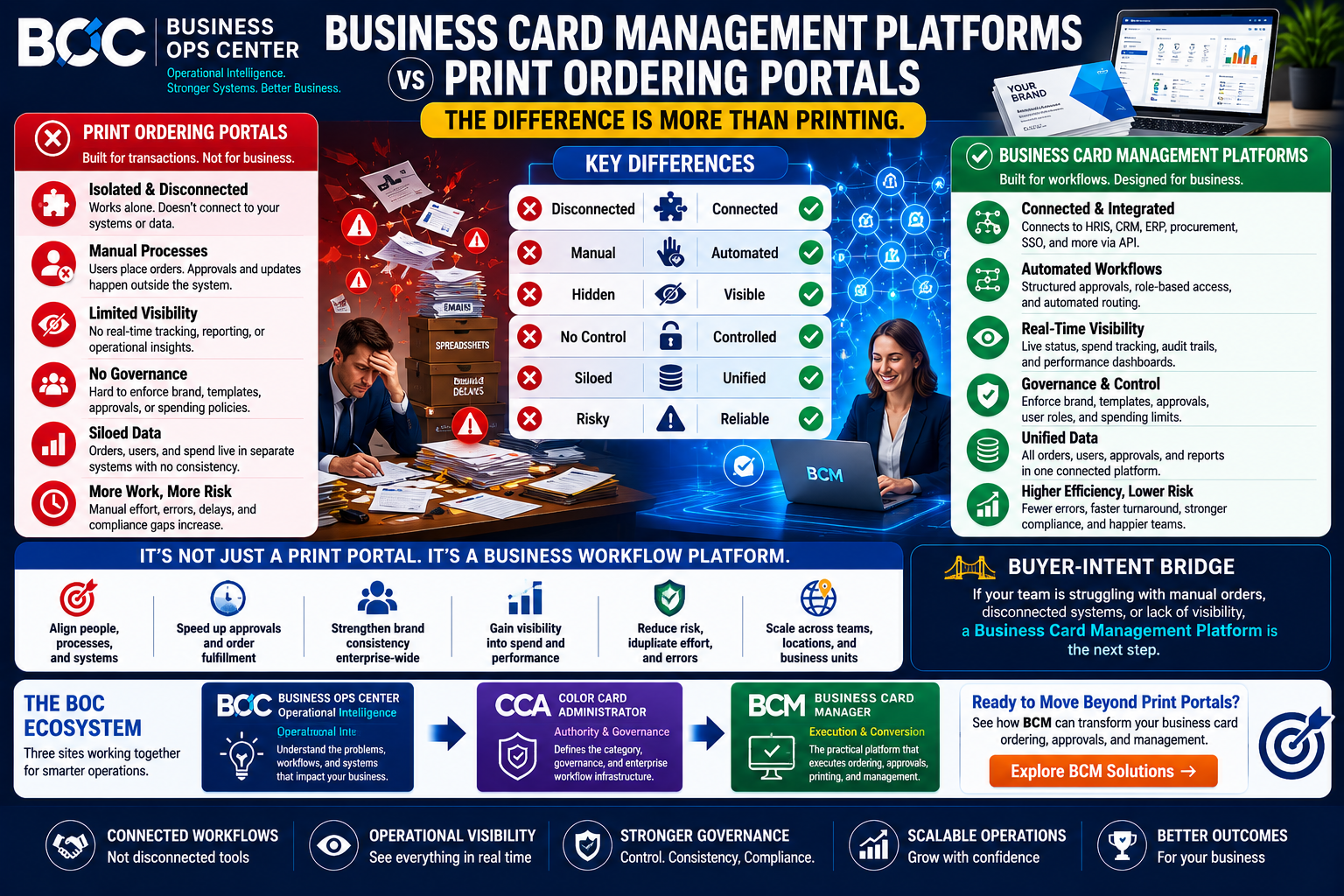
This category is different because the primary value is not only printing the card.
The value is controlling the operational system behind the card.
Comparison Framework
| Capability | Print Ordering Service | Corporate Print Portal | Enterprise Business Card Management Platform |
|---|---|---|---|
| Best fit | Individuals and small teams | Companies needing controlled print ordering | Medium and large companies needing workflow governance |
| Primary value | Design, price, and convenience | Branded print ordering and account support | Workflow control, integration, visibility, and governance |
| Centralized ordering | Limited | Often available | Core capability |
| Approval workflows | Limited | May be available | Core capability |
| HRIS / CRM / ERP integration | Usually limited | Usually limited or program-dependent | Core enterprise requirement |
| API integration | Usually limited | Usually limited or program-dependent | Strategic differentiator |
| Template governance | Basic design controls | Branded templates | Role, policy, and field-level controls |
| Procurement visibility | Limited | Account and order visibility | Cost center, approval, vendor, and workflow visibility |
| Multi-location governance | Limited | May be supported | Core capability |
| Vendor flexibility | Usually vendor-owned | Usually vendor-owned | Can support approved vendor routing |
| Auditability | Basic order history | Account-level order history | Workflow, approval, and operational audit trail |
| Operational reporting | Limited | Account reporting | Enterprise reporting and visibility |
Why API Integration Changes the Evaluation?
API integration is one of the most important differences between a print ordering tool and enterprise workflow infrastructure.
In many organizations, employee identity and operational data already live inside systems such as:
- HRIS platforms
- CRM systems
- ERP environments
- procurement systems
- identity providers
- finance systems
- proprietary internal databases
When business card workflows are disconnected from those systems, teams often duplicate data manually.
That creates errors.
Employee titles may become outdated. Phone numbers may be wrong. Cost centers may be missing. Approval routing may not match the current organization. Procurement teams may lack visibility into ordering activity.
API-connected workflow infrastructure helps solve that problem by connecting business card requests, employee identity data, approvals, procurement activity, vendor execution, and reporting across the organization.
For medium and large companies, API integration should not be treated as a minor feature.
It should be part of the core evaluation.
What Medium and Large Companies Should Evaluate?
1. Identity Data Control
The first question is not only whether the platform can print cards.
The question is whether the platform can keep employee identity data accurate.
Organizations should ask:
- Can business card data connect to HR or identity systems?
- Can titles, departments, locations, and phone numbers stay current?
- Can different systems own different fields?
- Can employee changes trigger workflow updates?
- Can outdated records be reduced or eliminated?
Identity data control becomes more important as employee count, department complexity, and location count increase.
2. Approval Workflow Depth
Simple approval workflows may work for small teams.
Medium and large organizations often need deeper logic.
They may need approvals based on:
- department
- manager
- cost center
- office location
- region
- brand
- title
- request type
- exception status
- procurement rules
This is where enterprise workflow infrastructure becomes important.
3. Procurement Visibility
Business card programs may appear small on a per-order basis, but they can create operational and procurement complexity across a large organization.
Procurement teams may need visibility into:
- who ordered
- who approved
- which cost center was used
- which vendor fulfilled the order
- what the order cost
- which location received the cards
- whether exceptions occurred
A print portal may provide order history.
An enterprise business card management platform should provide workflow visibility.
4. Template and Brand Governance
Brand control is not only about locking a design.
It is about ensuring the right employee gets the right version of the right template under the right rules.
Organizations may need different templates by:
- brand
- region
- country
- language
- department
- role
- regulatory requirement
- business unit
Template governance becomes more complex when companies operate across multiple locations, divisions, or regulated environments.
5. Operational Visibility
Operational visibility shows how work is moving across the organization.
For business card management, visibility may include:
- request status
- approval status
- production status
- delivery status
- exceptions
- bottlenecks
- vendor activity
- department activity
- cost center activity
- location activity
This matters because teams cannot improve workflows they cannot see.
6. Vendor Routing and Flexibility
Some organizations want one print provider.
Others need vendor flexibility.
Vendor flexibility may matter when an organization has:
- regional production requirements
- country-specific fulfillment needs
- approved vendor lists
- internal print shops
- backup vendors
- special procurement rules
- shipping cost considerations
A vendor-owned print portal may be the right choice when the company wants to standardize around that provider.
An enterprise management platform may be the better choice when the organization needs workflow control independent of a single vendor.
Where Business Card Manager Fits?
Business Card Manager is an example of an enterprise business card management platform.
It is designed for organizations that need:
- centralized business card ordering workflow
- approval routing
- template governance
- operational visibility
- HR and procurement coordination
- multi-location execution
- reporting
- API-connected workflow infrastructure
Business Card Manager integrations is part of the Color Card Administrator ecosystem, which focuses on enterprise business card governance, API-integrated enterprise business card governance workflow infrastructure, and identity-driven operational control.
For organizations that need business card workflows connected to HR, CRM, ERP, procurement, identity, finance, SSO, or proprietary systems, this operating model is different from a traditional print ordering portal.
Strategic Takeaway
Business card buying criteria change as organizations grow.
Individuals and small teams usually compare printing services based on price, design, paper, and delivery.
Medium and large companies need to evaluate the operating system behind business card management.
The strongest enterprise evaluation criteria include:
- centralized ordering
- approval workflows
- API integration
- HRIS, CRM, ERP, and procurement connectivity
- template governance
- procurement visibility
- operational reporting
- vendor flexibility
- auditability
- multi-location control
Print quality still matters.
Cost still matters.
But for larger organizations, the bigger question is whether the business card workflow can support governance, visibility, and operational control at scale. Enterprise business card infrastructure vs lightweight SaaS identity platforms.
That is the difference between ordering cards and managing enterprise business card infrastructure.