
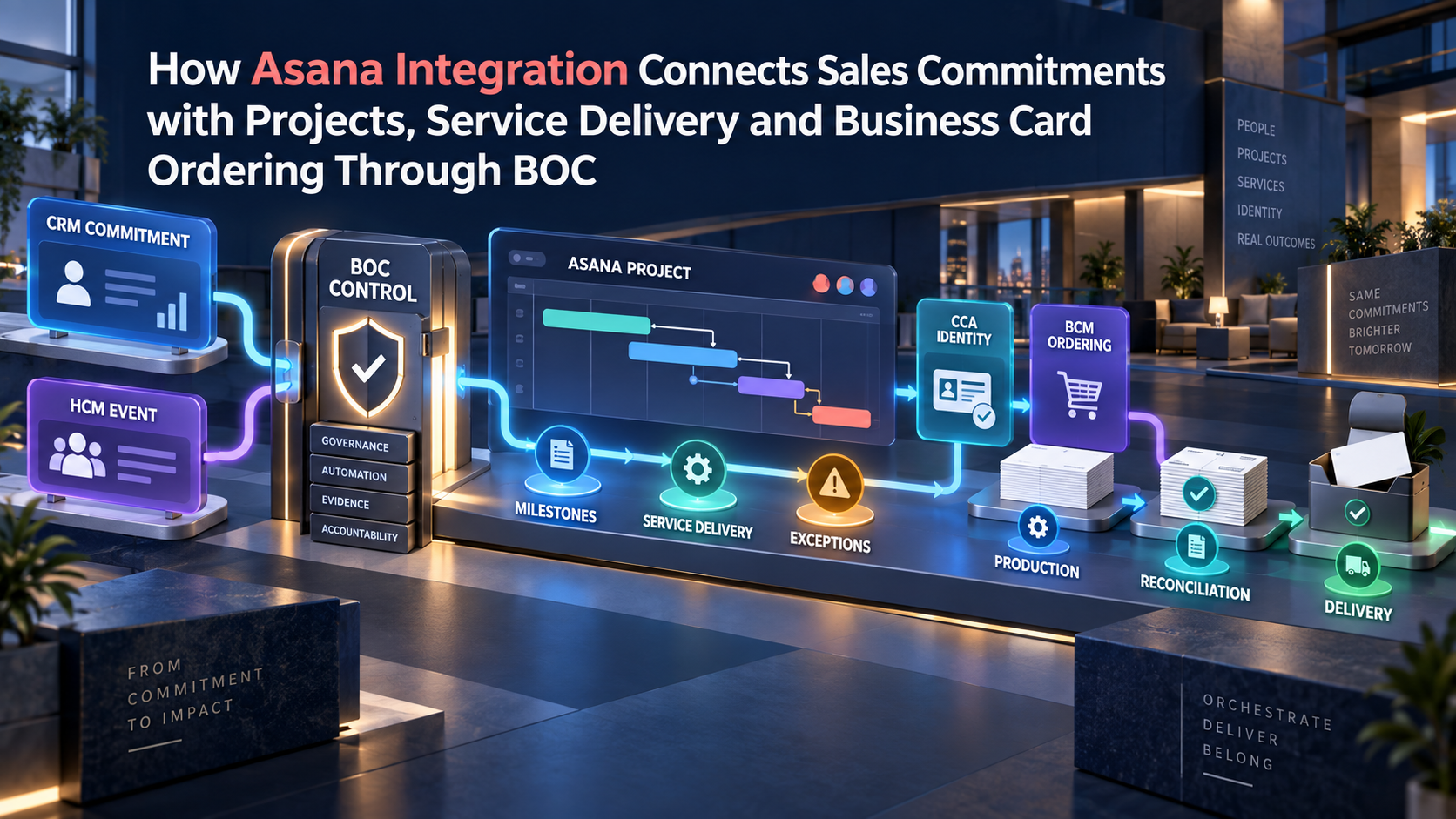
Connecting CRM HCM Asana APIs approvals CCA BCM and enterprise systems without confusing project completion with operational closure.
Asana can coordinate projects, tasks, milestones, and service delivery, but task completion is not automatically proof that a customer commitment, workforce change, purchasing decision, or business card order reached its intended outcome. BOC connects Asana work to authoritative CRM and HCM data, governs API execution, and coordinates CCA and BCM through evidence-backed delivery and closure.
Asana Becomes an Enterprise Delivery Surface Through BOC
Sales teams make commitments in CRM. HR teams initiate workforce changes in HCM. Operations teams coordinate delivery across finance, service, procurement, facilities, identity, and suppliers. Asana can make the resulting work visible, assigned, and time-bound, but the integration must preserve the systems that own the underlying business facts.
Business Ops Center provides that operating boundary. A qualified opportunity, signed agreement, customer onboarding event, employee joiner or mover, service exception, or business card management request creates a governed BOC case. BOC evaluates policy, determines which Asana project and tasks are required, supplies controlled context, tracks dependencies, invokes approved APIs, and verifies the final outcome.
Asana remains the work-management experience. CRM owns customer and commercial facts. HCM owns workforce facts. CCA owns approved printable identity. BCM owns business card conversion and fulfilment. BOC governs the transition from event to work, decision, execution, evidence, and closure.
Project Visibility Must Not Replace Operational Authority
An Asana task is designed for collaboration and delivery. It can be reassigned, moved, duplicated, commented on, added to more than one project, completed, reopened, or changed through rules and integrations. Custom fields, project access, team membership, and templates vary. These features help teams work but do not establish who owns customer, employee, financial, identity, or supplier records.
BOC separates work evidence from business authority. The Asana workspace, project, task, user, field change, completion, timestamp, dependency, and attachment reference can be linked to the source event, case version, policy, approver authority, downstream API result, exception history, reconciliation, and closure evidence.
The principle is simple: Asana organizes delivery; BOC governs cross-system action; authoritative platforms retain their records. Marking a task complete cannot bypass current CRM status, HCM eligibility, approval thresholds, printed identity rules, budget control, production confirmation, or delivery evidence.
Asana APIs Events and Webhooks Support Governed Integration
Asana provides APIs for tasks, projects, sections, users, teams, workspaces, portfolios, custom fields, stories, attachments, goals, time tracking, and other resources. Authentication options include OAuth, personal access tokens, and enterprise service accounts, with the appropriate choice depending on who uses the integration and how broadly it must operate.
Webhooks can notify BOC about relevant changes and use a handshake and signature mechanism for request verification. Asana documents at-most-once delivery behavior and recommends fallback polling when a use case cannot tolerate missed events. Webhook events are compact, so BOC retrieves the current resource state before making an operational enterprise decision governance.
BOC acknowledges inbound notifications promptly, verifies signatures and context, moves processing to a durable queue, suppresses duplicates, respects rate limits, and correlates every action with the current case. A task completion or custom-field change requests evaluation; it does not automatically authorize a downstream transaction.
The Governed Asana Integration Lifecycle
| Lifecycle stage | Authoritative context | BOC control | Required outcome |
|---|---|---|---|
| Business event | CRM HCM ERP service finance or monitoring record | Authenticate correlate classify and validate | Trusted BOC case |
| Asana plan | Approved project template tasks owners dates and fields | Minimize data and bind work to case | Controlled delivery plan |
| User action | Verified Asana identity field change or completion | Recheck authority source state and version | Valid work evidence |
| Execution | Authoritative system API and business rule | Invoke permitted idempotent action | Controlled downstream change |
| Exception | Failure conflict missing data delay or policy boundary | Assign owner deadline escalation and recovery | Owned resolution path |
| Reconciliation | Expected customer workforce supplier and delivery state | Compare verify and preserve evidence | Evidence-backed closure |
| Card ordering | HCM CRM CCA BCM supplier and delivery records | Govern eligibility identity product and fulfilment | Approved card delivery |
CRM Integration Turns Sales Commitments into Controlled Delivery Plans
A closed opportunity or approved customer commitment can require implementation, configuration, billing setup, training, migration, service readiness, fulfilment, or executive reporting. BOC retrieves the account, opportunity, owner, stage, value, product, promised date, territory, entitlement, dependencies, and contractual obligations from CRM and selects the appropriate Asana project model.
Asana receives a stable case reference, approved working context, owners, milestones, dependencies, and deadlines. Customer master data remains in CRM. Sensitive or frequently changing fields are linked rather than copied. If the deal, scope, date, or customer status changes, BOC updates affected work and routes material changes for review.
As milestones are completed, BOC verifies the actual downstream outcome before updating CRM or notifying the customer-facing team. A completed task may show that work was performed; operational closure requires the expected system state, evidence, and any required customer confirmation.
HCM Integration Connects Workforce Events to Coordinated Delivery
Joiners, movers, leavers, manager changes, titles, locations, departments, legal entities, and effective dates can create coordinated work across identity, access, equipment, facilities, communications, CRM assignments, and business card ordering. BOC builds the right Asana tasks for teams that need to act and omits unnecessary employee data.
Asana identity, task assignment, or team membership does not replace current HCM employment or manager authority. Before an action affects access, spending, identity, or fulfilment, BOC rechecks the employee, effective date, organization, role, and approver in the authoritative system.
Future-dated changes can be planned without premature execution. If an HCM event is corrected or cancelled, BOC updates the case, invalidates stale Asana actions, and recalculates dependent work. The project reflects the current business event rather than preserving an obsolete instruction.
Business Card Ordering Fits into an Asana Delivery Plan
A business card request may be part of employee onboarding, a role or location change, customer-facing sales readiness, event preparation, office opening, depleted inventory, or replacement. BOC can create Asana tasks for missing data, approvals, brand review, delivery coordination, or supplier exceptions without turning Asana into the ordering authority.
BOC verifies active employment, effective date, manager, title, location, legal entity, CRM role or territory, customer-facing need, quantity, cost center, prior orders, delivery address, and required date. A task can collect or confirm information, but BOC validates every material field against the authoritative source before release.
The project can show readiness milestones such as workforce data verified, identity approved, budget approved, order released, proof reviewed, production started, shipped, delivered, and reconciled. Each milestone is tied to one BOC case and current request version.
CCA and BCM Preserve Identity Product and Supplier Authority
Color Card Administrator governs the name, title, company, office, phone, email, language, legal text, brand, logo, and template approved for print. CCA returns a versioned identity decision. An Asana comment, task description, or attachment can request correction, but it does not silently become approved production data.
Business Card Manager converts the approved CCA enterprise identity standardization into a controlled product order. BCM applies card type, stock, finish, quantity, proof, supplier, price, shipping, and production rules. BOC monitors acknowledgement, proof, production, shipment, delivery, cancellation, correction, and reorder events.
Asana remains useful for accountable human work. BOC preserves the complete chain across HCM or CRM trigger, Asana task, approver, CCA version, BCM order, supplier result, delivery evidence, and cost treatment. The project closes only when the required business outcome is verified.
Dependencies and Milestones Need Operational Meaning
Asana dependencies and milestones can represent important business gates, but each gate needs a defined meaning. “Identity ready” may require an approved CCA version. “Order released” may require budget authority and an accepted BCM request. “Delivered” may require carrier or recipient evidence and successful reconciliation.
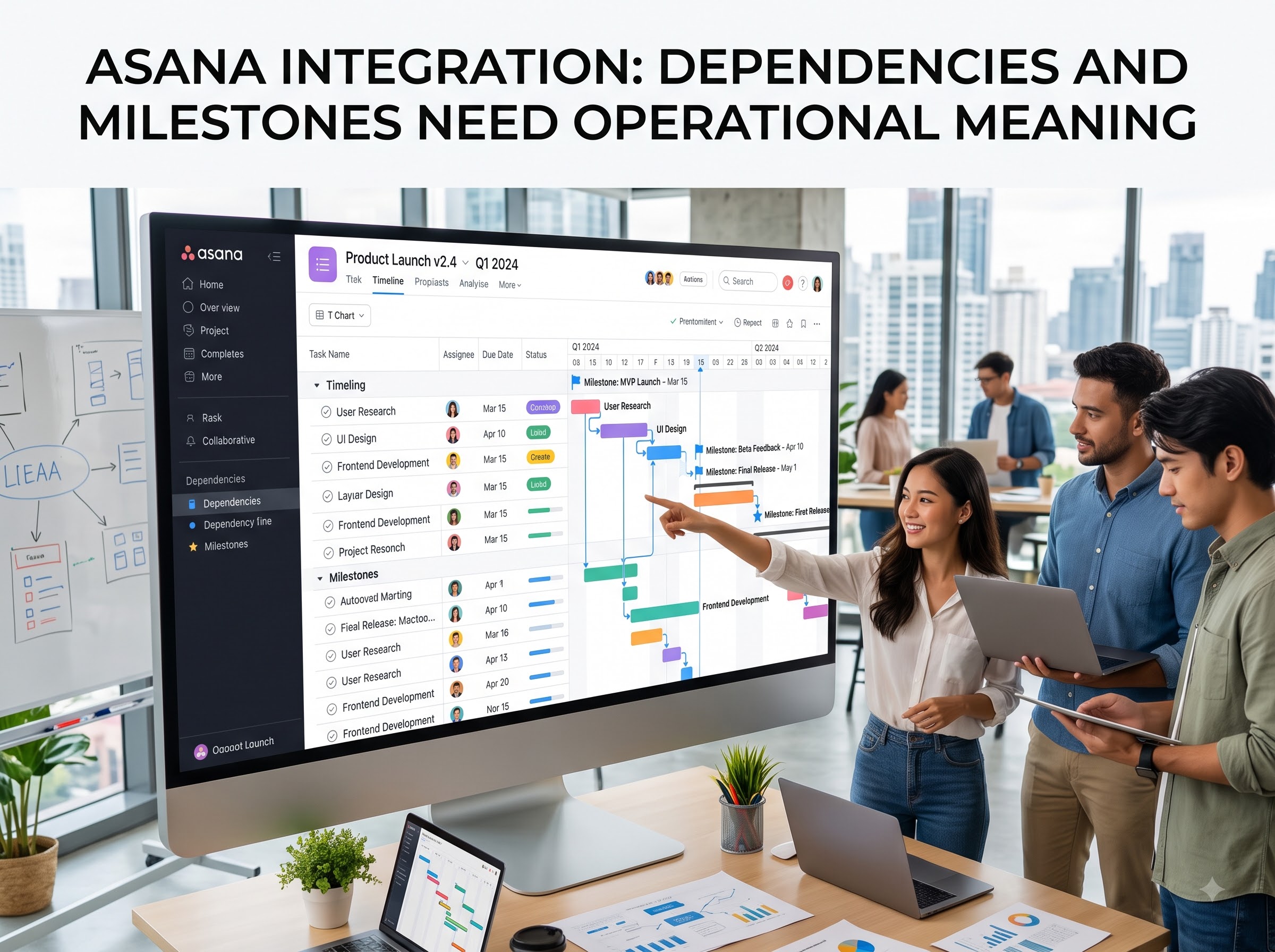
BOC evaluates the source state and evidence when a task or milestone changes. It prevents later tasks from triggering when a prerequisite has changed, expired, failed, or been cancelled. Repeated events and updates are correlated so one user action cannot create duplicate orders or downstream work.
This design separates progress reporting from authorization. Teams keep a clear delivery plan, while BOC ensures that dependencies represent real enterprise conditions rather than optimistic project labels.
Exceptions Become Owned Work with Verified Recovery
An API failure, missing field, approval delay, scope conflict, supplier rejection, proof correction, shipment problem, or reconciliation difference can create or update an Asana exception task. BOC groups related events, suppresses noise, applies materiality, assigns an owner and deadline, and includes safe diagnostic context.
Completing the exception task does not itself restore the operation. BOC retries where safe, obtains corrected data or authorization, monitors the downstream platform, and compares the actual state with the expected result. The exception closes after technical recovery and business reconciliation.
Escalation can follow elapsed time, customer impact, workforce readiness, financial exposure, event date, compliance importance, or repeated failure. The Asana task gives teams a coherent work surface while BOC retains timers, evidence, recovery logic, and closure authority.
Security Permissions and Integration Ownership Must Be Explicit
Authentication should match the use case. OAuth supports multi-user authorization. Personal access tokens inherit the access of the user who created them and require secure storage and lifecycle management. Enterprise service accounts can provide broad organizational access and therefore require especially strong scoping, administration, monitoring, and review.
Webhook endpoints must complete the handshake, store the secret securely, verify signatures, handle heartbeat events, and monitor delivery state. Access loss or token deletion can stop a webhook. Because delivery is at most once, critical integrations should include periodic reconciliation or polling appropriate to the business risk.
The integration should minimize CRM and HCM data in Asana, respect private projects and audiences, separate environments, protect credentials, and log stable identifiers, decisions, API results, and errors. Logs should not become a duplicate archive of customer or employee data.
Common Asana Integration Failures
Common failures include creating duplicate projects for retried events, mapping by project or task name, copying excessive personal or customer data, relying on one employee-owned token, treating a completed task as approval, and updating CRM before delivery is verified.
Teams can also confuse project progress with business outcome. Training may be complete while access is unavailable. An onboarding project may close while printed identity remains unapproved. A card-order task may finish while production failed or delivery is unconfirmed. These states need different owners and evidence.
BOC prevents this drift through correlation, current-state validation, version control, idempotent API actions, authority checks, exception routing, supplier monitoring, reconciliation, and evidence-backed closure.
A Practical Asana Integration Roadmap
Start with one high-friction workflow such as sales-to-delivery handoff, customer onboarding, employee onboarding, service implementation, or business card ordering. Map the source event, system of record, Asana project and template, tasks, fields, audiences, dependencies, milestones, authority, downstream APIs, exceptions, reconciliation, retention, and closure evidence.
Configure the authentication model, identity mapping, permissions, webhooks or events, signature verification, heartbeat monitoring, durable processing, deduplication, BOC policy, project creation and update rules, current-state validation, idempotent execution, fallback reconciliation, and recovery. Test retries, missing events, rapid field changes, token loss, user departure, access changes, template changes, partial completion, and supplier failure.
Measure project duplication, handoff time, milestone accuracy, stale-action prevention, exception aging, downstream completion, reconciliation accuracy, evidence completeness, card-order readiness, proof correction, production cycle, and on-time delivery. Expand after the first workflow is controlled and supportable.
BOC Creates a Reusable Project Delivery Control Pattern
Asana owns project coordination and work visibility. CRM owns customer and commercial facts. HCM owns workforce facts. Finance, service, ERP, and operational platforms own their domain records. CCA owns approved printed identity. BCM owns business card provisioning, conversion and fulfilment. BOC governs how events, decisions, APIs, exceptions, and outcomes move across them.
A focused discovery engagement can define the source matrix, project templates, task and custom-field model, dependency rules, permission boundaries, API architecture, exception taxonomy, evidence model, business card policy, implementation backlog, and success measures.
Choose one Asana workflow that currently depends on re-entry, spreadsheet checks, copied data, unclear authority, or subjective completion. BOC can turn it into a governed integration while keeping Asana effective for delivery teams and every enterprise platform authoritative.
Questions Integration Buyers Should Ask
- Which Asana workspaces projects templates tasks fields events and APIs support the workflow?
- Which systems own customer workforce financial identity product and fulfilment records?
- How are Asana users project access and task completion mapped to current enterprise authority?
- How are missed events duplicate updates stale tasks and partial completion controlled?
- Which CRM and HCM information may appear in Asana and for which audiences?
- Who owns tokens, service accounts, webhooks monitoring reconciliation recovery retention and evidence?
Turn one Asana project into a verified enterprise outcome. Business Ops Center can connect Asana with CRM, HCM, finance, service, CCA, BCM, suppliers, and other enterprise APIs while governing identity, authority, exceptions, evidence, and closure. Start with one sales handoff, onboarding plan, service-delivery workflow, or business card ordering process that currently depends on manual reconciliation.