


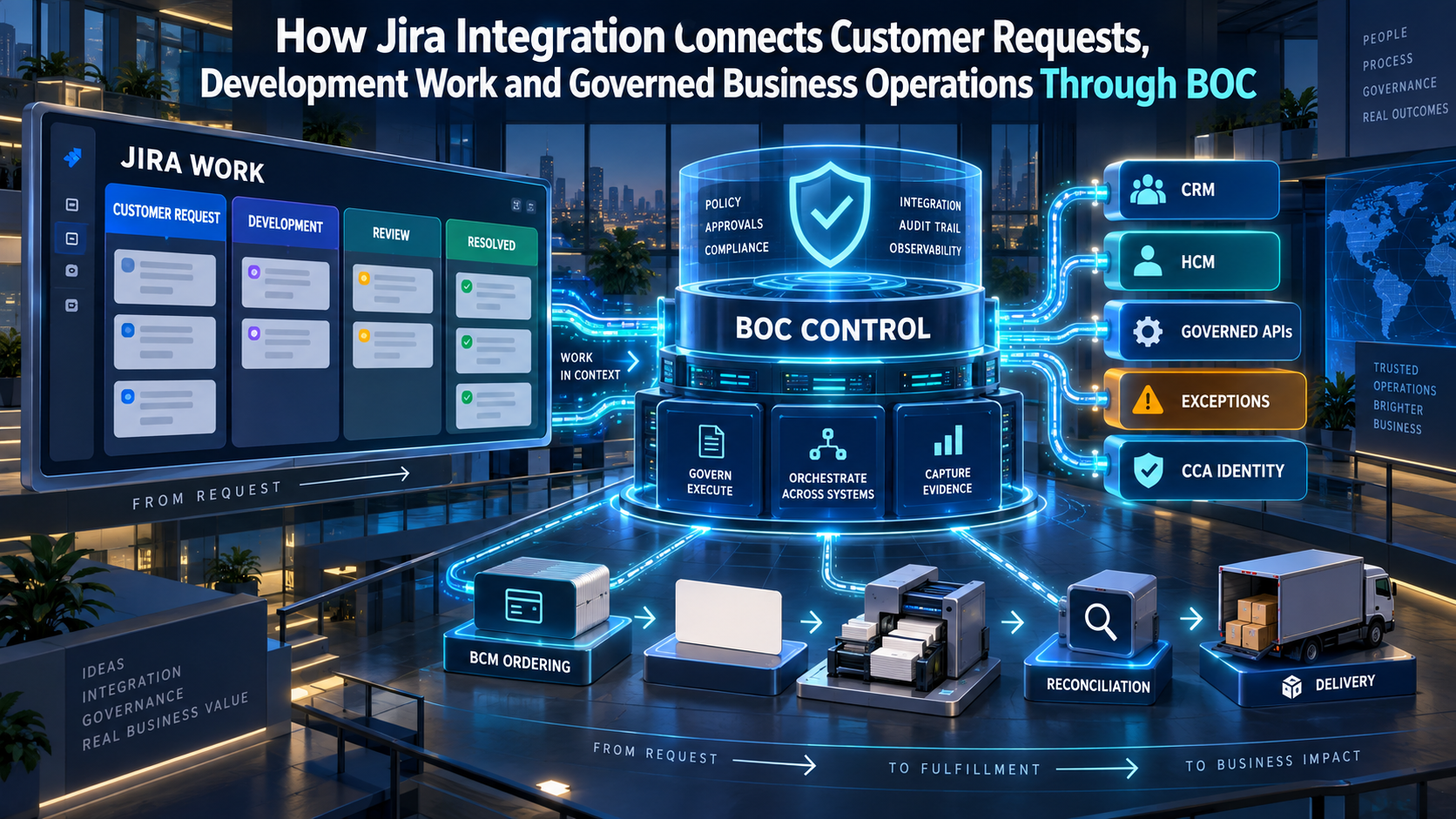
Connecting CRM HCM Jira APIs approvals CCA BCM and enterprise systems without confusing work tracking with operational authority.
Jira can organize service, development, integration, and operational work, but an issue is not automatically an authoritative customer, workforce, identity, purchasing, or fulfilment record. BOC governs the transition from CRM and HCM events into Jira work, controls API execution, and coordinates CCA and BCM business card ordering through evidence-backed completion and reconciliation.
Jira Becomes More Valuable When Work Is Connected to Business Context
Jira is often where technical and operational teams organize requests, defects, changes, service work, integration failures, and delivery commitments. The business opportunity is larger than creating tickets automatically. A useful integration connects every work item to the customer, employee, transaction, policy, approval, and intended outcome that caused it.
Business Ops Center provides this context and control. A CRM opportunity, customer escalation, HCM event, failed API transaction, coupa business card ordering exception, or supplier problem creates or updates a governed BOC case. BOC determines whether Jira work is required, creates the correct issue with the minimum necessary data, assigns ownership, tracks dependencies, and reconciles the outcome with the authoritative system.
Jira remains the work-management environment. CRM owns customer and commercial facts. HCM owns workforce facts. CCA owns approved identity. BCM owns business card conversion and fulfilment. BOC coordinates the decision, evidence, and cross-system outcome.
A Jira Issue Is Not the Enterprise System of Record
Issue fields are designed to help teams plan and execute work. They may be edited, transitioned, copied, linked, bulk changed, automated, or exposed through dashboards and marketplace apps. Project configuration, permissions, workflow schemes, field contexts, and retention practices can vary. These characteristics are powerful for delivery but require governance when Jira initiates enterprise actions.
BOC separates work evidence from business authority. The Jira site, project, issue, user, transition, comment, attachment reference, timestamp, and version can be correlated with the source event, current policy, approver authority, downstream API response, exception history, reconciliation, and closure evidence.
The operating principle is simple: Jira can organize and report work; BOC governs cross-system decisions and execution; authoritative platforms retain their domain records. Closing an issue is not enough when a CRM promise, HCM change, financial transaction, printed identity, or supplier delivery remains incomplete.
Jira APIs, Webhooks, and Events Support Governed Automation
Jira Cloud provides REST APIs for issues, projects, users, permissions, workflows, fields, search, links, audit records, and other platform resources. Webhooks and app events can notify an integration when relevant changes occur. The implementation model may use OAuth, Forge, or another supported approach according to deployment, administration, permissions, security, and product requirements.
BOC validates the source, tenant, identity, event type, issue, change, and current state before accepting an instruction. Longer processing moves to a durable queue. Duplicate or retried events are correlated and suppressed. Outbound actions use explicit permissions, idempotency, version awareness, error handling, and rate-limit controls.
Automation should use stable identifiers rather than issue summaries or free-form text. A transition can request execution, but BOC rechecks the authoritative system and policy before changing another platform. The result is returned to Jira as a concise status, linked evidence, or governed exception rather than an unsupported success message.
The Governed Jira Integration Lifecycle
| Lifecycle stage | Authoritative context | BOC control | Required outcome |
|---|---|---|---|
| Business event | CRM HCM ERP service finance or monitoring record | Authenticate, correlate, classify, and validate | Trusted BOC case |
| Jira work item | Approved project type fields owner and due state | Minimize data and bind issue to case | Actionable governed work |
| User transition | Verified Jira identity status change and timestamp | Recheck authority state and case version | Valid request or work evidence |
| Execution | Authoritative system API and business rule | Invoke permitted idempotent action | Controlled downstream change |
| Exception | Failure conflict missing data timeout or policy boundary | Assign owner deadline escalation and recovery | Owned resolution path |
| Reconciliation | Expected source target supplier and delivery state | Compare verify and preserve evidence | Evidence-backed closure |
| Card ordering | HCM CRM CCA BCM supplier and delivery records | Govern eligibility identity product and fulfilment | Approved card delivery |
CRM Integration Connects Customer Commitments to Delivery Work
CRM events can create governed Jira work for a sales engineering review, customer onboarding dependency, configuration request, contract obligation, implementation task, service escalation, renewal risk, or product defect. BOC retrieves the account, opportunity, owner, stage, value, entitlement, promised date, product, and service context and decides which details Jira users need.
The Microsoft Teams integration avoids uncontrolled duplication. Customer master data remains in CRM. Jira receives a stable reference, safe working context, ownership, service expectation, and links back to the governed case. Changes in CRM can update relevant Jira fields or invalidate work that is no longer required.
When Jira work reaches a meaningful transition, BOC verifies the underlying result before updating CRM or another system. “Done” may mean code completed, review passed, deployment confirmed, customer validation received, or obligation fulfilled. The required meaning must be explicit.
HCM Integration Connects Workforce Events to Controlled Work
HCM events such as joiner, mover, leaver, manager, title, location, legal-entity, department, or effective-date changes can require work across identity, access, equipment, facilities, communications, CRM assignments, and business card ordering. BOC creates Jira work only for the teams and exceptions that need human action.
The issue should contain the minimum necessary workforce information. Jira identity, reporter status, or assignee membership does not replace active HCM employment or manager authority. BOC rechecks the employee, effective date, organization, and responsible approver when a transition could cause a downstream change.
If a future HCM event is corrected or cancelled, BOC updates the case and dependent Jira work. Stale transitions cannot trigger access, purchasing, printed identity, or supplier actions after the source event changes.
Business Card Ordering Can Use Jira Without Turning Jira into the Ordering System
A business card ordering request may originate from an HCM joiner or mover, a CRM territory or customer-facing role, an event assignment, a depleted quantity, or a replacement need. BOC validates the trigger and creates Jira work when identity data, approval, brand review, delivery information, or supplier resolution requires an accountable owner.
BOC verifies active employment, effective date, manager, title, location, legal entity, CRM context, quantity, cost center, prior orders, delivery address, required date, and the authority of the person acting. Jira can show the task and exception, but issue fields do not authorize the identity or production order.
The workflow can route incomplete employee data to HR, customer-facing context to CRM operations, template questions to brand, budget exceptions to finance or procurement, and delivery failures to fulfilment. Every issue remains linked to one BOC case and one current request version.
CCA and BCM Preserve Identity and Fulfilment Authority
Color Card Administrator governs the name, title, company, office, phone, email, language, legal text, brand, logo, and template approved for print. CCA returns a versioned identity decision. A Jira issue may request correction or review, but an edited field or attachment does not silently become approved print data.
Business Card Manager converts the approved CCA identity into a controlled product order. BCM applies card type, stock, finish, quantity, proof, supplier, price, shipping, and production rules. BOC monitors acknowledgement, proof, production, shipment, delivery, cancellation, correction, and reorder events.
Jira can track human work around an exception while BOC preserves the complete chain: HCM or CRM trigger, Jira issue and transition, approver, CCA version, BCM order, supplier result, delivery evidence, and cost treatment. Closure occurs only when the expected business outcome is verified.

Workflow Transitions Need Decision and Authority Controls
A transition such as approve, ready for release, deploy, resolved, or close can carry operational identity governance meaning. The integration must define which users may perform it, for which project, object, employee, customer, amount, environment, risk, and exception. Jira project permissions are necessary but may not be sufficient for enterprise authorization.
BOC binds the transition to the current case and source versions, verifies authority, checks required evidence, prevents duplicate execution, and records the policy used. If material data changes after review, the action expires or routes back for reassessment.
High-risk actions may require a separate approval surface, dual control, or second factor. Jira continues to show the work state and outcome while BOC enforces the business decision model across systems.
Integration Failures Become Owned Jira Work Without Losing System Control
BOC can create or update Jira issues when API calls fail, mappings conflict, records are missing, suppliers reject an order, or reconciliation finds an unexpected state. It groups related events, suppresses duplicates, applies severity and materiality, sets an owner and response target, and includes safe diagnostic context.
Acknowledging or resolving the Jira issue does not by itself restore the operation. BOC retries where safe, requests correction where required, monitors the downstream platform, and compares the final state with the expected outcome. The issue closes only after technical recovery and business reconciliation are complete.
This pattern reduces alert noise and manual chasing. Teams see one coherent work item, while BOC retains timers, escalation, recovery, evidence, and the relationship to the affected customer, employee, order, or transaction.
Security Permissions and Data Boundaries Must Be Designed
Jira integrations require an explicit authentication and authorization model, least-privilege scopes or permissions, secure credentials, environment separation, tenant and site validation, and controlled app administration. Project roles, issue security, field configuration, workflow permissions, and app access affect who can see and change information.
Inbound webhook and event payloads must be validated. Outbound REST actions require status-code handling, pagination where applicable, retry discipline, throttling controls, and monitoring. Credentials, secrets, and service identities need rotation and ownership. App changes and permission revocation should create operational alerts.
Sensitive CRM and HCM data should not be copied into Jira unless the task requires it and the project audience is appropriate. Logs preserve identifiers, state changes, decisions, API results, and errors without becoming a duplicate archive of customer, employee, or cardholder information.
Common Jira Integration Failures
Common failures include creating duplicate issues for retries, mapping by summary text, copying excessive customer or employee data, using a service account with broad permissions, allowing stale transitions to trigger execution, and closing issues before the target system reaches the expected state.
Teams also confuse project approval workflow systems with enterprise processes. A developer may finish a change while customer validation remains open. An HR task may close while access or card production is incomplete. A supplier issue may resolve while the corrected order has not shipped. These are different outcomes and require different evidence.
BOC prevents this drift by preserving correlation, source ownership, case versions, idempotency, authorization, exception routing, reconciliation, and evidence. Jira remains useful because it does not have to impersonate every system it connects.
A Practical Jira Integration Roadmap
Start with one high-friction workflow such as customer onboarding, CRM escalation, HCM onboarding, integration recovery, or business card ordering. Map the trigger, system of record, Jira project and issue type, required fields, audience, transitions, authority, downstream APIs, exception paths, reconciliation, retention, and closure evidence.
Configure the supported app or API model, identity mapping, permissions, webhooks or events, durable processing, deduplication, case correlation, BOC policy, issue creation and update rules, current-state validation, idempotent execution, monitoring, and recovery. Test retries, bulk changes, stale issues, permission changes, deleted fields, workflow changes, throttling, partial completion, and supplier failures.
Measure issue duplication, assignment time, decision cycle, stale-transition prevention, exception aging, downstream completion, reconciliation accuracy, evidence completeness, card-order readiness, proof correction, production cycle, and on-time delivery. Expand after the first workflow is controlled and supportable.
BOC Creates a Reusable Work Management Control Pattern
Jira owns work planning and execution visibility. CRM owns customer and commercial facts. HCM owns workforce facts. Operational platforms own service and financial records. CCA owns approved printed identity. BCM owns business card conversion and fulfilment. BOC governs how events, decisions, APIs, exceptions, and outcomes move across them.
A focused discovery engagement can define the source matrix, issue model, field and transition rules, permission model, API architecture, data boundaries, exception taxonomy, evidence model, business card policy, implementation backlog, and success measures.
Choose one Jira workflow that currently depends on re-entry, manual status checks, copied data, unclear authority, or subjective closure. BOC can turn it into a governed integration while keeping Jira effective for teams and each enterprise platform authoritative.
Questions Integration Buyers Should Ask
- Which Jira projects issue types fields transitions APIs webhooks and app model support the workflow?
- Which systems own customer workforce financial identity product and fulfilment records?
- How are Jira identities and project permissions mapped to current enterprise authority?
- How are duplicate events, stale transitions, workflow changes, and partial completion controlled?
- Which CRM and HCM information may appear in Jira and for which audiences?
- Who owns credentials, permissions monitoring, reconciliation, recovery, retention, and evidence?
Turn one Jira issue into a verified enterprise outcome. Business Ops Center can connect Jira with CRM, HCM, service, finance, CCA, BCM, suppliers, and other enterprise APIs while governing identity, authority, exceptions, evidence, and closure. Start with one customer request, integration failure, onboarding task, or business card ordering workflow that currently depends on manual reconciliation.