


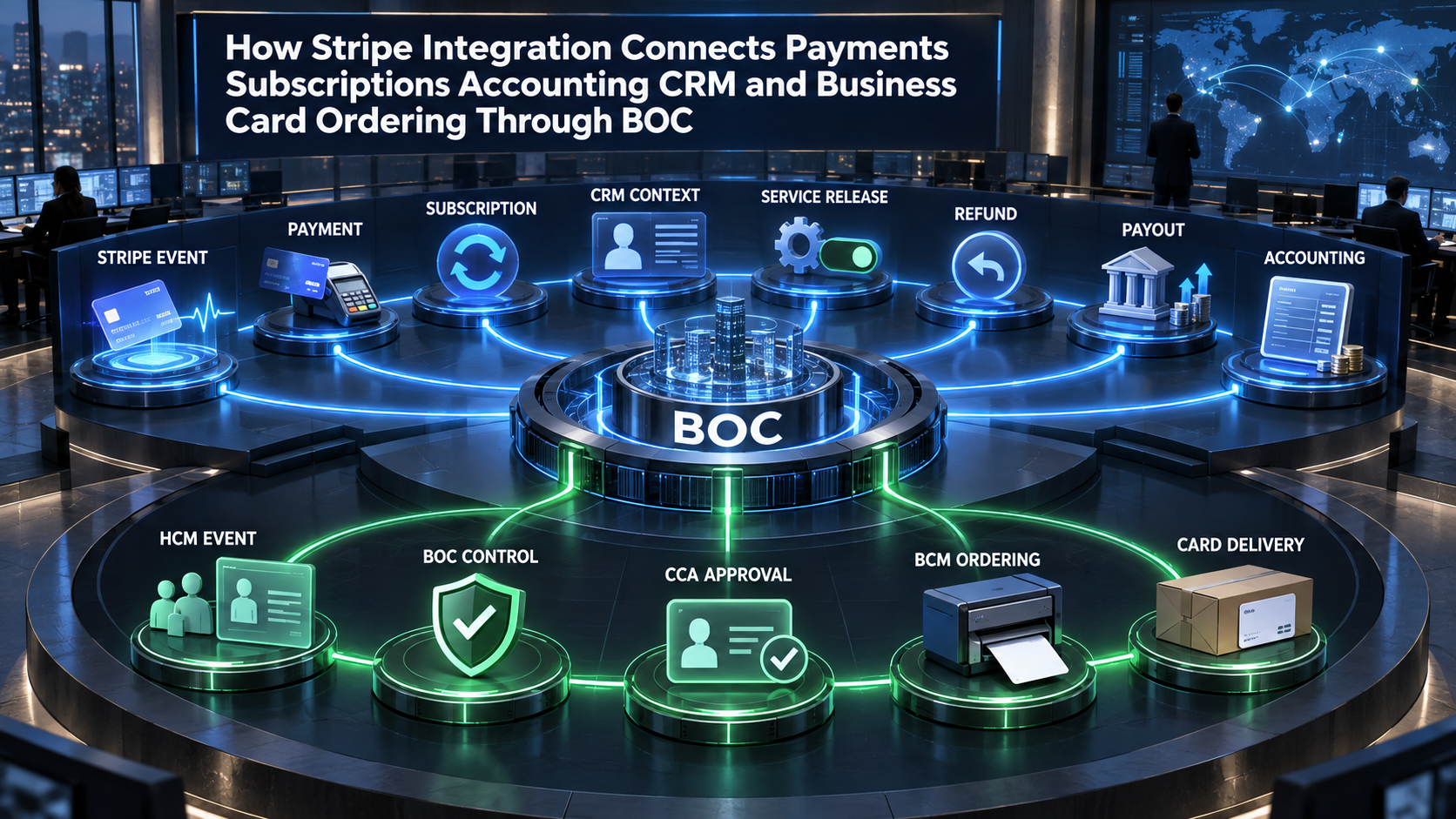
A governed operating model for revenue events, financial reconciliation, customer context, and employee identity fulfilment.
Stripe can create reliable payment and subscription events, but enterprise outcomes depend on what happens across CRM, service, accounting, HCM, identity governance, and fulfilment. BOC turns those events into controlled work, preserves system ownership, reconciles financial results, and connects employee changes to CCA-approved and BCM-fulfilled business card orders.
Stripe Events Become Enterprise Work Through BOC
A successful payment is rarely the end of a business process. The organization may still need to activate a service, update a customer record, create an invoice, recognize the correct accounting treatment, calculate tax, notify an account owner, reconcile a payout, and retain evidence. A failed payment can require retries, customer communication, service restrictions, collections, or an approved exception. These responsibilities usually sit in different systems and teams.
Business Ops Center provides the operational layer between a Stripe event and the verified outcome. Stripe remains authoritative for its payment, billing, dispute, refund, and payout records. CRM owns the commercial relationship. Subscription or service systems own entitlement. Accounting owns the financial books. HCM owns workforce facts, CCA owns approved business identity, and BCM owns business card management platforms conversion and fulfilment. BOC coordinates decisions without weakening those boundaries.
This operating model creates multiple integration opportunities. An organization can begin with payment-to-accounting reconciliation, subscription activation, failed-payment recovery, refund approval, dispute response, or customer-status synchronization. It can then reuse the same BOC controls for employee identity operations, including business card ordering triggered by an HCM or CRM change.
The Revenue Lifecycle Extends Beyond Payment Acceptance
Revenue operations span intent, authorization, capture, invoice, subscription status, fulfilment, refund, dispute, fee, settlement, payout, and accounting closure. These states do not always advance together. A charge may succeed while an internal activation fails. A subscription can remain active while a renewal payment is overdue. A refund can be initiated before the accounting credit is posted. A payout can arrive as one amount representing many transactions, fees, adjustments, and timing differences.
BOC represents this lifecycle as a correlated case rather than a sequence of disconnected notifications. It records the customer, account, contract, invoice, subscription, payment object, internal order, service outcome, refund, dispute, payout, and accounting references needed for control. Each stage has an owner, permitted action, service expectation, exception path, and evidence requirement.
The purpose is not to replicate Stripe. It is to make the work around Stripe governable. Teams gain a common view of what happened, what remains incomplete, which source is authoritative, why a decision was made, and whether the financial and customer outcome can be closed.
Stripe APIs and Webhooks Enable Event-Driven Operations
Its webhooks notify an HTTPS endpoint when events occur in an account. This documentation recommends verifying webhook signatures and describes retry behavior, duplicate events, event ordering, and asynchronous processing considerations. These characteristics make webhook consumers an operational visibility control point rather than a simple data pipe.
BOC validates the endpoint secret, signature, event identity, type, creation time, account context, schema, and minimum required data. It acknowledges receipt promptly, places work on a durable processing path, and stores correlation keys. Duplicate deliveries must not create duplicate activation, refund, fulfillment, notification, or accounting actions. Out-of-order events must be evaluated against the current authoritative state.
For outbound API calls, idempotency keys help protect eligible write operations from accidental repetition. BOC also governs authentication, restricted access, secret storage, environment separation, API versions, timeouts, backoff, rate limits, and recovery ownership. Periodic reconciliation complements event processing because webhook delivery alone does not prove that every downstream action completed.
A Governed Stripe Integration Lifecycle
| Lifecycle stage | Authoritative context | BOC control | Required outcome |
|---|---|---|---|
| Commercial intent | CRM account opportunity contract product and terms | Validate customer context and permitted treatment | Traceable revenue case |
| Billing event | Stripe customer subscription invoice and payment records | Authenticate correlate classify and deduplicate | Trusted event and current state |
| Operational release | Entitlement order service project or fulfilment system | Apply prerequisites before activation or release | Authorized customer outcome |
| Exception handling | Failure retry refund dispute or service variance | Assign owner deadline decision and escalation | Controlled recovery |
| Settlement | Stripe balance transaction fee adjustment and payout | Match components to expected cash | Explainable payout |
| Accounting | Ledger invoice credit tax cash and revenue records | Reconcile expected and posted value | Financial closure |
| Identity operations | HCM CRM CCA BCM and supplier evidence | Govern employee eligibility identity and order | Approved card delivery |
CRM Context Makes Payment Events Actionable
Stripe identifies a customer and financial object, but CRM may hold the account hierarchy, owner, sales opportunity, contract context, partner relationship, segment, service commitment, renewal risk, or territory needed for a business decision. BOC retrieves only the context required for the workflow and links it to the Stripe event.
A payment should not automatically overwrite CRM master data, and a CRM edit should not silently change a Stripe financial record. BOC maintains source ownership, flags conflicts, and routes correction to the responsible team. Stable cross-system identifiers are more reliable than matching on mutable values such as email address or company name.
The connected view enables useful actions: notify an account owner of a high-value failure, activate onboarding after required payment evidence, distinguish a renewal from a new sale, route an enterprise decision intelligence refund for approval, and prevent a service change when commercial prerequisites remain unresolved.
Subscription Integration Connects Billing to Service Delivery
Stripe Billing supports recurring and usage-oriented billing workflows, but the subscription record is only one part of the customer lifecycle. The enterprise must align plan, contract, price, quantity, billing period, trial, discount, tax, invoice, payment status, entitlement, usage, amendment, suspension, cancellation, and renewal treatment.
BOC maps subscription states to permitted operational actions. A created subscription may require contract validation before activation. An invoice payment can release onboarding or extend entitlement. Repeated failure can start a governed recovery sequence rather than immediate termination. A cancellation can require end-of-term calculation, data-retention tasks, asset return, service confirmation, and accounting adjustments.
Changes need effective dates and version awareness. Product catalog, pricing, contract, CRM, Stripe, and entitlement values can diverge. BOC detects mismatches and records whether the approved correction belongs in Stripe, CRM, the service platform, or accounting. This prevents integration code from becoming an undocumented commercial-policy engine.
Failed Payments Require Governed Recovery
A failed payment can result from authentication requirements, insufficient funds, an expired method, issuer decisions, configuration problems, or a processing error. The customer experience and operational response should depend on the failure context, product, contract, risk, and service policy.
BOC can coordinate permitted retries, customer notifications, account-owner tasks, payment-method updates, grace periods, service restrictions, collections, and escalation. It prevents overlapping automation from sending contradictory messages or disabling service while an approved exception is active. Each action is linked to the current Stripe and customer state.
Recovery closes only when the intended result is proven: payment succeeds, an alternative arrangement is approved, service is adjusted, the invoice is written off under authority, or the customer relationship is ended through the required process. Failure metrics then support policy improvement instead of remaining isolated gateway statistics.
Refunds and Disputes Need Decision Authority
Refund requests often begin in customer service, CRM, ecommerce, billing, or finance. The organization must confirm the transaction, amount, reason, fulfillment status, return evidence, contractual terms, previous credits, fraud indicators, and approval threshold. BOC assembles this context before a refund is submitted.
Stripe remains authoritative for the refund or dispute state. BOC controls who may request, approve, execute, communicate, and reconcile the action. It records the policy version and evidence used, prevents duplicate refunds, and creates follow-up work when the external action succeeds but a CRM, service, inventory, tax, or accounting update fails.
Disputes impose deadlines and evidence requirements. BOC can assign the case, collect order and service records, monitor response status, communicate the operational consequence, and reconcile the final financial result. The enterprise workflow orchestration separates a technical notification from the authorized business response.
Payout and Accounting Reconciliation Completes the Financial Outcome
A bank deposit is not necessarily a one-to-one match with a customer payment. Stripe payout reconciliation data can connect payouts with balance transactions such as charges, refunds, fees, disputes, and adjustments. Accounting systems may group or post those components differently based on entity, currency, account, tax, product, and close policy.
BOC compares expected Stripe activity with invoices, credits, fees, cash receipts, bank deposits, and ledger entries. It classifies timing differences separately from true variances. Missing transactions, duplicates, unexpected fees, currency differences, unallocated payouts, refunds without credits, and disputes without adjustments become owned exceptions.
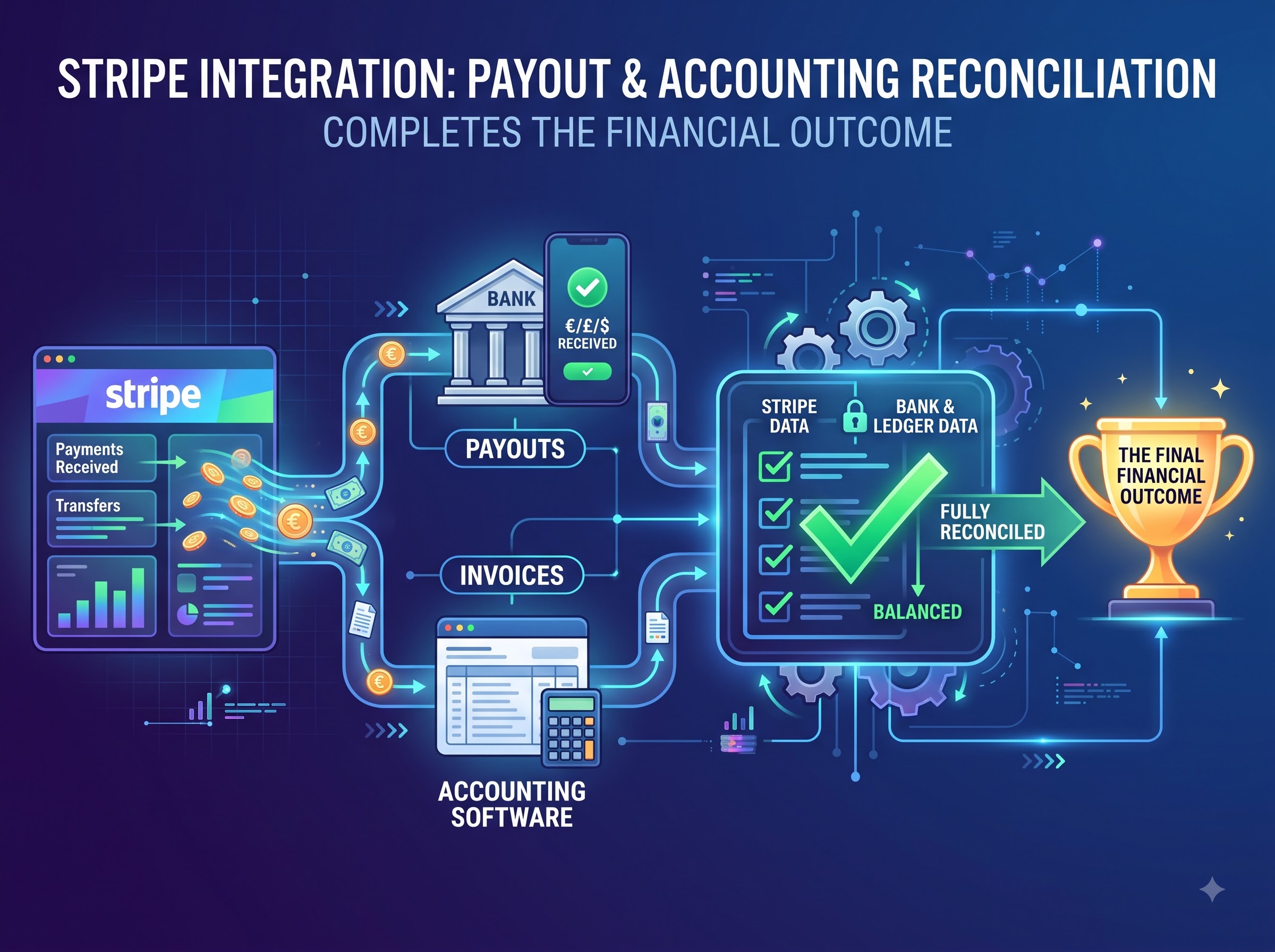
Reconciliation design must define time zone, cutoff, currency, rounding, settlement timing, payout grouping, legal entity, materiality, aging, and correction authority. Scheduled comparison is essential even when webhook processing is healthy. Financial closure requires explainable value, not merely a successful API response.
Business Card Ordering Remains Part of the BOC Operating Model
Payment integration should not displace BOC’s base purpose: coordinating governed business operations, including business card ordering. A new employee, role change, territory assignment, office move, customer-facing promotion, or approved event can create a legitimate card need. The trigger may originate in HCM, CRM, or an authorized operational request.
BOC verifies employment status, effective date, legal entity, role, location, manager, customer-facing need, CRM territory or account assignment, requested quantity, budget, previous orders, delivery address, and required date. It routes missing or conflicting facts to HR, sales operations, management, brand, enterprise procurement, or the requester.
The workflow is separate from customer payments but uses the same control disciplines: authenticated events, source ownership, eligibility rules, approval authority, API governance, exception handling, fulfillment tracking, cost reconciliation, evidence, and authorized closure. This continuity keeps BOC positioned as an operational control layer rather than a single-purpose payment connector.
CCA and BCM Control Identity and Physical Fulfilment
Color Card Administrator governs the employee identity that may be printed. It validates the approved name, title, company, location, phone, email, language, legal text, brand, logo, and template. CCA returns a controlled identity version so BOC can prove what was authorized at the time of release.
Business Card Manager converts that approved identity into a controlled product and supplier order. BCM applies card stock, finish, quantity, cost, proof, supplier, shipping method, and delivery rules. It returns production, shipment, tracking, delivery, cancellation, and reorder events for BOC to monitor.
If Stripe is used to collect an authorized charge or allocate a payment in a relevant ordering model, BOC correlates the payment with the employee request, approval, CCA identity version, BCM order, supplier result, and accounting record. Payment success never substitutes for identity or purchasing authority.
API Security and Data Minimization Protect Both Workflows
Stripe credentials, webhook secrets, and connected-system identities require controlled storage, least privilege, environment separation, rotation, monitoring, and access review. Webhook signatures must be verified against the raw request body according to the implementation guidance. Sensitive payment data should remain within the appropriate Stripe-supported handling model.
The integration contract should specify every exchanged field, purpose, source, recipient, classification, retention period, and masking rule. CRM does not need complete payment details. A business card supplier needs approved print and delivery fields, not subscription history or HCM files. Logs should favor identifiers, timestamps, decisions, and error codes over full payloads.
BOC quarantines messages that fail authentication, schema, freshness, authorization, or required-field checks. It keeps customer revenue cases separate from employee identity cases while applying consistent control policy. Audit evidence should explain the workflow without unnecessarily reproducing sensitive data.
Common Stripe Integration Failures
The most common design error is equating payment success with operational completion. Other failures include processing duplicate events, assuming event order, performing long work before acknowledging a webhook, using weak customer matching, embedding commercial rules in connector code, and closing a refund before accounting and service updates finish.
Subscription catalog differences can cause incorrect entitlements. Manual changes can remain isolated in Stripe or CRM. Retries can duplicate downstream actions. Payout deposits can be posted without component traceability. Access can be broader than necessary. API versions can change without coordinated testing. Business card payment or cost handling can bypass CCA or BCM authority.
BOC addresses these risks by defining the event, authoritative source, required context, permitted decision, action owner, idempotency key, correlation method, exception route, evidence requirement, reconciliation rule, and closure condition. Monitoring then measures business outcomes as well as connector availability.
A Practical Stripe Integration Roadmap
Start with one revenue journey, such as successful payment to service activation, failed renewal to recovery, refund request to financial closure, or payout to accounting reconciliation. Map the current process, system owners, object identifiers, state transitions, volumes, service commitments, approvals, exceptions, and evidence. Choose a scope that produces a measurable result.
Build webhook authentication, durable ingestion, deduplication, current-state lookup, CRM correlation, decision rules, downstream actions, exception routing, monitoring, and scheduled reconciliation. Test duplicates, delayed and out-of-order events, retries, timeouts, partial refunds, disputed payments, failed downstream calls, API-version changes, and uncertain outcomes.
Add the HCM and CRM triggered business card process as a distinct governed workflow through BOC, CCA, and BCM. Measure activation time, payment-recovery rate, manual touches, refund cycle time, dispute timeliness, payout variance, reconciliation aging, card-order readiness, proof corrections, on-time delivery, and evidence completeness.
BOC Creates a Reusable Integration Control Pattern
BOC creates value by coordinating responsibilities that remain distributed. Stripe owns payment and billing events. CRM owns customer and commercial context. Service platforms own delivery and entitlement. Accounting owns the financial books. HCM owns workforce facts. CCA owns approved identity. BCM owns business card conversion and fulfillment.
A focused discovery engagement can define the event catalog, source matrix, state model, API architecture, commercial decision boundaries, exception taxonomy, reconciliation design, identity-ordering policy, implementation backlog, and success metrics. This gives buyers a practical route from one integration pain point to a reusable enterprise capability.
Organizations should select a Stripe handoff that currently requires re-entry, produces inconsistent status, delays revenue or service, or weakens accountability. BOC turns that handoff into a governed operation and extends the same architecture to customer, finance, workforce, and physical identity workflows.
Questions Integration Buyers Should Ask
- Which Stripe objects events APIs webhook endpoints and account structures support the required workflow?
- Which systems own customer contract subscription entitlement payment refund payout accounting workforce and identity data?
- How will duplicate delayed and out-of-order events be handled without repeating value-changing actions?
- How are Stripe CRM service accounting HCM BOC CCA and BCM records correlated?
- Which failures can be automated and which require sales service finance HR brand procurement or security approval?
- Who owns credentials API versions monitoring reconciliation recovery retention and evidence?
Connect one Stripe event to a verified enterprise outcome. Business Ops Center can map the revenue lifecycle, define system ownership, connect Stripe with CRM, subscription, service, and accounting platforms, and implement exception handling and reconciliation. BOC can also connect HCM and CRM events to CCA identity approval and BCM business card ordering, creating one governed operating model across customer revenue and employee identity workflows.