


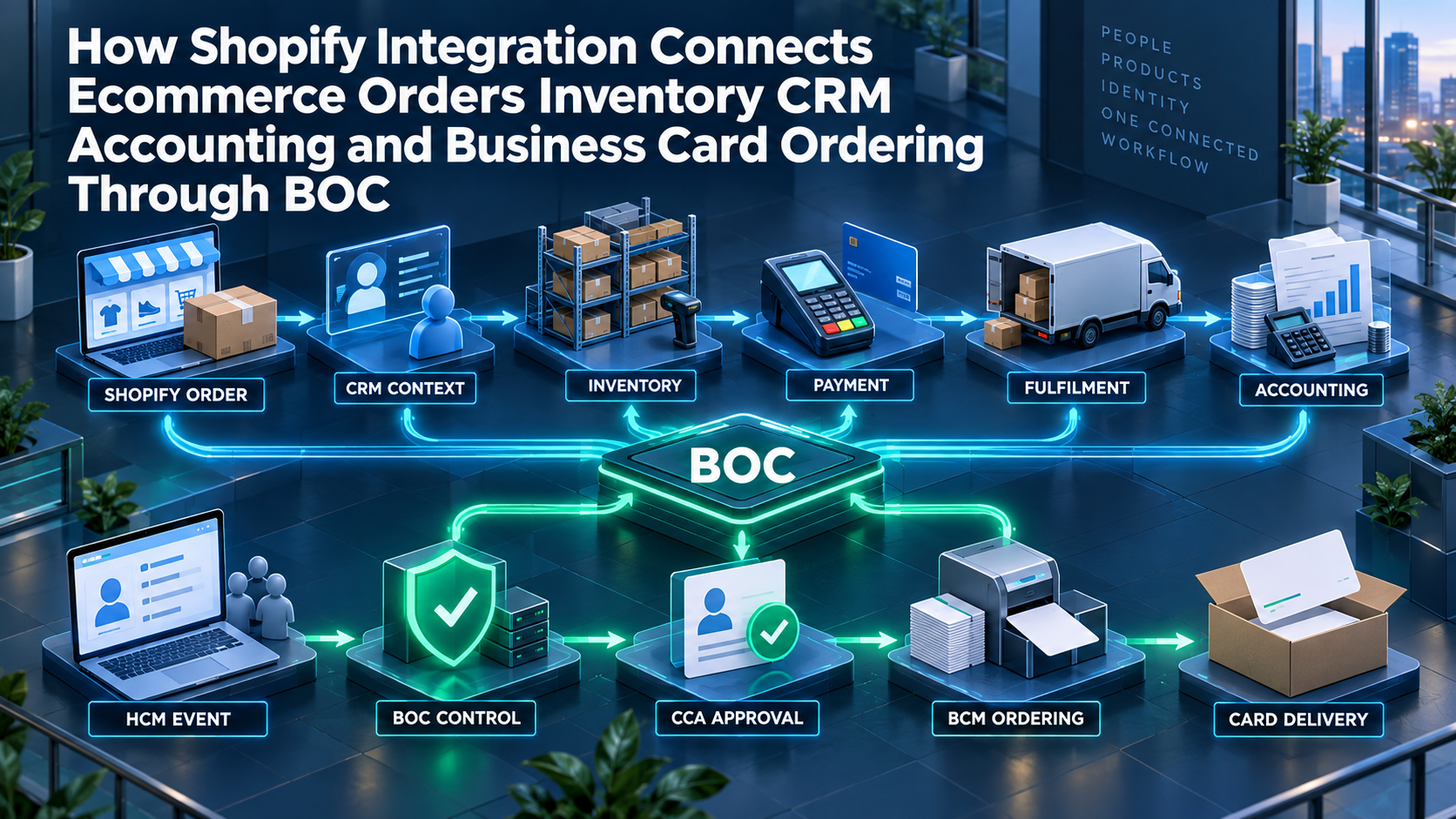
A governed commerce workflow from customer demand to fulfilment, financial reconciliation, and controlled employee identity ordering.
Shopify can capture digital demand and manage commerce records, but reliable enterprise operations require control beyond the storefront. BOC connects Shopify orders, CRM context, inventory, payments, fulfilment, accounting, HCM events, CCA identity approval, and BCM business card ordering so each workflow reaches a verified business and financial outcome.
BOC Connects Shopify Demand to Enterprise Operations
A Shopify order creates immediate operational work. The business must validate the buyer and selling terms, reserve inventory, collect or confirm payment, release fulfilment, monitor shipment, handle cancellations and returns, record revenue and fees, and resolve exceptions. When these activities span separate systems, a storefront status can hide unfinished work.
Business Ops Center coordinates the cross-system outcome. Shopify remains responsible for storefront, customer, cart, order, and commerce events within the customer’s configuration. CRM retains account and relationship context. ERP or inventory systems own stock and fulfilment commitments. Payment providers own transaction states. Accounting owns invoices, payouts, fees, tax, refunds, and reconciliation. BOC correlates their records and governs the decisions between them.
The same operational layer also supports employee-facing commerce. A growing Shopify merchant hires sales, retail, partner, event, and customer-service teams that may need approved business cards. HCM supplies workforce facts, CRM explains customer-facing need, CCA controls printed identity, and BCM converts approval into a physical order. BOC applies one governance model across customer orders and employee identity operations.
Shopify Integration Creates Multiple Customer Opportunities
Shopify integrations are often purchased to solve one visible pain point: order re-entry, incorrect inventory, delayed fulfilment, fragmented customer records, payout matching, or weak return handling. Each problem can begin as a focused BOC engagement with a clear source matrix, workflow boundary, exception owner, service target, and measurement plan.
Shopify also documents external-system integration for B2B data, including customers, companies, orders, order updates, inventory, products, catalogs, pricing, payment terms, fulfilments, refunds, cancellations, transactions, and payouts. Available methods include direct connectors, integration platforms, and custom APIs. Compatibility depends on the merchant’s plan, apps, B2B features, and connected systems.
BOC does more than synchronize records. It determines what an event means for the operation, whether prerequisites are satisfied, which application should act, who owns a conflict, and what evidence permits closure. This is valuable when a merchant must coordinate ecommerce, wholesale, finance, service, workforce, and branded-material processes without weakening system ownership.
Shopify APIs and Webhooks Support Event-Driven Integration
Shopify’s Admin GraphQL API provides programmatic access to administrative commerce data. Shopify webhooks notify applications when selected events occur, reducing the need to poll continuously. Its order and fulfilment documentation describes workflows for managing fulfilment work. The exact objects, scopes, versions, plan features, and app permissions must be confirmed for the merchant’s current environment.
A Shopify order-created, updated, cancelled, fulfilled, refunded, or inventory-related event can initiate BOC evaluation. BOC validates the shop, topic, signature, event identifier, timestamp, schema, and required data before acting. The workflow stores the Shopify reference and uses idempotent processing, so duplicate deliveries do not create duplicate fulfilment or accounting actions.
Webhooks are signals, not proof that every dependent system completed its work. BOC follows the signal through inventory, payment, warehouse, carrier, CRM, service, and accounting states. It retries transient technical failures, quarantines invalid messages, assigns business exceptions, and reconciles missed or out-of-order events.
The Governed Shopify Order Lifecycle
| Lifecycle stage | Authoritative context | BOC control | Required outcome |
|---|---|---|---|
| Commerce event | Shopify customer, company cart order line price tax and channel | Authenticate, correlate, classify, and validate | One traceable case with complete demand |
| Commercial context | CRM account territory agreement campaign and service status | Resolve identity and terms conflicts | Approved customer and selling context |
| Availability | ERP inventory location allocation, backorder and promise date | Prevent duplicate or impossible release | Reliable fulfilment commitment |
| Payment | Gateway authorization capture failure refund dispute and payout | Separate payment states and route risk | Authorized financial treatment |
| Fulfilment | Warehouse pick, pack, shipment tracking, cancellation, and return | Monitor milestones and recovery ownership | Delivered order or owned exception |
| Accounting | Invoice, tax, fees, payout, refund, credit, and settlement records | Reconcile expected and actual value | Evidence-backed financial closure |
| Learning | Exception cause, service result, margin, and customer outcome | Record patterns and improve policy | Measurable operational improvement |
CRM Adds Account and Relationship Context
Shopify identifies the buyer and order, but CRM may hold the relationship facts needed for enterprise operational accountability treatment. An account can have negotiated service commitments, a named owner, partner status, campaign attribution, territory rules, support history, or an active sales opportunity. BOC retrieves the minimum context required for the order decision.
Source ownership remains explicit. Shopify owns the commerce transaction. CRM owns account and relationship information. A shipping-address correction should not silently overwrite an account master, and a CRM record should not change the paid Shopify order without an authorized process. BOC detects conflicts and routes them to the responsible owner.
The combined view helps operations distinguish a normal consumer order from a B2B company order, a partner purchase, an event order, or an account with special fulfilment terms. BOC records why a different treatment was approved instead of embedding undocumented exceptions in connector code.
Inventory and ERP Integration Protects the Promise
Storefront availability can differ from the stock that a warehouse can commit. ERP, warehouse, or inventory systems may own on-hand quantity, reservations, safety stock, kits, lot controls, location selection, backorders, and promise dates. BOC treats their response as the operational commitment rather than assuming that checkout completed the allocation.
The workflow needs a stable mapping among Shopify variants, enterprise item identifiers, locations, units of measure, bundles, and fulfilment services. It must define how adjustments, partial fulfilments, substitutions, split shipments, cancellations, and returns affect both systems. Mapping changes require version control and testing.
BOC monitors orders that remain unallocated, oversold, partially fulfilled, or stranded between states. It assigns exceptions, applies service targets, and updates Shopify with customer-appropriate status. Periodic operational reconciliation compares recent Shopify demand with inventory reservations and fulfilment records to detect missed events.
Payment States Need Separate Operational Decisions
Authorization, capture, settlement, payout, refund, chargeback, and dispute are different financial states. A paid label in one system may not describe the complete cash position. BOC maps each payment event to the action it permits and prevents fulfilment or refund steps from running under the wrong assumption.
Fraud review, manual payment terms, B2B deposits, partial capture, multiple tenders, gift cards, foreign currency, and failed refunds can require specialized paths. The payment provider and Shopify retain their authoritative records. BOC coordinates release, hold, cancellation, service communication, and finance follow-up.
A technical retry must be idempotent. Repeated capture, refund, or order events cannot create duplicate value. BOC uses transaction references and operation keys, records the response, and sends uncertain outcomes to reconciliation rather than guessing whether the prior request succeeded.
Fulfilment Requires Outcome Level Monitoring
A fulfilment request is not the same as a delivered customer outcome. Warehouse acceptance, pick, pack, carrier handoff, shipment, delivery attempt, delivery confirmation, return, and reshipment represent different conditions. BOC maps those milestones to owners and expected times.
When stock, address, carrier, or supplier problems occur, BOC creates an exception with the relevant order, line, customer promise, inventory commitment, and recovery choices. Customer service can see a clear summary without searching Shopify, a warehouse portal, carrier tracking, and email.

Closure follows evidence. A shipped order can remain open when delivery proof is required. A delivered order can remain financially open while a refund, credit, or fee variance is unresolved. BOC closes the case when the approved outcome and material residual obligations have an authorized treatment.
Accounting Reconciliation Connects Orders to Cash
Shopify commerce produces orders, discounts, taxes, shipping charges, payments, fees, refunds, disputes, transactions, and payouts. Accounting or ERP systems record revenue, tax liabilities, receivables, cash, fees, refunds, inventory, cost, and settlement according to company policy. BOC connects these records without making the storefront an accounting ledger.
Reconciliation compares Shopify order totals, gateway transactions, refunds, fees, payout batches, bank deposits, invoices, credits, and accounting entries. Missing transactions, duplicate postings, currency differences, timing differences, tax mismatches, unallocated fees, and refunds without credits become owned exceptions.
The integration must define cutoffs, time zones, currencies, rounding, tax treatment, payout grouping, settlement timing, and correction ownership. A scheduled reconciliation process complements event handling because a webhook can be missed even when the underlying transaction remains valid.
Business Card Ordering Extends Shopify Workforce Operations
A Shopify merchant may need business cards for retail leaders, wholesale representatives, partner managers, event teams, customer-success staff, and field operations. The trigger can originate in HCM when an employee joins or changes role, in CRM when a territory or account assignment changes, or in BOC when an approved event requires printed materials.
BOC verifies active employment, effective date, legal entity, location, customer-facing need, requested quantity, delivery date, prior orders, and budget. A manager can confirm need, HR can resolve workforce facts, sales operations can verify CRM context, brand can approve published identity, and procurement can authorize exceptional cost.
This type of enterprise workflow governance keeps the Shopify integration relevant to the merchant’s wider operating model. Customer orders and employee card orders use different transaction systems, but both require authenticated triggers, source ownership, approvals, exception handling, fulfilment evidence, and financial reconciliation.
CCA and BCM Preserve Identity and Ordering Authority
Color Card Administrator controls the name, title, company, address, phone, email, language, legal text, brand, logo, and template approved for print. It returns a specific identity version. BOC links that version to the workforce event, CRM need, approval, and delivery case.
Business Card Manager converts the approved CCA identity into a controlled product and fulfilment order. BCM applies card type, quantity, stock, finish, supplier, proof, shipping service, and delivery address rules. It returns production, shipment, tracking, delivery, cancellation, and reorder events.
A Shopify storefront may be used as a commerce channel in some business models, but it should not bypass CCA authority or BCM controls. If Shopify participates in the ordering experience, BOC still verifies eligibility and approved identity before release and correlates the commerce record with the BCM and supplier outcome.
API Security and Data Minimization: Define Safe Integration
Shopify applications require approved access scopes and secure credential handling. Webhook consumers must verify authenticity and protect against replay or duplicate processing. Integration identities, tokens, secrets, and certificates need controlled storage, environment separation, rotation, monitoring, and access review.
The data contract should identify every field, purpose, source, recipient, and retention period. Warehouses need order and delivery data, not complete CRM history. Business card suppliers need approved print and shipping values, not customer orders or workforce files. Logs should favor identifiers, timestamps, status, and errors over complete payloads.
BOC quarantines messages that fail signature, authorization, schema, freshness, version, or required-field checks. Rate limits, timeouts, retries, dead-letter handling, API-version changes, and recovery ownership must be designed before production. Security and resilience are part of the operating workflow.
Common Shopify Integration Failures
The most common mistake is treating synchronization as control. Copying orders into an ERP does not prove allocation, fulfilment, delivery, payment settlement, or accounting completion. Other failures include weak variant mapping, duplicate webhook processing, broad access scopes, premature fulfilment release, and closing after shipment.
Customer, company, address, price, tax, inventory, and refund ownership can become ambiguous. Manual corrections may remain in one system. A connector can silently drop a field after an API change. Returns can reach the warehouse without the corresponding credit. Payouts can be posted without traceability to their component transactions.
BOC reduces these risks by defining the event, authoritative source, required context, decision rule, permitted action, correlation key, exception owner, evidence requirement, and closure condition. The integration then serves the operation instead of merely moving data.
A Practical Shopify Integration Roadmap
Begin with one Shopify store, one sales channel, one order type, one inventory owner, one payment path, and one fulfilment location. Map the current journey from checkout to delivery and financial settlement. Identify source owners, customer promises, field mappings, common exceptions, volumes, cutoffs, and evidence required for closure.
Configure the supported Shopify API and webhook access, then build authentication, event validation, correlation, CRM lookup, inventory reservation, payment-state handling, fulfilment orchestration, customer status updates, accounting integration, exception routing, and reconciliation. Test duplicates, delayed events, rate limits, partial fulfilment, cancellation, return, refund, failed payout, address change, and inventory variance.
Add the workforce card process as a separate governed flow using HCM, CRM, CCA, and BCM. Measure order cycle time, allocation latency, oversell prevention, fulfilment exceptions, on-time delivery, refund completion, payout variance, manual touches, business-card readiness, proof corrections, and evidence completeness.
BOC Creates a Reusable Commerce Control Pattern
BOC creates value by coordinating responsibilities that remain distributed. Shopify owns commerce demand. CRM owns relationship context. Inventory and ERP systems own stock and enterprise HR system transactions. Payment providers own payment events. Accounting owns financial records. HCM owns workforce facts. CCA owns approved identity. BCM owns physical card conversion and fulfilment.
A focused discovery engagement can define the event catalogue, source matrix, API architecture, order-state model, mapping controls, exception taxonomy, reconciliation rules, workforce card policy, implementation backlog, and measurement plan. One high-friction order or payout workflow provides a practical entry point.
Organizations evaluating BOC should choose a Shopify handoff that causes re-entry, delay, inconsistent status, or weak accountability. BOC turns that handoff into a governed operation and provides a reusable pattern for other customer, supplier, finance, and employee workflows.
Questions Integration Buyers Should Ask
- Which Shopify APIs, webhooks, scopes, versions, and plan features support the required workflow?
- Which systems own customers, product prices, inventory, payments, fulfilment, accounting, and workforce identity?
- How will BOC prevent duplicate order fulfilment, refund, and accounting actions?
- How are Shopify CRM inventory, payment carrier accounting, BOC CCA, and BCM records correlated?
- Which exceptions can be automated, and which require operations, finance, service, HR, brand, or procurement approval?
- Who owns credentials, API changes, monitoring, reconciliation, recovery, and data retention?
Connect one Shopify event to a verified enterprise outcome. Business Ops Center can map the order lifecycle, define source ownership, connect Shopify with CRM, inventory, payment, fulfilment, and accounting systems, and implement exception handling and reconciliation. BOC can also connect HCM and CRM events to CCA enterprise identity standardization and BCM business card ordering, giving the merchant one governed operating model across customer and employee workflows.