
GIntroduction: Why Workflow Speed Alone Is Not Enough
Modern enterprises are under constant pressure to move faster. Customers expect rapid responses, employees expect intuitive digital experiences, regulators expect evidence, and executives expect real-time insight into operational performance. As a result, workflow automation has become a central part of digital transformation.
Yet speed without governance creates a new form of risk. A process may complete more quickly while still routing work to the wrong approver, bypassing policy checks, losing important documentation, or creating inconsistent outcomes across regions. Automation can reduce manual effort, but it does not automatically create accountability, compliance, or strategic alignment.
Enterprise workflow governance ensures that every automated or human-driven step reflects approved business rules. It defines how work enters the system, how decisions are made, how responsibilities are assigned, how evidence is captured, and how outcomes are monitored. The objective is not to slow execution with additional controls. The objective is to design controls into execution so that speed and assurance improve together.
The Hidden Cost of Ungoverned Workflows
Ungoverned workflows are often invisible because the organization continues to function. Employees compensate through email, spreadsheets, chat messages, meetings, and personal knowledge. Work eventually gets completed, but the hidden cost accumulates through rework, delays, inconsistent customer treatment, operational risk, and management uncertainty.
The same request may follow different approval paths depending on the department. Managers may approve items without complete information. Exceptions may be granted without clear justification. Escalations may depend on who knows whom rather than established policy. Reporting becomes unreliable because the process itself is not standardized.
These weaknesses become more serious as the organization grows. New regions introduce local practices. Acquisitions add unfamiliar systems. Remote teams rely on fragmented communication. Regulatory requirements increase. What once appeared to be flexibility becomes operational fragility. Workflow governance converts this informal complexity into explicit, measurable, and improvable execution.
What Enterprise Workflow Governance Really Means
Enterprise workflow governance is the coordinated system of policies, decision rights, controls, roles, data requirements, service expectations, and monitoring mechanisms that determine how work moves through the organization. It is broader than process documentation and more strategic than automation configuration.
A governed workflow answers essential questions before work begins. Who owns the process? What business outcome is the workflow designed to create? Which inputs are mandatory? Which decisions require approval? What evidence must be retained? What happens when a service level is missed? How are exceptions handled? Which metrics determine whether the workflow remains effective?
By answering these questions consistently, the enterprise creates a common execution language. Departments may still use specialized systems and retain local expertise, but critical decisions follow a shared governance model. BOC provides the coordination layer that makes this possible without requiring every function to abandon its existing applications.
Workflow Automation vs. Governance
Workflow automation focuses on task movement. Governance focuses on decision integrity. Automation asks how to eliminate manual steps. Governance asks whether the steps, authorities, evidence, and outcomes are correct. The two capabilities are complementary, but governance must lead.
An automated procurement workflow, for example, can route a purchase request from an employee to a manager and then to finance. A governed procurement workflow additionally determines approval thresholds, segregation of duties, supplier risk requirements, budget validation, exception criteria, audit evidence, escalation timing, and post-approval monitoring.
When governance is absent, automation can accelerate weak processes. When governance is embedded, automation becomes a force multiplier for enterprise control and performance. BOC helps organizations move from isolated task automation to governed workflow orchestration across the operating model.
The Eight Foundations of Governed Execution
Sustainable workflow governance depends on eight interconnected foundations. The first is clear process ownership. Every critical workflow must have an accountable owner responsible for policy alignment, performance, risk, and continuous improvement.
The second is defined decision rights. Authority must be explicit, role-based, and appropriate to the value, risk, and context of the decision. The third is standardized intake. Work cannot be governed reliably when requests enter through uncontrolled channels with incomplete information.
The fourth is embedded policy. Business rules should be reflected directly in routing, validation, approval, and exception logic. The fifth is evidence preservation. Decisions must retain the information, comments, documents, and timestamps required for auditability and learning.
The sixth is exception governance. Not every situation can follow the standard path, but exceptions must be visible, justified, authorized, and reviewed. The seventh is operational observability. Leaders need real-time insight into throughput, delays, bottlenecks, breaches, and risk. The eighth is continuous improvement. Governance must evolve as strategy, regulations, technology, and operating conditions change.
| Foundation | Governance Purpose | Operational Result |
| Process ownership | Establishes end-to-end accountability | Clear responsibility and improvement authority |
| Decision rights | Defines who can approve what | Faster and more consistent decisions |
| Standardized intake | Ensures complete and comparable requests | Less rework and better routing |
| Embedded policy | Applies rules during execution | Stronger compliance with less manual checking |
| Evidence preservation | Maintains decision context and audit trail | Improved transparency and defensibility |
| Exception governance | Controls legitimate deviations | Flexibility without uncontrolled risk |
| Operational observability | Reveals flow, delays, and risk | Earlier intervention and better management |
| Continuous improvement | Uses performance evidence to evolve workflows | Sustained operational maturity |
Decision Rights and Approval Architecture
Approval design is one of the most important and most frequently misunderstood aspects of workflow governance. Many organizations add approvals to reduce risk, only to create long cycle times and decision fatigue. Others remove approvals to increase speed, only to weaken control. Effective approval architecture balances authority, materiality, risk, and accountability.
Decision rights should be assigned to roles rather than individuals wherever possible. Thresholds should reflect business significance. Low-risk, routine transactions should move through simplified or automated paths. High-value, sensitive, or unusual decisions should receive greater scrutiny. Parallel approvals may be appropriate when independent expertise is required, while sequential approvals should be reserved for genuine dependencies.
BOC enables enterprises to model these decision paths transparently. Approval rules can incorporate business unit, geography, transaction value, risk classification, regulatory requirement, customer impact, and other contextual factors. This creates speed for standard work while preserving control for consequential decisions.
Governing Exceptions Without Blocking the Business
No enterprise can eliminate exceptions. Markets change, customers present unusual requirements, supply chains fail, regulations evolve, and strategic opportunities demand judgment. The goal of governance is not to force every situation into a rigid template. The goal is to make deviation controlled, visible, and learnable.
A mature exception workflow captures the reason for deviation, the specific policy affected, the approving authority, the duration of the exception, compensating controls, and the required follow-up. Temporary exceptions should expire automatically or trigger review. Repeated exceptions should be analyzed because they often indicate that the standard workflow no longer reflects operational reality.
BOC turns exceptions into structured operational intelligence. Instead of disappearing into email threads, exception patterns become visible to process owners and executives. This allows the organization to distinguish legitimate flexibility from uncontrolled process erosion.
Workflow Intelligence and Operational Observability
Governed workflows generate a reliable operational record. Each request, decision, handoff, delay, exception, and outcome contributes to a body of evidence that can be analyzed. This is the foundation of workflow intelligence.
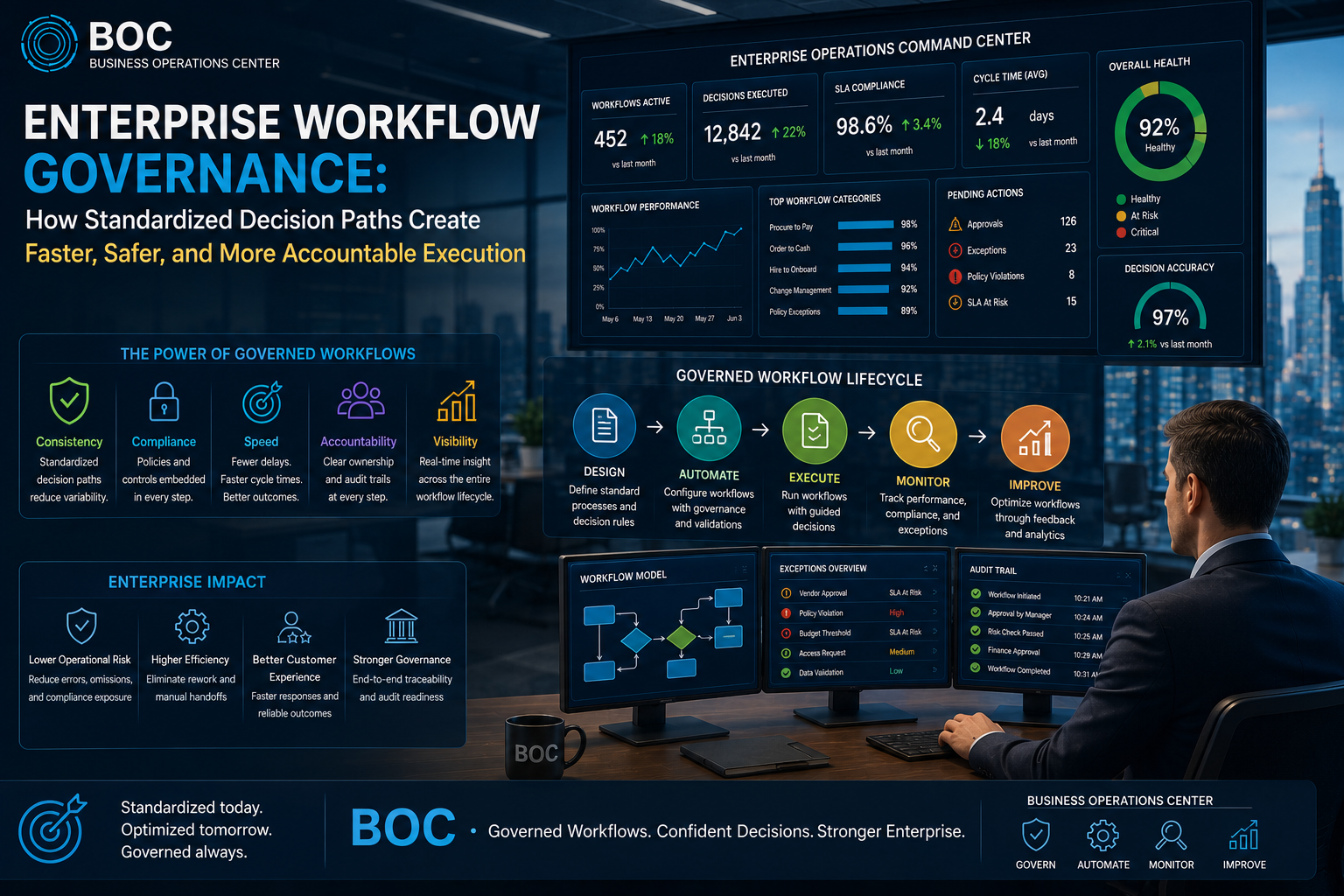
Traditional reporting often describes what was completed. Workflow intelligence explains how work was completed, where friction occurred, why service levels were missed, which approvals added value, and where controls or capacity should change. BOC provides operational observability across workflow health, cycle time, queue aging, approval performance, exception frequency, workload distribution, and policy adherence.
This visibility supports both frontline management and executive decision-making. Teams can intervene before deadlines are missed. Process owners can redesign bottlenecks. Risk leaders can identify control weaknesses. Executives can see whether operational capacity supports strategic commitments. Governance becomes a measurable management system rather than a static policy framework.
Cross-Functional Governance Across the Enterprise
Most meaningful business outcomes cross departmental boundaries. Customer onboarding may involve sales, legal, finance, compliance, implementation, and support. Employee onboarding may involve HR, IT, facilities, finance, security, and the hiring manager. Product launch may involve marketing, operations, procurement, legal, and executive leadership.
When each function manages only its own portion, the end-to-end outcome becomes fragmented. Handoffs fail, priorities conflict, and no one owns the complete journey. Enterprise workflow governance establishes shared accountability across these boundaries.
BOC provides a common operational layer that connects departmental systems while preserving functional responsibility. Shared milestones, service levels, escalation paths, data requirements, and outcome metrics create one governed process across many teams. This is especially important for global organizations, where regional autonomy must coexist with enterprise standards.
AI, Agents, and the Future of Governed Work
Artificial intelligence is rapidly changing how work is initiated, analyzed, routed, and completed. AI assistants can summarize requests, recommend actions, detect anomalies, predict delays, and generate content. Autonomous agents may eventually execute increasingly complex operational tasks across systems.
These capabilities increase the need for workflow governance. An AI-generated recommendation must be based on trusted data, applied within defined authority, and preserved with sufficient explanation. Autonomous actions must respect policies, approval limits, segregation of duties, privacy requirements, and escalation rules.
BOC can serve as the governance layer for human and machine execution. AI may accelerate analysis and action, while BOC defines the permitted pathway, records the decision context, applies controls, and ensures accountable oversight. The future of enterprise operations is not ungoverned autonomy. It is governed intelligence operating at greater speed and scale.
Enterprise Scenario: Global Customer Onboarding
Consider a multinational technology company with customers in multiple regulated industries. Before workflow governance, customer onboarding differs by region. Sales teams collect inconsistent information, legal reviews arrive late, security assessments are duplicated, and implementation begins before contractual obligations are fully understood.
The organization introduces BOC as the enterprise workflow governance layer. A standardized intake captures customer, product, regulatory, commercial, security, and implementation requirements. Risk-based routing determines which reviews are mandatory. Decision rights are assigned by region, contract value, data sensitivity, and industry. All evidence is attached to the governed record.
The result is not merely faster onboarding. The enterprise gains predictable execution, consistent risk treatment, improved customer communication, stronger audit readiness, and clear accountability from opportunity approval through go-live. Exceptions remain possible, but they follow a controlled path, and we analyze them for continuous improvement.
Implementation Roadmap
Organizations should begin with a small number of high-value, cross-functional workflows rather than attempting enterprise-wide standardization immediately. The first phase is discovery: identify workflow owners, current decision paths, systems, pain points, controls, and performance measures.
The second phase is governance design. Define the desired outcome, standardized intake, decision rights, approval thresholds, evidence requirements, exception rules, service levels, and escalation logic. The third phase is orchestration. Configure BOC to connect systems, route work, enforce controls, and preserve the operational record.
The fourth phase is observability. Introduce dashboards, alerts, queue management, and risk indicators. The fifth phase is optimization. Use workflow intelligence to simplify approvals, improve capacity, automate standard decisions, and redesign recurring exception patterns. The final phase is scale. Extend the governance model to additional workflows while maintaining common standards and reusable controls.
Metrics That Demonstrate Workflow Governance Maturity
Workflow governance should be measured through a balanced set of speed, quality, control, and outcome indicators. Cycle time and queue aging reveal whether work moves efficiently. First-time-right rates show whether intake and decision requirements are clear. Service-level adherence demonstrates execution reliability.
Approval metrics should include turnaround time, delegation frequency, rework, and escalation volume. Governance metrics should include policy adherence, exception rate, evidence completeness, audit findings, and control effectiveness. Business outcome measures may include customer onboarding time, revenue activation, employee productivity, supplier performance, or risk reduction.
The most mature organizations also measure governance effectiveness itself. They examine whether controls are proportionate, whether approval layers add value, whether exceptions reveal policy gaps, and whether workflow changes produce sustained improvement. BOC provides the operational data needed for this evidence-based governance.
Common Failure Patterns
The first failure pattern is automating the current process without challenging its design. This preserves unnecessary steps and embeds outdated policy. The second is treating governance as a one-time documentation project. Workflows must be actively owned, monitored, and improved.
The third is designing every workflow for the highest-risk scenario. This creates excessive approvals and encourages users to bypass the system. Risk-based paths are more effective. The fourth is ignoring the employee experience. Governance that is difficult to use produces workarounds and incomplete data.
The fifth is measuring only completion. A workflow can finish while still creating poor decisions or weak outcomes. Finally, organizations fail when they fragment workflow ownership. Technology teams may configure automation, but business leaders must own the policy, performance, and outcome.
Conclusion
Enterprise workflow governance is becoming a defining capability of modern operations. It enables organizations to move faster without losing control, standardize execution without eliminating judgment, and scale automation without creating hidden risk.
Business Operations Center transforms workflows into governed decision systems. By connecting policies, decision rights, roles, data, evidence, observability, and continuous improvement, BOC helps enterprises create execution that is faster, safer, more transparent, and more accountable.
The organizations that gain the greatest advantage from digital transformation will not be those that automate the most tasks. They will be those that govern how decisions move across people, systems, and intelligent agents. Workflow governance is the mechanism that turns technology investment into dependable enterprise performance.