


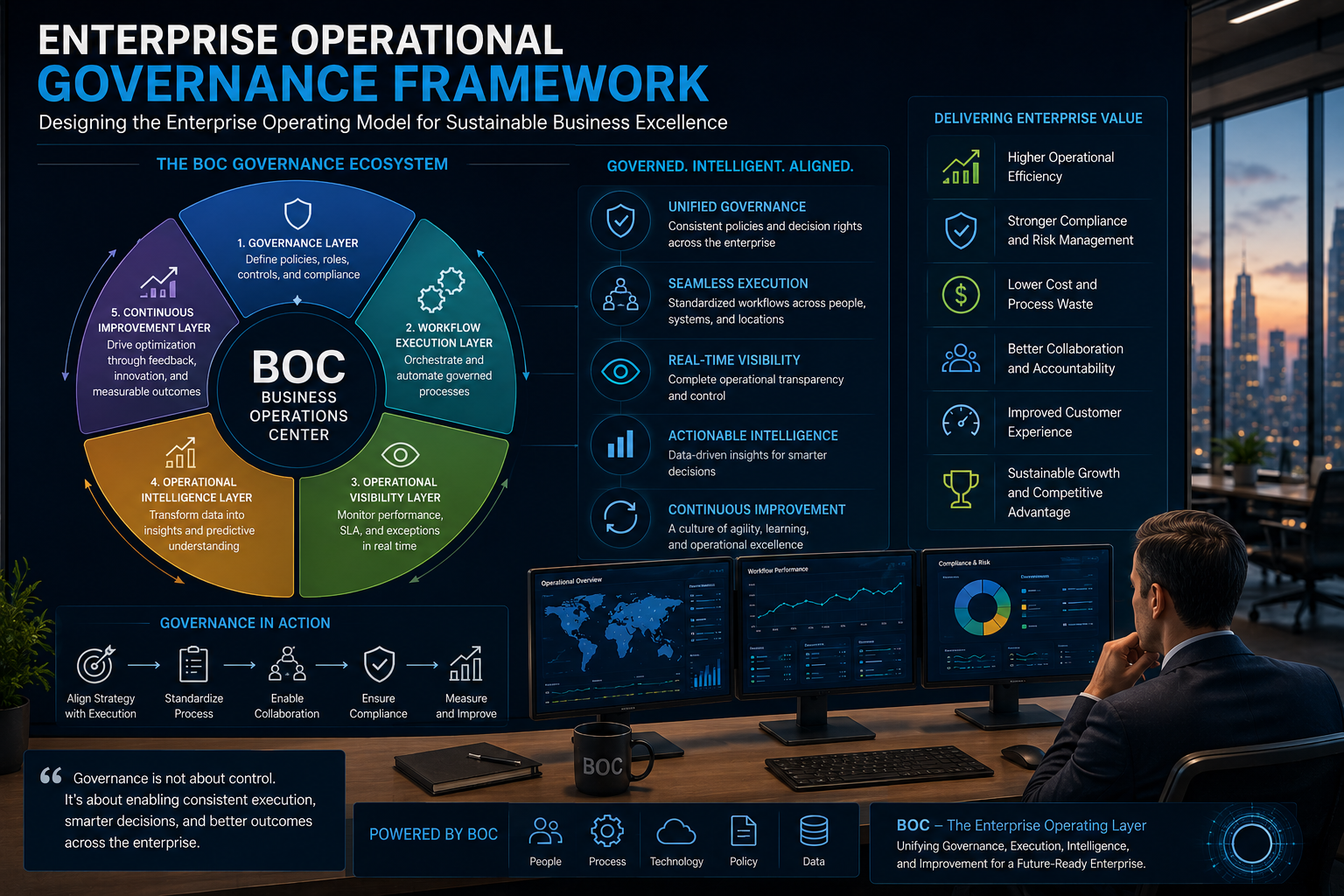
Enterprise accountability is often discussed as a cultural value, yet high-performing organizations treat it as an operating capability. Accountability becomes reliable only when ownership is explicit, decision rights are understood, evidence is preserved, exceptions are visible, and unresolved work escalates before it becomes business risk.
In fragmented operating environments, responsibility frequently becomes ambiguous. Teams may know who initiated a request but not who owns the outcome. Approvers may act without a clear record of rationale. Exceptions may remain in email or messaging threads. Leaders may receive status summaries without the evidence needed to determine whether commitments are truly under control. The result is not simply inefficiency; it is a governance gap.
Business Operations Center (BOC) closes that gap by creating an enterprise accountability layer across workflows, decisions, approvals, controls, service commitments, and performance outcomes. BOC connects ownership to execution, execution to evidence, and evidence to continuous improvement. It enables enterprises to move from assumed responsibility to demonstrable accountability.
This article explains how governance-first operational accountability strengthens execution, reduces hidden risk, improves decision quality, and gives leadership confidence that critical work is progressing under defined ownership and control.
Introduction: Execution Requires More Than Activity
Enterprises generate enormous volumes of activity. Requests are submitted, meetings are held, approvals are issued, projects are launched, and reports are produced. Yet activity does not guarantee accountability. A workflow may be technically complete while its intended business outcome remains unclear. A decision may be approved without a durable explanation. A service issue may be reassigned repeatedly while no single owner remains accountable for resolution.
This distinction matters because enterprise performance depends not only on whether work moves, but on whether every material obligation has an accountable owner, a governed decision path, a measurable outcome, and a reliable record. When those elements are absent, organizations experience delayed execution, conflicting instructions, repeated escalations, weak audit readiness, and leadership uncertainty.
BOC positions accountability as a structural property of enterprise operations. It makes ownership visible at the point where work begins, preserves it as work moves across teams and systems, and connects it to outcomes after the workflow closes.
1. Why Accountability Breaks at Enterprise Scale
Accountability becomes harder as organizations grow because execution crosses more boundaries. A single business outcome may depend on finance, legal, procurement, IT, operations, security, and executive approval. Each function may complete its local responsibility while the enterprise outcome remains delayed or exposed.
Several common conditions weaken accountability. Ownership is assigned to a group rather than a named role. Decision authority is not matched to risk. Tasks are visible, but outcome ownership is not. Escalations depend on personal relationships instead of policy. Documentation is stored separately from the workflow. Metrics report throughput without showing unresolved obligations.
These conditions create an accountability illusion: many people are involved, but no one can prove who is responsible for the final result. BOC resolves this by binding ownership, authority, evidence, and escalation to the workflow itself.
2. Accountability Is More Than Task Ownership
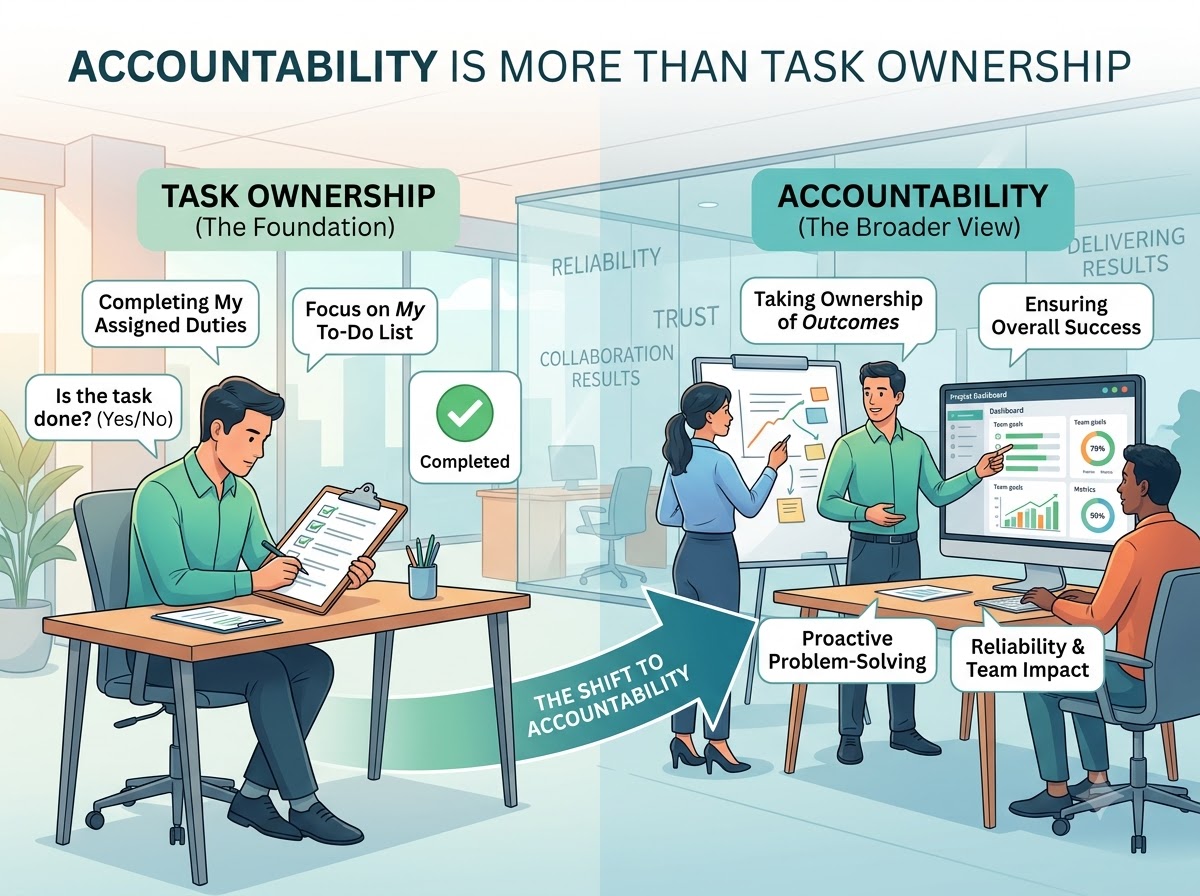
Task ownership answers the question, “Who is expected to perform this activity?” Operational accountability answers a broader set of questions: Who owns the business outcome? Who has authority to decide? What evidence demonstrates completion? What happens when a commitment is missed? Who accepts residual risk? How will leadership know that the obligation is closed?
A mature accountability model distinguishes contributors from accountable owners. Contributors may perform research, validate data, review controls, or complete assigned actions. The accountable owner remains responsible for coordinating the full outcome, resolving conflicts, initiating escalation, and confirming closure.
This distinction prevents workflows from becoming collections of disconnected tasks. It also enables leaders to measure not only activity, but ownership effectiveness.
3. The Business Operations Center Accountability Model
BOC establishes accountability through an integrated operating model that connects six elements: obligation, owner, authority, evidence, timing, and outcome. Every governed workflow begins with a defined business obligation. The obligation is assigned to an accountable role. Decision rights clarify what the owner can approve, delegate, or escalate. Evidence requirements define what must be captured. Timing rules establish service commitments and escalation thresholds. Outcome measures confirm whether the business objective was achieved.
Because these elements are integrated, BOC does more than display status. It creates a traceable chain from intent to action to decision to outcome. This chain enables operational transparency without relying on manual follow-up or informal knowledge.
4. Six Foundations of Governed Accountability
Explicit Ownership
Every material workflow, decision, control, and exception has one accountable owner. Supporting participants are visible, but accountability is not diluted across a group.
Defined Decision Rights
Owners must understand the authority attached to their role, including approval limits, delegation rules, risk thresholds, and mandatory escalation conditions.
Evidence by Design
The workflow specifies which documents, approvals, comments, validations, or system records demonstrate responsible execution.
Time-Bound Commitments
Accountability is connected to measurable service levels, due dates, aging thresholds, and recovery expectations rather than open-ended responsibility.
Governed Escalation
Escalation follows policy. It is triggered by risk, delay, control failure, or decision deadlock and routes the issue to the appropriate authority.
Outcome Confirmation
Closure requires more than task completion. The owner confirms that the initiative achieved the intended business result and that someone accepts or transfers unresolved risk appropriately.
5. From Responsibility Matrices to Live Operational Ownership
Responsibility matrices such as RACI can help organizations design roles, but static documents do not govern live execution. They are often stored in project files, updated infrequently, and disconnected from the actual workflow. When operating conditions change, teams may continue using outdated ownership assumptions.
BOC converts accountability design into operational behavior. Ownership is embedded directly within workflows and can vary according to geography, risk level, transaction value, business unit, customer type, or regulatory requirement. When roles change, the governance model can be updated centrally and applied consistently.
This creates a live accountability map. Leadership can see which individuals or roles own critical obligations, where capacity is concentrated, which responsibilities are repeatedly reassigned, and where decision authority no longer matches operational reality.
6. Evidence, Auditability, and Decision Rationale
Accountability cannot depend on memory. Enterprises need durable evidence showing what was decided, who decided it, what information was considered, which policy applied, and whether the outcome was achieved. This evidence is essential for audit readiness, regulatory response, customer assurance, internal reviews, and organizational learning.
BOC captures evidence as part of execution rather than as a separate administrative exercise. Required documents, validation checks, comments, approvals, timestamps, policy references, and exception decisions remain associated with the workflow record. The organization gains a complete operational narrative instead of fragmented artifacts.
Decision rationale is particularly important. A decision may be valid even when the outcome is unfavorable, provided it was made within authority, based on reliable information, and aligned with approved risk appetite. Preserving rationale allows leadership to distinguish poor governance from acceptable business judgment.
7. Exception Governance and Escalation
Normal workflows reveal how an organization intends to operate. Exceptions reveal whether governance can withstand reality. High-performing enterprises do not hide exceptions or treat them as administrative inconvenience. They govern them explicitly.
BOC identifies exceptions when required information is missing, thresholds are exceeded, controls fail, approvals conflict, service commitments are at risk, or outcomes diverge from expectation. Each exception is assigned an owner, severity, response requirement, and escalation path.
This prevents critical issues from remaining trapped in local inboxes or informal conversations. It also creates enterprise intelligence. Repeated exceptions may indicate poor policy design, inadequate capacity, weak training, unreliable data, or a process that no longer reflects business conditions.
8. Leadership Visibility Without Micromanagement
Operational accountability should increase leadership confidence, not create a culture of surveillance. Executives do not need to inspect every task. They need reliable visibility into material obligations, emerging risks, unresolved exceptions, ownership concentration, aging decisions, and outcomes that require intervention.
BOC provides this visibility through role-based operational intelligence. Leaders can review accountability health across business units, processes, regions, or strategic initiatives. They can identify where ownership is clear and effective, where obligations are repeatedly overdue, and where escalation mechanisms are not resolving risk.
Because the underlying evidence is available, leadership conversations become more objective. Teams spend less time debating status and more time resolving the conditions that affect performance.
9. Accountability Across Human and AI Work
As enterprises introduce AI agents, copilots, autonomous workflows, and machine-generated recommendations, accountability must remain humanly governed. AI can perform analysis, route work, identify anomalies, draft decisions, or execute low-risk actions. It cannot eliminate the enterprise obligation to define authority, oversight, evidence, and accountability.
BOC enables a governed human-AI operating model. Organizations can specify which decisions AI may recommend, which actions it may execute, what evidence must be retained, when human review is mandatory, and who remains accountable for the outcome. Automated actions become traceable events within the same accountability framework as human actions.
This approach allows enterprises to scale automation without creating an accountability vacuum. Innovation accelerates while governance remains explicit.
10. Enterprise Scenario: Global Customer Remediation
Consider a global enterprise responding to a customer-impacting service defect. The issue affects multiple regions and requires coordination among customer success, product, legal, finance, operations, and executive leadership.
Before a governed accountability model, teams may create separate action lists. Customer communications may be owned locally, financial credits may require manual approval, legal guidance may remain in email, and executives may receive inconsistent reports. Each team is active, but the enterprise cannot confidently demonstrate who owns the total remediation outcome.
With BOC, the remediation is established as a governed enterprise obligation. One accountable executive owner is named. Regional and functional contributors receive defined responsibilities. Decision rights specify who can approve customer compensation, policy exceptions, or public communication. Evidence requirements capture customer impact, approvals, communications, and closure confirmation. Escalation rules trigger when response commitments are at risk.
Leadership receives a unified view of affected customers, open obligations, pending decisions, exception severity, and outcome progress. After resolution, BOC preserves the full operational record and identifies recurring causes for continuous improvement. Accountability becomes measurable, visible, and defensible.
11. Implementation Roadmap
| Phase | Enterprise Focus |
| Phase 1 — Identify Critical Obligations | Prioritize workflows and decisions that carry significant customer, financial, regulatory, operational, or reputational impact. |
| Phase 2 — Define Accountable Ownership | Assign one accountable role to each material outcome and distinguish it clearly from supporting responsibilities. |
| Phase 3 — Establish Decision and Delegation Rules | Document authority limits, approval conditions, delegation rights, risk acceptance responsibilities, and escalation triggers. |
| Phase 4 — Embed Evidence Requirements | Specify the records needed to demonstrate responsible execution and make evidence capture part of the workflow. |
| Phase 5 — Activate Accountability Intelligence | Measure aging, reassignment, escalation, evidence completeness, ownership capacity, and outcome quality. |
| Phase 6 — Expand Across the Enterprise | Apply reusable accountability patterns to additional processes, regions, systems, and AI-enabled workflows. |
| Phase 7 — Improve Continuously | Use recurring exceptions, delays, and outcome gaps to refine governance, capacity, policy, and process design. |
12. Measuring Accountability Maturity
Organizations should measure accountability maturity through both identity governance quality and business outcomes. Metrics must show whether ownership is clear, whether obligations are resolved on time, and whether accountable execution creates better enterprise results.
| Measure | What It Reveals |
| Ownership clarity | Percentage of critical workflows with one named accountable role |
| Reassignment rate | Frequency with which the organization transfers obligations after initiation |
| Aging exposure | Volume and risk level of overdue accountable obligations |
| Escalation effectiveness | Percentage of escalations resolved within the governed response window |
| Evidence completeness | Percentage of closed workflows containing all required records and rationale |
| Decision latency | Time from decision requirement to authorized decision |
| Outcome confirmation | Percentage of workflows closed with verified business-result confirmation |
| Repeat exception rate | Frequency of recurring exception categories after corrective action |
13. The Strategic Value of Operational Accountability
Accountability improves more than compliance. It accelerates execution because teams know who can decide and what evidence is required. This reduces rework because responsibilities are defined before work begins. It strengthens resilience because exceptions are surfaced and escalated early. And improves customer trust because commitments can be traced to accountable owners and verified outcomes.
Operational accountability also strengthens strategic execution. Enterprise initiatives often fail not because strategy is unclear, but because ownership becomes fragmented during implementation. BOC preserves accountability as strategy moves through programs, decisions, approval workflow, and operational delivery.
14. Future Outlook: From Accountability Reporting to Accountability Intelligence
The next generation of enterprise operations will move beyond retrospective accountability reporting. Organizations will use predictive signals to identify obligations at risk, overloaded owners, weak delegation structures, recurring approval delays, and emerging decision bottlenecks before outcomes deteriorate.
AI will help summarize evidence, recommend escalation, identify inconsistent decisions, and compare outcomes across similar workflows. However, these capabilities will create value only when they operate within a governed accountability model. BOC provides the foundation by ensuring that every recommendation and automated action remains connected to authority, evidence, oversight, and enterprise policy.
As accountability intelligence matures, leaders will be able to see not only what happened, but where ownership design itself is creating or limiting enterprise performance.
Conclusion
Enterprise accountability cannot rely on good intentions, personal follow-up, or static responsibility charts. The organization must build it into its operating system.
Business Operations Center creates that operating system by linking obligations to owners, owners to authority, authority to evidence, evidence to escalation, and execution to verified outcomes. This governance-first model enables enterprises to demonstrate who is accountable, what was decided, how risk was managed, and whether the intended result was achieved.
When accountability becomes visible, measurable, and operationally enforced, organizations execute faster, govern with greater confidence, and learn more effectively from every outcome. BOC transforms accountability from a management expectation into a durable enterprise capability.