
Introduction
Enterprise operational maturity is achieved when governance, people, processes, technology, and data operate as a coordinated system rather than isolated capabilities. Many organizations invest heavily in digital transformation but continue to experience inconsistent execution because governance remains fragmented and operational visibility is limited. Business Operations Center (BOC) establishes a governance-first operating model that connects enterprise workflows, operational intelligence, process observability, analytics, and continuous improvement. The result is a mature operating environment where every business function contributes to measurable enterprise performance.
Understanding Operational Maturity
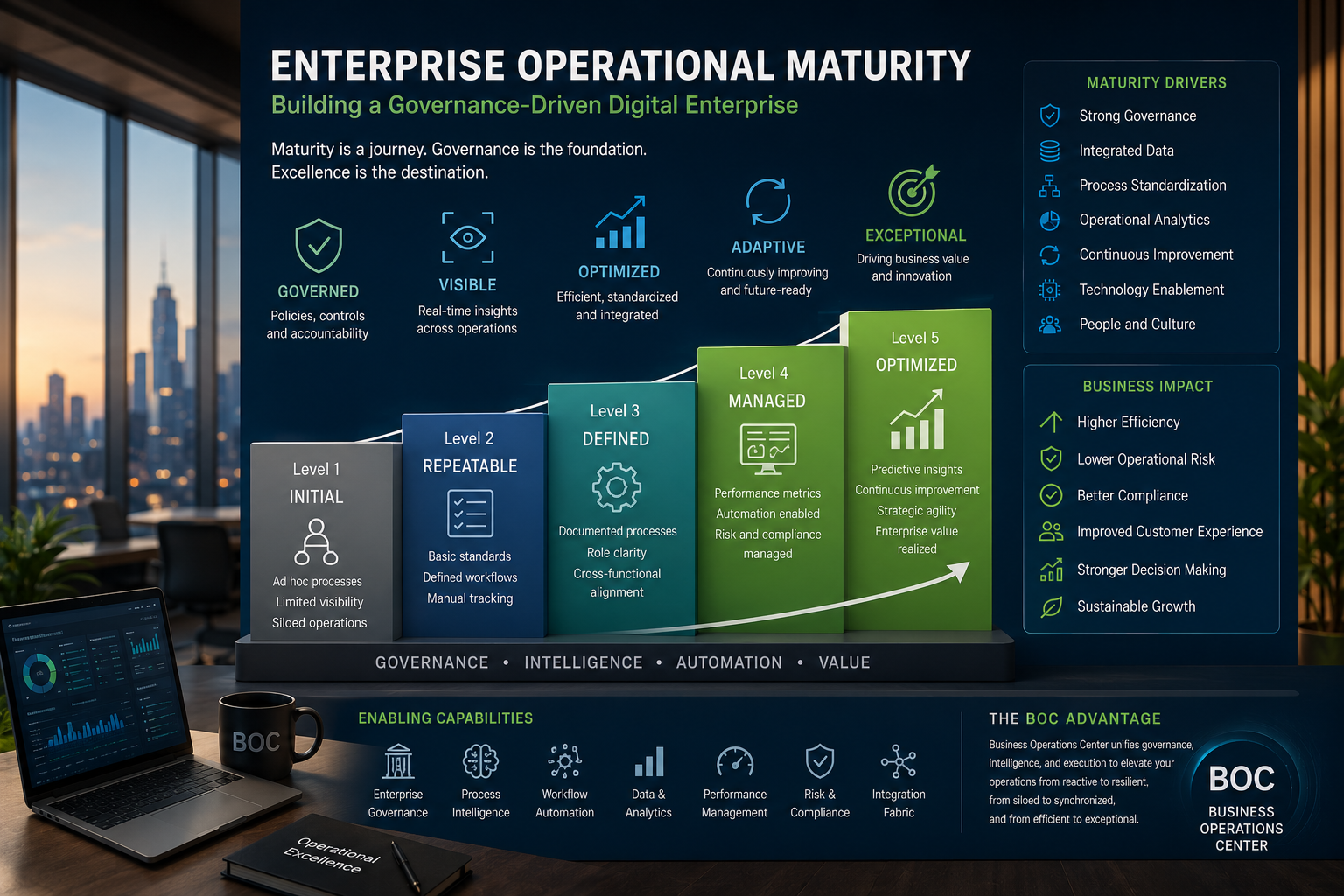
Operational maturity extends beyond process automation. It reflects an organization’s ability to execute consistently, adapt quickly, measure accurately, and improve continuously. Mature enterprises establish common governance standards, standardized workflows, clearly defined ownership, policy-driven execution, enterprise KPIs, and transparent accountability. BOC enables this progression by creating a unified operational framework that evolves alongside business growth.
The Maturity Journey
Organizations typically progress through multiple stages: ad hoc operations, standardized execution, governed workflows, measurable operational intelligence, predictive optimization, and intelligent enterprise operations. Each stage increases organizational resilience while reducing operational risk. Business Operations Center provides the governance mechanisms required to move confidently through each level of maturity.
Governance as the Maturity Accelerator
Governance creates consistency across departments by defining workflow ownership, approval structures, escalation rules, documentation standards, audit controls, and compliance policies. Once execution becomes standardized, enterprise analytics become meaningful and continuous improvement initiatives generate measurable outcomes. Governance therefore becomes the accelerator of operational maturity rather than a compliance burden.
Enterprise Visibility and Analytics
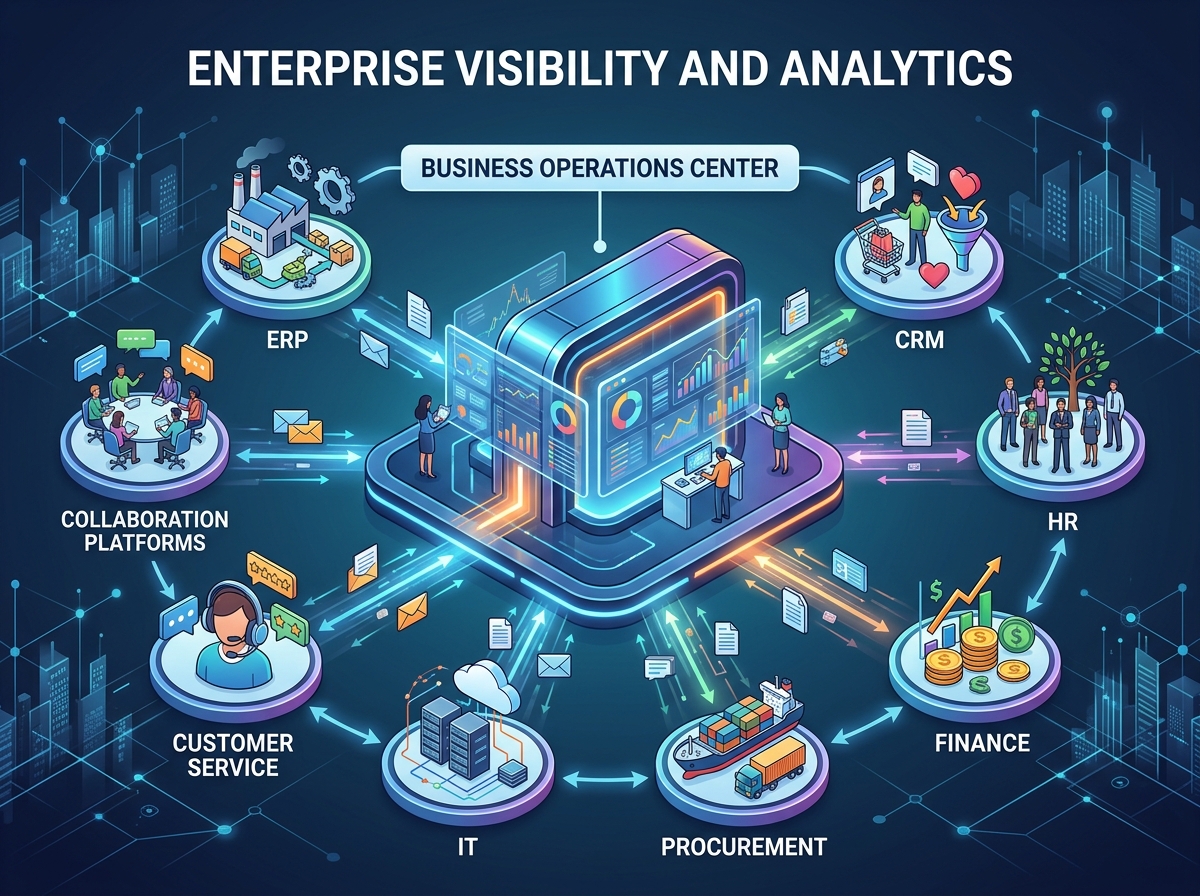
Operational maturity requires enterprise-wide visibility. Business Operations Center consolidates workflow execution across ERP, CRM, HR, finance, procurement, IT, customer service, and collaboration platforms. Executives monitor strategic KPIs while operational leaders identify bottlenecks, workload imbalances, SLA risks, policy exceptions, automation opportunities, and resource utilization. Every governed workflow contributes trusted operational intelligence.
Continuous Improvement Framework
Mature organizations establish permanent feedback loops. Workflow observations, operational analytics, audit findings, customer feedback, compliance reviews, and executive priorities continuously refine governance policies and operational processes. Rather than treating optimization as a one-time project, BOC embeds continuous improvement into everyday execution, creating a culture of operational learning.
Enterprise Scenario
A multinational enterprise begins with inconsistent regional workflows, duplicated approvals, and fragmented reporting. After implementing Business Operations Center, governance policies become standardized, operational metrics are unified, and workflow observability exposes recurring bottlenecks. Leadership prioritizes improvements based on measurable evidence. Within successive governance review cycles, approval times fall, compliance improves, operational costs decline, and customer satisfaction increases. The organization progresses from reactive management to predictive, intelligence-driven operations.
Preparing for the Autonomous Enterprise
As AI agents, predictive analytics, digital twins, and autonomous workflows become more common, enterprises will require governance frameworks capable of coordinating both human and digital workers. Organizations with mature operational foundations will integrate these innovations faster because execution is already standardized, observable, and measurable. Business Operations Center provides the trusted operating layer that enables responsible enterprise innovation.
Conclusion
Enterprise Operational Maturity is the outcome of disciplined governance, standardized execution, enterprise-wide visibility, operational intelligence, and continuous improvement. Business Operations Center enables organizations to transform fragmented business activities into a resilient, scalable, and intelligent operating model that supports long-term digital transformation and sustainable competitive advantage.