


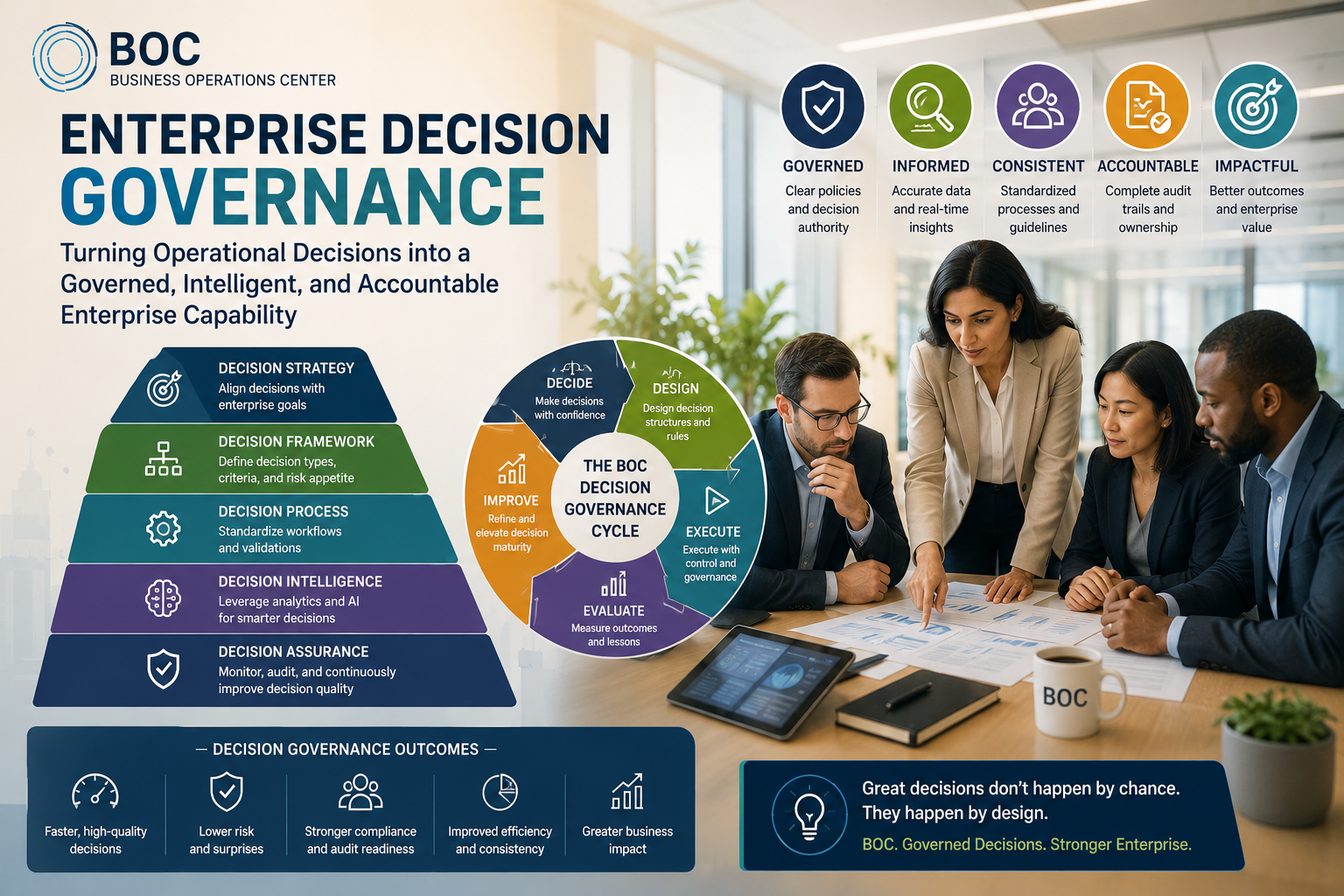
Enterprise performance depends not only on the speed of operational activity but on the quality, consistency, and accountability of the decisions embedded within that activity. Every approval, exception, escalation, prioritization, and policy interpretation shapes risk, customer experience, cost, compliance, and strategic execution. Yet in many organizations, these decisions remain fragmented across emails, spreadsheets, meetings, chat threads, and disconnected applications.
Business Operations Center (BOC) provides a governance-first framework for enterprise decision execution. It connects decision rights, workflow rules, data context, approvals, exceptions, and audit evidence within one operational layer. This transforms decision-making from an informal human dependency into a repeatable enterprise capability.
This article explains how enterprise decision governance enables faster execution without sacrificing control, how BOC creates a trusted decision architecture across systems, and how organizations can prepare for a future in which people and AI agents increasingly share responsibility for operational decisions.
Introduction: Decisions Are the Hidden Infrastructure of Operations
Every enterprise workflow contains decisions. A purchase request must be approved. A customer exception must be evaluated. A contract must be reviewed. A budget variance must be escalated. A security event must be prioritized. A supplier must be accepted, rejected, or monitored. These moments determine how work progresses and whether the organization operates within its intended risk boundaries.
However, decision-making is often treated as a personal or departmental activity rather than an enterprise capability. Different teams interpret policies differently. Approval authority is unclear. Escalation paths depend on personal knowledge. Supporting data is incomplete. Decisions are made quickly but cannot be explained later, or they are delayed because no one knows who owns them.
Enterprise decision governance addresses this operational gap. It establishes how decisions should be made, who is authorized to make them, what evidence is required, how exceptions are handled, and how outcomes are monitored. Business Operations Center operationalizes these principles across enterprise workflows.
Why Traditional Decision-Making Breaks at Enterprise Scale
Informal decision-making may appear efficient when an organization is small. Leaders know one another, exceptions can be resolved through direct conversation, and institutional knowledge is concentrated in a limited group. As the enterprise grows, the same model creates risk and delay.
Global operations introduce multiple regions, regulatory environments, business units, product lines, and technology platforms. The number of decisions increases while context becomes distributed. A manager may approve an action without seeing its financial, compliance, customer, or security implications. Another manager may reject the same action using a different interpretation of policy.
The result is decision inconsistency. Similar cases produce different outcomes. Employees learn to navigate around formal controls. Approvals become bottlenecks. Audit teams cannot reconstruct the rationale behind decisions. Executives receive performance reports but lack visibility into the decision patterns creating those results.
BOC replaces this fragmentation with a structured enterprise decision model. It ensures that operational decisions are made within defined authority, supported by trusted context, executed through governed workflows, and retained as institutional knowledge.

What Is Enterprise Decision Governance?
Enterprise decision governance is the system of policies, roles, data requirements, controls, and workflows that determines how operational decisions are made and executed. It does not centralize every decision or remove managerial judgment. Instead, it establishes clear boundaries within which judgment can be exercised responsibly.
A mature decision governance model defines decision ownership, approval thresholds, segregation of duties, required evidence, acceptable risk, escalation paths, exception handling, review frequency, and outcome measurement. These elements create consistency while allowing the organization to adapt decisions to relevant business context.
Within BOC, decision governance is embedded directly into operational workflows. The system identifies the decision point, presents the correct context, routes the request to the appropriate authority, applies policy rules, records the rationale, triggers the resulting action, and preserves the full audit trail.
The Six Layers of a Governed Decision Architecture
1. Decision Rights and Accountability
Every important operational decision requires an owner. Decision rights define who can approve, reject, recommend, override, or escalate an action. They also clarify where authority changes based on value, risk, geography, customer impact, or regulatory exposure.
BOC translates decision rights into workflow roles and approval logic. Requests no longer depend on employees knowing whom to contact. The correct decision-maker is identified automatically using enterprise rules, and accountability remains visible throughout the process.
2. Trusted Decision Context
Decisions are only as reliable as the information available when they are made. A decision-maker may need financial exposure, customer history, contract terms, compliance status, inventory availability, risk scoring, or previous exception patterns.
BOC assembles relevant data from connected systems and presents it within the decision workflow. This reduces application switching, prevents decisions based on partial information, and creates a consistent evidence standard across teams.
3. Policy and Control Enforcement
Policies should guide operational behavior at the moment of action. When policies exist only in documents, interpretation varies and compliance becomes dependent on memory.
BOC embeds policy thresholds, validation rules, required fields, approval sequences, and segregation-of-duties controls directly into workflows. Standard decisions can progress quickly, while higher-risk cases receive additional review.
4. Exception and Escalation Governance
No operational model can eliminate exceptions. The objective is to ensure that exceptions are visible, justified, approved by the correct authority, and analyzed over time.
BOC distinguishes between standard processing and exception handling. It captures the reason for the exception, routes the case through the appropriate escalation path, records compensating controls, and monitors whether exceptions are becoming systemic.
5. Decision Evidence and Auditability
Enterprises must often explain not only what happened but why it happened. An audit-ready decision record should include the request, evidence reviewed, policies applied, people involved, timestamps, comments, approvals, overrides, and resulting actions.
BOC creates this record automatically as work progresses. Audit evidence becomes a natural byproduct of execution rather than a manual reconstruction exercise.
6. Outcome Learning and Continuous Improvement
Good governance does not end when a decision is approved. Organizations must determine whether the decision produced the expected result. Repeated delays, overrides, reversals, or negative outcomes may indicate that policies, thresholds, or workflows require refinement.
BOC connects decision history with operational outcomes. Leaders can identify recurring bottlenecks, compare decision performance across teams, and improve the operating model using evidence rather than anecdote.
How BOC Turns Decision Governance into Operational Speed
Governance is sometimes viewed as the opposite of speed. In reality, unclear governance creates delay. Employees wait for direction, approvals move through unnecessary layers, and decision-makers request information that should have been supplied at the beginning.
BOC accelerates execution by making the path predictable. Standard requests are routed immediately. Required information is collected before review. Low-risk decisions can be automated within defined limits. Higher-risk cases receive the right level of scrutiny without slowing every transaction.
This creates differentiated governance. The enterprise applies stronger controls where exposure is high while allowing routine work to move quickly. Speed and control become complementary outcomes of the same operating model.
Decision Governance Across the Enterprise
Enterprise decision governance is relevant wherever operational activity crosses functions or systems. In procurement, BOC can govern supplier selection, purchase approvals, nonstandard terms, and spend exceptions. Finance, it can manage budget variances, payment approvals, credit decisions, and revenue adjustments.
Human resources, it can coordinate hiring approvals, compensation exceptions, access changes, and policy waivers. Customer operations, it can manage service credits, contract exceptions, priority escalations, and onboarding approvals. In IT and security, it can govern access requests, change approvals, incident severity, remediation priorities, and technology exceptions.
The value of BOC is not merely that it supports these individual workflows. It provides a common decision framework across them, enabling enterprise-wide visibility into ownership, risk, workload, and outcomes.
The Role of Operational Intelligence
Decision governance becomes strategic when leadership can analyze how decisions are shaping enterprise performance. BOC converts decision activity into operational intelligence.
Executives can monitor approval cycle time, decision volume, exception frequency, override rates, escalation patterns, policy adherence, workload distribution, and outcome quality. These metrics reveal where governance is working and where the operating model is creating friction.
For example, a high exception rate may indicate an unrealistic policy. Repeated escalations may show that the organization positions authority too low. Long approval times may reflect missing context rather than slow decision-makers. Operational intelligence allows leaders to correct the underlying design.
AI and the Future of Governed Decisions
Artificial intelligence will increasingly support operational decisions through recommendations, risk scoring, anomaly detection, summarization, forecasting, and automated routing. However, AI introduces new governance requirements. Organizations must know what data informed the recommendation, which rules were applied, where human review is required, and how the outcome can be explained.
BOC provides the governance layer required for responsible AI-assisted operations. AI can generate insight, but decision rights remain defined. Automated actions can be limited by thresholds. High-impact decisions can require human approval. Every recommendation and action can be recorded within the operational history.
This enables a practical human-and-AI operating model. AI improves speed and consistency, while governance preserves accountability, transparency, and enterprise control.
Enterprise Scenario: Governing Commercial Exceptions
Consider a global technology company that receives frequent requests for nonstandard pricing, contract terms, implementation commitments, and service-level guarantees. Before BOC, these requests move through email chains involving sales, finance, legal, security, and delivery teams. Information is incomplete, ownership is unclear, and similar requests receive inconsistent decisions.
With BOC, the company establishes a governed commercial exception workflow. Sales submits one structured request containing customer context, revenue value, requested deviation, strategic rationale, and supporting documents. BOC evaluates predefined thresholds and determines which functions must review the request.
Finance assesses margin and credit exposure. Legal reviews contractual risk. Security evaluates data obligations. Delivery confirms feasibility. Higher-risk cases escalate to executive authority, while lower-risk requests follow an accelerated path. Every decision, comment, and condition is retained.
Over time, operational intelligence reveals which exception types are common, which policies create repeated friction, and where standard offerings should be redesigned. The enterprise does not merely process exceptions more efficiently; it learns from them and improves commercial strategy.
Implementation Roadmap for Enterprise Decision Governance
Phase 1: Identify High-Impact Decision Points
Begin with workflows where decisions have meaningful financial, regulatory, customer, security, or strategic consequences. Document current owners, inputs, delays, exceptions, and failure modes.
Phase 2: Define Decision Rights and Policies
Clarify who owns each decision, which thresholds change authority, what evidence you require, and when escalation must occur. Remove unnecessary approval layers and resolve conflicting policies.
Phase 3: Design Governed Decision Workflows
Configure BOC to collect the correct context, apply business rules, route requests, manage exceptions, and record decision rationale. Ensure that the workflow reflects real accountability rather than simply digitizing legacy email processes.
Phase 4: Integrate Enterprise Data and Systems
Connect BOC with the systems that provide decision context and receive resulting actions. Integration reduces manual entry and ensures that decisions are based on current, trusted information.
Phase 5: Establish Metrics and Review Cadence
Monitor cycle time, decision quality, exception rates, policy adherence, reversals, and business outcomes. Review the data with process owners and governance leaders regularly.
Phase 6: Introduce Intelligent Assistance
Once the decision model is stable and auditable, introduce AI recommendations, predictive risk, automated summaries, and low-risk decision automation within controlled boundaries.
Measuring Decision Governance Maturity
Organizations should evaluate both efficiency and control. Useful measures include average decision cycle time, percentage of decisions completed within SLA, percentage of requests submitted with complete evidence, exception frequency, override rate, escalation rate, policy compliance, audit evidence completeness, reversal rate, and outcome variance.
Mature organizations also evaluate decision concentration and resilience. If too many decisions depend on a small number of individuals, the enterprise remains vulnerable. BOC helps distribute authority appropriately while preserving accountability and transparency.
Key Takeaways
Enterprise decisions are a core part of operational infrastructure. When decision rights, evidence, policies, and outcomes remain fragmented, the organization experiences delay, inconsistency, and risk.
Business Operations Center creates a governed decision layer across enterprise workflows. It connects the right authority with the right context, applies controls at the moment of action, manages exceptions visibly, and converts decision history into operational intelligence.
The objective is not to remove judgment. It is to make judgment more informed, consistent, accountable, and scalable. This foundation also enables responsible AI-assisted decisions without surrendering enterprise control.
Conclusion
Organizations cannot achieve operational excellence through process automation alone. Every automated process still depends on decisions that determine priorities, exceptions, risk acceptance, and outcomes.
Enterprise decision governance ensures that a clear and trusted operating model makes these choices. BOC provides the infrastructure to embed decision rights, policy controls, evidence, escalation, auditability, and continuous learning directly into daily execution.
When decisions become governed, enterprises move faster with greater confidence. They reduce operational ambiguity, improve accountability, strengthen compliance, and create a decision system capable of supporting both human leadership and intelligent automation.