
Introduction
Digital transformation has encouraged organizations to adopt hundreds of specialized business applications. Finance, procurement, HR, IT, customer service, legal, compliance, and operations often deploy independent platforms that perform exceptionally well within their individual domains. Unfortunately, enterprise work rarely remains inside a single department. Every customer request, employee onboarding process, vendor approval, purchase request, compliance review, and operational exception travels across multiple business functions.
Without orchestration, these processes become fragmented. Employees manually transfer information between systems; approvals become delayed, managers lose visibility, and executives receive inconsistent reporting. The organization may own world-class software, yet operational execution remains disconnected.
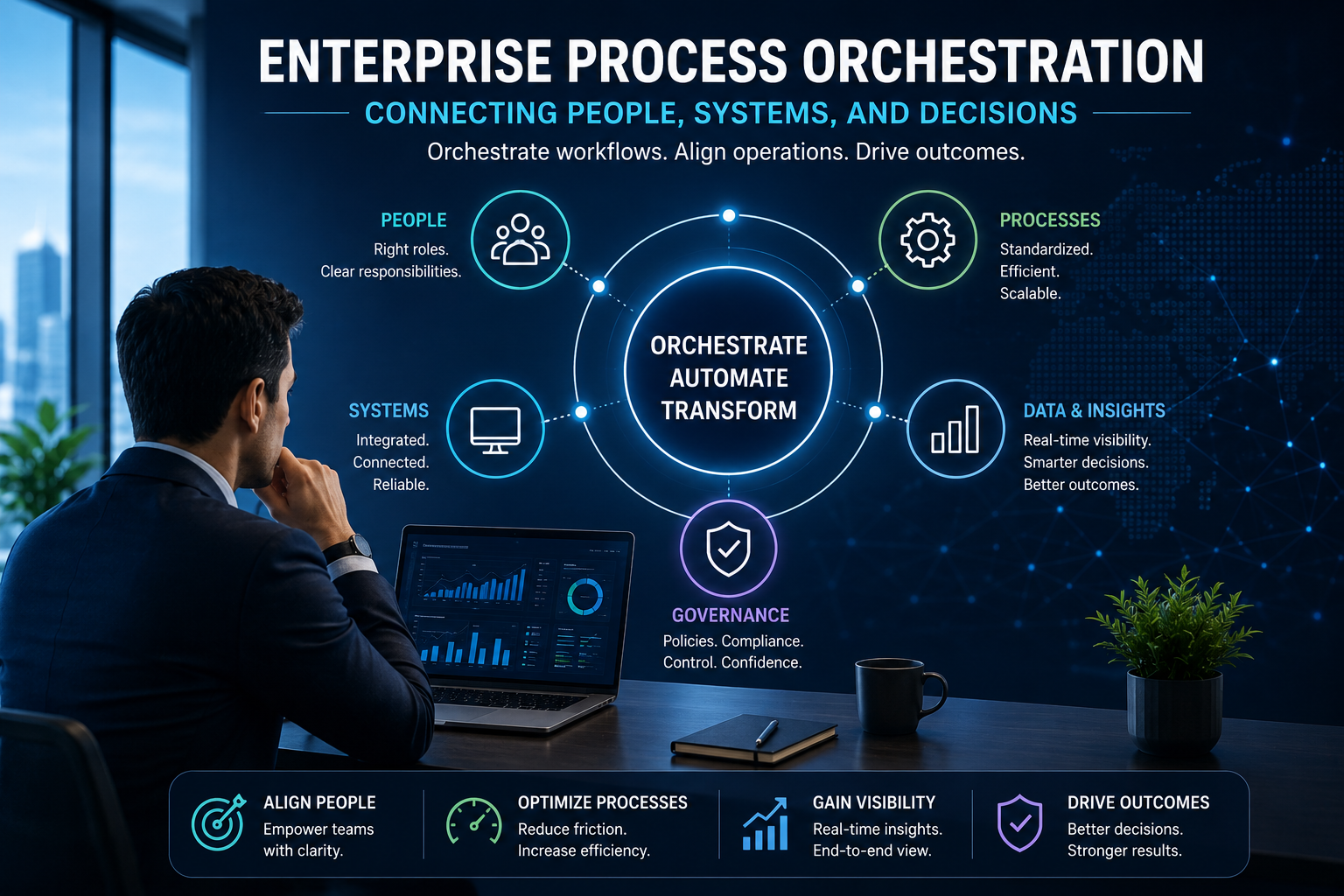
Business Operations Center (BOC) addresses this challenge by introducing enterprise process orchestration—a governance-first operational framework that coordinates people, systems, workflows, approvals, and business policies into a unified execution model. Rather than focusing on isolated automation, BOC enables organizations to manage complete operational journeys from initiation through completion.
Understanding Enterprise Process Orchestration
Enterprise process orchestration is the discipline of coordinating multiple workflows, technologies, and stakeholders so business activities progress according to predefined governance rules. Instead of viewing each department independently, orchestration treats every operational activity as part of a connected enterprise value chain.
An orchestrated environment ensures that information moves automatically between business functions, approvals follow defined authority structures, service level agreements are monitored continuously, and exceptions are escalated without relying on manual intervention. The result is predictable execution, consistent governance, and complete operational transparency.
As organizations scale, Approval Workflows Are the Foundation of Operational Governance, ensuring every decision follows a controlled and auditable path.
Why Process Automation Alone Is Not Enough
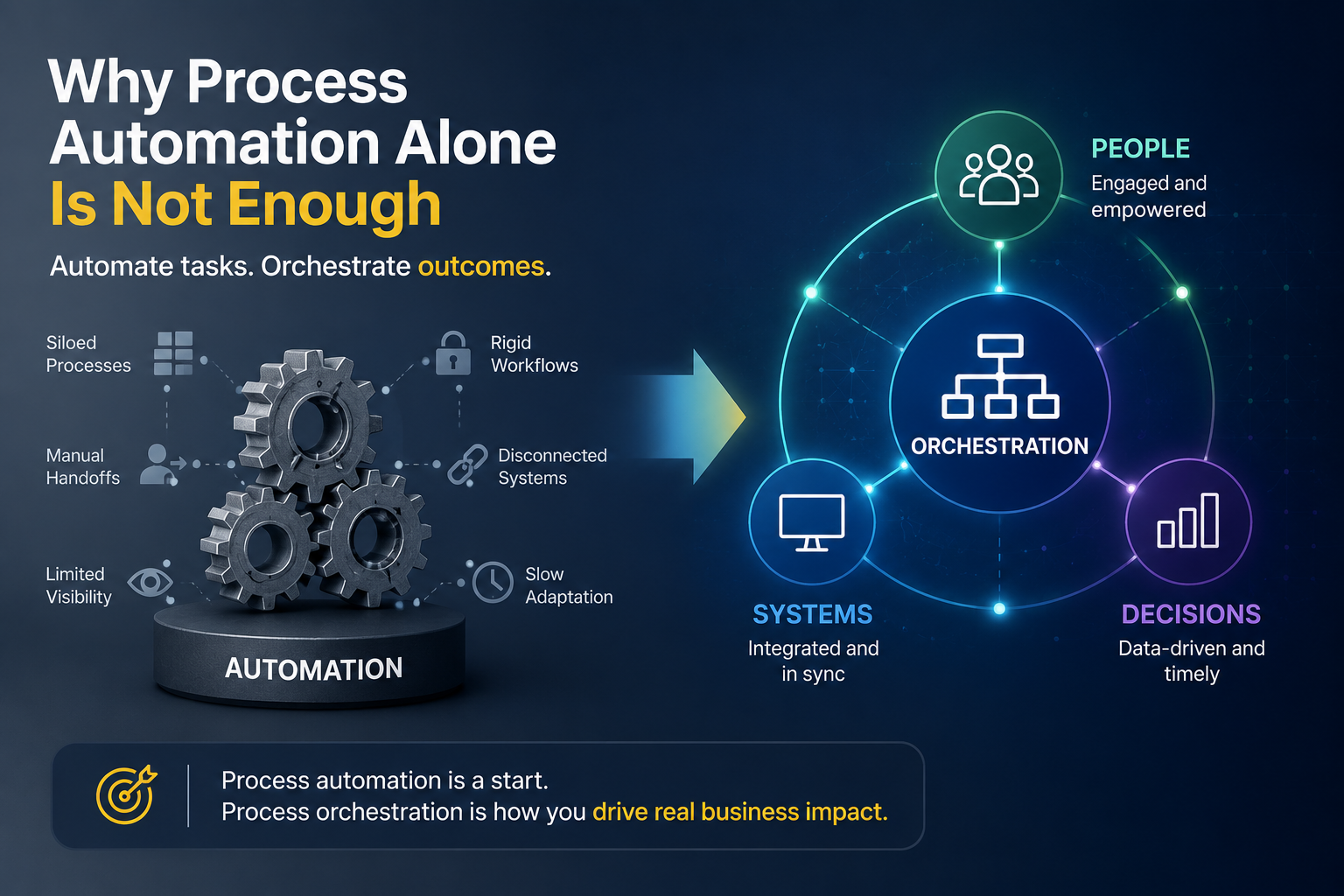
Many organizations believe workflow automation solves operational complexity. In practice, isolated automation often creates new silos because each department automates only its own activities. Procurement automates purchasing, HR automates onboarding, finance automates invoicing, and IT automates ticketing, yet cross-functional coordination remains manual.
Enterprise orchestration sits above individual automation. It connects independent workflows into a governed operational ecosystem. Every process understands when to start, when to wait, who owns the next action, which policy applies, and how progress should be measured.
Key Components of an Orchestrated Enterprise
Successful orchestration requires standardized workflow definitions, centralized approval governance, role-based responsibility, policy enforcement, integration with enterprise applications, audit logging, operational analytics, SLA monitoring, exception handling, and executive reporting. Together, these components create a repeatable operational model capable of supporting organizational growth without increasing administrative complexity.
Continuous improvement becomes possible when Operational Analytics provides real-time insights into workflow performance, bottlenecks, and exceptions.
How the Business Operations Center Enables Orchestration
Business Operations Center acts as the operational coordination layer connecting business units rather than replacing existing enterprise systems. It provides centralized workflow governance, process visibility, operational dashboards, approval routing, escalation management, and enterprise reporting.
Managers gain visibility into work in progress. Department leaders identify bottlenecks before they affect customers. Compliance teams receive complete audit trails. Executives obtain trusted operational intelligence because every metric originates from governed execution rather than manually prepared reports.
Organizations achieve better coordination when they recognize that Operational Visibility Starts with Standardized Enterprise Workflows across teams and systems.
Enterprise Benefits
Organizations implementing enterprise process orchestration typically achieve faster cycle times, improved collaboration, reduced operational risk, stronger compliance, better resource utilization, lower manual effort, improved customer experience, greater accountability, and significantly higher operational visibility. Standardized execution also improves the quality of strategic planning because leaders can rely on consistent enterprise-wide operational data.
Teams planning enterprise transformation can explore additional Workflow Automation Resources to identify best practices and implementation strategies.
Implementation Strategy
Implementation should begin with high-value workflows that cross departmental boundaries, such as employee onboarding, vendor onboarding, procurement approvals, contract management, customer exception handling, operational change requests, and governance reviews. Organizations should document existing processes, identify ownership, define governance rules, establish KPIs, integrate supporting systems, and continuously optimize execution based on measurable operational insights generated by BOC.
Implementing Enterprise Workflow Governance helps organizations standardize decision-making while reducing operational risks.
Operational Governance and Continuous Improvement
Orchestration is not a one-time implementation project. As organizations evolve, workflows, approval structures, compliance obligations, and operational priorities change. BOC supports continuous optimization by providing visibility into recurring bottlenecks, policy exceptions, approval delays, workload distribution, and process performance. These insights enable operational leaders to refine execution while maintaining governance consistency across the enterprise.
Conclusion
Enterprise process orchestration is the foundation of operational excellence. By connecting people, systems, approvals, policies, and decisions into a single governed execution model, organizations replace fragmented operations with coordinated enterprise performance. Business Operations Center empowers enterprises to standardize execution, strengthen governance, improve visibility, and build an operational foundation capable of supporting sustainable growth and digital transformation.
Business Operations Center helps enterprises orchestrate complex operations through governance-first workflow execution. If your organization is struggling with disconnected systems, inconsistent approvals, or limited operational visibility, BOC provides the operational foundation needed to coordinate enterprise execution at scale.