


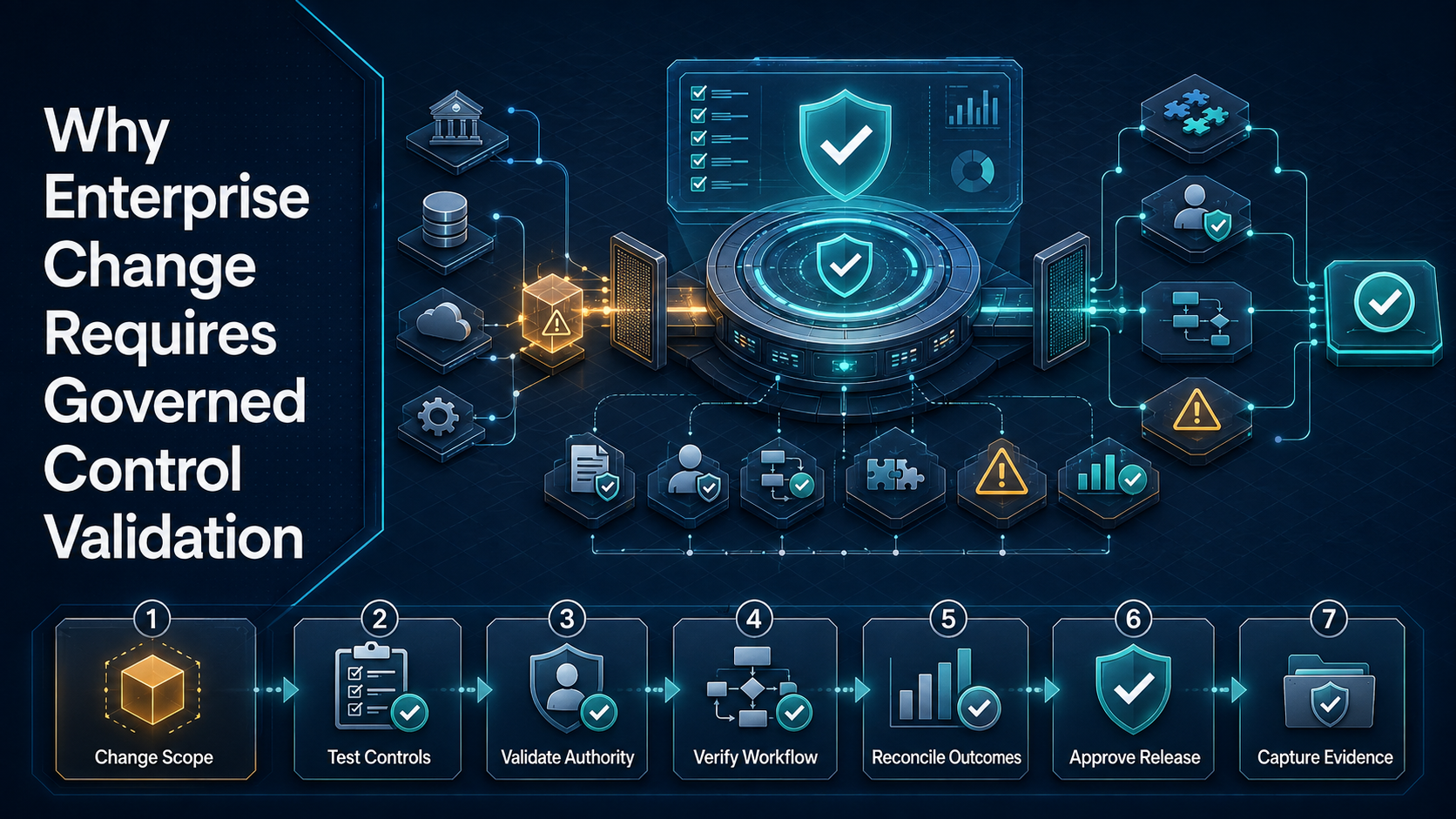
Impact Analysis Identifies Risk; Validation Proves Control
Enterprise change does not become safe merely because its consequences have been identified. Impact analysis establishes what may be affected, which dependencies matter, and what treatment is required. The next obligation is proof: the enterprise must demonstrate that the changed operating model still enforces policy, respects authority, controls workflow execution, manages exceptions, reconciles outcomes, and produces defensible evidence.
This distinction matters because a design can be complete on paper and still fail in operation. An approval rule may be configured but reference an obsolete role. An integration may transmit a technically valid payload that omits the policy version used for the decision. An operational reconciliation rule may detect a difference without creating accountable resolution work. Each component can pass a local test while the governed business outcome remains wrong.
Business Ops Center treats control validation as governed enterprise work rather than a final technical checkpoint. BOC connects the approved change decision to explicit control objectives, test scenarios, evidence requirements, accountable reviewers, defects, remediation, activation criteria, and post-change assurance. The result is a provable decision about operational readiness—not an accumulation of disconnected test results.
What Governed Control Validation Means
Governed control validation is the structured demonstration that a proposed or implemented change preserves the intended control outcome across the complete business event. It tests both design and operation: whether the control is defined appropriately, whether it is implemented in the relevant systems and workflow standardization, and whether observed execution produces the authorized and reconcilable result.
The validation record identifies the change and control versions, population and scope, risk classification, scenarios, expected results, authoritative data, decision rights, evidence sources, test performers, independent reviewers, deviations, remediation, retest status, acceptance authority, effective date, and monitoring obligations. Every conclusion can therefore be traced to the control objective and evidence that supports it.
Governed validation is proportional. Low-risk documentation changes may require ownership and version checks. A mapping revision may require targeted contract and reconciliation tests. Changes involving approval authority, financial thresholds, identity access, regulated data, customer commitments, or external fulfillment may require negative testing, segregation review, independent evidence, transaction-level reconciliation, and controlled post-activation monitoring.
Why Conventional Testing Is Not Enough
Traditional testing is commonly organized around applications, releases, interfaces, or project requirements. It asks whether a screen works, an API responds, a field maps, or a deployment completes. These tests are necessary, but they do not by themselves prove that the enterprise obligation remains governed from authorized intent through verified closure.
Local pass results can conceal cross-system failure. The HRIS may publish a valid change while identity applies the wrong effective date. The approval engine may route correctly while the approver no longer holds valid delegated authority. Procurement governance may issue the approved order while the supplier fulfills an unauthorized substitution. An ERP may close a transaction before required evidence has arrived.
BOC changes the unit of validation from the component to the governed event. The question becomes: did the right policy and authoritative facts determine the decision, did a permitted actor authorize the exact version, did execution remain within approved constraints, were exceptions owned, and did evidence prove the expected outcome?
The Control Domains BOC Must Validate
- Policy application: the correct policy version, scope, thresholds, prohibitions, effective dates, and retention obligations are applied to the event.
- Authority and segregation: decision-makers possess current, scoped authority; delegations and expirations are enforced; incompatible duties are prevented or compensated.
- Workflow behavior: qualification, routing, approval, release, escalation, exception, reconciliation, and closure occur in the authorized order.
- Data and integration integrity: authoritative sources, identifiers, mappings, payload versions, timing, idempotency, acknowledgements, and status meanings remain reliable.
- Exception control: failures and deviations are detected, classified, assigned, time-bound, escalated, resolved, and supported by approved evidence.
- Outcome reconciliation: approved intent is compared with actual execution, fulfillment, financial treatment, access state, and completion evidence.
- Evidence and auditability: the enterprise can reconstruct what occurred, under which versions, who decided, what was tested, what differed, and why release was authorized.
From Control Objective to Validation Decision
Validation begins with an approved impact decision and a clear control objective. BOC translates each material impact into an observable assertion. Instead of stating that approval routing should work, the assertion specifies which policy, value, entity, role, delegation, sequence, segregation condition, and effective date must determine the result.
Scenarios then cover normal, boundary, negative, exception, recovery, and transition conditions. BOC links each scenario to controlled test data and expected evidence. This prevents teams from proving only the preferred path while leaving expired authority, duplicate delivery, partial fulfillment, unavailable systems, missing acknowledgements, or in-flight version changes untested.
The output is a validation decision: pass, pass with time-bound conditions, remediate and retest, contain, or reject activation. Assumptions, exclusions, residual risks, compensating controls, and monitoring requirements remain visible. A project milestone cannot silently substitute for the authorized acceptance of operational risk.
A Governed Control-Validation Lifecycle
| Stage | Governance question | Control output |
| Define | What control outcome must remain true? | Objective, policy, scope, version, tolerance |
| Design | Which conditions could prove or disprove it? | Normal, boundary, negative, failure scenarios |
| Prepare | Are data, environments, roles, and evidence controlled? | Test basis, access, sources, responsibilities |
| Execute | Did observed behavior match the approved assertion? | Results, timestamps, system and workflow evidence |
| Assess | What does each variance mean for control? | Finding, materiality, owner, containment |
| Remediate | Was the cause corrected and effectiveness retested? | Fix, regression result, residual risk |
| Authorize | Who may accept readiness or conditions? | Release decision, conditions, expiry, monitoring |
| Verify | Did production outcomes remain controlled? | Early-life assurance, reconciliation, closure |
Validating Design, Implementation, and Operating Effectiveness
Design validation asks whether the proposed control can meet the policy and risk objective. It examines trigger conditions, authority, sequence, evidence, exception paths, reconciliation criteria, ownership, and closure. A beautifully implemented control is still inadequate if its design omits an important obligation.
Implementation validation asks whether the approved design has been configured consistently across systems. BOC compares the intended control version with workflow rules, identity groups, integration mappings, vendor configurations, evidence sources, and downstream closure logic. This exposes partial adoption and environment drift.
Operating-effectiveness validation observes real or representative events. It determines whether the control performed at the right time, for the correct population, using authoritative facts, and produced a supported outcome. The three layers prevent a configuration screenshot or successful API response from being treated as sufficient proof.
Testing the Conditions Enterprises Often Miss
Boundary conditions deserve explicit treatment: values immediately below, at, and above approval thresholds; authority that expires during active work; policies that become effective across time zones; and transactions spanning legal entities or geographies.
Negative scenarios prove that prohibited actions remain blocked. Tests should address missing approvals, incompatible roles, stale delegations, altered payloads, duplicate requests, unauthorized substitutions, absent evidence, premature closure, and attempts to bypass the governed channel.
Failure and recovery scenarios prove resilience. BOC can validate retry behavior, idempotency, delayed acknowledgements, manual fallback, temporary authority, compensating controls, reconciliation after recovery, and the treatment of events caught between versions. These conditions often determine whether control survives real operations.

Preserving Test Evidence and Independence
Evidence must be sufficient to support the conclusion without depending on the memory of the people who performed the work. BOC associates source snapshots, configuration versions, scenario inputs, timestamps, system responses, approval records, exception histories, reconciliations, screenshots where necessary, and reviewer decisions with the governed validation event.
Independence should reflect consequence. The same team may prepare and execute a low-risk test, while a material financial, identity, regulatory, or customer control may require separate evidence review or acceptance by an authorized control owner. BOC records the distinction between performer, reviewer, risk acceptor, and activation authority.
Corrections should add history rather than overwrite it. Failed results, revised expectations, remediation, and retests remain connected. This produces a trustworthy narrative of how the enterprise reached readiness and prevents selective evidence from presenting an unrealistically clean outcome.
Defects, Exceptions, and Conditional Approval
A failed test is not merely a project issue. It may reveal a design defect, implementation variance, data-quality problem, authority gap, integration fault, ownership failure, or evidence weakness. BOC classifies the finding against the control objective and assigns an accountable owner, materiality, due date, containment action, and retest requirement.
Conditional approval must be explicit and limited. It should state the affected scope, rationale, temporary authority, compensating control, monitoring frequency, expiry, remediation commitment, and conditions that require suspension. Open findings cannot disappear into meeting notes after the release decision.
BOC also distinguishes acceptance from closure. An authorized leader may accept defined residual risk for a period, but the underlying obligation remains visible until remediation, retesting, reconciliation, and evidence are complete.
Post-Activation Validation and Early-Life Assurance
Pre-production evidence cannot reproduce every operating condition. After activation, BOC verifies that real events use the approved control version and that observed results remain within expected tolerance. High-consequence changes may require validation of every event; other changes may use risk-based sampling with documented rationale.
Early-life assurance can compare business card approval workflow overrides, exception rates, latency, duplicate activity, unmatched acknowledgements, reconciliation variance, residual access, supplier deviations, and evidence completeness with the prior baseline. A stable application that produces unexplained operational variance remains an open control concern.
Post-activation findings feed the living control model. They can refine dependency maps, test scenarios, tolerances, data contracts, ownership rules, monitoring, and future materiality decisions. Validation therefore becomes part of continuous brand governance rather than a one-time release ceremony.
Where Governed Validation Creates Enterprise Value
- Operations leaders receive a readiness decision connected to real obligations and ownership rather than a technical status summary.
- Technology and integration teams gain precise business assertions, expected evidence, and failure treatments that make testing more useful and reduce ambiguity.
- Risk, compliance, internal control, and audit teams gain traceability from policy and change impact through scenarios, findings, acceptance, activation, and observed outcomes.
- Enterprise leaders gain transformation velocity with discipline. They can approve change faster when material controls, unresolved conditions, accountable acceptance, and proof requirements are visible in one governed record.
Metrics That Reveal Validation Quality
- Control coverage: percentage of material impacted controls linked to approved validation assertions and evidence.
- Scenario completeness: coverage of normal, boundary, negative, exception, recovery, and transition conditions required by risk class.
- First-pass effectiveness: percentage of controls that meet expected outcomes without material remediation.
- Defect escape rate: material validation findings discovered only after activation.
- Evidence completeness: percentage of validation decisions supported by required source, execution, review, and acceptance evidence.
- Retest closure time: elapsed time from material finding through remediation, retest, and authorized closure.
- Post-change variance: change in exceptions, overrides, reconciliation failures, delays, and closure gaps during early-life assurance.
Implementation Priorities for Enterprise Leaders
- Start with one consequential cross-system change where authority, finance, identity, customer, regulatory, or fulfillment impact makes failure material.
- Define control assertions before test cases. State the governed outcome, authoritative facts, permitted actor, expected behavior, evidence, and tolerance.
- Build risk-based scenario standards. Require boundary, negative, exception, recovery, and transition testing where consequence warrants them.
- Connect validation to the impact decision and living control model. Avoid creating another isolated testing repository.
- Separate performance, review, risk acceptance, and activation authority according to materiality.
- Govern findings through ownership, containment, expiry, remediation, retesting, reconciliation, and closure evidence.
- Extend validation beyond deployment. Use early-life monitoring and observed outcomes to confirm control effectiveness and improve future change decisions.
Questions Enterprise Buyers Should Ask
- Can the platform translate each material change impact into a traceable control assertion and validation requirement?
- Does validation span policy, authority, workflow, integration, exceptions, reconciliation, and evidence across systems?
- Can scenarios cover boundary, negative, failure, recovery, and in-flight transition conditions?
- Are test data, performers, reviewers, acceptance authority, evidence, defects, and retests preserved in one decision record?
- Can conditional approvals enforce scope, compensating controls, monitoring, expiry, and remediation?
- Does post-activation assurance compare observed outcomes with the approved control model?
- Can recurring findings improve control definitions, dependency maps, tolerances, and future validation standards?
From Change Impact to Proven Operational Readiness
Business Ops Center validates the business obligation across design, implementation, and observed effectiveness. It makes scenarios, findings, acceptance, activation, and post-change assurance part of the same governed chain.
The result is not a promise that change is safe. It is a defensible record showing what was expected, what was tested, what failed, who accepted the outcome, what entered operation, and whether the enterprise remained authorized, controlled, reconcilable, and accountable.
If your change programs can prove that applications were tested but cannot prove that end-to-end business controls still operate as intended, the enterprise remains exposed between deployment success and operational truth. Explore how Business Ops Center can connect impact decisions, control assertions, validation evidence, findings, acceptance, activation, and post-change assurance across the enterprise.