


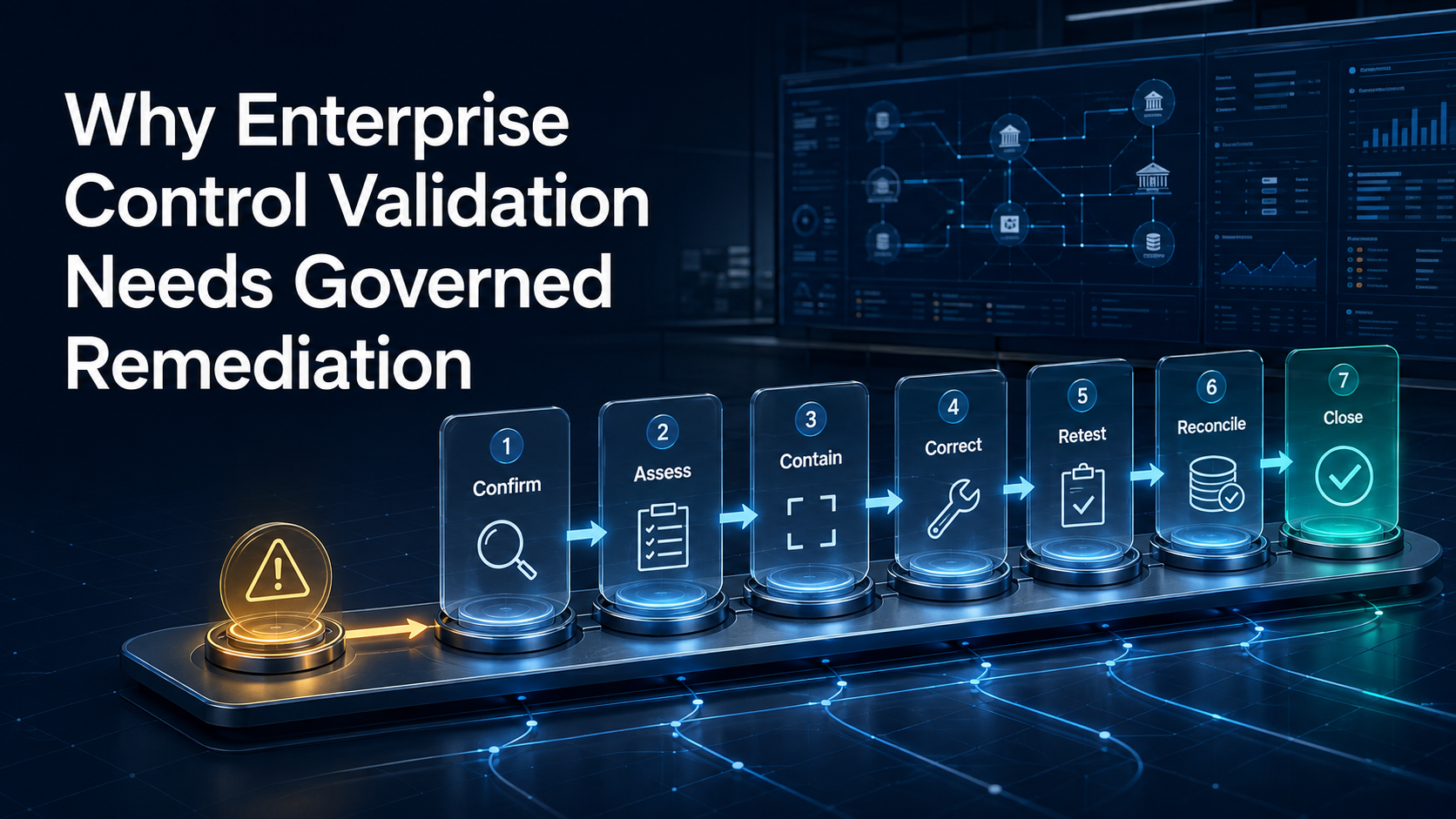
Validation Finds the Gap; Remediation Restores the Control
Governed control validation gives the enterprise something more valuable than a pass-rate dashboard: it reveals where policy, authority, workflow, integration, exception, reconciliation, or evidence controls do not operate as intended. Yet discovery alone does not reduce exposure. A failed assertion becomes useful only when the organization contains its consequence, identifies the accountable owner, corrects the underlying cause, proves the correction, and closes the obligation with evidence.
This is where many change programs lose control. Findings are exported into project trackers, technical defects, email threads, audit workpapers, and local spreadsheets. Each team may act responsibly within its own boundary, but no single governed record connects the original control objective to the failure, business impact, containment, remediation decision, implementation, retest, production verification, risk acceptance, and final closure.
Business Ops Center treats remediation as a governed enterprise operational lifecycle. BOC keeps the finding attached to the affected policy, authority model, workflow version, system dependency, active business events, evidence obligation, and authorized decision. It coordinates work across operations, technology, risk, compliance, identity, procurement, finance, and external providers without allowing ticket completion to masquerade as restored control.
What Governed Remediation Means
Governed remediation is the controlled process through which an enterprise responds to a validated control deficiency and demonstrates that the intended operational outcome has been restored. It begins when a finding is confirmed—not when a ticket is created—and ends only when corrective action has been implemented, independently retested where required, reconciled against affected outcomes, and accepted by the authorized control owner.
The remediation record should identify the originating change and validation scenario, failed assertion, control and policy versions, affected population, materiality, root cause, accountable owner, containment action, corrective design, approval authority, dependencies, due date, test requirement, evidence, residual risk, production verification, and closure decision. That continuity prevents context from being lost as work moves between governance and execution teams.
Remediation must also be proportional. A documentation discrepancy may require correction and ownership confirmation. An expired delegation affecting approvals may require immediate containment, transaction review, authority repair, retesting, and retrospective operational reconciliation. Involving financial posting, identity access, regulated data, or customer fulfillment may require suspension, legal or compliance review, expanded population analysis, and executive risk acceptance.
Why Conventional Defect Management Is Not Enough
Defect management is normally optimized for delivery: describe the issue, assign priority, implement a fix, and close the ticket. Governed remediation is optimized for control restoration. It asks what obligation failed, which decisions and events may be affected, what temporary protection is required, who can authorize the treatment, and what evidence proves that the enterprise is again operating within policy.
A technical fix can therefore be necessary but insufficient. Correcting a mapping does not establish whether earlier transactions were wrong. Updating an approval group does not prove that approvals made under stale authority were reviewed. Restoring an acknowledgement does not reconcile orders that were released while the connection failed. BOC preserves the link between correction and consequence.
The unit of closure is not the code change, configuration update, or completed task. It is the governed business obligation. Closure means the control is appropriately designed, implemented consistently, operating infrastructure for workflow effectively, and supported by sufficient evidence for the relevant population and period.
The Remediation Domains BOC Must Coordinate
- Policy remediation: clarify or correct policy scope, thresholds, effective dates, prohibitions, retention, and interpretation where the control design did not represent the enterprise obligation.
- Authority remediation: correct roles, delegations, approval limits, segregation conflicts, expirations, and temporary access while reviewing decisions made under invalid authority.
- Workflow remediation: repair qualification, routing, approval, release, escalation, exception, reconciliation, or closure logic and address work already processed through the defective path.
- Integration and data remediation: correct authoritative sources, identifiers, mappings, schemas, timing, idempotency, acknowledgements, and status semantics, then reconcile affected cross-system records.
- Exception and outcome remediation: assign unresolved failures, restore ownership, correct actual execution, recover missing evidence, and prove that authorized intent matches downstream fulfillment, access, or financial state.
- Evidence remediation: rebuild the traceable record where source data, decisions, timestamps, versions, reviews, or closure proof were incomplete, while clearly distinguishing reconstructed evidence from contemporaneous evidence.
A Governed Remediation Lifecycle
| Stage | Governance question | Required control output |
|---|---|---|
| Confirm | What failed, against which approved assertion? | Validated finding, scope, version, evidence |
| Assess | What is the consequence and affected population? | Materiality, exposure, impacted events, escalation |
| Contain | How is further harm prevented now? | Restriction, fallback, monitoring, temporary authority, expiry |
| Diagnose | Why did the control fail across the full event? | Root cause and contributing control conditions |
| Design | What corrective action restores the obligation? | Approved remediation plan, owners, dependencies, evidence |
| Implement | Was the authorized correction deployed completely? | Versioned change, execution records, approvals |
| Retest | Does the control now work under material conditions? | Positive, boundary, negative, recovery results |
| Reconcile | Were prior and in-flight outcomes corrected? | Population review, adjustments, exception closure |
| Close | Who accepts restoration and residual risk? | Authorized closure, evidence, monitoring, lessons |
From Finding to Materiality and Containment
BOC begins by preserving the finding exactly as validation established it. The failed assertion, expected result, observed result, evidence, environment, time, control version, and affected business event remain immutable inputs to the remediation decision. This prevents later work from redefining the original failure to fit a convenient solution.
Materiality is assessed through business consequence rather than technical severity alone. The enterprise considers affected value, transaction volume, access privilege, customer commitment, regulatory obligation, geographic reach, duration, detectability, reversibility, and the possibility that the observed sample signals a larger population. BOC routes the decision to the authority appropriate for that consequence.
Containment protects the enterprise identity governance while permanent corrective action is developed. It may pause release, narrow permissions, require secondary approval, redirect activity to a controlled manual path, increase monitoring, isolate a vendor or integration, or block closure without reconciliation. Every temporary measure needs an owner, scope, effective time, expiry, evidence requirement, and explicit criteria for removal.
Diagnosing Root Cause Across the Governed Event
Root cause should not stop at the component that displayed the failure. An incorrect order may originate in an ambiguous policy, stale employee data, invalid delegated authority, workflow branching, a mapping transformation, vendor substitution, or premature downstream closure. BOC maps the complete chain from policy and authoritative facts through decision, execution, exception, and evidence.
The distinction between direct cause, contributing condition, and control weakness matters. A malformed payload may be the direct cause, while missing contract validation is a contributing condition and absent reconciliation is the weakness that allowed the error to persist. Repairing only the payload leaves the enterprise vulnerable to a different malformed event tomorrow.
Recurring findings should be analyzed together. Patterns across business units, vendors, systems, or change types can reveal weak control definitions, unclear ownership, unreliable source data, insufficient negative testing, or incentives that encourage bypass. BOC turns remediation history into intelligence for the living control model.
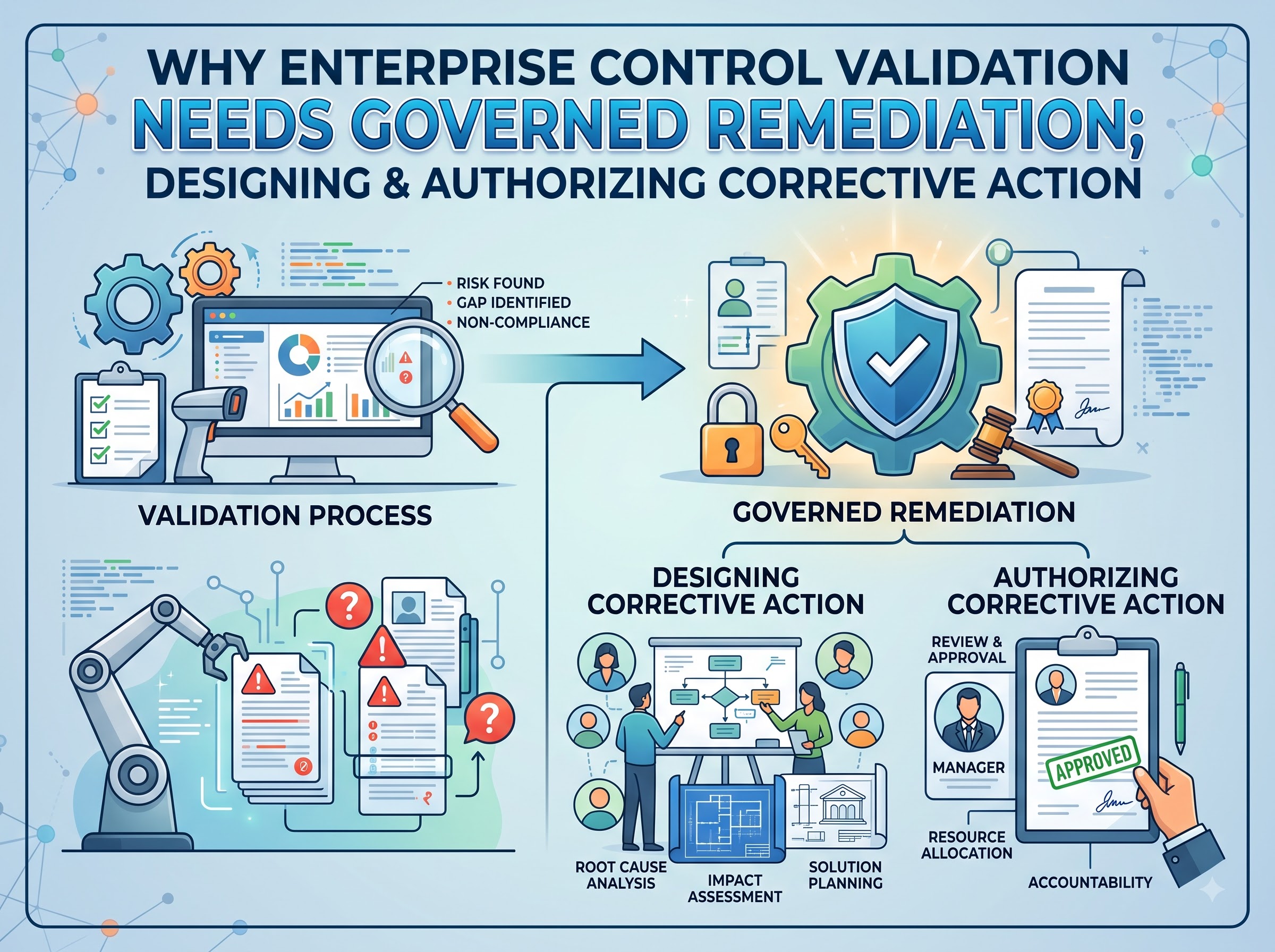
Designing and Authorizing Corrective Action
A remediation plan should state the control outcome to restore, the affected scope, corrective actions, accountable owners, sequencing, dependencies, validation criteria, evidence, target dates, deployment method, rollback treatment, and residual risk. The plan must distinguish permanent correction from compensating control so temporary measures do not quietly become the operating model.
Approval rights should follow the obligation. Technology may authorize a code deployment, but the business control owner must decide whether the proposed treatment restores policy intent. Risk or compliance may need to approve residual exposure. Identity, finance, procurement, or customer leadership may own decisions within their domains. BOC records these distinct authorities rather than collapsing them into a generic sign-off.
Material corrections should also consider transition. In-flight work, queued messages, cached identities, open approvals, partially fulfilled orders, and historical reporting may cross the remediation boundary. Effective-date and version rules determine which treatment applies to each population and prevent the new control from creating a second layer of ambiguity.
Retesting the Control, Not Merely the Fix
Retesting must return to the original control assertion and cover the conditions that exposed the deficiency. BOC links the remediation version to normal, boundary, negative, exception, recovery, and transition scenarios. A successful replay of the single failed case is not sufficient when the corrective action changes routing, authority, integrations, evidence, or downstream closure.
Regression scope should reflect dependency. Correcting an authority rule may affect request qualification and segregation. Changing a data mapping may alter business card approvals, pricing, reporting, and reconciliation. BOC uses the living control model and change-impact relationships to identify related controls that require validation.
Independence remains risk-based. The implementer may perform initial verification, while a material control may require separate evidence review, business-owner acceptance, or assurance testing. Failed retests remain part of the history, and each new correction is versioned rather than overwriting prior evidence.
Reconciliation and Retrospective Correction
Restoring future behavior does not resolve past consequence. BOC determines the affected population from the earliest plausible failure through confirmed correction. It compares approved intent with actual approvals, access, orders, fulfillment, postings, notifications, evidence, and closure states to identify every event requiring treatment.
Correction may include reversing access, reauthorizing a decision, adjusting a financial record, replacing an order, obtaining missing acknowledgement, notifying stakeholders, or reopening an exception. Where perfect reconstruction is impossible, assumptions, sampling rationale, residual uncertainty, and authorized acceptance must be recorded explicitly.
This retrospective discipline is especially important for intermittent failures. A connector can appear healthy while losing a subset of acknowledgements; an expired role may affect only requests above a threshold; a vendor may substitute only when inventory is constrained. Population analysis and reconciliation turn anecdotal repair into defensible closure.
Conditional Closure and Residual Risk
Some findings cannot be eliminated immediately. Governed conditional closure can permit operation only when the residual risk is understood, accepted by the correct authority, bounded by scope and time, protected by a compensating control, monitored at an explicit frequency, and connected to a dated permanent action.
BOC distinguishes work completion, control restoration, and risk acceptance. A delivery team may finish the planned change while retesting remains incomplete. The control owner may confirm effectiveness while retrospective reconciliation remains open. An executive may accept residual exposure without extinguishing the remediation obligation. Each state remains visible.
Expiry is essential. Temporary approvals and compensating controls should automatically return for review before they lapse. If evidence, monitoring, or remediation milestones are missed, BOC can escalate, restrict activity, or require a new acceptance decision instead of allowing exceptions to age silently.
Where Governed Remediation Creates Enterprise Value
- Operations leaders gain a single view of which obligations are impaired, what containment is active, who owns recovery, and whether business outcomes have actually been corrected.
- Technology and integration teams receive precise control expectations, dependency context, retest requirements, and closure criteria instead of ambiguous priority labels.
- Risk, compliance, internal control, and audit teams gain traceability from the original assertion through finding, materiality, containment, root cause, corrective action, evidence, reconciliation, and authorized closure.
- Enterprise leaders gain speed with accountability. They can make informed activation, suspension, funding, and risk-acceptance decisions because material exposure and corrective progress are visible in the same governed record.
Metrics That Reveal Remediation Quality
- Time to containment: elapsed time from confirmed material finding to an active, evidenced protective measure.
- Population determination time: time required to identify the plausible set of affected business events and decisions.
- Root-cause recurrence rate: percentage of findings that repeat because corrective action treated the symptom rather than the governing weakness.
- Retest effectiveness: percentage of remediations that pass complete control and regression validation on the first authorized retest.
- Reconciliation closure time: elapsed time from control restoration to correction or acceptance of affected prior outcomes.
- Conditional-action aging: number and materiality of temporary controls, accepted risks, and overdue remediation commitments approaching or exceeding expiry.
- Evidence completeness: percentage of closures supported by required finding, decision, implementation, retest, reconciliation, and acceptance evidence.
Implementation Priorities for Enterprise Leaders
- Start with material validation findings that cross systems or organizational boundaries and currently fragment into separate ticketing, risk, audit, and operational records.
- Define a common remediation object connecting control objective, finding, affected population, materiality, containment, owner, corrective action, retest, reconciliation, and closure.
- Establish decision rights for containment, corrective design, residual-risk acceptance, activation, and final closure according to consequence.
- Require effective dates, expiry, monitoring, and removal criteria for every temporary control or conditional approval.
- Use control dependencies to set regression scope and prevent a local correction from creating downstream drift.
- Keep retrospective reconciliation separate from future-state repair so neither obligation can hide the other.
- Feed root causes, recurring patterns, and corrective evidence back into the living control model, validation standards, and change-impact rules.
Questions Enterprise Buyers Should Ask
- Can the platform keep a validation finding linked to the exact policy, authority, workflow, integration, evidence, and control versions involved?
- Can it govern materiality, containment, corrective action, retesting, reconciliation, residual risk, and closure as distinct accountable decisions?
- Can it identify and treat affected historical and in-flight events rather than only correcting future configuration?
- Can temporary controls enforce scope, ownership, monitoring, evidence, expiry, and escalation?
- Can remediation dependencies drive regression testing across connected systems and business functions?
- Can authorized leaders distinguish technical completion from restored operational control and accepted residual risk?
- Can recurring findings update the living control model and improve future change analysis and validation?
From Proven Deficiency to Restored Operational Control
Post 64 established governed change-impact analysis. Blog Post 65 showed how governed control validation proves whether policy, authority, workflow, integration, exception, reconciliation, and evidence controls still operate as intended. Post 66 addresses the obligation created when that proof reveals a deficiency.
Business Ops Center turns remediation into an end-to-end governed chain. Findings retain their control context. Materiality determines response. Containment protects operations. Corrective action is authorized. Retesting proves effectiveness. Reconciliation addresses prior outcomes. Closure records the authority and evidence behind the decision.
The result is more than faster issue resolution. It is a defensible operating record showing how the enterprise moved from detected weakness to restored control—without losing ownership, history, accountability, or operational truth between systems and teams.
If your organization can identify failed controls but cannot connect them to containment, accountable correction, retesting, retrospective reconciliation, residual-risk acceptance, and evidenced closure, the remediation process remains fragmented. Explore how Business Ops Center can govern the complete path from validation finding to restored enterprise control.