
Introduction
Digital enterprises execute thousands of interconnected workflows every day across finance, procurement, HR, customer operations, IT, legal, compliance, sales, and partner ecosystems. While organizations invest heavily in ERP, CRM, HRMS, and collaboration platforms, many still struggle to understand how work actually moves across the enterprise. Individual systems expose isolated activities, but they rarely provide a complete picture of execution from initiation through completion.
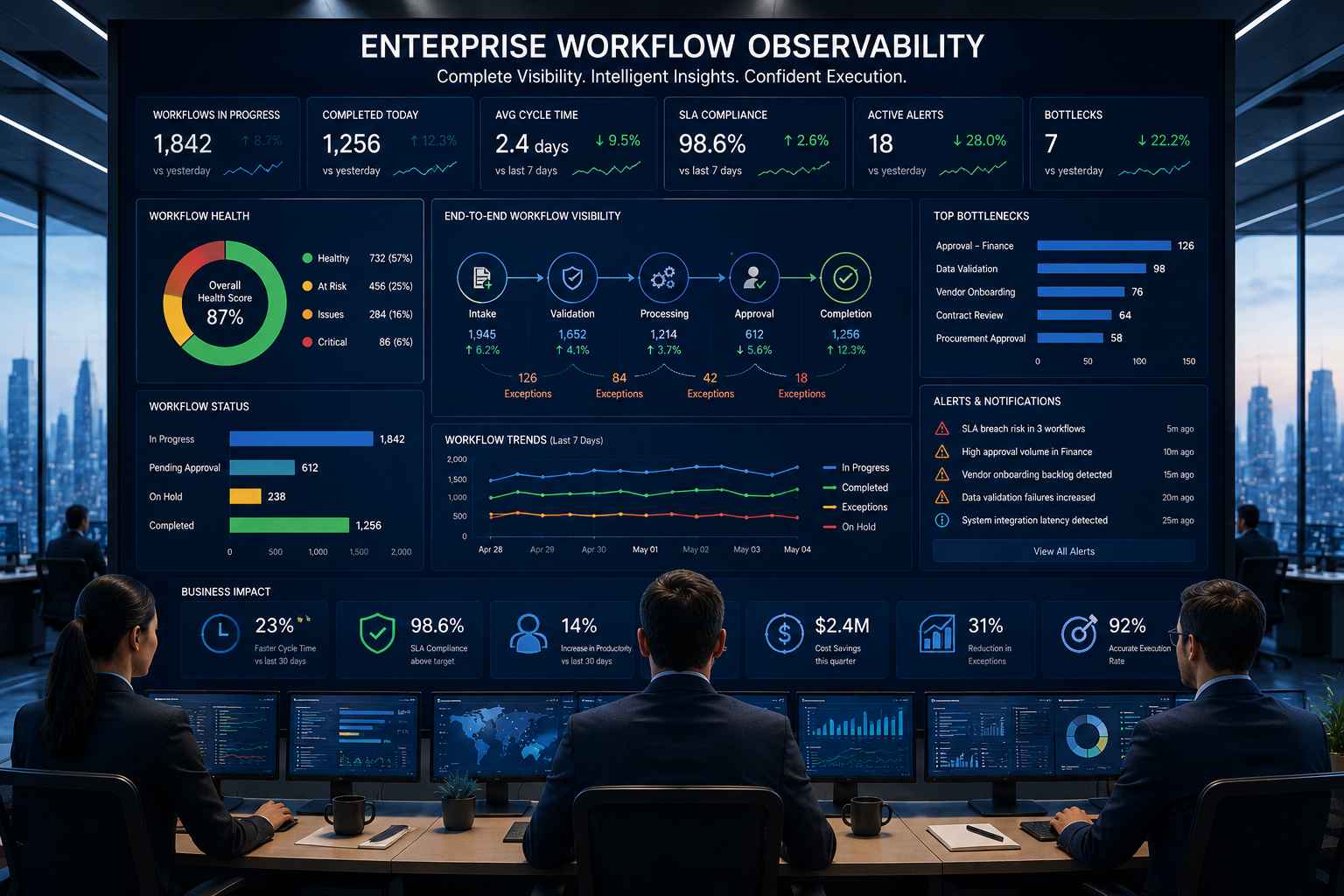
Enterprise Workflow Observability fills this gap. Rather than simply monitoring applications or reporting historical metrics, workflow observability provides continuous insight into how enterprise work progresses, where delays occur, why exceptions happen, and which governance controls influence execution. Business Operations Center (BOC) extends this concept by combining governance, orchestration, visibility, analytics, and operational intelligence into a unified enterprise operating layer.
Beyond Traditional Monitoring
Traditional workflow monitoring focuses on whether a process has started or finished. Enterprise observability examines every transition, approval, dependency, escalation, policy validation, SLA checkpoint, exception, and ownership change throughout the workflow lifecycle. This richer operational context enables leadership to understand not only what is happening but why it is happening and how execution can be improved.
Governance as the Foundation
Observability is only valuable when operational data is trustworthy. Governance standardizes workflow ownership, approval hierarchies, business rules, audit requirements, escalation paths, and policy enforcement before operational metrics are generated. Because the Business Operations Center governs execution before measuring it, every operational insight is supported by consistent enterprise standards.
Enterprise-Wide Visibility
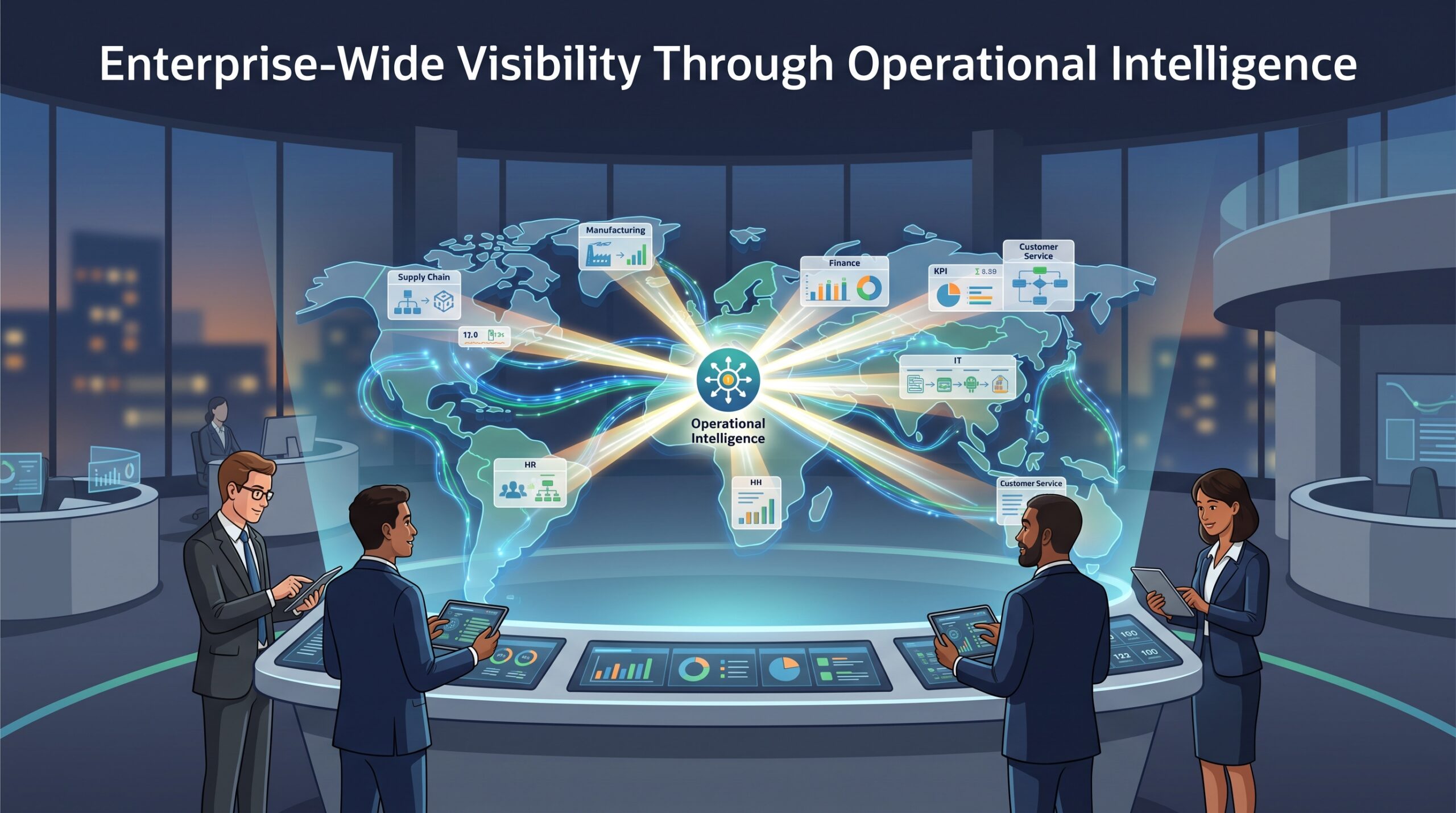
Workflow observability spans departmental boundaries. A procurement request may involve finance, legal, sourcing, inventory, and executive approvals. A customer onboarding process may require CRM, identity verification, contracts, billing, IT provisioning, and support teams. BOC connects these operational stages into a unified execution timeline, allowing stakeholders to identify bottlenecks, dependencies, workload imbalances, and compliance risks in real time.
Operational Intelligence
Every governed workflow generates valuable operational intelligence. Organizations can measure cycle time, queue duration, approval turnaround, SLA adherence, rework frequency, policy exceptions, workload distribution, automation effectiveness, and resource utilization. Instead of relying on periodic reports, operational leaders receive continuous intelligence that supports proactive decision-making and continuous improvement.
Supporting AI and Intelligent Automation
Artificial intelligence depends upon high-quality operational data. Workflow observability supplies the structured execution history required for predictive analytics, anomaly detection, intelligent routing, workload forecasting, capacity planning, and AI-assisted recommendations. Governance ensures these recommendations remain transparent, explainable, and aligned with enterprise policies.
Enterprise Scenario
Consider a multinational manufacturer managing thousands of engineering change requests each month. Before implementing the Business Operations Center, leaders only knew whether requests were open or closed. After introducing workflow observability, they identified recurring approval delays, supplier bottlenecks, inconsistent regional practices, and compliance exceptions. Standardized governance reduced cycle time, improved audit readiness, increased collaboration, and enabled executives to make evidence-based operational decisions.
Continuous Improvement
Workflow observability is not a one-time reporting capability. It establishes a continuous feedback loop where every workflow execution contributes new operational knowledge. Teams identify recurring bottlenecks, optimize approval structures, improve automation, refine governance policies, and strengthen enterprise resilience. Over time, operational maturity increases while execution risk decreases.
Future Outlook
As enterprises adopt autonomous operations, AI copilots, digital twins, and intelligent decision platforms, workflow observability will become a strategic capability rather than a technical feature. Organizations with mature governance and standardized workflows will innovate faster because they understand exactly how work flows across the enterprise.
Conclusion
Enterprise Workflow Observability transforms hidden operational activity into measurable business intelligence. Business Operations Center enables organizations to observe, govern, optimize, and continuously improve enterprise execution by combining governance-first workflows with real-time operational intelligence. The result is greater transparency, stronger compliance, faster execution, and a scalable operational foundation for future digital transformation.