

Operational Control Is Not a One-Time Design Decision
Enterprise control frameworks are often designed as if the operating environment will remain stable after launch. Policies are mapped, approval routes are configured, system interfaces are tested, ownership is assigned, and reporting is established. At that moment, the team may govern the workflow well. But the enterprise immediately begins to change around it. Employees transfer, approvers leave, thresholds shift, vendors change, systems are upgraded, business units reorganize, and new regulatory or security requirements appear.
A control that was correct at implementation can become incomplete, excessive, or invalid without generating an obvious technical failure. An API can continue returning successful responses while an approval route relies on an obsolete reporting structure. A workflow standardization can complete on time while using a policy superseded three months earlier. A vendor can deliver the requested item while the enterprise has lost the evidence needed to prove that the request remained authorized from initiation through fulfillment.
Business Ops Center addresses this durability problem by extending operational control into continuous governance. BOC does not treat governance as a periodic review layered on top of execution. It makes governance part of the execution model itself: policy versions, authority conditions, ownership, exceptions, evidence requirements, and outcomes remain observable and testable throughout the lifecycle of every governed business event.
What Continuous Operational Governance Means
Continuous operational governance is the capability to keep enterprise work aligned with current authority, policy, risk, and accountability as operating conditions evolve. It combines preventive controls that qualify work before release, detective controls that identify drift or deviation during execution, and corrective controls that restore an authorized state when conditions change.
The word continuous does not mean that every transaction requires constant human review. It means the control framework can determine when an event remains within approved boundaries and when a meaningful change requires intervention. Stable, low-risk work should move with minimal friction. Material changes—such as an approver losing authority, a request exceeding a threshold, a supplier substitution, a sensitive identity update, or a missing fulfillment record—should trigger the appropriate revalidation, escalation, or operational reconciliation path.
This model shifts governance from retrospective sampling to operational awareness. Audit and compliance teams still perform independent reviews, but they are no longer the first groups to discover that control intent and actual execution diverged. Operations can see the divergence while the obligation is active, preserve context, assign ownership, and resolve it before the exception becomes embedded in downstream records.
The Sources of Governance Drift Across Connected Systems
Governance drift occurs when the control design and the operating reality no longer match. It is especially common in connected environments because no single application sees the full business obligation. Each platform may maintain accurate local data while the end-to-end process becomes inconsistent.
- Organizational drift: reporting lines, cost centers, legal entities, locations, and delegated authorities change faster than workflow configuration.
- Policy drift: approval thresholds, evidence standards, eligibility rules, retention periods, and risk classifications are revised without consistent propagation.
- System drift: fields, APIs, event schemas, identifiers, and status meanings change across releases or migrations.
- Vendor drift: service scope, fulfillment methods, substitution rules, pricing, and evidence practices change outside the enterprise boundary.
- Behavioral drift: users develop informal workarounds when governed paths are slow, unclear, or do not reflect actual operating needs.
- Evidence drift: required records are created, but no longer correlated, retained, or accessible in a way that proves the complete outcome.
These forms of drift rarely arrive as a single dramatic breakdown. They accumulate through small discrepancies. Continuous governance makes those discrepancies visible as control signals rather than allowing them to become accepted operating practice.
A Governance Model Built Around Persistent Business Events
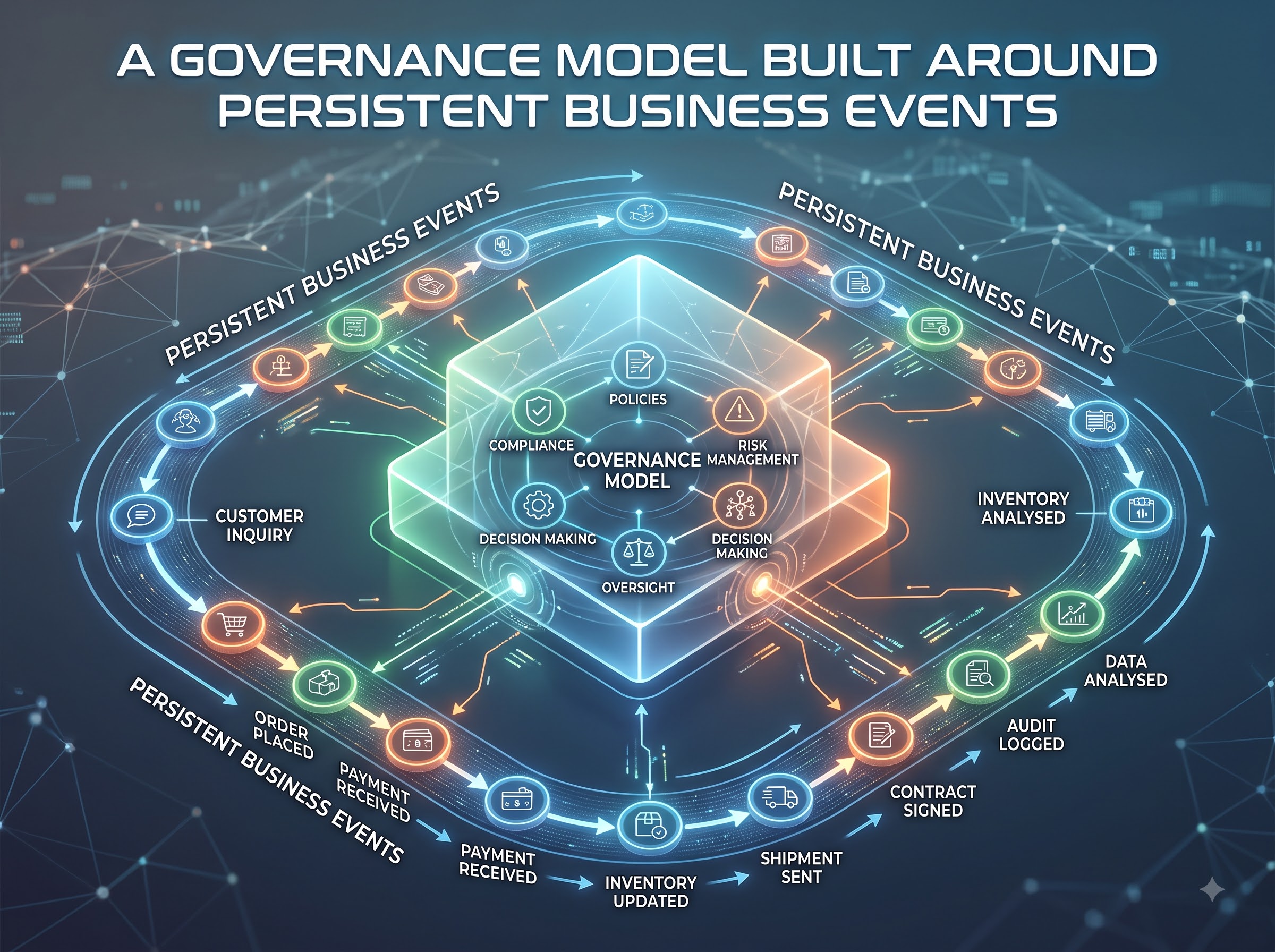
BOC organizes governance around the persistent business event—the enterprise obligation that must remain understandable across requests, approvals, system updates, vendor actions, exceptions, and closure. The event may be a new-hire onboarding, location opening, customer-facing identity change, purchase request, governed ordering decision, access modification, or supplier fulfillment commitment.
The event preserves more than a current status. It maintains the policy and authority basis that allowed work to begin, the version that was approved, the data used to make the decision, the downstream actions released, the acknowledgements received, the changes that occurred, and the evidence used to close the obligation. This continuity allows BOC to ask whether the event remains valid when its environment changes.
For example, if an employee changes departments after a request is approved but before fulfillment, BOC can evaluate whether the approved title, cost center, template, budget owner, and delivery location are still valid. The framework can allow an immaterial update, require targeted revalidation, or pause execution for new enterprise approval workflows. The decision is explicit and evidenced rather than left to an operator to infer from conflicting records.
The Seven Capabilities of Continuous Governance
Policy versioning and effective dating. Every governed event should reference the policy version in force when the decision occurred. When policy changes, BOC distinguishes work that may continue under the prior rule from work that must be re-evaluated.
Dynamic authority validation. Approver identity alone is insufficient. BOC verifies role, delegation, threshold, entity, geography, and segregation-of-duties conditions at the relevant decision point.
Change-impact evaluation. Material changes to subject data, scope, value, supplier, specification, delivery, or risk are assessed against the authorization already granted.
Continuous control monitoring. Operational signals reveal stale approvals, bypass attempts, excessive overrides, repeated exceptions, missing evidence, reconciliation delays, and other patterns that weaken control performance.
Governed exception ownership. Every material deviation receives a classification, accountable owner, service objective, escalation route, and permitted resolution options tied to the original event.
Outcome reconciliation. Authorized intent is compared with actual execution and final result. Closure requires a verified match, an accepted tolerance, or an explicitly authorized alternate disposition.
Evidence continuity. Decision, execution, recovery, and closure evidence remains correlated and retrievable despite system, organizational, or vendor changes.
Governance Checkpoints Across the Operational Lifecycle
| Lifecycle point | Governance question | Control response | Evidence retained |
| Initiation | Is the request legitimate, complete, unique, and in scope? | Qualification, policy selection, risk classification | Source, requester, subject, policy, initial data |
| Authorization | Does the decision-maker have current authority over this version? | Role, delegation, threshold, conflict, and expiry validation | Approver, capacity, conditions, timestamp, version |
| Pre-release | Has any material condition changed since approval? | Change-impact check and targeted revalidation | Changed fields, comparison, decision, release basis |
| Execution | Are dependencies, acknowledgements, and external actions within bounds? | Orchestration monitoring and controlled retries | Payloads, system IDs, responses, status history |
| Exception | Is the deviation owned and resolved through an authorized path? | Classification, assignment, escalation, correction | Cause, owner, actions, approvals, recovery result |
| Closure | Does actual outcome match authorized intent? | Reconciliation and evidence validation | Final comparison, disposition, completion proof |
How Continuous Governance Changes Enterprise Operations
For operations teams, continuous business card governance replaces hidden ambiguity with explicit decision states. Teams can see which work is authorized, which approval is becoming stale, which dependency is blocking closure, and which exception needs intervention. This reduces the time spent reconstructing context from email, tickets, system logs, and vendor portals.
For IT and integration teams, the model separates transport health from business control health. A connector can be technically available while events are failing governance conditions. Conversely, a temporary technical interruption does not need to become a business crisis when BOC preserves event state, prevents duplicate release, and resumes execution from a controlled checkpoint.
For risk, compliance, and audit teams, evidence becomes a by-product of governed execution. Reviewers can trace why work was permitted, which policy applied, whether authority was valid, what changed, how deviations were resolved, and what proved the final outcome. This is materially stronger than assembling retrospective evidence from systems that retain only their local portion of the process.
For business leaders, continuous governance creates a measurable operating system. Control effectiveness can be evaluated using live operational data instead of relying entirely on anecdotes, periodic certifications, or samples. Leaders can distinguish between isolated exceptions and structural weaknesses that require policy, system, supplier, or process redesign.
Metrics That Reveal Control Health
A continuous adaptive enterprise governance program should measure more than transaction volume and completion speed. The objective is to understand whether the enterprise is executing authorized intent consistently, recovering deviations responsibly, and improving the control environment over time.
- Authorization validity rate: the percentage of released events supported by current, sufficient authority.
- Material-change revalidation rate: how consistently significant post-approval changes receive the required review.
- Control bypass and override rate: frequency, concentration, rationale, and outcome of nonstandard paths.
- Exception age and recurrence: time to ownership, time to resolution, repeated root causes, and reopened events.
- Reconciliation completion rate: proportion of events closed with verified outcome evidence rather than administrative status alone.
- Evidence completeness rate: availability of the required decision, execution, recovery, and closure records.
- Policy propagation latency: time between an approved policy change and effective enforcement across relevant workflows.
Metrics must be interpreted in context. A falling exception count may indicate improvement, or it may indicate weaker detection. A high override count may expose poor discipline, or it may reveal a policy that no longer fits operating reality. BOC keeps the event-level evidence needed to distinguish these possibilities and direct improvement toward the correct cause.
Implementation Priorities for Enterprise Leaders
Start with obligations, not applications. Identify cross-system business events whose failure would create material operational, financial, security, customer, or compliance consequences.
Define the authority model. Document decision rights, delegation, thresholds, separation requirements, expiry conditions, and the specific changes that invalidate prior approval.
Establish the persistent event record. Create a correlation model that connects source requests, approvals, payloads, downstream identifiers, external responses, exceptions, and outcomes.
Instrument control signals. Detect stale approvals, scope changes, policy conflicts, missing evidence, bypasses, delayed acknowledgements, and reconciliation mismatches.
Design governed recovery paths. Specify the owner of each exception class, the permitted resolutions, the conditions requiring reapproval, and the process for verifying corrected execution.
Create a governance feedback loop. Use operational evidence to refine policies, thresholds, routing, supplier obligations, integration design, and evidence standards.
The organization should implement changes incrementally based on risk. The enterprise does not need to centralize every workflow before realizing value. A focused set of high-consequence events can establish the control model, demonstrate measurable improvement, and create reusable patterns for broader adoption.
Questions Enterprise Buyers Should Ask
- Can the platform preserve the exact policy, data, and decision version that authorized an event?
- Does it revalidate authority when roles, delegations, thresholds, or organizational structures change?
- Can it identify which post-approval changes are material and route only those changes for renewed review?
- Does exception management remain connected to the original business obligation and approved intent?
- Can the platform reconcile actual outcomes across internal applications and external providers?
- Are governance metrics based on end-to-end event evidence rather than isolated system statuses?
- Can audit, operations, risk, and leadership examine the same coherent record without manual reconstruction?
From a Controlled Framework to a Governed Operating System
Post 60 established the operational control framework that unifies authorized intent, orchestration, exception management, reconciliation, and evidence across connected systems. Continuous governance is what keeps that framework reliable after implementation. It ensures the control model evolves with the enterprise rather than slowly separating from it.
Business Ops Center turns governance into an active operational capability. Policies are not merely documented; people version and apply them. Authority is not assumed from an identity; it is validated in context. Changes are not silently overwritten; they are evaluated for impact. Exceptions are not detached from the work; they remain owned and governed. Completion is not inferred from a status; it is reconciled against authorized intent.
The result is a stronger form of enterprise agility. Organizations can change systems, structures, vendors, and operating models without surrendering accountability. They gain the ability to move quickly because control is persistent, observable, and adaptable—not because governance has been bypassed.
If your connected workflows operate across CRM, HRIS, identity, procurement, ERP, approval, and fulfillment systems, the next question is not only whether those integrations work today. It is whether their authority, policies, ownership, exceptions, and evidence will remain valid as the enterprise changes. Explore how Business Ops Center can establish continuous operational governance across the full lifecycle of enterprise work.