

Introduction
For many organizations, purchasing business cards has historically been viewed as a simple print procurement activity. Employees submit information, a vendor produces cards, and the order is delivered. For small businesses with limited operational complexity, this model may be sufficient.
However, as organizations grow, business card management often becomes far more complex than printing alone. Multiple locations, employee onboarding, approval requirements, vendor coordination, brand governance, reporting visibility, and operational accountability introduce challenges that traditional business card providers were never designed to solve.
This distinction is becoming increasingly important as organizations evaluate solutions for managing business card programs at scale.
The question is no longer simply:
Who can print business cards?

The question is increasingly:
Who can manage the workflows, governance, approvals, visibility, and operational infrastructure surrounding business card printing?”
This is where the difference between BCM and traditional business card providers becomes significant.
Understanding Traditional Business Card Providers
Traditional business card providers focus primarily on producing printed products.
Providers such as local printers, online print vendors, and large-scale commercial printing companies generally specialize in:
- Business card printing
- Product fulfillment
- Template customization
- Shipping and delivery
- Basic ordering portals
These services fulfill an important operational need. Organizations need printed materials produced accurately and delivered on time.
However, printing represents only one stage of the broader business card lifecycle.
Most traditional providers are optimized for transactions rather than operational workflows.
The Operational Challenge Behind Business Cards
As organizations grow, business card requests frequently intersect with multiple operational processes.
Examples include:
- Employee onboarding
- Employee promotions
- Employee transfers
- Department changes
- Brand governance
- Procurement controls
- Approval requirements
- Reporting obligations
Without a structured management platform, organizations often rely on emails, spreadsheets, disconnected ordering portals, and manual coordination to manage these activities.
The result can include:
- Approval bottlenecks
- Brand inconsistencies
- Duplicate orders
- Limited visibility
- Vendor management complexity
- Administrative overhead
The challenge is no longer printing.
The challenge is operational management
What BCM Is Designed to Solve
BCM is designed as a Business Card Management Platform rather than a traditional print vendor.
The platform focuses on managing the entire lifecycle of business card operations, including:
- Centralized ordering
- Approval workflows
- Brand governance
- Reporting visibility
- Vendor coordination
- Employee lifecycle management
- Operational accountability
- API-connected integrations
Instead of functioning solely as a production provider, BCM acts as operational infrastructure.
This distinction becomes increasingly valuable as organizational complexity grows.
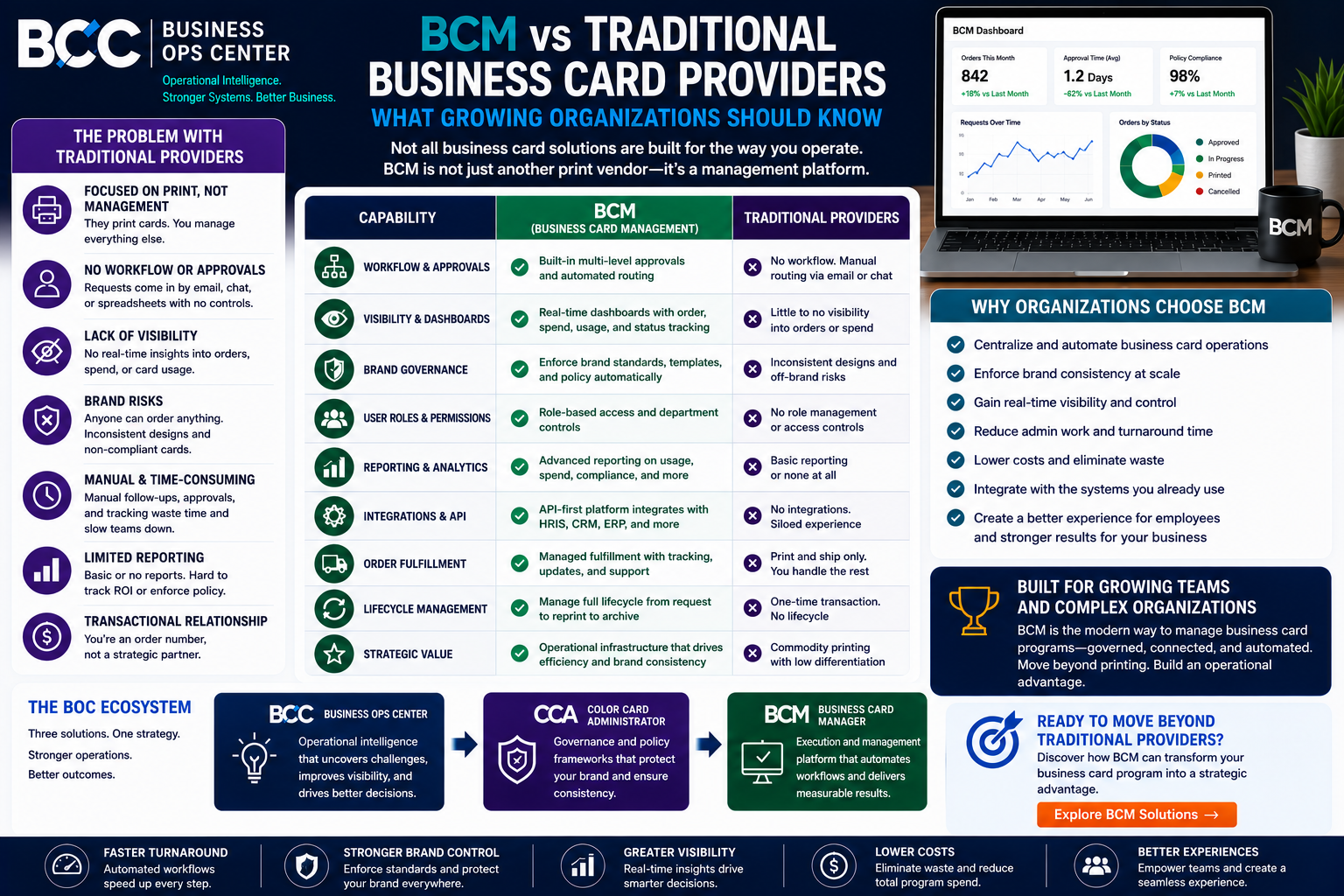
BCM vs Traditional Providers: Key Differences
Traditional providers typically optimize for order fulfillment.
BCM optimizes for workflow management.
Traditional providers focus on:
- Printing
- Product delivery
- Order processing
BCM focuses on:
- Workflow visibility
- Governance
- Approval controls
- Centralized management
- Operational reporting
- Systems integration
Organizations evaluating solutions should understand that these represent fundamentally different categories of value.
Workflow Visibility
One of the largest differences between BCM and traditional providers is workflow visibility.
Leadership teams often need answers to questions such as:
- Who requested cards?
- Which approvals are pending?
- Which departments generate the highest volume?
- What are overall spending patterns?
- Are brand standards being followed?
Traditional print providers often offer limited reporting beyond individual order tracking.
BCM provides visibility into the operational workflow itself.
This creates greater accountability and stronger decision-making capabilities.
Brand Governance
Brand governance becomes increasingly important as organizations scale.
Without governance controls, organizations frequently experience:
- Inconsistent templates
- Unauthorized modifications
- Outdated employee information
- Off-brand designs
BCM supports governance through centralized templates, approval workflows, policy controls, and reporting visibility.
This helps organizations maintain consistency while reducing operational risk.
API Integration and Operational Infrastructure
Modern organizations operate across multiple business systems.
Employee information often resides in HRIS platforms. Procurement activity may be managed through ERP systems. Approval workflows may exist within separate operational tools.
Traditional print providers generally operate independently from these environments.
BCM is designed to support API-connected operational infrastructure.
This enables organizations to connect business card management with onboarding processes, approval workflows, reporting systems, and broader operational ecosystems.
Buyer-Intent Bridge: When BCM Makes Sense
Organizations should evaluate BCM when they begin experiencing:
- Multiple locations
- Growing employee counts
- Approval complexity
- Brand governance challenges
- Vendor coordination requirements
- Reporting visibility needs
- Procurement oversight requirements
These signals often indicate that business card management has evolved beyond printing and become an operational workflow challenge.
Conclusion
Traditional business card providers play an important role in producing printed materials. However, growing organizations increasingly require more than production services.
They require visibility, governance, approvals, reporting, accountability, and operational coordination.
BCM addresses these requirements by providing centralized business card management infrastructure rather than simply processing print transactions.
For organizations seeking to improve operational efficiency while maintaining brand consistency and governance, the comparison is no longer about printers versus printers.
It is about operational management versus order fulfillment.