


A Closed Finding Is Not the Same as a Durable Control
Governed remediation gives the enterprise a disciplined way to move from a confirmed control deficiency through containment, corrective action, retesting, reconciliation, and authorized closure. That closure is essential, but it is not the end of the governance obligation. A control that performs correctly at the moment of retest can weaken again as policies change, authority shifts, source data deteriorates, integrations evolve, vendors alter behavior, or operators develop new workarounds.
The enterprise therefore needs a second feedback loop. Remediation must improve what the organization observes after closure: which conditions are monitored, what evidence is collected, how tolerances are defined, who owns a signal, when an anomaly becomes a governed exception, and which authority decides whether the control remains effective. Without that loop, recurring weakness appears as a new surprise instead of a known risk pattern.
Business Ops Center connects remediation history to continuous control monitoring. BOC converts the failed assertion, root cause, affected population, containment logic, corrective design, retest evidence, residual risk, and closure conditions into persistent monitoring requirements. The objective is not more alerts. It is continuing proof that the governed business obligation remains intact across systems and over time.
What Continuous Control Monitoring Means in BOC
Continuous enterprise control monitoring is the risk-based observation of the events, decisions, configurations, evidence, and outcomes that demonstrate whether an operational control continues to function as authorized. It links every monitored signal to a defined control objective, authoritative data source, expected condition, tolerance, accountable owner, evidence requirement, escalation path, and decision right.
Continuous does not always mean real time. A privileged-access change may require immediate detection. High-value approval overrides may require event-level monitoring. Vendor substitution or reconciliation variance may be reviewed daily. Evidence completeness for a lower-risk control may be assessed monthly. Frequency should follow consequence, rate of change, detectability, and the time available to prevent or limit harm.
The monitoring record also preserves context. It identifies the policy and control versions, business population, system sources, query or rule version, time window, exceptions, exclusions, data-quality limitations, investigation, decision, and closure evidence. That context allows leaders to distinguish a healthy control from a quiet dashboard built on incomplete or stale information.
Why Remediation Is the Best Source for Monitoring Design
A remediation event contains evidence about how a control actually fails. The failed validation scenario shows the observable difference between expected and actual behavior. Root-cause analysis identifies the upstream condition. Population analysis reveals where exposure can accumulate. Containment shows which signal matters early enough to interrupt harm. Retesting establishes the evidence that distinguishes restored control from continued weakness.
Those facts are more useful than generic monitoring templates. If an expired delegation caused approvals to remain technically valid but unauthorized, the monitoring design should not merely count workflow failures. It should compare active approvals with current delegated authority and effective dates. If a connector lost acknowledgements intermittently, availability monitoring is insufficient; the enterprise must reconcile released events with downstream confirmation.
BOC captures these lessons as governed monitoring requirements rather than leaving them in a post-incident report. Recurrence patterns can update control assertions, thresholds, sampling, data sources, exception taxonomy, ownership, and future validation scenarios. Every material remediation becomes an opportunity to strengthen the living control model.
The Control Signals Enterprises Need to Observe
- Policy signals: events processed under obsolete policies, incorrect thresholds, wrong jurisdiction or entity scope, missing retention, and decisions made across effective-date boundaries.
- Authority signals: expired or over-scoped delegations, incompatible duties, unauthorized overrides, dormant privileged access, missing secondary approval, and decisions made after role changes.
- Workflow signals: bypassed stages, abnormal routing, skipped evidence, repeated rework, premature release, excessive aging, manual intervention, and closure before required reconciliation.
- Integration and data signals: mapping drift, schema mismatch, duplicate or missing events, stale authoritative data, delayed acknowledgements, failed idempotency, status disagreement, and unprocessed queues.
- Exception signals: unowned failures, missed service levels, repeated causes, excessive reassignment, ineffective containment, expiring compensating controls, and accepted risks without progress.
- Outcome and evidence signals: mismatch between approved intent and actual fulfillment, access, financial treatment, vendor action, customer commitment, or retained proof.
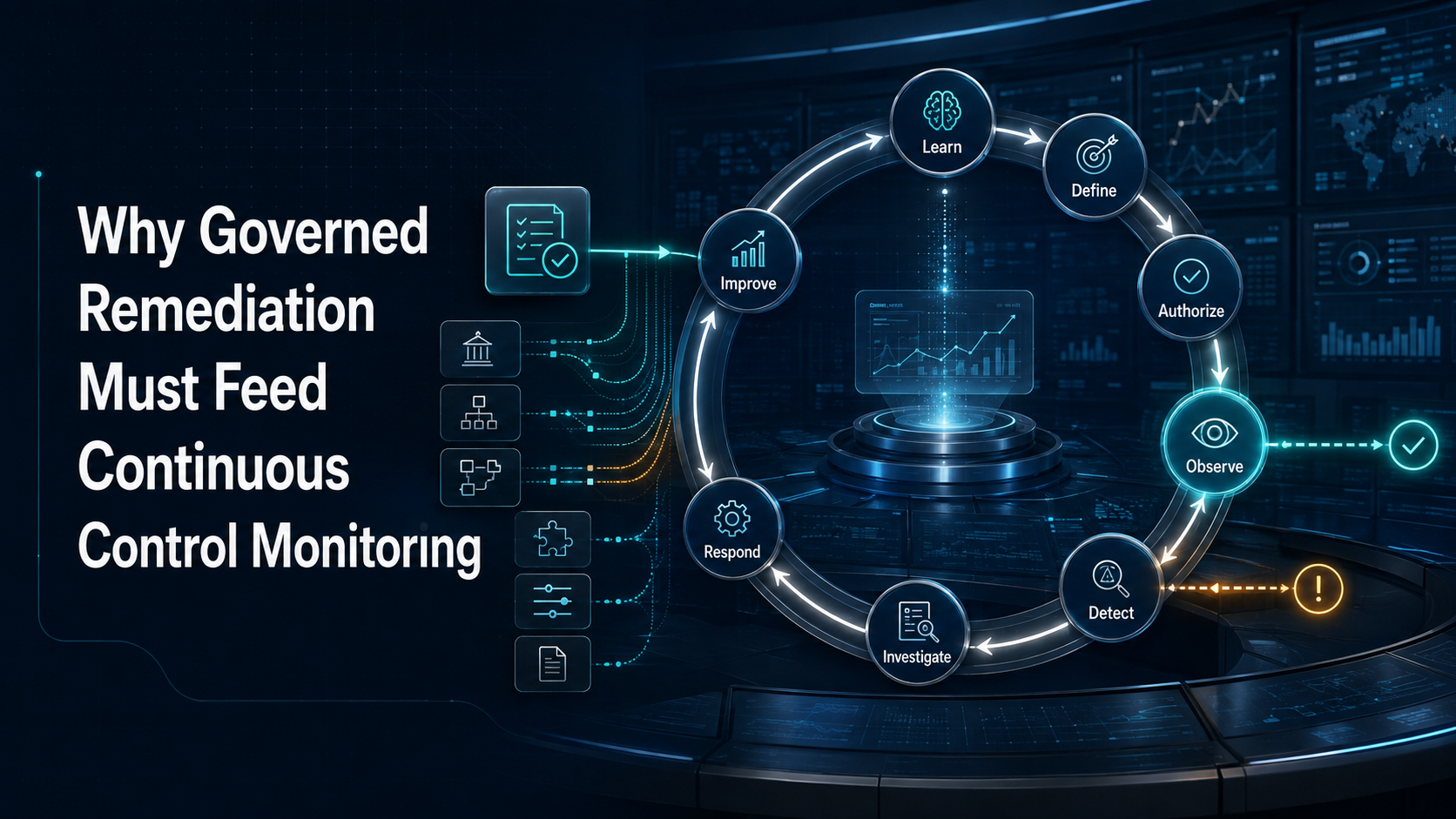
A Governed Monitoring Lifecycle
| Stage | Governance question | Control output |
|---|---|---|
| Learn | What did remediation reveal about failure? | Root cause, leading indicators, affected population |
| Define | What condition demonstrates continued control? | Assertion, signal, source, scope, tolerance |
| Authorize | Who approves the monitoring design? | Owner, reviewer, decision rights, evidence standard |
| Observe | Are relevant events and configurations visible? | Versioned data, event records, completeness checks |
| Detect | When does variation become actionable? | Threshold, anomaly, severity, confidence |
| Investigate | What explains the signal and its consequence? | Case, population, root cause, evidence |
| Respond | What action protects or restores control? | Exception, containment, remediation, acceptance |
| Improve | What must change in the control model? | New rule, scenario, threshold, ownership, assurance |
From Corrective Evidence to a Monitoring Requirement
BOC begins with the control assertion that remediation restored. The enterprise states the condition that must remain true: the correct policy applies, the decision-maker holds valid authority, the approved version reaches execution, exceptions have owners, outcomes reconcile, and closure evidence is complete. A monitoring rule is useful only when it tests an observable part of that obligation.
The design then identifies the authoritative source and expected coverage. Monitoring an approval platform alone may miss changes in enterprise HRIS systems and their role data, identity groups, vendor configuration, or ERP outcomes. BOC connects sources through stable business identifiers and version context so the signal represents the end-to-end event rather than one component’s local state.
Each requirement defines frequency, tolerance, severity, owner, review independence, response time, evidence retention, and conditions for escalation. It also states known limitations. A rule that observes 85 percent of the relevant population must not be presented as complete assurance; the residual blind spot needs explicit treatment.
Monitoring Design Must Be Risk-Based, Not Alert-Based
An enterprise can generate thousands of alerts and still lack control. Alert volume often reflects technical activity, while governance requires a decision about material deviation. BOC separates raw observations from control signals, signals from governed exceptions, and exceptions from findings that require containment, remediation, or risk acceptance.
Tolerance should reflect the obligation. Some controls permit no deviation: an unapproved privileged-access grant or a prohibited supplier may require immediate action. Other controls allow bounded variance: a small delay in acknowledgement may be acceptable if reconciliation completes within a defined period. Thresholds should record the business rationale and approval authority, not emerge silently from dashboard convenience.
Severity also depends on context. One duplicate notification may be operational visibility noise, while one duplicate financial release can be material. A minor mapping variance across a regulated population may outrank a larger variance in an internal low-risk process. BOC evaluates the signal against policy, value, population, reversibility, duration, and downstream consequence.
Configuration Monitoring and Control Drift
Operational controls frequently drift before outcomes visibly fail. A workflow rule changes, a role group accumulates members, a threshold is updated in one environment, an integration mapping diverges, a vendor configuration is altered, or a compensating control expires. Configuration monitoring can detect these changes before a high-consequence event uses them.
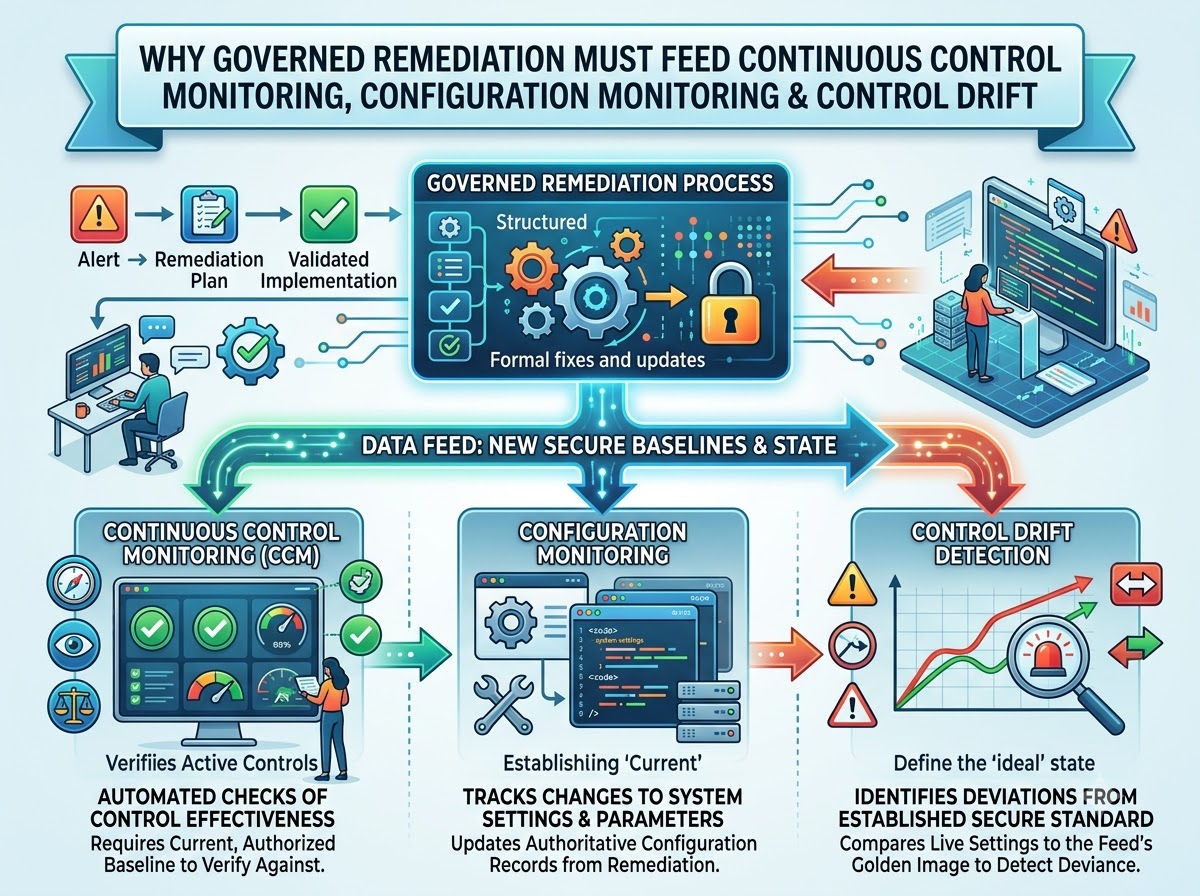
BOC compares the approved control version with deployed configuration across systems. It tracks who changed what, under which authority, when it became effective, what dependencies were affected, whether required validation occurred, and whether rollback remains possible. An authorized technical change can still become a governance exception when it does not match the approved business control.
Drift detection must include absence as well as difference. Missing evidence collection, disabled monitoring, stale data feeds, silent integration failures, and unreviewed exceptions can make the control appear stable because the enterprise has stopped seeing it. Monitoring health is therefore itself a governed control validation.
Event Monitoring and Outcome Reconciliation
Configuration evidence proves what the system is designed to do; event evidence proves what happened. BOC observes representative or complete populations according to risk. It can compare request qualification, approval authority, release conditions, execution acknowledgements, exception treatment, fulfillment, financial posting, access state, and retained evidence across the business event.
Reconciliation is the strongest form of outcome monitoring because it compares authorized intent with actual state. It detects cases where every individual system reports success but the enterprise outcome remains wrong: the correct order was approved but an unauthorized substitution shipped; access was revoked in one directory but persisted in a downstream application; a workflow closed while financial adjustment remained unmatched.
Monitoring must also cover timing. A control can eventually reconcile and still violate a required window. BOC records event and evidence timestamps, tolerances, aging, retry behavior, and escalation so delay is treated according to its operational consequence rather than hidden by eventual technical completion.
Turning Signals Into Governed Exceptions
A signal becomes useful when it enters accountable work. BOC creates a governed exception with the relevant control, policy, population, source evidence, severity, owner, due date, containment expectation, and decision path already attached. Teams do not have to reconstruct why an alert matters before they can respond.
Investigation distinguishes data-quality issues, expected variation, isolated operational errors, configuration drift, design weaknesses, and recurring root causes. The investigator can expand the population, compare versions, seek independent review, or invoke immediate containment. Disposition requires evidence and authority; dismissing an alert is itself a governed decision.
Material or recurring exceptions can reopen remediation. BOC preserves lineage from the original finding and corrective action to the new signal, enabling the enterprise to determine whether the fix failed, the environment changed, the monitoring rule revealed a broader condition, or the original root cause was incomplete.
Monitoring the Monitors
Continuous assurance depends on the reliability of the monitoring mechanism. Data feeds can stop, queries can change, business identifiers can lose integrity, evidence can arrive late, and thresholds can become obsolete. A green dashboard is meaningless if the monitored population is incomplete or the rule no longer represents the control objective.
BOC governs rule ownership, versioning, source availability, data freshness, population completeness, test cases, change approval, false-positive analysis, missed-event analysis, review frequency, and evidence retention. Material monitoring rules should be validated before activation and after significant source or control changes.
Periodic challenge remains necessary. Control owners and independent reviewers should ask whether the signal still detects the relevant failure, whether new pathways bypass observation, whether tolerances remain defensible, and whether response capacity matches alert volume. Continuous monitoring complements judgment; it does not replace accountable governance.
Human Review, Automation, and Decision Rights
Automation is valuable when it collects evidence, tests explicit conditions, correlates events, identifies population variance, opens exceptions, and enforces escalation. It should not silently make risk-acceptance decisions that policy assigns to an accountable leader. BOC keeps the boundary between automated detection and authorized disposition visible.
Human review should focus on ambiguity, materiality, causation, compensating control, and residual risk. Review queues can be prioritized by consequence and confidence rather than arrival time alone. Repeated low-value alerts should trigger rule improvement, while repeated overrides should trigger control-model review.
Decision rights must remain current. The authority to dismiss, accept, contain, remediate, or close a signal may differ. Delegations, thresholds, segregation, and expiry apply to monitoring decisions just as they apply to operational approvals. CCA can supply the authority context while BOC coordinates the operational evidence and workflow.
Where Continuous Monitoring Creates Enterprise Value
- Operations leaders gain early visibility into control drift, recurring exceptions, aging obligations, and downstream outcome variance before failures become systemic.
- Technology and integration teams receive business-defined signals, authoritative sources, tolerances, and response expectations that turn telemetry into useful control evidence.
- Risk, compliance, internal control, and audit teams gain traceability from remediation lessons through monitoring design, observed populations, exceptions, decisions, and control-model improvement.
- Enterprise leaders gain assurance velocity: material deviations reach the correct authority sooner, while healthy controls can be supported by current evidence rather than periodic reconstruction.
Metrics That Reveal Monitoring Quality
- Control coverage: percentage of material controls with approved, active monitoring mapped to explicit assertions and sources.
- Population completeness: proportion of relevant events, configurations, identities, vendors, and systems included in monitoring.
- Time to detection: elapsed time between control deviation and governed signal creation.
- Time to accountable response: elapsed time from signal creation to ownership, assessment, and required containment.
- Recurrence rate: frequency with which previously remediated root causes or related conditions reappear.
- Signal precision: proportion of alerts that represent genuine control variation, with false-positive and missed-event analysis.
- Monitoring health: data freshness, rule execution success, source coverage, evidence completeness, and overdue review rates.
- Control improvement yield: number of monitoring insights that produce validated changes to policy, control design, testing, ownership, or workflow.
Implementation Priorities for Enterprise Leaders
- Begin with material remediations from the last operating period and identify which failure conditions could recur or evolve.
- Translate each root cause and corrective assertion into an observable signal, authoritative source, population, tolerance, owner, and response path.
- Prioritize end-to-end outcome reconciliation where component health cannot prove the business obligation.
- Govern monitoring-rule changes with the same impact analysis, validation, evidence, and authority expected for other controls.
- Create explicit health checks for data sources, population completeness, rule execution, evidence retention, and review capacity.
- Connect signals to governed exceptions and remediation so alerts do not remain detached from accountable operational work.
- Use recurrence and investigation evidence to update the living control model and future change-validation standards.
Questions Enterprise Buyers Should Ask
- Can the platform convert remediation root causes, failed assertions, and retest evidence into governed monitoring requirements?
- Can every signal be traced to a policy, control version, authoritative source, population, tolerance, owner, and decision right?
- Does monitoring span configurations, events, authority, exceptions, reconciliation, and evidence across connected systems?
- Can the platform distinguish raw alerts, governed exceptions, control findings, remediation, and accepted residual risk?
- Can it prove that monitoring rules, data sources, and observed populations remain healthy and complete?
- Can recurring signals reopen remediation and preserve lineage to the original finding and corrective action?
- Can monitoring insight update the living control model, validation scenarios, thresholds, and future change-impact analysis?
From Restored Control to Persistent Assurance
Business Ops Center connects the restored control to the signals that prove it remains effective. Monitoring observes configuration, authority, events, exceptions, outcomes, and evidence. Governed thresholds distinguish variation from material deviation. Accountable workflows convert signals into investigation and response. Recurrence updates the living control model instead of becoming another isolated incident.
The result is not a promise that controls will never fail. It is a defensible operating system for seeing weakness earlier, acting through the correct authority, preserving evidence, and continuously improving how the enterprise governs connected operations.
If your organization can remediate control findings but cannot prove that restored controls remain effective as systems, roles, vendors, policies, and operating conditions change, assurance still depends on periodic reconstruction. Explore how Business Ops Center can connect remediation evidence, continuous control monitoring, governed exceptions, operational reconciliation, and control-model improvement across the enterprise.