


A Living Control Model Must Understand Consequences
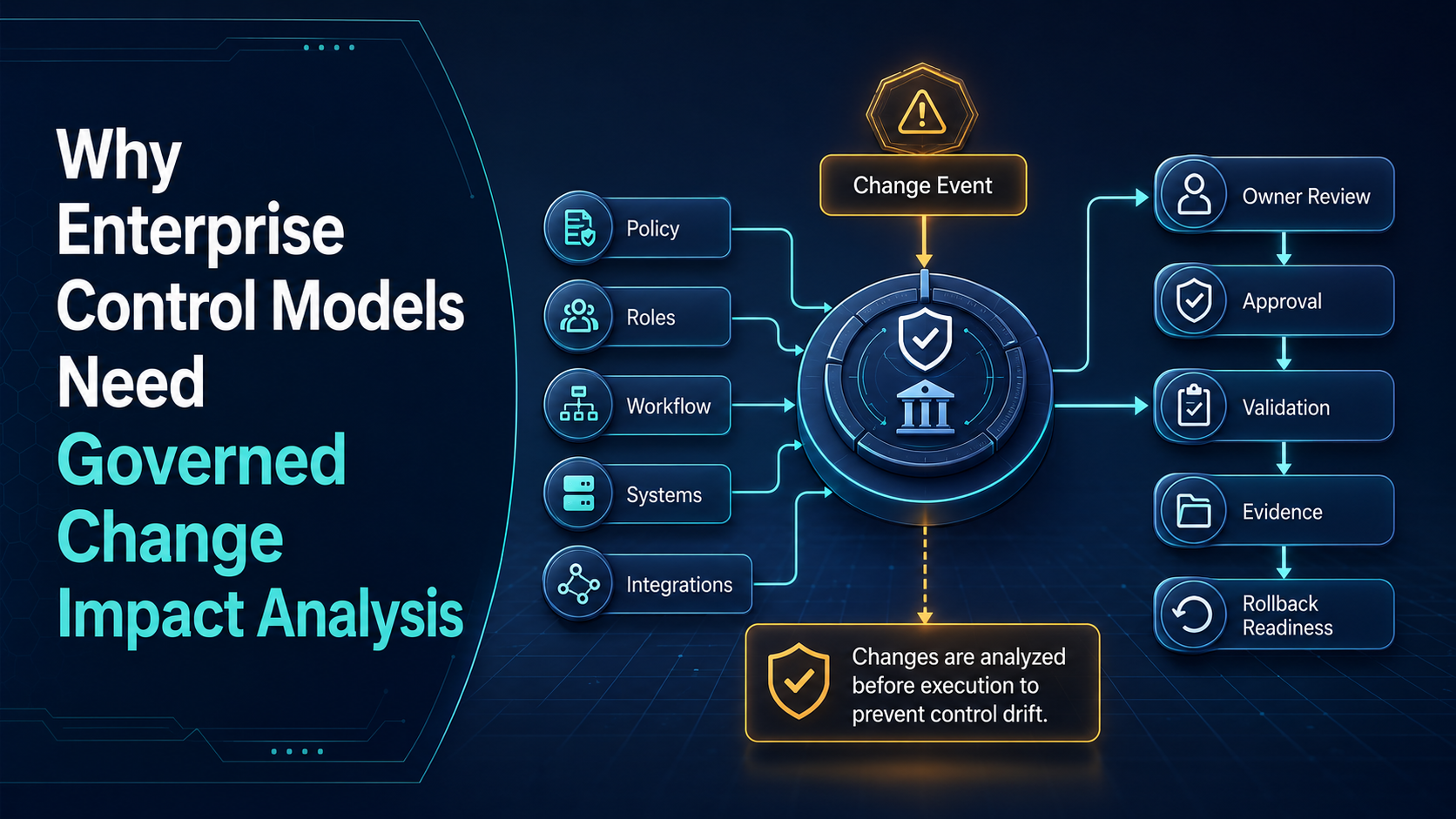
A living control model is valuable because it stays aligned with a changing enterprise. Yet keeping a model current requires more than recording that something changed. The enterprise must understand what the change affects, which governed work can continue, what must be revalidated, who may authorize the transition, and what evidence will prove that the new state operates as intended.
A policy threshold can alter approval routing. A reorganization can change delegated authority, escalation ownership, and segregation-of-duties conditions. A new HRIS field can affect identity provisioning, employee data, customer-facing specifications, procurement allocation, and reporting. A supplier status change can redefine what counts as fulfillment. Individually, each modification may appear local. Operationally, it can cross many systems and control boundaries.
Business Ops Center treats change impact analysis as governed work. BOC connects each proposed change to the policy, authority, intent, workflow, integration, exception, operational reconciliation, ownership, and evidence objects it may affect. The result is not a technical dependency list alone. It is an enterprise decision record that establishes whether the change is permitted, how it will be introduced, and how the organization will verify continued control.
What Governed Change Impact Analysis Means
Governed change impact analysis is the controlled evaluation of how a proposed or detected change may alter authorized intent, decision rights, process behavior, system execution, enterprise operational command centers and their outcomes, and evidence obligations. It begins before deployment whenever possible and continues until the enterprise has verified the resulting operating state.
The analysis identifies a change source, accountable sponsor, reason, proposed effective date, affected scope, dependencies, risk classification, required reviewers, validation plan, transition method, verification criteria, and rollback or containment path. These elements convert an informal modification into a reviewable control event.
Governed does not mean that every minor update requires the same ceremony. BOC supports proportional treatment. A documentation correction may require ownership and version evidence. A nonmaterial mapping change may require targeted testing. A change to approval authority, financial thresholds, identity permissions, regulated data, or closure evidence may require independent review, renewed authorization, active-work assessment, and post-implementation reconciliation.
Why Conventional Impact Assessments Miss Operational Risk
Traditional change management often focuses on whether an application will remain available, an interface will continue to pass data, or a project will meet its deployment milestones. Those questions matter, but they do not establish whether the end-to-end business obligation remains authorized and controlled.
Technical inventories can identify systems and interfaces without identifying the policy meaning of the data they carry. Process maps can show sequence without proving who possessed authority at a decision point. Risk registers can describe exposure without connecting it to active transactions. Test plans can confirm expected responses without proving that the correct policy version, approval context, exception path, and evidence requirement were exercised.
This creates a dangerous gap: a change can be technically successful and operationally wrong. BOC closes the gap by evaluating dependencies through the governed event. The question is not only, ‘What components will change?’ It is, ‘What authorized decisions, released instructions, active obligations, accountable owners, expected outcomes, and proof requirements could change with them?’
The Change Domains BOC Must Evaluate
- Policy and regulatory change: obligations, scope, thresholds, retention periods, prohibited conditions, and effective dates may alter which controls apply.
- Authority and organizational change: roles, delegations, reporting lines, conflicts, geography, entity boundaries, and expiry conditions may change who can decide or act.
- Workflow and control change: qualification, approval, segregation, release, exception, reconciliation, and closure rules may be added, removed, reordered, or reinterpreted.
- Data and integration change: fields, identifiers, mappings, schemas, timing, status semantics, and error behaviors may alter the facts used for decisions or outcome verification.
- System and provider change: application upgrades, platform replacements, supplier changes, and service-level revisions may change execution capability or evidence quality.
- Ownership and operating-model change: team boundaries, service responsibilities, escalation paths, and control ownership may leave work or exceptions without accountable resolution.
- Risk and assurance change: new threat patterns, audit findings, control failures, or tolerance decisions may require stronger monitoring, testing, or containment.
From Change Detection To An Impact Decision
The lifecycle begins when BOC receives an approved proposal, a configuration event, a policy revision, an organizational update, a provider notice, an integration-contract change, or an observed variance from the control baseline. The change record captures origin, sponsor, scope, reason, timing, and the versions being compared.
BOC then resolves direct and indirect dependencies. Direct dependencies include rules, workflow standardization, fields, roles, systems, and evidence sources explicitly linked to the changed object. Indirect dependencies include active work authorized under the earlier state, downstream reports that interpret a status, exception paths that depend on an owner, or reconciliations that assume a prior data contract.
The output is an impact decision rather than a raw list. It states what can proceed unchanged, what requires testing, what requires renewed approval, which active events need migration or revalidation, what must be suspended, and who owns each action. Assumptions and unresolved dependencies remain visible so uncertainty cannot silently become permission.
A Governed Change-Impact Lifecycle
| Stage | Governance question | Control output |
| Register | What is changing, why, by whom, and when? | Source, sponsor, scope, versions, effective date |
| Discover | Which governed objects and active events depend on it? | Direct and indirect dependency map |
| Classify | How material is the impact to authority, control, or outcome? | Risk class and required governance path |
| Decide | What may continue, migrate, reapprove, or suspend? | Authorized impact and transition decision |
| Validate | Will the new state preserve intended control outcomes? | Control, integration, exception, and evidence tests |
| Activate | How will the approved version enter operation? | Effective dating, deployment, migration, containment |
| Verify | Did observed execution match the approved change? | Reconciliation, early-life monitoring, outcome proof |
| Close | Are residual issues owned and evidence complete? | Closure decision, remediation, model update |
Protecting Active Work During Transition
One of the hardest questions is how a change affects work already in progress. Automatically applying the newest configuration can overwrite the basis on which a request was approved. Freezing every active event under its original rules can also be unsafe when a policy, authority, or security change requires immediate treatment.
BOC separates historical truth, active-work treatment, and future-state activation. Historical events retain the versions that governed their decisions and execution. Future events adopt the new model on its approved effective date. Active events are classified according to materiality and stage: continue under the prior version, migrate through a controlled rule, obtain renewed approval, correct released instructions, increase monitoring, or suspend until an owner resolves the conflict.
This approach preserves defensibility. The enterprise can show why an event remained under the former model or moved to the new one, who authorized that treatment, which facts were reconsidered, and what evidence confirmed the transition.
Validating Business Outcomes, Not Just Deployment
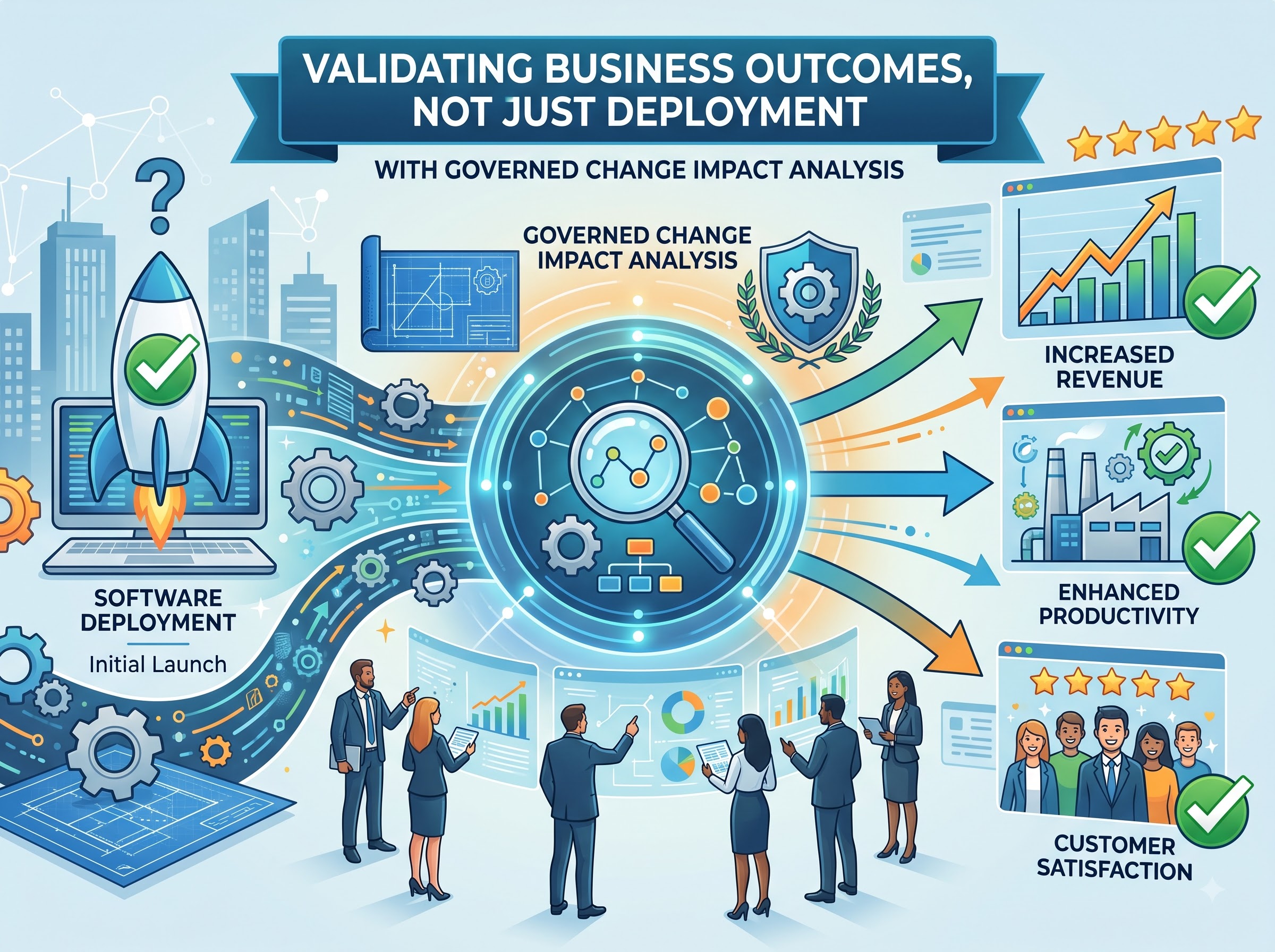
A completed deployment ticket is not proof that operational control survived the change. Verification must determine whether governed events used the intended versions, decision rights remained valid, routing and segregation operated correctly, downstream systems executed the authorized intent, exceptions were owned, and outcomes reconciled.
BOC can define early-life monitoring for a representative population or every high-consequence event. It can compare pre-change and post-change exception rates, approval overrides, latency, reconciliation variance, evidence completeness, supplier acknowledgments, and closure failures. A technically healthy release that creates unexplained operational variance remains open as a control issue.
Verification also protects against partial adoption. One application may use the new field while another retains the old mapping. A workflow may enforce the new threshold while an approval group still reflects the prior authority model. BOC correlates evidence across those systems to determine whether the enterprise outcome—not merely each local component—matches the approved change.
Managing Emergency and Unplanned Change
Not every change can wait for a normal review cycle. Security events, provider outages, legal directives, data corruption, or material operational failures may require immediate containment. Speed, however, should not erase accountability.
BOC can support an emergency path with defined eligibility, limited authority, narrow scope, expiry, compensating controls, mandatory logging, and retrospective review. The record distinguishes temporary containment from an approved permanent design. Exceptions created by the emergency response receive owners, deadlines, reconciliation requirements, and closure evidence.
Unplanned changes detected after deployment require similar discipline. The enterprise business card integrations identify the variance, contain affected work where necessary, reconstruct the control impact, determine whether decisions or outcomes were compromised, and record remediation. BOC makes an unexplained configuration difference a governed event rather than allowing it to remain an invisible technical condition.
Where Governed Impact Analysis Creates Enterprise Value
Operations leaders gain a clear transition plan tied to active obligations and accountable owners. Teams can act without interpreting disconnected project, policy, and system artifacts.
Technology and integration teams receive business context for testing. They can see which data elements, routing conditions, evidence sources, and outcome tolerances make a change material.
Risk, compliance, internal control, and audit teams obtain a complete decision trail: what changed, what was affected, who approved the treatment, what was tested, how active work was handled, and whether the intended result was achieved.
Enterprise leaders gain safer transformation velocity. The organization can restructure, replace platforms, modify providers, and refine policies without accepting that control drift is an unavoidable cost of change.
Metrics That Reveal Change-Control Health
- Impact coverage: percentage of material changes with complete policy, authority, workflow, integration, ownership, active-work, and evidence analysis.
- Pre-activation resolution: percentage of identified material dependencies resolved or explicitly accepted before effective date.
- Active-work disposition: percentage of in-flight governed events with documented continue, migrate, reapprove, monitor, or suspend decisions.
- Validation completeness: percentage of required control and outcome tests completed with approved evidence.
- Post-change variance: changes in exceptions, overrides, delays, reconciliation failures, and evidence gaps after activation.
- Unauthorized drift detection: time required to identify and contain operating behavior that differs from the approved control version.
- Change closure quality: percentage of material changes closed only after deployment, operational verification, remediation, and evidence requirements are complete.
Implementation Priorities For Enterprise Leaders
- Begin with changes to a consequential cross-system event. Select an obligation where policy, identity, approval, enterprise procurement governance, ERP, fulfillment, or customer impact makes control drift material.
- Define change objects and materiality rules. Establish required fields, owners, authority, risk factors, transition choices, validation requirements, and evidence for each class of change.
- Connect dependencies to the living control model. Link policies, authority, workflow rules, integrations, owners, exceptions, reconciliations, and evidence sources instead of creating another isolated change register.
- Design active-work treatments before they are needed. Specify when prior versions remain valid and when migration, renewed approval, correction, monitoring, or suspension is mandatory.
- Require outcome-based verification. Test whether authorized intent reached execution and produced a reconcilable result, not merely whether components were deployed.
- Create an emergency path with expiry and retrospective review. Preserve speed while making temporary authority, compensating controls, and remediation visible.
- Use findings to improve the model. Recurring impact gaps should create better dependency maps, data contracts, ownership rules, control patterns, and change thresholds.
Questions Enterprise Buyers Should Ask
- Can the platform trace a proposed change to affected policies, authority, workflows, systems, integrations, owners, evidence, and active events?
- Does it distinguish technical dependency from business-control impact?
- Can impact materiality determine the required reviewers, testing, authorization, transition, and verification?
- Are historical, active, and future events treated through explicit version and effective-date rules?
- Can the organization prove why active work continued, migrated, was reapproved, or was suspended?
- Does post-change assurance test end-to-end outcomes and reconciliation rather than deployment status alone?
- Are emergency changes limited, expiring, reviewable, and connected to compensating controls?
- Can recurring exceptions and drift findings improve the living control model?
From A Living Model To Governed Enterprise Change
Business Ops Center evaluates change through the operational obligation, not through one application or project view. It reveals dependencies, protects active work, preserves decision authority, requires proportionate validation, and verifies that the approved future state became the observed operating state.
The result is a stronger form of change management: one that can prove not only that the enterprise changed, but that it remained authorized, controlled, reconcilable, and accountable while doing so.
If policy updates, role changes, workflow modifications, integration revisions, and platform releases are assessed in separate systems, your enterprise may be approving change without seeing its complete operational impact. Explore how Business Ops Center can connect change decisions to control dependencies, active work, validation, reconciliation, and evidence across the enterprise.