

Static Controls Cannot Govern a Changing Enterprise
Enterprise controls are often documented as if the operating model will remain fixed. A policy is approved, an authority matrix is published, workflow rules are configured, system integrations are tested, and control evidence is assigned to an owner. The design may be sound on launch day. Yet the enterprise immediately begins to change: roles move, delegations expire, thresholds are revised, systems are replaced, suppliers change, data definitions evolve, and new risks emerge.
When those changes are absorbed separately, control drift becomes inevitable. Policy may say one thing while a workflow enforces another. An approver may remain in a routing table after decision authority has changed. A downstream integration may accept a field that was not part of the authorized version. An exception procedure may rely on an owner who has left the role. The organization still has controls, but it no longer has a dependable model of how those controls work together.
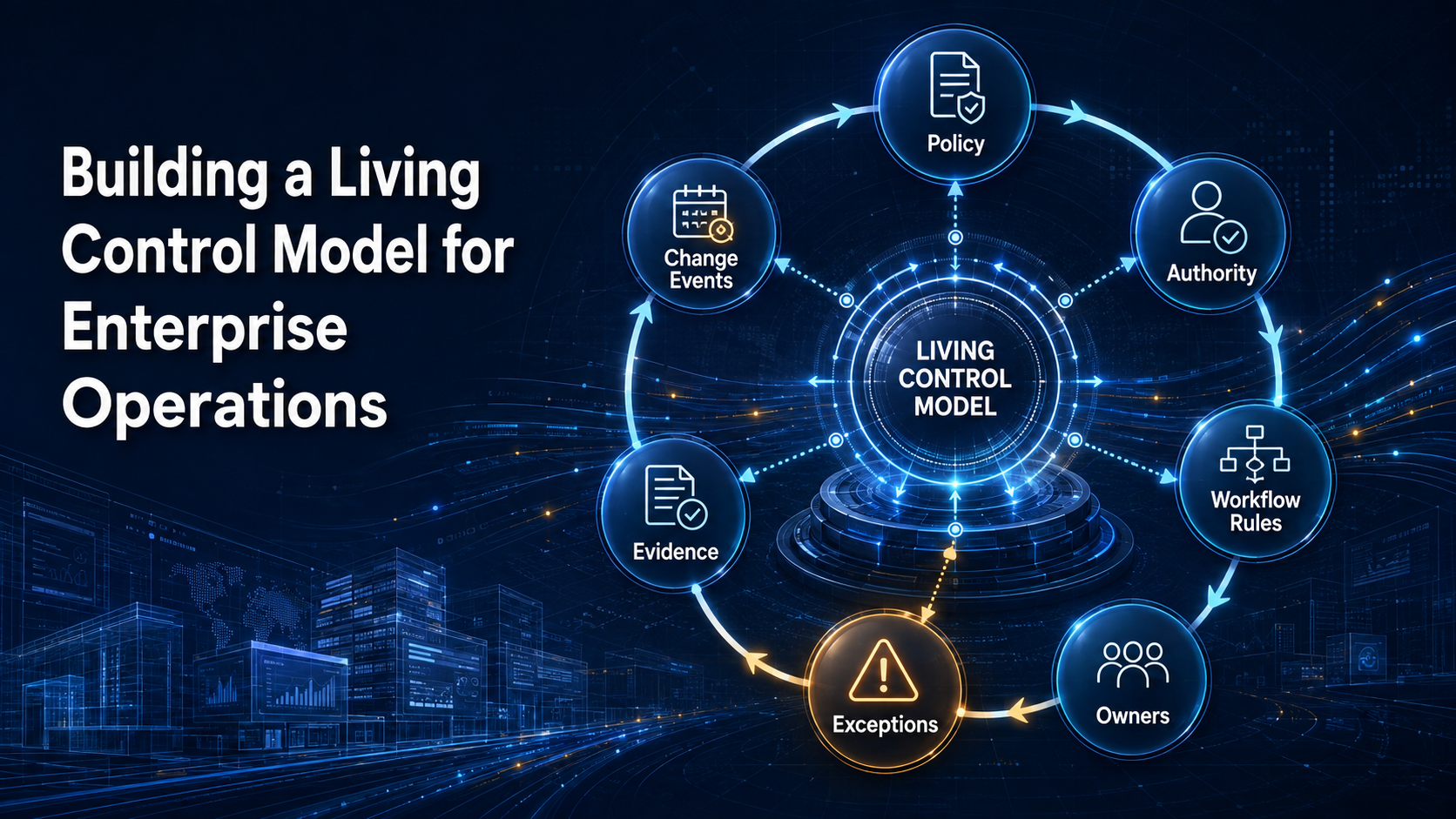
Business Ops Center addresses this weakness through a living control model. BOC connects policy intent, delegated authority, decision rules, workflow checkpoints, system actions, exception ownership, operational reconciliation requirements, and evidence obligations as versioned operational objects. When one element changes, the enterprise can identify what is affected, determine what must be revalidated, and preserve a defensible account of why execution remains permitted.
What a Living Control Model Means
A living control model is the continuously maintained representation of how the enterprise authorizes, executes, verifies, and proves governed work. It is not simply a policy library, process diagram, risk register, integration map, or audit archive. Each of those resources can be useful, but none alone expresses the complete relationship between a business obligation and the controls that must shape its execution.
The model begins with a governed business event: an employee onboarding, identity change, purchase, customer-facing asset request, location opening, access modification, or fulfillment obligation. It then connects the policy version that applies; the facts that establish scope and risk; the authority required; the approved intent; the workflow and system actions released; the exception paths permitted; the outcome evidence expected; and the conditions for closure.
Living does not mean uncontrolled or constantly rewritten. It means versioned, effective-dated, dependency-aware, and responsive to approved change. Historical events retain the control basis that applied when decisions were made. New or active events use the current approved model. Proposed changes can be evaluated before deployment, and material changes can trigger targeted revalidation instead of silently altering work already in progress.
Why Conventional Control Documentation Falls Behind
Most enterprises distribute control knowledge across repositories and teams. Policy owners maintain documents. Identity teams manage roles and groups. Application administrators configure rules. Integration teams maintain mappings and retries. Operations teams use procedures and spreadsheets. Risk teams track controls, while auditors collect samples after execution. Each view may be accurate locally, yet the relationships among them are difficult to maintain.
This fragmentation creates several recurring failures. A policy update is approved without identifying every workflow and integration that implements it. A role change reaches the directory but not an application-specific approval table. A new supplier changes acknowledgment behavior without changing the enterprise closure rule. A workaround introduced during an incident becomes normal practice without a formally accepted control design. An audit test confirms that evidence exists but does not establish that it came from the authorized version of the process.
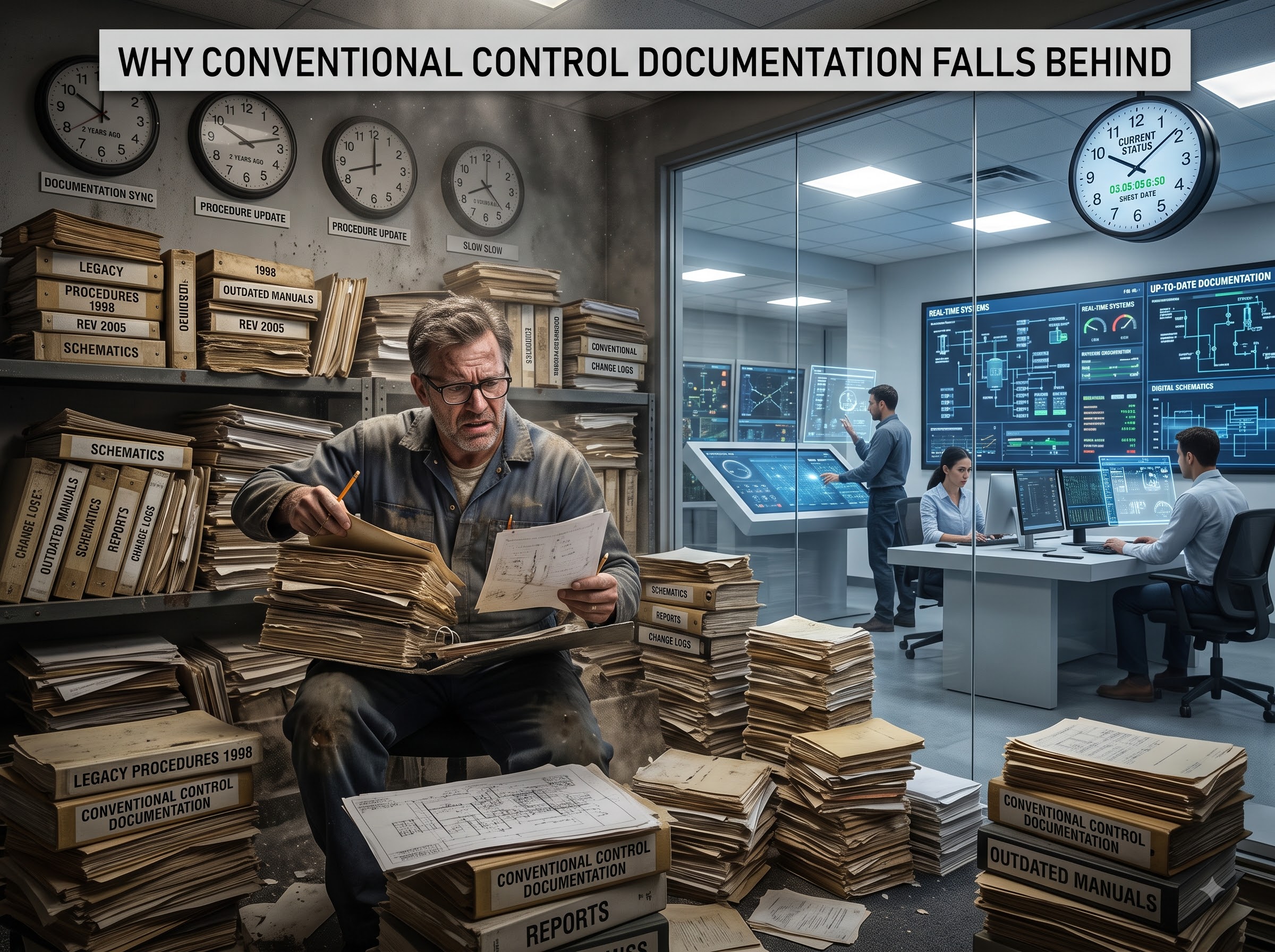
The problem is not a lack of documentation. It is the absence of a governed dependency model. BOC makes those dependencies explicit so change can be assessed as an operational governance control event rather than discovered later through exceptions, reconciliation failures, or audit findings.
The Core Objects in the BOC Control Model
- Policy objects define the obligation, scope, effective period, thresholds, required controls, and acceptable outcomes. They connect written intent to the operational rules that implement it.
- Authority objects define who may decide, in what capacity, for which entity, geography, value, risk class, or business unit, and under what delegation, conflict, and expiry conditions. BOC preserves authority at decision time rather than relying on a current directory snapshot.
- Intent and version objects preserve the exact facts, specifications, and data authorized for release. Requested, approved, released, corrected, and fulfilled states remain distinguishable.
- Workflow and control objects define qualification, approval, segregation, release, monitoring, exception, reconciliation, and closure checkpoints. They identify which system performs an action without surrendering enterprise accountability to that system.
- Ownership objects assign accountable business and operational roles for normal work, exceptions, evidence, remediation, and model maintenance. Ownership includes escalation paths and time objectives, not merely a name.
- Evidence objects define what must be retained, where it originates, how it correlates to the governed event, how long it remains valid, and what proves closure. Change objects connect proposed modifications to affected policies, rules, roles, integrations, active events, and evidence requirements.
How the Model Responds to Change
Every meaningful change should enter BOC with an identified source, owner, effective date, reason, and scope. The platform evaluates dependencies: which policies refer to the changed threshold, which approval routes depend on the role, which integrations carry the affected field, which exception paths use the supplier, and which active events were authorized under the prior state.
The result is a controlled impact assessment. Nonmaterial changes may proceed with recorded validation. Changes that affect only future work can be activated on an effective date while historical versions remain intact. Changes that alter the basis of active work can trigger targeted revalidation, renewed approval workflow, a controlled migration, or suspension. High-risk changes can require segregation of duties, testing evidence, and formal release authority.
BOC then monitors whether the intended change reached execution. Configuration acknowledgement alone is insufficient. The enterprise needs evidence that the correct rule version was deployed, affected events were treated as designed, exceptions were owned, and downstream outcomes remained reconcilable. The control model therefore governs both the decision to change and the operational proof that the change worked.
Preventing Control Drift Across System Boundaries
Control drift rarely begins with an explicit decision to weaken governance. It develops through small, locally reasonable changes. A CRM administrator adds a field, an HR team revises a job structure, an identity group is renamed, procurement introduces a threshold, an ERP mapping is adjusted, or a supplier changes a status code. Each change can be technically valid while altering the facts, authority, sequence, or evidence on which the end-to-end control depends.
A living model gives BOC a baseline against which operational behavior can be evaluated. Expected control versions, data contracts, approval conditions, owner assignments, reconciliation rules, and evidence sources are known. When observed enterprise execution excellence differs from that baseline, the platform can distinguish an authorized model change from unexplained variance. The response can be proportionate: notify an owner, hold release, require revalidation, open a governed exception, or escalate a potentially systemic control failure.
This matters especially where no single application sees the complete obligation. An HRIS can confirm an employee attribute, an identity platform can confirm access, a workflow tool can record approval, and an ERP can confirm a transaction. Only the cross-system control model can determine whether those local facts belong to the same authorized event, use compatible versions, and collectively satisfy the enterprise outcome.
Separating Control Design, Operation, and Assurance
A mature model separates three related responsibilities. Control design defines the intended rule, authority, checkpoint, tolerance, owner, and evidence. Operation applies those requirements to live events and manages deviations. Control assurance evaluates whether design and operation continue to produce the intended result. Conflating these responsibilities makes it difficult to identify whether a failure came from a weak rule, incorrect execution, or incomplete testing.
BOC connects the three without erasing their accountability. Policy and risk owners can approve the design. Operations and systems can execute the controls. Risk, compliance, internal control, or audit functions can examine event-level evidence and population metrics. Findings remain linked to the relevant model objects, enabling remediation to address the actual dependency rather than producing a disconnected action item.
The separation also supports defensible change. The person who configures a rule need not be the person who authorizes its control meaning. The team that resolves an exception need not decide whether the exception pattern is acceptable. The function that tests a control can evaluate both current effectiveness and whether approved design changes were implemented. BOC preserves these decision boundaries as part of the operational record.
A Practical Change-to-Control Lifecycle
| Stage | Governance question | BOC control response | Evidence retained |
| Detect | What changed, who owns it, and when should it become effective? | Register source, reason, scope, owner, and proposed version | Change record and baseline |
| Assess | Which controls, systems, roles, and active events depend on it? | Resolve relationships and classify materiality | Impact map and risk decision |
| Authorize | Who may approve this control change? | Validate change authority, conflicts, and segregation | Decision context and approved version |
| Validate | Will the change preserve intended control outcomes? | Test rules, data, integrations, exceptions, and evidence | Test results and acceptance |
| Activate | How should future and active work transition? | Effective dating, migration, revalidation, or suspension | Deployment and transition evidence |
| Verify | Did execution adopt the change and remain controlled? | Monitor, reconcile, and review early exceptions | Outcome proof and findings |
| Improve | What does operating evidence reveal about the design? | Feed patterns into model refinement | Remediation and new version |
Where a Living Model Creates Enterprise Value
For operations teams, the model provides current, contextual guidance. Operators can see the rule, authority basis, approved version, permitted recovery path, and evidence requirement attached to the event they are managing. They do not need to reconcile conflicting documents before acting.
For IT and integration teams, it establishes the business meaning behind technical configuration. A field mapping, retry rule, identity group, or workflow condition can be traced to the obligation it supports. Change testing can focus on affected control outcomes rather than only technical connectivity.
For risk, compliance, and audit teams, the model creates a testable control population. Reviewers can see which version operated, how authority was validated, what exceptions occurred, whether outcomes reconciled, and whether later changes affected the event. Evidence becomes part of execution rather than a retrospective collection exercise.
For enterprise leaders, the living model improves change velocity without accepting uncontrolled drift. The organization can replace systems, restructure teams, alter suppliers, and refine policy while retaining a coherent control fabric above those components. Governance becomes an enabler of dependable transformation.
Metrics That Reveal Control-Model Health
- Model coverage: percentage of high-consequence governed events connected to policy, authority, workflow, exception, reconciliation, and evidence objects.
- Dependency completeness: percentage of approved changes with identified downstream rules, systems, owners, active events, and evidence impacts.
- Control-version alignment: proportion of executions using the intended effective policy, authority, and workflow versions.
- Change revalidation performance: percentage of material changes receiving required testing, approval, migration, or active-event review before activation.
- Orphaned-control rate: number of rules, integrations, roles, or procedures without a current policy basis or accountable owner.
- Exception-to-design feedback: proportion of recurring exception classes converted into approved control, workflow, data, or supplier improvements.
- Evidence continuity: percentage of events retaining complete, correlated proof across model and system changes.
Implementation Priorities for Enterprise Leaders
- Start with a consequential event, not the entire enterprise. Select a cross-system governance coordination & obligation where authorization, execution, and outcome mismatch would create material operational, financial, security, customer, or compliance impact.
- Define the canonical control objects. Establish identifiers, owners, versions, effective dates, relationships, and evidence standards for policy, authority, intent, workflow, exception, outcome, and change.
- Map dependencies to execution. Connect model objects to the actual routing rules, system configurations, integration contracts, supplier actions, and closure requirements that implement them.
- Classify change materiality. Specify which changes require documentation only, targeted validation, renewed approval, active-event migration, or suspension.
- Preserve historical truth. Never overwrite the basis of prior decisions. Maintain effective-dated versions so the enterprise can reconstruct what governed an event at any point.
- Close the feedback loop. Use exception patterns, reconciliation variances, override concentration, audit findings, and operational delay to improve the control model itself.
- Scale through reusable patterns. Once one event establishes the model, extend the same identity, versioning, authority, exception, reconciliation, and evidence structure to adjacent workflows.
Questions Enterprise Buyers Should Ask
- Can the platform represent policy, authority, approved intent, workflow controls, ownership, evidence, and change as connected objects?
- Does it preserve the exact control version that governed each historical decision and execution event?
- Can a proposed change reveal affected workflows, integrations, roles, suppliers, active events, and evidence obligations?
- Does material change trigger targeted revalidation or renewed authorization before execution continues?
- Can technical configuration be traced to a business policy and accountable control owner?
- Are exception and reconciliation findings fed back into control design rather than stored only as operational history?
- Can the enterprise prove that an approved change was implemented and produced the intended operational result?
- Does the model remain portable when applications, providers, or organizational structures change?
From Traceability to a Living Operational Control System
Post 61 established the need for continuous governance as policies, roles, risks, and systems change. Post 62 showed why that governance requires an unbroken trace from policy and delegated authority through execution, exceptions, reconciliation, and evidence. A living control model turns those capabilities into a maintainable enterprise operating system.
Business Ops Center does not treat governance as a static overlay or a collection of disconnected records. It creates a versioned model of the obligation, the authority to act, the controls that shape execution, the people accountable for outcomes, and the evidence required for closure. Change becomes governed work with known dependencies, impact decisions, validation requirements, and proof of implementation.
The result is operational control that can survive enterprise evolution. Specialized systems continue to perform their functions, but the meaning of authorized intent is not trapped inside any one application. BOC maintains the control relationships needed to keep policy, decisions, execution, outcomes, and evidence aligned over time.
If your enterprise maintains policies, approval rules, workflow configurations, system mappings, exception procedures, and audit evidence as separate artifacts, control drift is already difficult to see. Explore how Business Ops Center can establish a living control model that keeps authority, execution, ownership, change, and evidence aligned across enterprise systems.