
Introduction
Most organizations understand the value of branding. They invest heavily in logos, websites, visual identities, messaging frameworks, customer experiences, marketing campaigns, and design standards. Brand recognition often becomes one of the most valuable assets a company possesses.
However, many organizations fail to recognize an important reality. Creating a strong brand and maintaining a strong brand are two very different challenges.
While marketing teams frequently focus on developing brand assets, organizations often overlook the operational systems required to ensure those assets are used consistently. As businesses grow, maintaining consistency becomes significantly more difficult. Employees join and leave. Departments operate independently. Vendors produce materials across multiple locations. New workflows emerge. Acquisitions introduce additional complexity. Without governance, even the strongest brands can become fragmented over time.
This is why brand governance is becoming increasingly important. What was once viewed primarily as a marketing responsibility is now emerging as a critical operational capability.
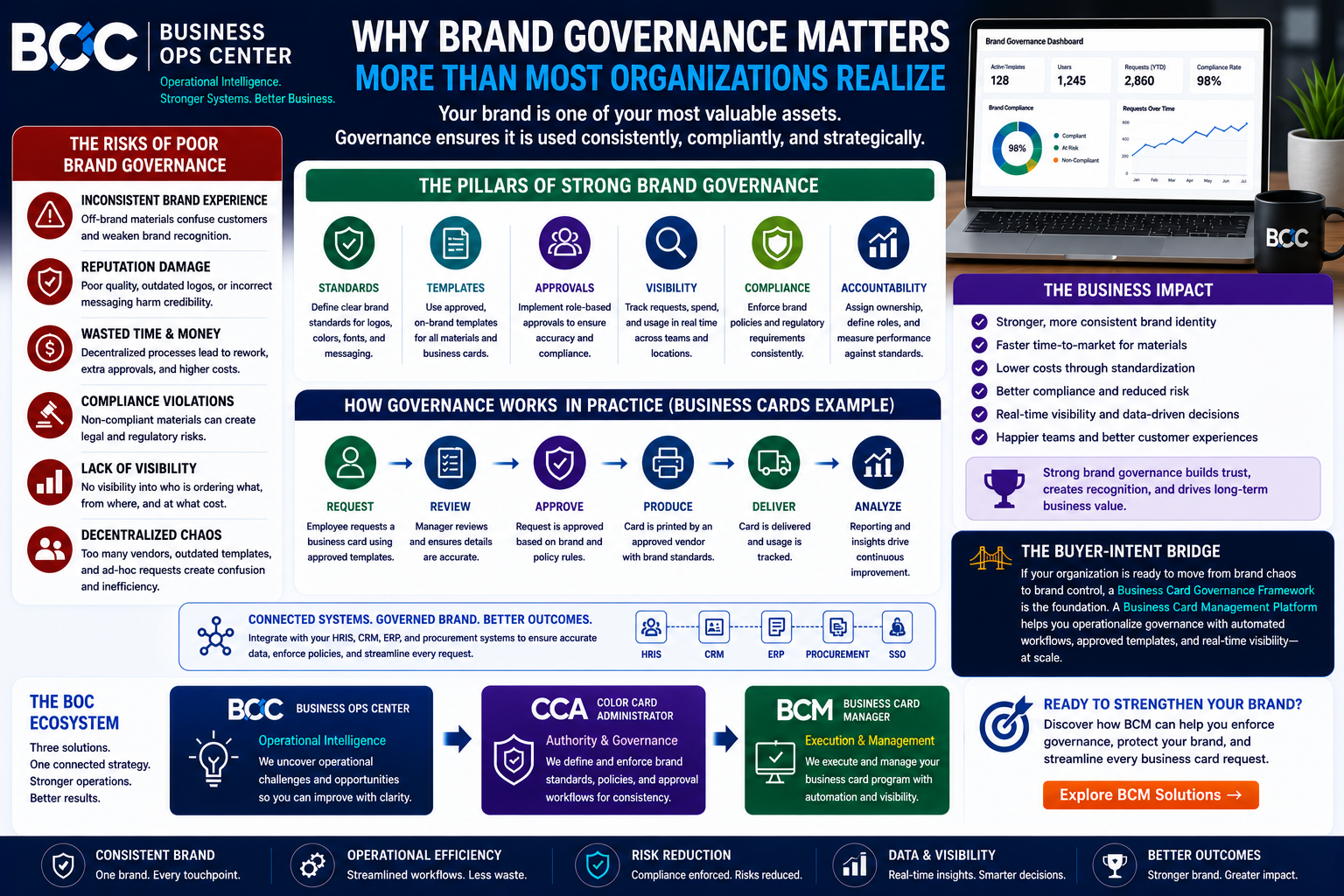
Understanding Brand Governance

Brand governance refers to the policies, standards, workflows, responsibilities, approval structures, and operational controls that ensure a brand is represented consistently throughout an organization.
Effective governance creates a framework for managing:
- Brand standards
- Templates
- Design assets
- Approval workflows
- Vendor relationships
- Compliance requirements
- Employee usage
- Reporting and accountability
Rather than relying on individual judgment, governance creates repeatable systems that protect brand integrity while enabling operational efficiency.
The Hidden Cost of Poor Brand Governance
Organizations frequently underestimate the cost of inconsistent branding.
Most leaders recognize the obvious consequences, such as outdated logos or incorrect messaging. However, the operational impact often extends much further.
Poor governance can lead to:
- Rework and redesign costs
- Delayed approvals
- Vendor confusion
- Inconsistent customer experiences
- Reduced credibility
- Compliance challenges
- Internal inefficiencies
- Increased administrative effort
These issues create costs that are often difficult to measure but significant over time.
As organizations scale, even small inconsistencies can multiply across departments, locations, and workflows.
Why Growth Creates Governance Challenges
Smaller organizations often maintain consistency through direct communication. Employees know who owns the brand. Approvals happen quickly. Templates are shared informally. Questions can be answered immediately.
Growth changes this dynamic.
As organizations expand, they frequently introduce:
- Multiple offices
- Regional teams
- Larger employee populations
- Additional vendors
- Expanded product lines
- New communication channels
The complexity associated with these changes creates more opportunities for inconsistency.
Without governance, employees may use outdated assets, bypass approval processes, create unauthorized materials, or engage vendors who are unfamiliar with company standards.
The larger the organization becomes, the greater the need for governance infrastructure.
Brand Governance Is an Operational Issue
One of the biggest misconceptions about brand governance is that it belongs exclusively to marketing departments.
In reality, governance intersects with operational processes throughout the organization.
Brand-related decisions often affect:
- Procurement workflows
- Employee onboarding
- Vendor management
- Approval processes
- Operational reporting
- Compliance initiatives
- Identity management
As a result, governance increasingly requires operational visibility, workflow coordination, accountability, and technology support.
Organizations that view governance solely through a marketing lens often underestimate its operational importance.
The Relationship Between Governance and Accountability
Accountability is one of the most important outcomes of governance.
Organizations need to know:
- Who owns standards
- Who approves materials
- Which vendors are authorized
- How exceptions are handled
- Whether compliance requirements are being followed
Without visibility, accountability becomes difficult to enforce.
Governance frameworks create clear ownership structures that reduce ambiguity while improving decision-making consistency.
When responsibilities are clearly defined, organizations can improve execution while reducing operational risk.
Business Card Governance: A Practical Example
Business cards provide one of the clearest examples of why governance matters.
At first glance, business cards may appear to be a relatively simple operational requirement. However, larger organizations quickly discover that business card management introduces challenges involving branding, approvals, procurement, reporting, employee lifecycle management, and vendor coordination.
Without governance, organizations often experience:
- Off-brand card designs
- Inconsistent templates
- Unauthorized ordering
- Outdated employee information
- Vendor inconsistencies
- Limited reporting visibility
These challenges are rarely caused by printing itself. They are typically caused by a lack of governance surrounding the workflow.
This is why enterprise organizations increasingly adopt business card governance frameworks that combine centralized controls, approval workflows, reporting visibility, and operational accountability.
Technology’s Role in Governance
Modern governance depends on technology.
Manual governance processes often create bottlenecks, increase administrative burden, and reduce visibility. Organizations increasingly rely on centralized platforms to support governance activities.
Technology can help organizations:
- Enforce template standards
- Control asset usage
- Automate approvals
- Manage vendors
- Maintain audit trails
- Improve reporting visibility
API-connected systems further strengthen governance by integrating workflows across HRIS platforms, procurement systems, ERP environments, and reporting tools.
The result is a more consistent and scalable governance model.
When Organizations Should Invest in Governance
Governance becomes increasingly important when organizations begin experiencing:
- Multiple locations
- Rapid employee growth
- Brand consistency challenges
- Increased vendor complexity
- Approval bottlenecks
- Limited operational visibility
- Compliance concerns
These indicators often suggest that informal management approaches are no longer sufficient.
Organizations that address governance proactively are typically better positioned to scale while maintaining consistency and control.
Brand Governance as a Competitive Advantage
Many organizations view governance as a defensive strategy designed to reduce risk. While governance certainly supports compliance and consistency, its benefits extend much further.
Strong governance can improve:
- Operational efficiency
- Decision-making speed
- Brand trust
- Employee experience
- Vendor coordination
- Reporting accuracy
- Organizational scalability
In this sense, governance becomes a competitive advantage rather than simply a compliance mechanism.
Organizations with strong governance frameworks often operate more efficiently because standards, workflows, and responsibilities are clearly defined.
Conclusion
Brand governance matters far more than most organizations realize.
It is not simply a marketing discipline. It is an operational capability that supports accountability, visibility, compliance, consistency, and scalability.
As organizations continue to grow and operational complexity increases, governance will become increasingly important. Businesses that invest in governance frameworks, workflow controls, operational visibility, and centralized management systems will be better positioned to protect their brand while supporting long-term growth.