

INTRODUCTION
Organizations often perceive business cards as one of the simplest assets they manage. Someone submits a request, a printer produces a card, and the employee receives the finished product. For small organizations, this perception may be accurate. For enterprise organizations, however, business card management frequently becomes a surprisingly complex operational challenge.
Business cards sit at the intersection of employee onboarding, employee lifecycle management, procurement oversight, brand governance, workflow management, vendor coordination, reporting, compliance, and operational accountability. As organizations expand, the complexity surrounding these activities grows significantly.
The challenge is no longer printing business cards. The challenge is managing the workflows, approvals, governance requirements, reporting obligations, and operational controls that surround the printing process.
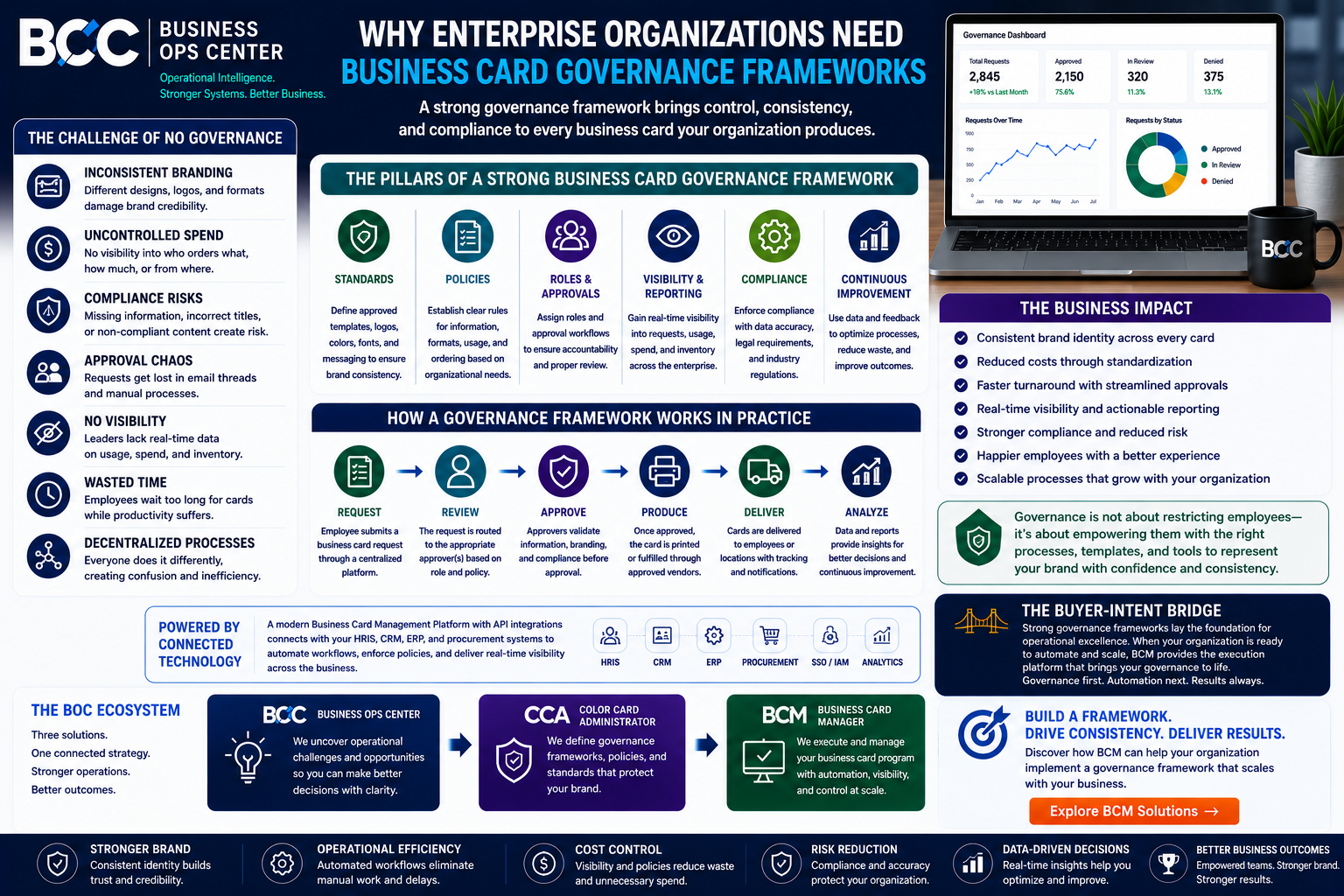
This reality is driving many organizations toward formal business card governance frameworks. These frameworks provide the policies, workflows, controls, standards, responsibilities, and reporting structures required to manage business card programs consistently at scale.
THE EVOLUTION OF BUSINESS CARD MANAGEMENT

Historically, business card ordering was largely decentralized. Employees contacted a vendor, submitted information, received managerial approval, and ordered cards. The process was simple because organizations were smaller and operational complexity was limited.
Today, organizations operate in far more complex environments. They manage distributed workforces, multiple business units, hybrid work models, acquisitions, regional teams, and increasingly sophisticated compliance requirements.
Every new employee, title change, department transfer, location change, and rebranding initiative can affect business card management. As complexity grows, organizations require greater structure and visibility.
This is why business card management is evolving from a procurement activity into an operational governance function.
WHAT IS A BUSINESS CARD GOVERNANCE FRAMEWORK?
A business card governance framework is a structured approach for managing how business cards are requested, approved, produced, tracked, reported, and governed throughout an organization.
The framework typically defines:
- Who can request business cards?
- Who approves requests?
- Which templates do we authorize?
- How do we enforce brand standards?
- Which vendors can we use?
- What information do we require?
- How do we maintain reporting?
- We train you on data up to October 2023.
How exceptions are handled.
Rather than relying on individual interpretation, governance frameworks create repeatable standards that support consistency and accountability.
WHY ENTERPRISES NEED GOVERNANCE
Large organizations cannot depend on informal processes.
Without governance, business card programs often suffer from inconsistent branding, unauthorized purchases, duplicate orders, outdated employee information, fragmented vendor relationships, and limited reporting visibility.
While each issue may appear small in isolation, together they create significant operational inefficiencies.
Governance frameworks reduce these risks by establishing clear processes and responsibilities.
BRAND CONSISTENCY AT SCALE
Brand consistency is one of the primary reasons organizations implement governance frameworks.
Business cards remain one of the most visible representations of an organization. We distribute them during customer meetings, recruiting events, conferences, trade shows, and sales engagements.
When employees use inconsistent designs, outdated logos, unauthorized modifications, or non-standard templates, brand credibility suffers.
Governance frameworks provide centralized controls that help ensure every card aligns with approved standards regardless of location or department.
APPROVAL WORKFLOWS AND ACCOUNTABILITY
Approval workflows are central to governance.
Organizations need confidence that they review requests appropriately and that they follow policies consistently.
Structured workflows hold individuals accountable by documenting who requested cards, who approved them, what decisions the team made, and when actions occurred.
This visibility improves operational discipline while reducing confusion.
THE VALUE OF WORKFLOW VISIBILITY
Visibility is one of the most important outcomes of governance.
Leadership teams frequently need answers to operational questions:
- How many cards are being ordered?
- Which departments generate the highest volume?
- What are spending patterns?
- How quickly are approvals completed?
- Which vendors are being used?
Governance frameworks create reporting structures that help organizations answer these questions efficiently.
VISIBILITY SUPPORTS BETTER DECISION-MAKING
Organizations cannot improve processes they cannot see.
Workflow visibility enables leadership teams to identify bottlenecks, improve approval times, optimize vendor relationships, reduce costs, and strengthen accountability.
Without visibility, decision-making often depends on assumptions rather than operational intelligence.
PROCUREMENT AND VENDOR GOVERNANCE
Business card programs frequently involve multiple vendors.
Without governance, vendor relationships can become fragmented. Different departments may negotiate independently, use inconsistent pricing structures, and bypass procurement controls.
Governance frameworks improve procurement oversight by standardizing vendor relationships and reporting practices.
EMPLOYEE LIFECYCLE MANAGEMENT
Employee lifecycle events often trigger business card requests.
Examples include:
- New employee onboarding.
- Promotions.
- Department transfers.
- Title changes.
- Location changes.
Governance frameworks help coordinate these activities consistently while reducing administrative effort.
API-CONNECTED GOVERNANCE INFRASTRUCTURE
Modern governance increasingly depends on technology.
Enterprise organizations operate across HRIS systems, ERP platforms, procurement applications, workflow tools, identity management systems, and reporting environments.
API-connected infrastructure allows business card governance activities to integrate with broader operational processes.
Employee onboarding can trigger requests automatically. You can centralize reporting. You can synchronize approval workflows across systems.
This creates a more scalable governance model.
WHY GOVERNANCE IMPROVES OPERATIONAL EFFICIENCY
Many organizations initially view governance as a control mechanism. However, in reality, governance often improves efficiency because it reduces ambiguity, standardizes workflows, eliminates duplicate effort, and improves coordination.
Employees spend less time searching for information. Managers spend less time resolving exceptions. Vendors receive clearer instructions. Leadership gains better visibility.
The result is a more efficient operational environment.
GOVERNANCE AS A COMPETITIVE ADVANTAGE
Strong governance frameworks create benefits that extend beyond compliance.
Organizations with mature governance capabilities often achieve:
- Greater consistency.
- Stronger accountability.
- Better reporting.
- Improved operational visibility.
- More efficient workflows.
- Enhanced scalability.
These outcomes contribute directly to operational performance and organizational maturity.
WHEN SHOULD ORGANIZATIONS INVEST IN GOVERNANCE?
Several indicators suggest that governance frameworks are necessary:
- Rapid growth.
- Multiple offices.
- Brand consistency challenges.
- Approval bottlenecks.
- Vendor complexity.
- Procurement oversight requirements.
- Limited reporting visibility.
Organizations experiencing these challenges often discover that decentralized approaches are no longer sufficient.
CONCLUSION
Enterprise business card governance is not simply about controlling printed materials. It is about creating operational consistency, accountability, visibility, compliance, and scalability.
As organizations continue to grow, governance frameworks become increasingly important for managing complexity while maintaining control.
Governance, workflow visibility, connected systems, and operational infrastructure define the future of business card management rather than printing alone.